PUBLISHER: Mordor Intelligence | PRODUCT CODE: 2155653

PUBLISHER: Mordor Intelligence | PRODUCT CODE: 2155653
South America Metro Dense Wave Division Multiplexing (DWDM) - Market Share Analysis, Industry Trends & Statistics, Growth Forecasts (2026 - 2031)
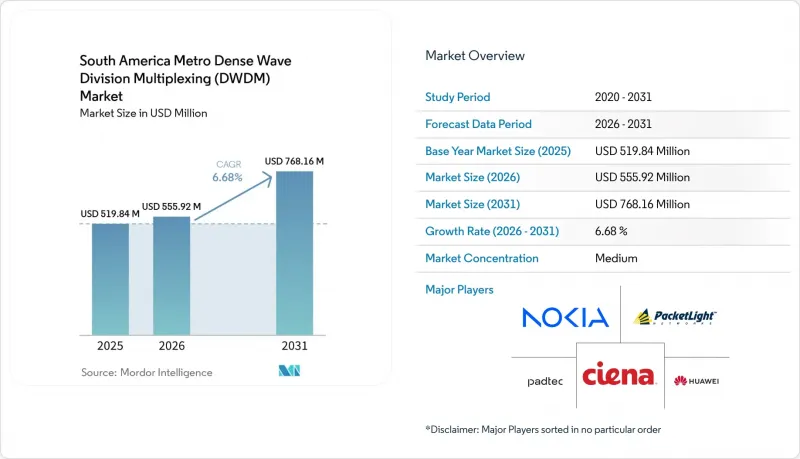
According to Mordor Intelligence, the South America metro dense wave division multiplexing (DWDM) market size is expected to grow from USD 519.84 million in 2025 to USD 555.92 million in 2026, and is forecast to reach USD 768.16 million by 2031, at a 6.68% CAGR over 2026-2031.
South America Metro Dense Wave Division Multiplexing (DWDM) Market Trends and Insights
5G Mobile Backhaul and Fronthaul Capacity Upgrades
Brazil's 5G standalone rollout reached 464 cities by the end of 2024. Anatel's spectrum commitments require fiber backhaul at 530 municipal seats by December 31, 2026. This deadline establishes a defined period for transport investment by operators that need to meet coverage obligations. Mid-band 5G networks use fiber-based fronthaul because eCPRI traffic can exceed the capacity of older microwave connections. DWDM systems allow operators to add transport capacity where fiber already reaches base station areas. In Argentina, Telecom Argentina ended 2025 with 1,000 5G sites after adding more than 800 locations that year, and it targeted more than 2,000 sites by the end of 2026. The effect is concentrated in metropolitan aggregation networks rather than only in long-distance routes. Each new radio cluster needs adequate capacity between the access network and the metro core. Operators also need low latency at each aggregation point to support standalone 5G services. The South America metro dense wave division multiplexing (DWDM) market, therefore, benefits when coverage targets lead operators to increase fiber-backed transport capacity. Anatel's 2025-2029 network plan identified 1,207 municipalities without optical backhaul, indicating continued work beyond the current rollout phase.
Cloud and Hyperscale Data Center Interconnect Expansion
Sao Paulo has become the region's main location for AI infrastructure and large data center campuses. These campuses require low-latency optical rings that connect availability zones and nearby facilities. This need differs from traditional traffic patterns that depended mainly on backbone links between cities. Ascenty secured 150 MW of new AI contracts and announced a USD 1.2 billion plan for 4 hyperscale data centers in the Sao Paulo metropolitan area. The plan includes a facility designed for large-scale AI workloads. These projects create direct demand for high-capacity metro data center interconnect links.
High Imported-Equipment Exposure and Financing Costs
Brazil depends on imported equipment for 75-85% of the value of DWDM hardware. This exposure became more significant after GECEX Resolution 852/2026 raised duties on selected IT and telecommunications products in February 2026. The listed rates were 7.2%, 12.6%, or 20%, depending on product classification. Optical transport apparatus can face headline import duties of 12-16% before IPI and ICMS are added. Operators that do not qualify for the ex-tariff program may face total landed-cost increases of 40-60%. The ex-tariff process averages 180 days, which can extend equipment planning. Brazil also applied a definitive anti-dumping duty of USD 2.42 per kilogram on optical fiber cables from China for 5 years. This adds a separate cost element for projects that require new fiber and active transport equipment. Argentina faces high benchmark interest rates and periodic foreign exchange restrictions. Those conditions can extend financing cycles for imported coherent optical systems. Locally assembled systems and access to domestic financing can therefore affect vendors' commercial position.
Other drivers and restraints analyzed in the detailed report include:
- Fiberization and FTTH Aggregation
- Migration to 400G and 800G Coherent Optics
- Shortage of Specialized Optical Engineering and Maintenance Skills
For complete list of drivers and restraints, kindly check the Table Of Contents.
Segment Analysis
Hardware held 85.73% of the South America Metro DWDM market share in 2025. The share reflected the capital required for 400G coherent line cards and flex-grid ROADM chassis. These systems remain central to major network construction projects across the region. Hardware spending also includes equipment needed to expand capacity at established metro sites. Services account for the remaining component demand through integration, deployment, and support contracts. NEC coordinated system integration for Eletronet's backbone modernization, spanning 8,000 km of new fiber routes across 23 Brazilian states.
Software is projected to expand at a 10.17% CAGR through 2031, the highest rate among components. Operators use software to manage multivendor networks, automate wavelength provisioning, and analyze performance across layers. These functions become more valuable as networks add more sites and higher-capacity wavelengths. Adtran introduced a terabit-scale edge router in 2026 that integrates with its FSP 3000 IP OLS and ZR or ZR+ coherent optics. The design extends 400G edge transport and reduces the need for separate transponder equipment. Software management can consequently become a larger part of each deployed network element.
The up-to-100 Gbps tier accounted for 36.84% of the South America metro dense wave division multiplexing (DWDM) market in 2025. Its position reflects a sizeable installed base of older metro systems. Many operators have not reached the financial threshold to fully replace these systems. The 200 Gbps and 400 Gbps tiers serve as transition options for operators upgrading selected core nodes. This approach allows operators to improve key routes while retaining older equipment in aggregation rings. It also supports equipment demand across more than 1 speed tier simultaneously.
The above-400 Gbps segment is projected to expand at a 10.22% CAGR through 2031. The segment is supported by data center interconnect routes between hyperscale campuses and colocation facilities in Brazil. Scala Data Centers, Lightera, and Nokia completed South America's first AccuCore hollow-core fiber proof of concept at Scala's Sao Paulo campus in November 2025. Nokia's 1830 PSI-M platform and sixth-generation PSE-6 photonic chipset were used in the demonstration. The project showed a possible path to higher wavelength capacity over time. Its relevance lies in testing capacity improvements that could reduce limitations of conventional single-mode fiber.
Complete Report Scope:
- By Component
- Hardware
- Software
- Services
- By Transmission Capacity
- Up to 100 Gbps
- 200 Gbps
- 400 Gbps
- Above 400 Gbps
- By Application
- Data Center Interconnect
- Mobile Backhaul and Fronthaul
- Broadband and Access Network Aggregation
- Other Applications
- By End-User
- Communication Service Providers
- Cloud and Data Center Providers
- Enterprises
- Government and Public Sector
- By Country
- Brazil
- Argentina
- Rest of South America
List of Companies Covered in this Report:
- Huawei Technologies Co., Ltd.
- Nokia Corporation
- Ciena Corporation
- Padtec S.A.
- ZTE Corporation
- Smartoptics AS
- Cisco Systems, Inc.
- ADTRAN, Inc.
- Ribbon Communications Inc.
- PacketLight Networks Ltd.
- NEC Corporation
- Silica Networks Argentina S.A.
- Tejas Networks Limited
- Raisecom Technology Co., Ltd.
- FiberHome Telecommunication Technologies Co., Ltd.
- Datacom S.A.
Additional Benefits:
- The market estimate (ME) sheet in Excel format
- 3 months of analyst support
TABLE OF CONTENTS
1 INTRODUCTION
- 1.1 Study Assumptions and Market Definition
- 1.2 Scope of the Study
2 RESEARCH METHODOLOGY
3 EXECUTIVE SUMMARY
4 MARKET LANDSCAPE
- 4.1 Market Overview
- 4.2 Market Drivers
- 4.2.1 5G Mobile Backhaul and Fronthaul Capacity Upgrades
- 4.2.2 Cloud and Hyperscale Data Center Interconnect Expansion
- 4.2.3 Fiberization and FTTH Aggregation
- 4.2.4 Migration to 400G and 800G Coherent Optics
- 4.2.5 AI Workload Concentration in Sao Paulo Metro Hubs
- 4.2.6 Funding-Enabled Regional ISP DWDM Buildout Beyond Coastal Corridors
- 4.3 Market Restraints
- 4.3.1 High Imported-Equipment Exposure and Financing Costs
- 4.3.2 Shortage of Specialized Optical Engineering and Maintenance Skills
- 4.3.3 Municipal Right-of-Way and Permitting Delays
- 4.3.4 Power and Site Constraints in Dense Metro Corridors
- 4.4 Industry Value Chain Analysis
- 4.5 Regulatory Landscape
- 4.6 Technological Outlook
- 4.7 Porter's Five Forces Analysis
- 4.7.1 Bargaining Power of Suppliers
- 4.7.2 Bargaining Power of Buyers
- 4.7.3 Threat of New Entrants
- 4.7.4 Threat of Substitutes
- 4.7.5 Competitive Rivalry
- 4.8 Impact of Macroeconomic Factors on the Market
5 MARKET SIZE AND GROWTH FORECASTS (VALUE)
- 5.1 By Component
- 5.1.1 Hardware
- 5.1.2 Software
- 5.1.3 Services
- 5.2 By Transmission Capacity
- 5.2.1 Up to 100 Gbps
- 5.2.2 200 Gbps
- 5.2.3 400 Gbps
- 5.2.4 Above 400 Gbps
- 5.3 By Application
- 5.3.1 Data Center Interconnect
- 5.3.2 Mobile Backhaul and Fronthaul
- 5.3.3 Broadband and Access Network Aggregation
- 5.3.4 Other Applications
- 5.4 By End-User
- 5.4.1 Communication Service Providers
- 5.4.2 Cloud and Data Center Providers
- 5.4.3 Enterprises
- 5.4.4 Government and Public Sector
- 5.5 By Country
- 5.5.1 Brazil
- 5.5.2 Argentina
- 5.5.3 Rest of South America
6 COMPETITIVE LANDSCAPE
- 6.1 Market Concentration
- 6.2 Strategic Moves
- 6.3 Market Share Analysis
- 6.4 Company Profiles (includes Global Level Overview, Market Level Overview, Core Segments, Financials as available, Strategic Information, Market Rank/Share, Products and Services, Recent Developments)
- 6.4.1 Huawei Technologies Co., Ltd.
- 6.4.2 Nokia Corporation
- 6.4.3 Ciena Corporation
- 6.4.4 Padtec S.A.
- 6.4.5 ZTE Corporation
- 6.4.6 Smartoptics AS
- 6.4.7 Cisco Systems, Inc.
- 6.4.8 ADTRAN, Inc.
- 6.4.9 Ribbon Communications Inc.
- 6.4.10 PacketLight Networks Ltd.
- 6.4.11 NEC Corporation
- 6.4.12 Silica Networks Argentina S.A.
- 6.4.13 Tejas Networks Limited
- 6.4.14 Raisecom Technology Co., Ltd.
- 6.4.15 FiberHome Telecommunication Technologies Co., Ltd.
- 6.4.16 Datacom S.A.
7 MARKET OPPORTUNITIES AND FUTURE OUTLOOK
- 7.1 White-Space and Unmet-Need Assessment

