PUBLISHER: Mordor Intelligence | PRODUCT CODE: 2157041

PUBLISHER: Mordor Intelligence | PRODUCT CODE: 2157041
Asia-Pacific Metro Dense Wave Division Multiplexing (DWDM) - Market Share Analysis, Industry Trends & Statistics, Growth Forecasts (2026 - 2031)
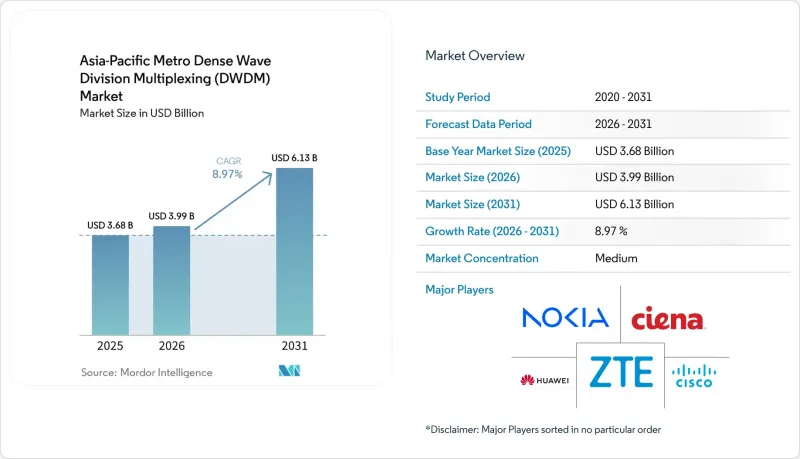
According to Mordor Intelligence, the Asia-Pacific metro dense wave division multiplexing (DWDM) market size is expected to increase from USD 3.68 billion in 2025 to USD 3.99 billion in 2026 and reach USD 6.13 billion by 2031, growing at a CAGR of 8.97% over 2026-2031.
Asia-Pacific Metro Dense Wave Division Multiplexing (DWDM) Market Trends and Insights
Accelerating 5G Metro Backhaul and Fronthaul Upgrades
The Asia-Pacific Metro DWDM market benefits from 5G densification, as each new radio site increases transport requirements. Massive MIMO sites require sustained fronthaul or midhaul bandwidth that exceeds the requirements of legacy LTE sites. OTN-based transport remains suited to applications that require predictable latency and service isolation. Hybrid designs now place IPoDWDM in the IP core while keeping OTN in latency-sensitive fronthaul networks. China Mobile spent USD 18.4 billion on transport in 2025 and upgraded 580,000 base stations in tier-2 and tier-3 cities with 100 Gbps coherent backhaul. NTT Docomo completed a nationwide 100 Gbps rollout in March 2025 and continued trials of 800 Gbps ZR+ optics for extended reality services.
Hyperscale Data Center Interconnect Expansion
The Asia-Pacific Metro DWDM market is gaining momentum from data center links connecting large computing clusters. AI training and inference workloads require capacity between campuses, cloud regions, and landing stations. Vodafone Idea deployed Ciena WaveLogic 6 Extreme on its meshed DCI network in India in March 2026. The deployment reached 1.6 Tb/s per wavelength without a new fiber build. This result showed how higher-baud optics can increase available capacity on established routes. It also reinforced the commercial case for upgrades where new cable construction would take longer or cost more.
High Initial Deployment and Integration Costs
The Asia-Pacific Metro DWDM market faces a cost barrier, as operators have limited revenue per user and multiple network priorities. Deployments require coherent line systems, ROADM nodes, amplifiers, transponders, and management software. India's fiberization reached 38% against a 75% target. Closing the gap requires INR 1.5-2.5 trillion (USD 17.9-29.8 billion) and competes with 5G radio investment. Multi-vendor networks can also add testing, certification, and operational costs. ITU-T and Open ROADM MSA frameworks help establish interoperability baselines, but they do not remove the cost of managing separate optical platforms.
Other drivers and restraints analyzed in the detailed report include:
- Rising Cloud, Video, AI, and Internet Traffic
- Government-Led Fiber and Digital Infrastructure Investment
- Export Controls and Fragmented Certification Requirements
For complete list of drivers and restraints, kindly check the Table Of Contents.
Segment Analysis
Hardware accounted for 84.73% of the Asia-Pacific Metro DWDM market share in 2025, reflecting the value of coherent line systems, ROADMs, amplifiers, and transponders. These assets set the performance limits of an optical deployment and remain central to vendor selection. Hardware spending is high because systems are installed across multiple network sites and must support long operating lives. Suppliers are advancing coherent optics to increase capacity on existing fiber routes. Huawei introduced a single-wavelength 2T metro solution on the OSN 9800 platform in March 2026. The platform supports 800G, 1.2T, 1.6T, and 2T operation per wavelength.
Software is projected to expand at a 12.63% CAGR from 2026 to 2031, the fastest rate among component groups. Operators are shifting from isolated element management systems toward controllers that manage optical capacity across wider networks. KDDI began a large-scale deployment of Cluster-Based Distributed Disaggregated Backbone Routers in June 2026. The system combined DriveNets software with UfiSpace hardware, reducing deployment costs by 50% compared with conventional chassis-based routers. Software-based control can improve how operators introduce new services and operate multi-vendor equipment. Services remain relevant because many operators need external support for network design and management. The Asia-Pacific Metro DWDM industry, therefore, continues to combine large equipment purchases with a rising need for software and specialist services.
The 400 Gbps tier accounted for 32.14% of the Asia-Pacific Metro DWDM market in 2025. It became the core metro standard as operators replaced older 100G grid-based systems in China, Japan, and South Korea. Its balance of capacity, cost, and deployment readiness supported broad adoption. The OIF 400ZR Implementation Agreement established a coherent pluggable interface for metro links of up to 80 km. OpenZR+ then provided more flexibility for regional transport needs. These approaches enable the integration of coherent optics into routers and can reduce the number of network layers.
Capacity above 400 Gbps is projected to grow at a 13.32% CAGR through 2031. Demand comes from data center interconnect requirements and the availability of 800G coherent pluggables. Huawei's 2T solution represented a further step in high-capacity metro transmission during 2026. The system provides multi-rate support and addresses routes with increasing AI and cloud traffic. ZTE and China Telecom completed an extended C+L-band 80X800 Gbps WDM trial on a live network in March 2025. The trial supported the case for improving fiber utilization by using a wider spectrum rather than by installing new cable. Up to 100 Gbps and 200 Gbps systems still serve edge metro and aggregation sites with lower traffic volumes.
Complete Report Scope:
- By Component
- Hardware
- Software
- Services
- By Transmission Capacity
- Up to 100 Gbps
- 200 Gbps
- 400 Gbps
- Above 400 Gbps
- By Application
- Data Center Interconnect
- Mobile Backhaul and Fronthaul
- Broadband and Access Network Aggregation
- Other Applications
- By End-User
- Communication Service Providers
- Cloud and Data Center Providers
- Enterprises
- Government and Public Sector
- By Country
- China
- Japan
- South Korea
- India
- Australia and New Zealand
- Rest of Asia-Pacific
List of Companies Covered in this Report:
- Huawei Technologies Co., Ltd.
- Ciena Corporation
- Nokia Corporation
- ZTE Corporation
- Cisco Systems, Inc.
- Raisecom Technology Co., Ltd.
- Fujitsu Limited
- NEC Corporation
- Lumentum Holdings Inc.
- Hewlett-Packard Enterprise Company (Juniper Networking)
- ADTRAN, Inc.
- Ribbon Communications Inc.
- Tejas Networks Limited
- FS.com Inc.
- Smartoptics AS
- Ekinops S.A.
- InnoLight Technology Corporation
- PacketLight Networks Ltd.
- Accelink Technologies Co., Ltd.
- FiberHome Telecommunication Technologies Co., Ltd.
Additional Benefits:
- The market estimate (ME) sheet in Excel format
- 3 months of analyst support
TABLE OF CONTENTS
1 INTRODUCTION
- 1.1 Study Assumptions and Market Definition
- 1.2 Scope of the Study
2 RESEARCH METHODOLOGY
3 EXECUTIVE SUMMARY
4 MARKET LANDSCAPE
- 4.1 Market Overview
- 4.2 Market Drivers
- 4.2.1 Accelerating 5G Metro Backhaul and Fronthaul Upgrades
- 4.2.2 Hyperscale Data Center Interconnect Expansion
- 4.2.3 Rising Cloud, Video, AI and Internet Traffic
- 4.2.4 Government-Led Fiber and Digital Infrastructure Investment
- 4.2.5 Replacement of Legacy 100G Networks With 400G and 800G Coherent Systems
- 4.2.6 Expansion of Open and Disaggregated Optical Networking Architectures
- 4.3 Market Restraints
- 4.3.1 High Initial Deployment and Integration Costs
- 4.3.2 Export Controls and Fragmented Certification Requirements
- 4.3.3 Dependence on Specialized Coherent DSPs and Photonic Components
- 4.3.4 Country-Level Import Licensing and Local-Content Requirements
- 4.4 Industry Value Chain Analysis
- 4.5 Regulatory Landscape
- 4.6 Technological Outlook
- 4.7 Porter's Five Forces Analysis
- 4.7.1 Bargaining Power of Suppliers
- 4.7.2 Bargaining Power of Buyers
- 4.7.3 Threat of New Entrants
- 4.7.4 Threat of Substitutes
- 4.7.5 Competitive Rivalry
- 4.8 Impact of Macroeconomic Factors on the Market
5 MARKET SIZE AND GROWTH FORECASTS (VALUE)
- 5.1 By Component
- 5.1.1 Hardware
- 5.1.2 Software
- 5.1.3 Services
- 5.2 By Transmission Capacity
- 5.2.1 Up to 100 Gbps
- 5.2.2 200 Gbps
- 5.2.3 400 Gbps
- 5.2.4 Above 400 Gbps
- 5.3 By Application
- 5.3.1 Data Center Interconnect
- 5.3.2 Mobile Backhaul and Fronthaul
- 5.3.3 Broadband and Access Network Aggregation
- 5.3.4 Other Applications
- 5.4 By End-User
- 5.4.1 Communication Service Providers
- 5.4.2 Cloud and Data Center Providers
- 5.4.3 Enterprises
- 5.4.4 Government and Public Sector
- 5.5 By Country
- 5.5.1 China
- 5.5.2 Japan
- 5.5.3 South Korea
- 5.5.4 India
- 5.5.5 Australia and New Zealand
- 5.5.6 Rest of Asia-Pacific
6 COMPETITIVE LANDSCAPE
- 6.1 Market Concentration
- 6.2 Strategic Moves
- 6.3 Market Share Analysis
- 6.4 Company Profiles (includes Global Level Overview, Market Level Overview, Core Segments, Financials as available, Strategic Information, Market Rank/Share, Products and Services, Recent Developments)
- 6.4.1 Huawei Technologies Co., Ltd.
- 6.4.2 Ciena Corporation
- 6.4.3 Nokia Corporation
- 6.4.4 ZTE Corporation
- 6.4.5 Cisco Systems, Inc.
- 6.4.6 Raisecom Technology Co., Ltd.
- 6.4.7 Fujitsu Limited
- 6.4.8 NEC Corporation
- 6.4.9 Lumentum Holdings Inc.
- 6.4.10 Hewlett-Packard Enterprise Company (Juniper Networking)
- 6.4.11 ADTRAN, Inc.
- 6.4.12 Ribbon Communications Inc.
- 6.4.13 Tejas Networks Limited
- 6.4.14 FS.com Inc.
- 6.4.15 Smartoptics AS
- 6.4.16 Ekinops S.A.
- 6.4.17 InnoLight Technology Corporation
- 6.4.18 PacketLight Networks Ltd.
- 6.4.19 Accelink Technologies Co., Ltd.
- 6.4.20 FiberHome Telecommunication Technologies Co., Ltd.
7 MARKET OPPORTUNITIES AND FUTURE OUTLOOK
- 7.1 White-Space and Unmet-Need Assessment

