PUBLISHER: Mordor Intelligence | PRODUCT CODE: 2156920

PUBLISHER: Mordor Intelligence | PRODUCT CODE: 2156920
France Seed Processing Machinery - Market Share Analysis, Industry Trends & Statistics, Growth Forecasts (2026 - 2031)
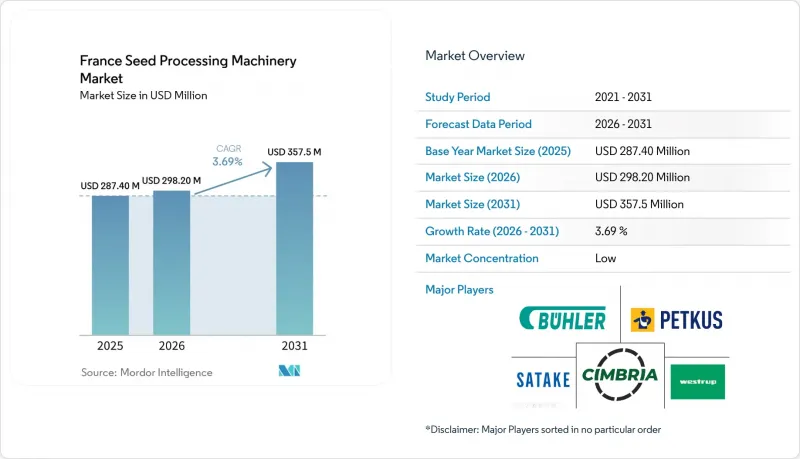
According to Mordor Intelligence, the France seed processing machinery market size is forecast to increase from USD 287.40 million in 2025 to USD 298.20 million in 2026, and reach USD 357.50 million by 2031, at a CAGR of 3.69% during the forecast period 2026-2031.
France Seed Processing Machinery Market Trends and Insights
Mandatory Varietal Purity and Germination Compliance
France's official seed certification system establishes stringent quality standards that directly influence demand for seed processing equipment. Certification is administered by the French National Seed and Plant Association (Societe Nationale des Agriculteurs Multiplicateurs de Semences, SEMAE) through the Official Quality and Control Directorate (Direction de la Qualite et du Controle Officiel, DQCO), which evaluates seed lots for varietal purity, germination capacity, moisture content, and freedom from harmful organisms before granting certification. Maize seed must achieve a minimum germination rate of 90% to qualify for the SOC France label, making precise cleaning, grading, sorting, and lot uniformity essential throughout the processing chain. As a result, the France seed processing machinery market sees sustained demand for high-precision processing technologies, as equipment that consistently meets certification requirements helps processors minimize lot rejection and maintain compliance with national quality standards.
Expansion of Certified Seed and Export-Oriented Production
France plays a significant role in certified seed production, and its large multiplication base supports demand for reliable conditioning capacity. SEMAE identifies the country as a major supplier of large-crop certified seed, which sustains the relevance of export-quality processing for plant investment. Export-oriented buyers require traceable lots, controlled packaging, and reliable purity verification. The Organization for Economic Co-operation and Development (OECD) Seed Schemes provide the common framework used for varietal certification and international trade. Processing plants, therefore, require equipment that supports repeatable results and clear lot identification. This operational requirement provides the France seed processing machinery market with a stable base among facilities serving certified and export channels.
High Upfront Cost and Long Project Payback
The high capital investment required for advanced seed processing facilities remains a key restraint in the France seed processing machinery market. Modern processing lines integrating optical sorters, gravity separators, automated seed treatment systems, and digital inspection technologies require substantial upfront expenditure, while financial returns are typically realized over several production cycles through improved throughput and lower processing losses. Recognizing these investment challenges, FranceAgriMer allocated a EUR 20 million (USD 23.2 million) budget under the France 2030 program to support investments in innovative agricultural equipment, with public funding covering 20-40% of eligible equipment costs. This ongoing need for capital subsidies underscores the financial burden of adopting advanced processing technologies. As a result, small and medium-sized seed processors often defer equipment modernization due to limited investment capacity and extended payback periods, thereby slowing the adoption of next-generation seed processing systems.
Other drivers and restraints analyzed in the detailed report include:
- Replacement of Aging Cleaning and Grading Lines
- Automation to Offset Rural Technician Scarcity
- Limited Utilization Outside Seasonal Conditioning Windows
For complete list of drivers and restraints, kindly check the Table Of Contents.
Segment Analysis
By machinery type, optical sorters accounted for 24.0% of the France seed processing machinery market size in 2025. This position reflects the role of machine vision in identifying defects and supporting purity checks for certified lots that must remain distinguishable during processing. Cleaners and pre-cleaners remove foreign material and perform primary size separation, while graders, separators, destoners, and seed packagers support higher-volume cereal and maize programs. Coating and seed treatment equipment are gaining importance as organic seed producers prepare for the transition to approved coating substances. Polishers and other specialized machines remain relevant for vegetable and specialty seed work, where surface quality and careful lot handling are particularly important.
Optical sorters are forecast to expand at a 7.5% CAGR between 2026 and 2031, supported by their ability to manage small, traceable, and specification-sensitive lots. The equipment complements screening and gravity separation, enabling plants to add inspection capability without altering the role of core mechanical stages. Suppliers continue to invest in test capability and advanced sorting platforms, helping operators evaluate a machine against the characteristics of their own crop and lot mix.
Complete Report Scope:
- By Machinery Type
- Pre-Cleaners
- Cleaners
- Dryers
- Graders
- Coaters and Treaters
- Separators and Destoners
- Polishers
- Optical Sorters
- Seed Packagers
- Other Specialized Equipment
- By Operation Mode
- Automatic
- Semi-Automatic
- By End User
- Commercial Seed Processing Plants
- Seed Producers
- Research Institutions
- On-Farm Facilities
- Grain Handling Facilities
List of Companies Covered in this Report:
- Buhler AG
- Cimbria A/S ( Grain & Protein Technologies)
- PETKUS Technologie GmbH
- Satake Corporation
- Ag Growth International Inc.
- Westrup ApS
- Skiold A/S (Solix Group)
- Oliver Manufacturing Co., Inc.
- Carter Day International, Inc.
- DOREZ SAS
- ETABL SCHNEIDER JAQUET CIE
- MERIS Services Industries SAS
- FAO SAS
- Atrissem SAS
- Meyer Corp
Additional Benefits:
- The market estimate (ME) sheet in Excel format
- 3 months of analyst support
TABLE OF CONTENTS
1 INTRODUCTION
- 1.1 Study Assumptions and Market Definition
- 1.2 Scope of the Study
2 RESEARCH METHODOLOGY
3 EXECUTIVE SUMMARY
4 MARKET LANDSCAPE
- 4.1 Market Overview
- 4.2 Market Drivers
- 4.2.1 Mandatory Varietal Purity and Germination Compliance
- 4.2.2 Expansion of Certified Seed and Export-Oriented Production
- 4.2.3 Replacement of Aging Cleaning and Grading Lines
- 4.2.4 Automation to Offset Rural Technician Scarcity
- 4.2.5 Retrofit Demand from Multi-Crop, Small-Lot Changeovers
- 4.2.6 Optical Sorting for Identity-Preserved Organic and Specialty Lots
- 4.3 Market Restraints
- 4.3.1 High Upfront Cost and Long Project Payback
- 4.3.2 Stringent CE, ATEX, and Documentation Compliance
- 4.3.3 Small-Lot Changeover and Cleaning Validation Burden
- 4.3.4 Limited Utilization Outside Seasonal Conditioning Windows
- 4.4 Regulatory Landscape
- 4.5 Technological Outlook
- 4.6 Porter's Five Forces Analysis
- 4.6.1 Bargaining Power of Suppliers
- 4.6.2 Bargaining Power of Buyers
- 4.6.3 Threat of New Entrants
- 4.6.4 Threat of Substitutes
- 4.6.5 Intensity of Competitive Rivalry
5 MARKET SIZE AND GROWTH FORECASTS (VALUE)
- 5.1 By Machinery Type
- 5.1.1 Pre-Cleaners
- 5.1.2 Cleaners
- 5.1.3 Dryers
- 5.1.4 Graders
- 5.1.5 Coaters and Treaters
- 5.1.6 Separators and Destoners
- 5.1.7 Polishers
- 5.1.8 Optical Sorters
- 5.1.9 Seed Packagers
- 5.1.10 Other Specialized Equipment
- 5.2 By Operation Mode
- 5.2.1 Automatic
- 5.2.2 Semi-Automatic
- 5.3 By End User
- 5.3.1 Commercial Seed Processing Plants
- 5.3.2 Seed Producers
- 5.3.3 Research Institutions
- 5.3.4 On-Farm Facilities
- 5.3.5 Grain Handling Facilities
6 COMPETITIVE LANDSCAPE
- 6.1 Market Concentration
- 6.2 Strategic Moves
- 6.3 Market Share Analysis
- 6.4 Company Profiles (Includes Global Level Overview, Market Level Overview, Core Segments, Financials as Available, Strategic Information, Market Rank/Share, Products and Services, Recent Developments)
- 6.4.1 Buhler AG
- 6.4.2 Cimbria A/S ( Grain & Protein Technologies)
- 6.4.3 PETKUS Technologie GmbH
- 6.4.4 Satake Corporation
- 6.4.5 Ag Growth International Inc.
- 6.4.6 Westrup ApS
- 6.4.7 Skiold A/S (Solix Group)
- 6.4.8 Oliver Manufacturing Co., Inc.
- 6.4.9 Carter Day International, Inc.
- 6.4.10 DOREZ SAS
- 6.4.11 ETABL SCHNEIDER JAQUET CIE
- 6.4.12 MERIS Services Industries SAS
- 6.4.13 FAO SAS
- 6.4.14 Atrissem SAS
- 6.4.15 Meyer Corp
7 MARKET OPPORTUNITIES AND FUTURE OUTLOOK

