PUBLISHER: Mordor Intelligence | PRODUCT CODE: 2157114

PUBLISHER: Mordor Intelligence | PRODUCT CODE: 2157114
Japan Metal Forming Equipment - Market Share Analysis, Industry Trends & Statistics, Growth Forecasts (2026 - 2031)
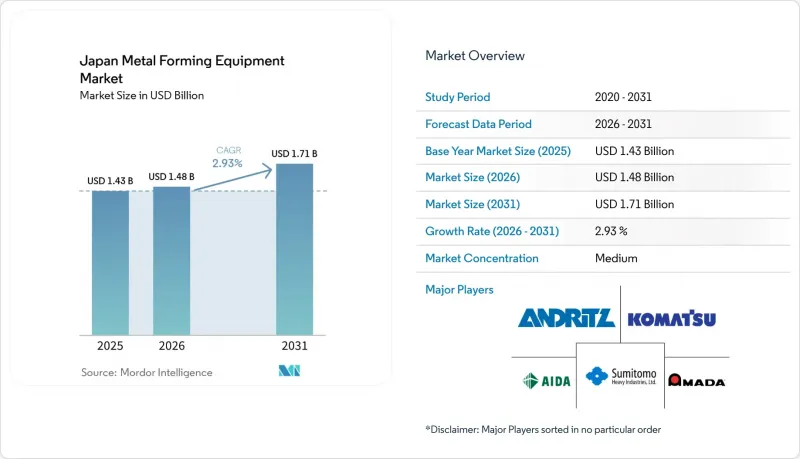
According to Mordor Intelligence, the Japan metal forming equipment market size was valued at USD 1.43 billion in 2025, and is estimated to grow from USD 1.48 billion in 2026 to reach USD 1.71 billion by 2031, at a CAGR of 2.9% during the forecast period (2026-2031).
Japan Metal Forming Equipment Market Trends and Insights
Replacement of Japan's Aging Press and Forming Equipment Base
The Japan metal forming equipment market is supported by a large installed base that requires renewal, maintenance, and repair. Renewal, maintenance, and repair represented 30.8% of planned manufacturing capital expenditure among major firms in FY2025, the highest share among investment motives. The same purpose accounted for 37.8% of FY2025 planned capital expenditure among small and medium-sized manufacturers, making it the largest purpose category in that survey. These figures point to a backlog of time-expired assets moving into replacement cycles. Older mechanical presses also carry higher maintenance needs and lower productivity than newer servo platforms. METI's 2025 vision called for the modernization of the machine parts and tooling base as manufacturers move toward higher-value applications.
EV Lightweighting and Battery-Component Forming
The Japan metal forming equipment market is being reshaped by battery electric vehicle production requirements. Honda's 0 Series production plan uses a 6,000-ton megacasting machine to reduce 60 battery-case parts to 5 parts. This change reduces some multi-stage stamping work while increasing the need for high-precision, high-force production systems. Automotive equipment investment in Japan reached JPY 1.6 trillion in 2024 (USD 10.24 billion), and transport equipment capital expenditure was planned to rise 28.2% in FY2025. UACJ's work on one-piece 6000-series aluminum door inners for Lexus shows how material choices are changing forming requirements. The shift favors equipment that can manage aluminum deep drawing and controlled motion profiles. It also narrows the role of conventional mechanical presses in selected applications.
High Upfront Cost and Long Payback for Smart Press Lines
Domestic automotive investment introduces a cyclical element to the Japan metal forming equipment market. Automotive and transportation held 38% of demand in 2025, which makes changes in OEM capital plans important to equipment suppliers. Major manufacturers planned a 28.2% increase in transport equipment capital expenditure in FY2025. The increase reflected electrification spending and may not represent a lasting annual spending level. Nissan announced in July 2025 that it would transfer and consolidate vehicle production from Oppama to Nissan Motor Kyushu. JFMA data showed domestic transport-equipment orders for forming machinery rose 5.2% in FY2025, while electrical machinery orders fell 18.7%.
Other drivers and restraints analyzed in the detailed report include:
- Servo-Electric and Hybrid Press Adoption for Energy Productivity
- Semiconductor, Electronics, and Precision-Component Capacity Expansion
- Cyclical Domestic Automotive Capital Expenditure
For complete list of drivers and restraints, kindly check the Table Of Contents.
Segment Analysis
Press machines held 41.5% of the Japan metal forming equipment market share in 2025, making them the largest equipment category. Mechanical and hydraulic presses continue to support established automotive bodies and powertrain operations. Press brakes and bending machines are used across hydraulic, servo-electric, and mechanical configurations. JFMA reported that press brake orders increased 14.6% year over year in FY2025, the strongest result among sheet metal sub-categories.
Servo presses are expected to post the highest 5.2% CAGR through 2031 as users seek programmable motion, die protection, and compatibility with advanced steels and aluminum. Komatsu Industries began taking orders for an upgraded H1F200-2 servo press in June 2026, with faster operation, higher-precision control, and expanded ICT connectivity. The Japan metal forming equipment industry is moving toward product refreshes that retain machine-family value while meeting newer performance expectations. JFMA had 158 certified models across 44 product lines registered as of January 1, 2026, a signal that favors servo and hybrid-electric equipment. Forging, roll forming, wire and tube forming, extrusion, and hydroforming equipment serve automotive, aerospace, and industrial machinery users. Hydroforming and extrusion equipment have a smaller installed base but align with growing aluminum and titanium use.
Stamping and punching accounted for 30.5% of the Japan metal forming equipment market size in 2025, supported by high-volume sheet processing. Deep drawing, bending, forging, rolling, roll forming, and extrusion serve separate production requirements across the manufacturing base. This capability suits battery electric vehicle chassis and battery enclosure designs. The Japan metal forming equipment market retains a broad process base because manufacturers require both high-volume and precision work.
Hydroforming has the highest projected CAGR at 5.8% through 2031 because it forms complex aluminum and steel tubular structures with fewer operations. Gigacasting and megacasting can replace multi-stage stamping for selected body panels. They can also increase demand for hydroforming and deep drawing of structural parts that are not economical to cast. Domestic forming equipment orders from the metal products manufacturing sector rose 8.2% year over year in FY2025. Forging equipment benefits from aerospace fasteners and precision drivetrain components. Extrusion serves aluminum profile requirements in battery trays and heat management systems.
Complete Report Scope:
- By Equipment Type
- Press Machines
- Mechanical Presses
- Hydraulic Presses
- Servo Presses
- Other General-Purpose Presses
- Press Brakes and Bending Machines
- Hydraulic Press Brakes
- Servo / Electric Press Brakes
- Mechanical Press Brakes
- Other Bending Machines
- Forging Equipment
- Forging Presses
- Forging Hammers
- Upsetting and Heading Machines
- Other Forging Equipment
- Roll Forming and Plate/Profile Rolling Equipment
- Roll Forming Machines
- Plate Rolling Machines
- Section and Profile Rolling Machines
- Other Secondary Rolling/Forming Equipment
- Wire, Tube and Profile Forming Equipment
- Wire and Bar Drawing/Forming Equipment
- Tube Forming and Bending Equipment
- Profile Forming Equipment
- Extrusion Presses
- Hydroforming Equipment
- Other Metal Forming Equipment
- Press Machines
- By Forming Process
- Stamping and Punching
- Deep Drawing
- Bending
- Forging
- Rolling and Roll Forming
- Extrusion
- Hydroforming
- Other Forming Processes
- By Material Formed
- Carbon and Low-Alloy Steel
- Stainless Steel
- Aluminum and Aluminum Alloys
- Copper and Copper Alloys
- Titanium, Nickel and Other Non-Ferrous Metals
- Other Materials
- By End-Use Industry
- Automotive and Transportation
- Aerospace and Defense
- Industrial Machinery and Capital Equipment
- Metal Products and Fabrication
- Electrical and Electronics
- Construction and Infrastructure
- Energy and Power
- Consumer Appliances and Durable Goods
- Medical and Precision Manufacturing
- Other End-Use Industries
List of Companies Covered in this Report:
- AMADA Co., Ltd.
- AIDA ENGINEERING, LTD.
- Komatsu Ltd.
- Sumitomo Heavy Industries, Ltd.
- ANDRITZ Schuler Group
- DMG MORI Co., Ltd.
- Mitsubishi Heavy Industries Machine Tool Co., Ltd.
- Yamada Dobby Co., Ltd.
- ASAI CORPORATION
- Enshu Limited
- Kojima Iron Works Co., Ltd.
- Kuroda Precision Industries Ltd.
- Nidec Minster Corporation
- Toyokoki Co., Ltd.
- Mitsubishi Electric Corporation
- FANUC Corporation
- Murata Machinery, Ltd.
- Bystronic AG
- TRUMPF SE + Co. KG
- Salvagnini Italia S.p.A.
- Prima Industrie S.p.A.
- Fagor Arrasate S. Coop.
Additional Benefits:
- The market estimate (ME) sheet in Excel format
- 3 months of analyst support
TABLE OF CONTENTS
1 INTRODUCTION
- 1.1 Study Assumptions and Market Definition
- 1.2 Scope of the Study
2 RESEARCH METHODOLOGY
3 EXECUTIVE SUMMARY
4 MARKET LANDSCAPE
- 4.1 Market Overview
- 4.2 Market Drivers
- 4.2.1 Replacement of Japan's Aging Press and Forming Equipment Base
- 4.2.2 EV Lightweighting and Battery-Component Forming
- 4.2.3 Servo-Electric and Hybrid Press Adoption for Energy Productivity
- 4.2.4 Semiconductor, Electronics and Precision-Component Capacity Expansion
- 4.2.5 Skilled-Die-Maker Scarcity Increasing Demand for Autonomous Process Windows
- 4.2.6 Japan-Based Precision Tooling as an Export-Linked Demand Multiplier
- 4.3 Market Restraints
- 4.3.1 High Upfront Cost and Long Payback for Smart Press Lines
- 4.3.2 Cyclical Domestic Automotive Capital Expenditure
- 4.3.3 Retrofit and Data-Integration Friction Across Legacy Japanese Factories
- 4.3.4 Concentration of Specialized Tooling and Service Expertise in Aging Suppliers
- 4.4 Value and Supply-Chain Analysis
- 4.4.1 Press Manufacturers and System Integrators
- 4.4.2 Controls, Drives, Sensors, and Automation Suppliers
- 4.4.3 Dies, Tooling, and Workholding
- 4.4.4 Distribution, Installation, and Aftermarket Services
- 4.4.5 Import Dependencies and Regional Supply Chain
- 4.5 Regulatory Landscape
- 4.5.1 Act on the Rationalization of Energy Use and Top Runner Principles
- 4.5.2 Industrial Safety and Press-Guarding Requirements
- 4.5.3 JIS, ISO and CE-Linked Equipment Compliance
- 4.5.4 Cybersecurity and Connected-Machine Governance
- 4.6 Technological Outlook
- 4.6.1 Mechanical, Hydraulic and Servo Press Technologies
- 4.6.2 CNC, PLC, and Motion-Control Systems
- 4.6.3 Robotic Automation and In-Line Inspection
- 4.6.4 Digital Twins, Predictive Maintenance, and Cybersecurity
- 4.6.5 Hot Stamping, Hydroforming, and Incremental Forming
- 4.7 Impact Assessment of Geopolitical Events on the Market
5 MARKET SIZE AND GROWTH FORECASTS
- 5.1 By Equipment Type
- 5.1.1 Press Machines
- 5.1.1.1 Mechanical Presses
- 5.1.1.2 Hydraulic Presses
- 5.1.1.3 Servo Presses
- 5.1.1.4 Other General-Purpose Presses
- 5.1.2 Press Brakes and Bending Machines
- 5.1.2.1 Hydraulic Press Brakes
- 5.1.2.2 Servo / Electric Press Brakes
- 5.1.2.3 Mechanical Press Brakes
- 5.1.2.4 Other Bending Machines
- 5.1.3 Forging Equipment
- 5.1.3.1 Forging Presses
- 5.1.3.2 Forging Hammers
- 5.1.3.3 Upsetting and Heading Machines
- 5.1.3.4 Other Forging Equipment
- 5.1.4 Roll Forming and Plate/Profile Rolling Equipment
- 5.1.4.1 Roll Forming Machines
- 5.1.4.2 Plate Rolling Machines
- 5.1.4.3 Section and Profile Rolling Machines
- 5.1.4.4 Other Secondary Rolling/Forming Equipment
- 5.1.5 Wire, Tube and Profile Forming Equipment
- 5.1.5.1 Wire and Bar Drawing/Forming Equipment
- 5.1.5.2 Tube Forming and Bending Equipment
- 5.1.5.3 Profile Forming Equipment
- 5.1.6 Extrusion Presses
- 5.1.7 Hydroforming Equipment
- 5.1.8 Other Metal Forming Equipment
- 5.1.1 Press Machines
- 5.2 By Forming Process
- 5.2.1 Stamping and Punching
- 5.2.2 Deep Drawing
- 5.2.3 Bending
- 5.2.4 Forging
- 5.2.5 Rolling and Roll Forming
- 5.2.6 Extrusion
- 5.2.7 Hydroforming
- 5.2.8 Other Forming Processes
- 5.3 By Material Formed
- 5.3.1 Carbon and Low-Alloy Steel
- 5.3.2 Stainless Steel
- 5.3.3 Aluminum and Aluminum Alloys
- 5.3.4 Copper and Copper Alloys
- 5.3.5 Titanium, Nickel and Other Non-Ferrous Metals
- 5.3.6 Other Materials
- 5.4 By End-Use Industry
- 5.4.1 Automotive and Transportation
- 5.4.2 Aerospace and Defense
- 5.4.3 Industrial Machinery and Capital Equipment
- 5.4.4 Metal Products and Fabrication
- 5.4.5 Electrical and Electronics
- 5.4.6 Construction and Infrastructure
- 5.4.7 Energy and Power
- 5.4.8 Consumer Appliances and Durable Goods
- 5.4.9 Medical and Precision Manufacturing
- 5.4.10 Other End-Use Industries
6 COMPETITIVE LANDSCAPE
- 6.1 Market Concentration
- 6.2 Strategic Moves
- 6.3 Market Share Analysis
- 6.4 Company Profiles (includes Global Level Overview, Market Level Overview, Core Segments, Financials as available, Strategic Information, Products and Services, Recent Developments)
- 6.4.1 AMADA Co., Ltd.
- 6.4.2 AIDA ENGINEERING, LTD.
- 6.4.3 Komatsu Ltd.
- 6.4.4 Sumitomo Heavy Industries, Ltd.
- 6.4.5 ANDRITZ Schuler Group
- 6.4.6 DMG MORI Co., Ltd.
- 6.4.7 Mitsubishi Heavy Industries Machine Tool Co., Ltd.
- 6.4.8 Yamada Dobby Co., Ltd.
- 6.4.9 ASAI CORPORATION
- 6.4.10 Enshu Limited
- 6.4.11 Kojima Iron Works Co., Ltd.
- 6.4.12 Kuroda Precision Industries Ltd.
- 6.4.13 Nidec Minster Corporation
- 6.4.14 Toyokoki Co., Ltd.
- 6.4.15 Mitsubishi Electric Corporation
- 6.4.16 FANUC Corporation
- 6.4.17 Murata Machinery, Ltd.
- 6.4.18 Bystronic AG
- 6.4.19 TRUMPF SE + Co. KG
- 6.4.20 Salvagnini Italia S.p.A.
- 6.4.21 Prima Industrie S.p.A.
- 6.4.22 Fagor Arrasate S. Coop.
7 MARKET OPPORTUNITIES AND FUTURE OUTLOOK
- 7.1 White-Space and Unmet-Need Assessment
- 7.1.1 Automation and Flexible Forming Solutions for SMEs
- 7.1.2 Energy-Efficient Retrofits for Legacy Forming Equipment
- 7.1.3 Local Service and Aftermarket Support for Imported Equipment
- 7.1.4 Forming Solutions for EV, Battery, and Emerging Industrial Applications
- 7.1.5 Machine Connectivity and Data Interoperability

