PUBLISHER: Mordor Intelligence | PRODUCT CODE: 2157120

PUBLISHER: Mordor Intelligence | PRODUCT CODE: 2157120
United States Metal Forming Equipment - Market Share Analysis, Industry Trends & Statistics, Growth Forecasts (2026 - 2031)
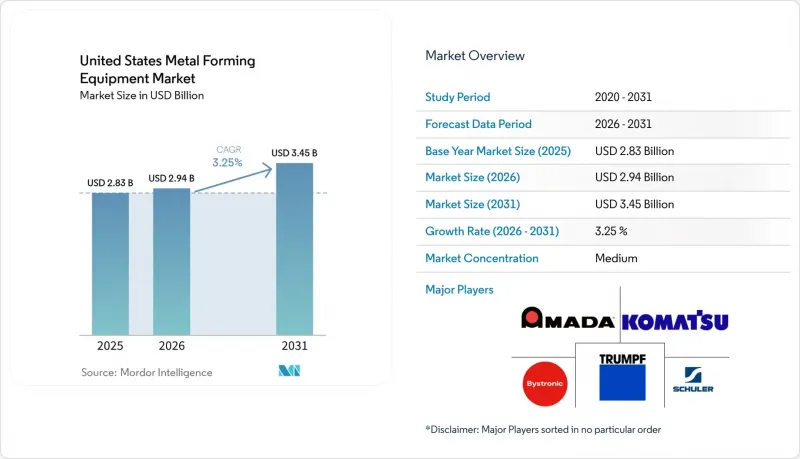
According to Mordor Intelligence, the United States metal forming equipment market size is projected to be USD 2.83 billion in 2025, USD 2.94 billion in 2026, and reach USD 3.45 billion by 2031, growing at a CAGR of 3.25% from 2026 to 2031.
United States Metal Forming Equipment Market Trends and Insights
Reshoring and Federal Manufacturing Investment
Build America, Buy America provisions require every iron and steel manufacturing process used for federally assisted infrastructure projects to occur within the United States, tying federally funded construction demand to qualified domestic fabrication facilities. This requirement supports purchases of presses, roll formers, bending machines, and related systems used by fabricators making compliant components. The Reshoring Initiative reported that fabricated metals reshoring grew 19% in 2025, indicating that more production activity was returning to United States manufacturing locations. It also recorded a 12-fold year-over-year rise in tariff-driven reshoring rationales, showing the growing role of trade conditions in location decisions. These conditions favor committed spending on stamping lines, forging presses, and roll-forming systems instead of short-term changes in where production is performed. Announced semiconductor investments exceeding USD 630 billion across 140 projects add fabrication work for structural steel and aluminum used in facility buildings, data centers, and power substations.
EV, Battery, and Lightweight-Component Manufacturing
Electric vehicles require purpose-designed stamped components for battery integration, structural support, and related powertrain changes, increasing the range of metal parts that suppliers must form. Aluminum battery enclosures increase demand for equipment that can process lightweight sheet materials while meeting production and quality requirements. Novelis states that aluminum solutions can reduce battery enclosure mass by up to 50% compared with equivalent steel solutions, which gives material weight a central role in equipment selection. This requirement favors aluminum-capable servo presses, hydroforming equipment, and CNC press brakes with suitable controls, tooling, and forming capability. Domestic-content requirements for battery components direct a greater share of this work toward United States plants rather than offshore supply arrangements. Tariffs on aluminum derivatives also reinforce the cost case for local sourcing of formed aluminum parts and related component systems.
High Capital Cost and Financing Sensitivity
New forming equipment requires substantial capital, particularly for smaller fabricators that lack long-term original equipment manufacturer supply agreements to support financing applications or secure predictable equipment use. The contrast between lower unit orders and higher order value in 2026 shows how automation content and advanced controls can raise the cost of a new equipment purchase. The Small Business Administration 504 program offers fixed-asset financing for eligible small businesses, including equipment investments that meet program requirements. Its approval process can slow purchases tied to time-sensitive contract awards, creating a practical challenge for fabricators seeking to respond quickly to new production opportunities. The 2023-2025 period of elevated interest rates delayed equipment replacement decisions and showed that the United States metal forming equipment market is sensitive to financing conditions. Tax expensing can ease acquisition costs, but larger press-line investments can exceed the range where those provisions provide the strongest support.
Other drivers and restraints analyzed in the detailed report include:
- Industry 4.0 Automation and Labor-Productivity Imperatives
- Aerospace, Defense, and Shipbuilding Capacity Expansion
- Skilled Technician and Controls-Engineer Shortages
For complete list of drivers and restraints, kindly check the Table Of Contents.
Segment Analysis
Press machines held 44% of the United States metal forming equipment market size in 2025, supported by mechanical and hydraulic systems used in high-volume automotive stamping, industrial component fabrication, and general metal-products operations. Servo presses are the fastest-growing subsegment, with a projected 5.3% CAGR from 2026 to 2031, because programmable slide motion supports electric vehicle components, aerospace parts, and precision medical forming applications. A 2026 study of a 25,000 kN heavy-duty servo press found that dynamics parameter calibration reduced peak torque error by 72.7%. The same study reduced effective motor torque prediction error from 7.6% to 1.4%, which supports the use of servo technology where precision and repeatable operation are required. Hydraulic presses remain important for deep drawing, rubber-pad forming, and hydroforming, where controlled force is needed over long stroke lengths.
Mechanical presses retain a role in commodity stamping because high production speed remains central to their economics. Press brakes and bending machines are the second-largest equipment category, while electric and servo variants gain interest as purchasers consider energy use and lifetime operating costs. Roll-forming equipment serves construction and infrastructure work, whereas forging equipment supports aerospace and defense applications requiring specialized parts. Hydroforming equipment and extrusion presses address adjacent precision requirements for automotive structures, aerospace ducts, and aluminum battery enclosure frames. Schuler Inc. and Feintool launched a new HFA fineblanking press generation during January 2026, with servo-controlled hydraulic pump drives, higher stroke rates, and double-digit energy-efficiency gains.
Stamping and punching held 32.5% of the United States metal forming equipment market size in 2025, reflecting their broad use across automotive body panels, electrical enclosures, appliance components, and industrial hardware. Progressive-die and transfer-press lines suit these applications because they can produce repeatable parts at high volumes. Hydroforming is the fastest-growing process segment, forecast to expand at a 4.9% CAGR from 2026 to 2031. Electric vehicle platforms and aerospace duct systems require seamless tubular or sheet-formed shapes that conventional die stamping cannot consistently provide. Bending, including press-brake and roll-bending work, also benefits from aerospace and defense investment in high-tonnage systems for naval vessels and space-launch structures.
Cincinnati Incorporated delivered large press brakes to rocket programs during May 2026, illustrating demand for precision fabrication of large structural components. Deep drawing remains important for consumer appliances, medical devices, and aerospace fuel systems, where draw depth, wall thickness, and surface finish matter. Forging benefits from the defense procurement of high-integrity titanium and nickel-superalloy parts used in aerospace and missile programs. Rolling and roll-forming processes provide structural steel and aluminum profiles for highway, bridge, and construction projects. Other processes, including electromagnetic forming, rubber-pad forming, and incremental sheet forming, have uses in low-volume, complex aerospace and defense prototypes, while digital-twin systems are becoming relevant in hot-stamping qualification.
Complete Report Scope:
- By Equipment Type
- Press Machines
- Mechanical Presses
- Hydraulic Presses
- Servo Presses
- Other General-Purpose Presses
- Press Brakes and Bending Machines
- Hydraulic Press Brakes
- Servo / Electric Press Brakes
- Mechanical Press Brakes
- Other Bending Machines
- Forging Equipment
- Forging Presses
- Forging Hammers
- Upsetting and Heading Machines
- Other Forging Equipment
- Roll Forming and Plate/Profile Rolling Equipment
- Roll Forming Machines
- Plate Rolling Machines
- Section and Profile Rolling Machines
- Other Secondary Rolling/Forming Equipment
- Wire, Tube and Profile Forming Equipment
- Wire and Bar Drawing/Forming Equipment
- Tube Forming and Bending Equipment
- Profile Forming Equipment
- Extrusion Presses
- Hydroforming Equipment
- Other Metal Forming Equipment
- Press Machines
- By Forming Process
- Stamping and Punching
- Deep Drawing
- Bending
- Forging
- Rolling and Roll Forming
- Extrusion
- Hydroforming
- Other Forming Processes
- By Material Formed
- Carbon and Low-Alloy Steel
- Stainless Steel
- Aluminum and Aluminum Alloys
- Copper and Copper Alloys
- Titanium, Nickel and Other Non-Ferrous Metals
- Other Materials
- By End-Use Industry
- Automotive and Transportation
- Aerospace and Defense
- Industrial Machinery and Capital Equipment
- Metal Products and Fabrication
- Electrical and Electronics
- Construction and Infrastructure
- Energy and Power
- Consumer Appliances and Durable Goods
- Medical and Precision Manufacturing
- Other End-Use Industries
List of Companies Covered in this Report:
- TRUMPF Inc.
- AMADA AMERICA, INC.
- Bystronic Inc.
- Komatsu America Industries LLC
- Schuler Inc.
- Cincinnati Incorporated
- Prima Power North America Inc.
- Salvagnini America, Inc.
- LVD Company NV
- MC Machinery Systems, Inc.
- Mazak Optonics Corporation
- Mitsubishi Electric Automation, Inc.
- Beckwood Press Company
- Greenerd Press & Machine Company, Inc.
- AIDA Engineering, Ltd.
- Fagor Arrasate S. Coop.
- Wilson Tool International
- Piranha Fabrication Equipment
- Accurpress
- Ermak USA, Inc.
- Haco-Atlantic, Inc.
- Pacific Press Technologies
- Wysong and Miles Company
Additional Benefits:
- The market estimate (ME) sheet in Excel format
- 3 months of analyst support
TABLE OF CONTENTS
1 Introduction
- 1.1 Study Assumptions and Market Definition
- 1.2 Scope of the Study
2 Research Methodology
3 Executive Summary
4 Market Landscape
- 4.1 Market Overview
- 4.2 Market Drivers
- 4.2.1 Reshoring and Federal Manufacturing Investment
- 4.2.2 EV, Battery and Lightweight-Component Manufacturing
- 4.2.3 Industry 4.0 Automation and Labor-Productivity Imperatives
- 4.2.4 Aerospace, Defense and Shipbuilding Capacity Expansion
- 4.2.5 Distributed Production Requiring Fast-Changeover Forming Cells
- 4.2.6 Digital Serviceability of Legacy Presses and Controls
- 4.3 Market Restraints
- 4.3.1 High Capital Cost and Financing Sensitivity
- 4.3.2 Skilled Technician and Controls-Engineer Shortages
- 4.3.3 Tariff Exposure and Imported Component Volatility
- 4.3.4 Integration Risk Across Mixed-Vintage Factory Systems
- 4.4 Value / Supply-Chain Analysis
- 4.4.1 Steel, Aluminum and Specialty-Alloy Inputs
- 4.4.2 Dies, Tooling, Controls, Servo Drives and Sensors
- 4.4.3 Machine Builders, Integrators, Distributors and Service Providers
- 4.4.4 Fabricators, Tier Suppliers and Large OEM Buyers
- 4.4.5 Aftermarket Parts, Retrofits, Training and Remote Diagnostics
- 4.5 Regulatory Landscape
- 4.5.1 Occupational Safety and Machine Guarding Requirements
- 4.5.2 Energy Efficiency, Emissions and Environmental Compliance
- 4.5.3 Buy America, Federal Procurement and Domestic-Content Rules
- 4.5.4 Trade Remedies, Tariffs and Customs Classification
- 4.6 Technological Outlook
- 4.6.1 Servo-Electric and Hybrid Press Architectures
- 4.6.2 Fiber Laser, CNC and Multi-Axis Forming Integration
- 4.6.3 Robotics, Vision Inspection and In-Die Sensing
- 4.6.4 Digital Twins, Predictive Maintenance and Remote Monitoring
- 4.6.5 Energy Monitoring and Regenerative Drives
- 4.7 Impact Assessment of Geopolitical Events on the Market
5 Market Size & Growth Forecasts
- 5.1 By Equipment Type
- 5.1.1 Press Machines
- 5.1.1.1 Mechanical Presses
- 5.1.1.2 Hydraulic Presses
- 5.1.1.3 Servo Presses
- 5.1.1.4 Other General-Purpose Presses
- 5.1.2 Press Brakes and Bending Machines
- 5.1.2.1 Hydraulic Press Brakes
- 5.1.2.2 Servo / Electric Press Brakes
- 5.1.2.3 Mechanical Press Brakes
- 5.1.2.4 Other Bending Machines
- 5.1.3 Forging Equipment
- 5.1.3.1 Forging Presses
- 5.1.3.2 Forging Hammers
- 5.1.3.3 Upsetting and Heading Machines
- 5.1.3.4 Other Forging Equipment
- 5.1.4 Roll Forming and Plate/Profile Rolling Equipment
- 5.1.4.1 Roll Forming Machines
- 5.1.4.2 Plate Rolling Machines
- 5.1.4.3 Section and Profile Rolling Machines
- 5.1.4.4 Other Secondary Rolling/Forming Equipment
- 5.1.5 Wire, Tube and Profile Forming Equipment
- 5.1.5.1 Wire and Bar Drawing/Forming Equipment
- 5.1.5.2 Tube Forming and Bending Equipment
- 5.1.5.3 Profile Forming Equipment
- 5.1.6 Extrusion Presses
- 5.1.7 Hydroforming Equipment
- 5.1.8 Other Metal Forming Equipment
- 5.1.1 Press Machines
- 5.2 By Forming Process
- 5.2.1 Stamping and Punching
- 5.2.2 Deep Drawing
- 5.2.3 Bending
- 5.2.4 Forging
- 5.2.5 Rolling and Roll Forming
- 5.2.6 Extrusion
- 5.2.7 Hydroforming
- 5.2.8 Other Forming Processes
- 5.3 By Material Formed
- 5.3.1 Carbon and Low-Alloy Steel
- 5.3.2 Stainless Steel
- 5.3.3 Aluminum and Aluminum Alloys
- 5.3.4 Copper and Copper Alloys
- 5.3.5 Titanium, Nickel and Other Non-Ferrous Metals
- 5.3.6 Other Materials
- 5.4 By End-Use Industry
- 5.4.1 Automotive and Transportation
- 5.4.2 Aerospace and Defense
- 5.4.3 Industrial Machinery and Capital Equipment
- 5.4.4 Metal Products and Fabrication
- 5.4.5 Electrical and Electronics
- 5.4.6 Construction and Infrastructure
- 5.4.7 Energy and Power
- 5.4.8 Consumer Appliances and Durable Goods
- 5.4.9 Medical and Precision Manufacturing
- 5.4.10 Other End-Use Industries
6 Competitive Landscape
- 6.1 Market Concentration
- 6.2 Strategic Moves
- 6.3 Market Share Analysis
- 6.4 Company Profiles (Includes Global Level Overview, Market Level Overview, Core Segments, Financials as Available, Strategic Information, Products and Services, Recent Developments)
- 6.4.1 TRUMPF Inc.
- 6.4.2 AMADA AMERICA, INC.
- 6.4.3 Bystronic Inc.
- 6.4.4 Komatsu America Industries LLC
- 6.4.5 Schuler Inc.
- 6.4.6 Cincinnati Incorporated
- 6.4.7 Prima Power North America Inc.
- 6.4.8 Salvagnini America, Inc.
- 6.4.9 LVD Company NV
- 6.4.10 MC Machinery Systems, Inc.
- 6.4.11 Mazak Optonics Corporation
- 6.4.12 Mitsubishi Electric Automation, Inc.
- 6.4.13 Beckwood Press Company
- 6.4.14 Greenerd Press & Machine Company, Inc.
- 6.4.15 AIDA Engineering, Ltd.
- 6.4.16 Fagor Arrasate S. Coop.
- 6.4.17 Wilson Tool International
- 6.4.18 Piranha Fabrication Equipment
- 6.4.19 Accurpress
- 6.4.20 Ermak USA, Inc.
- 6.4.21 Haco-Atlantic, Inc.
- 6.4.22 Pacific Press Technologies
- 6.4.23 Wysong and Miles Company
7 Market Opportunities & Future Outlook
- 7.1 White-Space and Unmet-Need Assessment
- 7.1.1 Retrofit-First Automation for Small and Mid-Sized Fabricators
- 7.1.2 Domestic Service and Spare-Parts Localization
- 7.1.3 Low-Energy Forming for Electrified Production Lines
- 7.1.4 Flexible Cells for High-Mix, Low-Volume Production
- 7.1.5 Cybersecure Connectivity for Legacy Equipment

