PUBLISHER: Mordor Intelligence | PRODUCT CODE: 2163382

PUBLISHER: Mordor Intelligence | PRODUCT CODE: 2163382
Germany Industrial Press Machines - Market Share Analysis, Industry Trends & Statistics, Growth Forecasts (2026 - 2031)
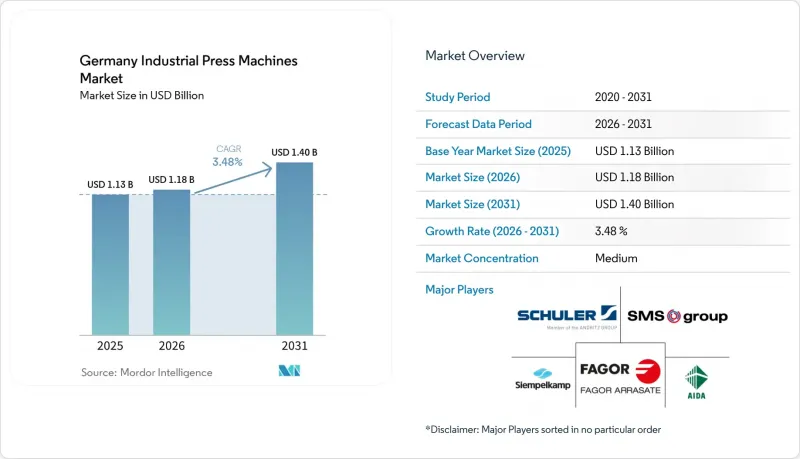
According to Mordor Intelligence, the Germany industrial press machines market size is expected to increase from USD 1.13 billion in 2025 to USD 1.18 billion in 2026 and reach USD 1.40 billion by 2031, growing at a CAGR of 3.48% over 2026-2031.
Germany Industrial Press Machines Market Trends and Insights
Automotive Electrification and Lightweight Component Production
The German industrial press machine market is changing as battery-electric vehicle platforms require different forming and assembly processes. Aluminum-intensive body structures, cylindrical battery housings, and motor laminations need programmable ram motion and closed-loop position control. Servo-hydraulic and servo-mechanical equipment can meet these requirements more effectively than fixed-speed conventional systems. Thin-gauge high-strength aluminum can increase die wear when it is formed at a fixed ram speed. Controlled servo motion can therefore support part quality while limiting tooling wear. Schuler Inc commissioned a 1.5-gigawatt battery-cell mass-formation line in southern Germany in January 2026, with more than 50,000 formation channels and a track-and-trace system that collects over 2 million data points per second
Modernization of Aging German Production Equipment
The Germany industrial press machines market benefits from the replacement needs of older hydraulic and conventional mechanical presses. Many installed machines no longer meet current expectations for energy performance, connected operation, and documented process control. The European Investment Bank found that nearly two-thirds of German companies' investment budgets were directed toward replacement and renewal in 2025. This pattern supports brownfield modernization even when new factory construction remains restrained. Older presses cannot always be upgraded economically with servo-controlled drives, digital twin connections, and predictive-maintenance sensors. Replacement decisions can therefore combine a capacity renewal with a move to equipment that meets OEM quality and traceability requirements.
Weak Domestic Capital Investment and Automotive-Cycle Exposure
Weak capital spending limits the ability of the Germany industrial press machines market to rely on domestic equipment expansion. German net investment fell to -0.23% of gross domestic product in 2025, indicating that investment did not exceed depreciation at the economy-wide level. Equipment investment declined by 2.5% in 2025, while manufacturers remained cautious about new capacity commitments. VDMA reported that domestic machinery order intake fell 1% over the full year, although total orders rose 3% in the fourth quarter of 2025. Automotive manufacturers must balance spending on new electric vehicle platforms against the continued operation of internal-combustion vehicle lines. This creates uncertainty around the timing of large press orders.
Other drivers and restraints analyzed in the detailed report include:
- Expansion of Aerospace, Defense, Medical Technology, and Electronics Manufacturing
- Demand for Energy-Efficient Servo-Hydraulic and Electrically Driven Presses
- High Purchase, Installation, and Tooling Costs
For complete list of drivers and restraints, kindly check the Table Of Contents.
Segment Analysis
Hydraulic presses held 37% of the Germany industrial press machines market share in 2025, making them the leading drive technology. Their position reflects high force density and variable-pressure control in deep drawing, large-panel forming, and heavy forging. These applications need controlled force at levels that are difficult for other systems to provide at a comparable capital cost. Conventional mechanical presses remained important for high-volume work with repeatable geometries. They serve consumer durable production, smaller automotive stampings, and electrical components. Pneumatic presses serve lighter work such as assembly, press-fitting, and connector insertion. Hybrid systems and other formats address specialized activities, including powder compaction and composite molding. This range of applications helps hydraulic presses retain a material role in the Germany industrial press machines market.
Servo-mechanical presses are forecast to record an 8.2% CAGR between 2026 and 2031, the highest growth rate within drive technologies. Their programmable RAM motion supports battery-tray forming, motor lamination stamping, and tight-tolerance medical component production. Real-time force monitoring also supports applications that require documented quality control. The HFA plus+ series from ANDRITZ Schuler combines servo-controlled hydraulic pump drives with connected process monitoring. Such systems can raise stroke rates while reducing energy use. Programmable motion can reduce die wear and scrap, which lowers lifecycle cost. This benefit matters as manufacturers face shortages of skilled press-setting technicians. The German industrial press machine industry is therefore shifting toward systems that simplify repeatable production without removing the need for high-force hydraulic equipment.
The 101-500-ton tier commanded 30.2% of the Germany industrial press machines market share in 2025. This capacity range supports automotive body panels, transmission components, brackets, electrical enclosures, and precision forgings. Its installed base is broad because it suits many production settings across German manufacturing. Buyers also benefit from a mature tooling base that can reduce changeover costs in high-mix operations. The up-to-100-ton category serves light stamping, electronics, and medical device assembly. The 501-1,000-ton and 1,001-2,000-ton ranges support structural vehicle components, heavy equipment frames, and specialized forging work. Each of these ranges requires controlled force profiles for different materials and part designs. The 101-500-ton category remains a central volume tier for the Germany industrial press machines market.
Presses above 2,000 tons are forecast to grow at a 6.8% CAGR from 2026 to 2031. Defense forging, aerospace structural frames, and energy infrastructure components are driving demand for these machines. The capability requirements favor suppliers with proven reliability and precision in high-force applications. Germany's 2025 defense approvals support the demand environment for armored vehicles and artillery outputs. ANDRITZ Schuler delivered a 6,500-ton GLK forging press with a kinetic energy recovery system that can reduce power demand by up to 40% against conventional presses at equivalent force. Extreme-tonnage equipment combines high technical requirements with the need for energy management. This makes the segment important to the Germany industrial press machines market, even though its unit volumes are limited. It also supports suppliers that can provide engineering and lifecycle services alongside the press.
Complete Report Scope:
- By Drive / Actuation Technology
- Conventional Mechanical Presses
- Servo-Mechanical Presses
- Hydraulic Presses
- Pneumatic Presses
- Other and Hybrid Presses
- By Press Force / Capacity
- Up to 100 Tons
- 101-500 Tons
- 501-1,000 Tons
- 1,001-2,000 Tons
- Above 2,000 Tons
- By Application / Process
- Stamping, Blanking and Punching
- Deep Drawing and Sheet Forming
- Forging
- Straightening and General Forming
- Compression Molding
- Powder Compaction
- Assembly, Press-Fitting and Joining
- Other Press Applications
- By End-Use Industry
- Automotive and Transportation
- Aerospace and Defense
- Industrial Machinery and Equipment
- Electrical and Electronics
- Appliances and Consumer Durables
- Construction and Heavy Equipment
- Energy and Power Equipment
- Metal Products and General Manufacturing
- Medical and Precision Manufacturing
- Other End-Use Industries
List of Companies Covered in this Report:
- Schuler Inc.
- Trumpf SE + Co. KG
- SMS group GmbH
- Siempelkamp Maschinen- und Anlagenbau GmbH
- LASCO Umformtechnik GmbH
- Hatebur Umformmaschinen AG
- Maschinenfabrik Lauffer GmbH & Co. KG
- Grabener Pressensysteme GmbH
- J. Dieffenbacher GmbH Maschinen- und Anlagenbau
- Fritz Mueller Pressen GmbH
- HBE GmbH Umformtechnik
- August Lapple GmbH
- H+E Maschinenbau GmbH
- G+K Umformtechnik GmbH
- Joos GmbH
- Schmale Maschinenbau GmbH
- MAWI Press Center GmbH
- Maschinenfabrik Alfing Kessler GmbH
- Kurtz GmbH
- Klaeger Pressen GmbH
Additional Benefits:
- The market estimate (ME) sheet in Excel format
- 3 months of analyst support
TABLE OF CONTENTS
1 Introduction
- 1.1 Study Assumptions and Market Definition
- 1.2 Scope of the Study
2 Research Methodology
3 Executive Summary
4 Market Landscape
- 4.1 Market Overview
- 4.2 Market Drivers
- 4.2.1 Automotive Electrification and Lightweight Component Production
- 4.2.2 Modernization of Aging German Production Equipment
- 4.2.3 Expansion of Aerospace, Defense, Medical Technology and Electronics Manufacturing
- 4.2.4 Demand for Energy-Efficient Servo-Hydraulic and Electrically Driven Presses
- 4.2.5 Retrofit Demand from Brownfield Press Lines and Installed Equipment
- 4.2.6 Domestic Manufacturing and Supplier Localization
- 4.3 Market Restraints
- 4.3.1 Weak Domestic Capital Investment and Automotive-Cycle Exposure
- 4.3.2 High Purchase, Installation and Tooling Costs
- 4.3.3 Competition from Lower-Cost Asian Machine Manufacturers
- 4.3.4 Skilled-Service Labor Shortages and Compliance Complexity
- 4.4 Regulatory Landscape
- 4.4.1 Machinery Regulation and CE Compliance
- 4.4.2 Occupational Safety and Press-Guarding Requirements
- 4.4.3 Functional Safety and Emergency-Stop Requirements
- 4.4.4 Energy Efficiency and Environmental Requirements
- 4.4.5 Import, Export and Dual-Use Compliance
- 4.5 Technological Outlook
- 4.5.1 Mechanical, Hydraulic, Servo and Hybrid Architectures
- 4.5.2 Direct-Drive Servo, Adaptive Forming and Force Control
- 4.5.3 Robotic Transfer, Coil Feeding and Automated Material Handling
- 4.5.4 Digital Twins, Predictive Maintenance and Machine Connectivity
- 4.5.5 Laser Blanking, High-Speed Blanking and Die-Change Flexibility
- 4.6 Industry and Manufacturing Trends
- 4.6.1 Flexible and High-Mix Production
- 4.6.2 Integration of Presses with Automated Manufacturing Cells
- 4.6.3 Advanced High-Strength Steel, Aluminum and Composite Forming
- 4.6.4 Increasing Demand for High-Precision and Tight-Tolerance Components
- 4.6.5 Sustainability and Energy-Consumption Reduction
- 4.7 Impact of Geopolitical and Trade Developments
- 4.7.1 Tariffs on Imported Presses and Critical Components
- 4.7.2 Supply-Chain Disruptions for Motors, Controls and Hydraulic Components
- 4.7.3 Domestic Capacity for Large-Scale Press Manufacturing
5 Market Size & Growth Forecasts
- 5.1 By Drive / Actuation Technology
- 5.1.1 Conventional Mechanical Presses
- 5.1.2 Servo-Mechanical Presses
- 5.1.3 Hydraulic Presses
- 5.1.4 Pneumatic Presses
- 5.1.5 Other and Hybrid Presses
- 5.2 By Press Force / Capacity
- 5.2.1 Up to 100 Tons
- 5.2.2 101-500 Tons
- 5.2.3 501-1,000 Tons
- 5.2.4 1,001-2,000 Tons
- 5.2.5 Above 2,000 Tons
- 5.3 By Application / Process
- 5.3.1 Stamping, Blanking and Punching
- 5.3.2 Deep Drawing and Sheet Forming
- 5.3.3 Forging
- 5.3.4 Straightening and General Forming
- 5.3.5 Compression Molding
- 5.3.6 Powder Compaction
- 5.3.7 Assembly, Press-Fitting and Joining
- 5.3.8 Other Press Applications
- 5.4 By End-Use Industry
- 5.4.1 Automotive and Transportation
- 5.4.2 Aerospace and Defense
- 5.4.3 Industrial Machinery and Equipment
- 5.4.4 Electrical and Electronics
- 5.4.5 Appliances and Consumer Durables
- 5.4.6 Construction and Heavy Equipment
- 5.4.7 Energy and Power Equipment
- 5.4.8 Metal Products and General Manufacturing
- 5.4.9 Medical and Precision Manufacturing
- 5.4.10 Other End-Use Industries
6 Competitive Landscape
- 6.1 Market Concentration
- 6.2 Strategic Moves
- 6.3 Market Share Analysis
- 6.4 Company Profiles (Includes Global Level Overview, Market Level Overview, Core Segments, Financials as Available, Strategic Information, Products and Services, Recent Developments)
- 6.4.1 Schuler Inc.
- 6.4.2 Trumpf SE + Co. KG
- 6.4.3 SMS group GmbH
- 6.4.4 Siempelkamp Maschinen- und Anlagenbau GmbH
- 6.4.5 LASCO Umformtechnik GmbH
- 6.4.6 Hatebur Umformmaschinen AG
- 6.4.7 Maschinenfabrik Lauffer GmbH & Co. KG
- 6.4.8 Grabener Pressensysteme GmbH
- 6.4.9 J. Dieffenbacher GmbH Maschinen- und Anlagenbau
- 6.4.10 Fritz Mueller Pressen GmbH
- 6.4.11 HBE GmbH Umformtechnik
- 6.4.12 August Lapple GmbH
- 6.4.13 H+E Maschinenbau GmbH
- 6.4.14 G+K Umformtechnik GmbH
- 6.4.15 Joos GmbH
- 6.4.16 Schmale Maschinenbau GmbH
- 6.4.17 MAWI Press Center GmbH
- 6.4.18 Maschinenfabrik Alfing Kessler GmbH
- 6.4.19 Kurtz GmbH
- 6.4.20 Klaeger Pressen GmbH
7 Market Opportunities & Future Outlook
- 7.1 White-Space and Unmet-Need Assessment
- 7.2 Press Modernization for Small and Medium-Sized German Manufacturers
- 7.3 Energy-Efficient Retrofit Kits for Existing Hydraulic Presses
- 7.4 Battery Housing and Electric-Motor Component Pressing
- 7.5 High-Precision Presses for Aerospace and Medical Technology
- 7.6 Predictive-Maintenance and Remote-Service Platforms
- 7.7 Flexible Low-Volume Production Cells
- 7.8 Localized Spare-Parts and Service Networks

