PUBLISHER: Mordor Intelligence | PRODUCT CODE: 2163604

PUBLISHER: Mordor Intelligence | PRODUCT CODE: 2163604
Thailand Industrial Press Machines - Market Share Analysis, Industry Trends & Statistics, Growth Forecasts (2026 - 2031)
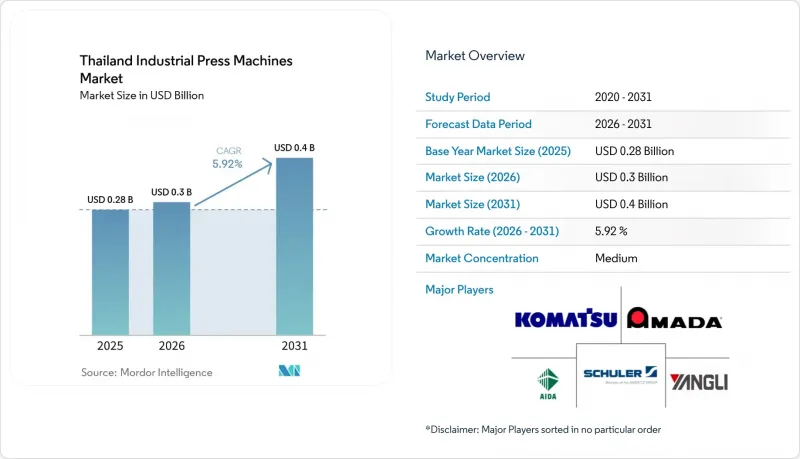
According to Mordor Intelligence, the Thailand industrial press machines market size was valued at USD 0.28 billion in 2025 and is estimated to grow from USD 0.3 billion in 2026 to reach USD 0.4 billion by 2031, at a CAGR of 5.92% during the forecast period (2026-2031).
Thailand Industrial Press Machines Market Trends and Insights
EV and Battery Component Manufacturing Expansion
Thailand's EV policy is encouraging manufacturers to increase local vehicle and component output. The Thailand Board of Investment had approved 198 EV-related projects worth more than USD 4.1 billion by May 2026, spanning vehicles, hybrid systems, batteries, and components. The March 2025 approval for Sunwoda Electronics' battery cell investment in Chonburi added a large-scale cell manufacturing project to the EEC production base. The EV 3.5 program requires participating producers to manufacture 2 vehicles in Thailand for every imported vehicle in 2026, with the requirement increasing to 3 vehicles in 2027. This requirement supports orders for body-panel, battery-case, and structural-component production equipment in the Thailand industrial press machines market. Battery cell production also creates a separate need for electrode calendering and deep-drawing equipment, which broadens demand beyond conventional vehicle stamping.
Electronics and PCB Manufacturing Investment
Advanced electronics investment is increasing demand for precision pressing systems used in multilayer board materials and connector production. New facilities increase the need for localized materials processing, connector production, and controlled lamination. PCB laminate production requires hydraulic presses with close temperature and pressure control, rather than the high-cycle mechanical equipment used for automotive stampings. Panasonic Industry announced a JPY 17 billion (USD 108.8 million) investment in September 2025 for a new multilayer circuit board materials plant at Ayutthaya, with operations planned for November 2027. The growth of PCB production in Ayutthaya, Pathum Thani, and Chonburi is therefore widening the Thailand industrial press machines market beyond the EEC automotive base.
High Capital Cost and Limited SME Financing
Financing conditions remain a direct constraint for smaller suppliers considering a press replacement or automation project. Outstanding Thai SME bank loans declined 3.1% year over year to THB 3.08 trillion (USD 97.8 billion) at the end of 2024. The SME gross nonperforming loan ratio stood at 7.2% in 2024, reflecting a cautious lending environment. SME nonperforming loans reached 7.6% in the second quarter of 2025, while stage-2 loans exceeded 13%. AMRO reported that SME lending returns of 8% to 10% can fall below total costs of 11% to 13%, limiting the incentive for banks to expand riskier credit. These conditions can postpone purchases of 200-500 tons servo presses, where collateral requirements and assessment costs are difficult for smaller manufacturers to absorb.
Other drivers and restraints analyzed in the detailed report include:
- Automation, Robotics, And Industry 4.0 Adoption
- Aging Mechanical Press Base and Retrofit Demand
- Dependence On Imported Equipment and Critical Components
For complete list of drivers and restraints, kindly check the Table Of Contents.
Segment Analysis
Conventional mechanical presses held 38.6% of demand in 2025 because Thailand retains a large automotive stamping installed base. These machines support established applications where high throughput and proven operating practices remain important. Hydraulic presses are used where controlled force delivery is more important than cycle speed. Pneumatic presses support light assembly and connector-fitting work in electronics operations. Other and hybrid systems, including servo-hydraulic equipment, serve high-value and lower-volume work in aerospace and medical forming.
Servo-mechanical presses are forecast to grow at an 8.1% CAGR through 2031, the highest rate among drive types. The Thailand industrial press machines market is adopting them for energy management, programmable motion, and production data collection. Tier-1 vehicle suppliers use in-stroke force monitoring and corrective controls when forming EV structural parts. These functions support tighter specifications for battery trays and motor housings than conventional flywheel-driven machines can provide. The 2025 to 2029 efficiency support program strengthens the financial case for shifting from older mechanical equipment to certified servo systems.
The 101-500 tons range commanded 40.2% of demand in 2025, covering general sheet-metal work, automotive stampings, and PCB laminate pressing. Up to 100 tons of equipment is used for electronic connectors, precision hardware, and medical components. The 501-1,000 tons and 1,001-2,000 tons ranges support larger body panels and heavy structural assemblies. Their presence reflects the depth of Thailand's established vehicle supply chain. The Thailand industrial press machines market is therefore anchored by a mid-range equipment base that serves several manufacturing activities.
The above 2,000 tons range is forecast to grow at a 6.8% CAGR through 2031, the fastest-growing capacity category. Battery enclosure deep drawing and larger EV structures can require high clamping forces and single-hit operations. Equipment in this range is relevant when factories form high-strength aluminum or ultra-high-strength steel parts. The Thailand industrial press machines market is also seeing demand shift toward larger investments in the EEC as battery projects prepare for later production ramp-ups. This change does not replace mid-range demand, but it adds a high-value equipment requirement for selected vehicle and battery plants.
Complete Report Scope:
- By Drive / Actuation Technology
- Conventional Mechanical Presses
- Servo-Mechanical Presses
- Hydraulic Presses
- Pneumatic Presses
- Other and Hybrid Presses
- By Press Force / Capacity
- Up to 100 Tons
- 101-500 Tons
- 501-1,000 Tons
- 1,001-2,000 Tons
- Above 2,000 Tons
- By Application / Process
- Stamping, Blanking and Punching
- Deep Drawing and Sheet Forming
- Forging
- Straightening and General Forming
- Compression Molding
- Powder Compaction
- Assembly, Press-Fitting and Joining
- Other Press Applications
- By End-Use Industry
- Automotive and Transportation
- Aerospace and Defense
- Industrial Machinery and Equipment
- Electrical and Electronics
- Appliances and Consumer Durables
- Construction and Heavy Equipment
- Energy and Power Equipment
- Metal Products and General Manufacturing
- Medical and Precision Manufacturing
- Other End-Use Industries
List of Companies Covered in this Report:
- AIDA Engineering, Ltd.
- Komatsu Industries (Thailand) Co., Ltd.
- AMADA CO., LTD.
- Schuler Group
- Yangli Group
- JIER Machine-Tool Group Co., Ltd.
- Chin Fong Machine Industrial Co., Ltd.
- SEYI Machinery Co., Ltd.
- SIMPAC Co., Ltd.
- Nidec Minster Corporation
- Fagor Arrasate S. Coop.
- Beckwood Press Company
- Macrodyne Technologies Inc.
- Sutherland Presses
- Stamtec, Inc.
- B.P. Power Engineering Co., Ltd.
- Siam General Engineering Co., Ltd.
- SENSON (THAILAND) CO., LTD.
- MEGA TECH CO., LTD.
- MC TECHNOS (THAILAND) CO., LTD.
Additional Benefits:
- The market estimate (ME) sheet in Excel format
- 3 months of analyst support
TABLE OF CONTENTS
1 Introduction
- 1.1 Study Assumptions and Market Definition
- 1.2 Scope of the Study
2 Research Methodology
3 Executive Summary
4 Market Landscape
- 4.1 Market Overview
- 4.2 Market Drivers
- 4.2.1 EV and Battery Component Manufacturing Expansion
- 4.2.2 Electronics and PCB Manufacturing Investment
- 4.2.3 Automation, Robotics and Industry 4.0 Adoption
- 4.2.4 Aging Mechanical-Press Installed Base and Retrofit Demand
- 4.2.5 Precision Forming Requirements for Lightweight Materials
- 4.2.6 Localized Press-Line Service and Refurbishment Ecosystem
- 4.3 Market Restraints
- 4.3.1 High Capital Cost and Limited SME Financing
- 4.3.2 Dependence on Imported Equipment and Critical Components
- 4.3.3 Shortage of Press-Programming and Maintenance Specialists
- 4.3.4 Long Qualification Cycles for Automotive and Electronics Customers
- 4.4 Value and Supply-Chain Analysis
- 4.4.1 Raw Materials and Fabricated Press Frames
- 4.4.2 Drives, Hydraulics, Motors and Control Systems
- 4.4.3 Dies, Tooling and Die-Change Systems
- 4.4.4 Press-Machine Manufacturers
- 4.4.5 Automation and System Integrators
- 4.4.6 Distributors and Authorized Dealers
- 4.4.7 Installation, Retrofit and Lifecycle Services
- 4.4.8 Heavy-Lift Logistics and Inland Transportation
- 4.5 Regulatory Landscape
- 4.5.1 Board of Investment Incentives for EV and Advanced Electronics Manufacturing
- 4.5.2 Eastern Economic Corridor Investment Framework
- 4.5.3 Thai Industrial Standards Institute Requirements
- 4.5.4 Electrical Safety and Machine-Guarding Requirements
- 4.5.5 IEC 60204-1 Compliance Requirements
- 4.5.6 Automotive Equipment Qualification and IATF 16949 Linkages
- 4.5.7 Import Duties and Preferential Trade Agreements
- 4.5.8 Environmental, Energy-Efficiency and Factory-Safety Requirements
- 4.6 Technological Outlook
- 4.6.1 Mechanical, Hydraulic and Servo Press Architectures
- 4.6.2 Servo-Hydraulic and Servo-Electric Drives
- 4.6.3 Robotic Transfer, Coil-Feed Automation and In-Line Quality Control
- 4.6.4 IoT Monitoring, Predictive Maintenance and Digital Integration
- 4.6.5 AI-Assisted Process Optimization and Die Management
- 4.6.6 Energy-Efficient and Low-Consumption Press Systems
- 4.7 Impact of Geopolitical and Trade Developments
- 4.7.1 Tariffs on Imported Presses and Critical Components
- 4.7.2 Supply-Chain Disruptions for Motors, Controls and Hydraulic Components
- 4.7.3 Domestic Capacity for Large-Scale Press Manufacturing
5 Market Size & Growth Forecasts
- 5.1 By Drive / Actuation Technology
- 5.1.1 Conventional Mechanical Presses
- 5.1.2 Servo-Mechanical Presses
- 5.1.3 Hydraulic Presses
- 5.1.4 Pneumatic Presses
- 5.1.5 Other and Hybrid Presses
- 5.2 By Press Force / Capacity
- 5.2.1 Up to 100 Tons
- 5.2.2 101-500 Tons
- 5.2.3 501-1,000 Tons
- 5.2.4 1,001-2,000 Tons
- 5.2.5 Above 2,000 Tons
- 5.3 By Application / Process
- 5.3.1 Stamping, Blanking and Punching
- 5.3.2 Deep Drawing and Sheet Forming
- 5.3.3 Forging
- 5.3.4 Straightening and General Forming
- 5.3.5 Compression Molding
- 5.3.6 Powder Compaction
- 5.3.7 Assembly, Press-Fitting and Joining
- 5.3.8 Other Press Applications
- 5.4 By End-Use Industry
- 5.4.1 Automotive and Transportation
- 5.4.2 Aerospace and Defense
- 5.4.3 Industrial Machinery and Equipment
- 5.4.4 Electrical and Electronics
- 5.4.5 Appliances and Consumer Durables
- 5.4.6 Construction and Heavy Equipment
- 5.4.7 Energy and Power Equipment
- 5.4.8 Metal Products and General Manufacturing
- 5.4.9 Medical and Precision Manufacturing
- 5.4.10 Other End-Use Industries
6 Competitive Landscape
- 6.1 Market Concentration
- 6.2 Strategic Moves
- 6.3 Market Share Analysis
- 6.4 Company Profiles (Includes Global Level Overview, Market Level Overview, Core Segments, Financials as Available, Strategic Information, Products and Services, Recent Developments)
- 6.4.1 AIDA Engineering, Ltd.
- 6.4.2 Komatsu Industries (Thailand) Co., Ltd.
- 6.4.3 AMADA CO., LTD.
- 6.4.4 Schuler Group
- 6.4.5 Yangli Group
- 6.4.6 JIER Machine-Tool Group Co., Ltd.
- 6.4.7 Chin Fong Machine Industrial Co., Ltd.
- 6.4.8 SEYI Machinery Co., Ltd.
- 6.4.9 SIMPAC Co., Ltd.
- 6.4.10 Nidec Minster Corporation
- 6.4.11 Fagor Arrasate S. Coop.
- 6.4.12 Beckwood Press Company
- 6.4.13 Macrodyne Technologies Inc.
- 6.4.14 Sutherland Presses
- 6.4.15 Stamtec, Inc.
- 6.4.16 B.P. Power Engineering Co., Ltd.
- 6.4.17 Siam General Engineering Co., Ltd.
- 6.4.18 SENSON (THAILAND) CO., LTD.
- 6.4.19 MEGA TECH CO., LTD.
- 6.4.20 MC TECHNOS (THAILAND) CO., LTD.
7 Market Opportunities and Future Outlook
- 7.1 White-Space and Unmet-Need Assessment
- 7.1.1 Servo and Hybrid Press Adoption Among Thai SMEs
- 7.1.2 Press-Line Retrofit Packages for Aging Equipment
- 7.1.3 Localized Die, Tooling and Process-Validation Services
- 7.1.4 Predictive-Maintenance and Remote-Diagnostics Services
- 7.1.5 Used-Equipment Certification and Safety Inspection
- 7.1.6 High-Tonnage Press Capacity for EV Battery Enclosures
- 7.1.7 Precision Pressing for Electronics and Semiconductor Components

