PUBLISHER: Mordor Intelligence | PRODUCT CODE: 2163386

PUBLISHER: Mordor Intelligence | PRODUCT CODE: 2163386
ASEAN Industrial Press Machines - Market Share Analysis, Industry Trends & Statistics, Growth Forecasts (2026 - 2031)
According to Mordor Intelligence, the ASEAN industrial press machines market size was valued at USD 1.32 billion in 2025 and is estimated to grow from USD 1.40 billion in 2026 to reach USD 1.93 billion by 2031, at a CAGR of 6.63% during the forecast period 2026-2031.
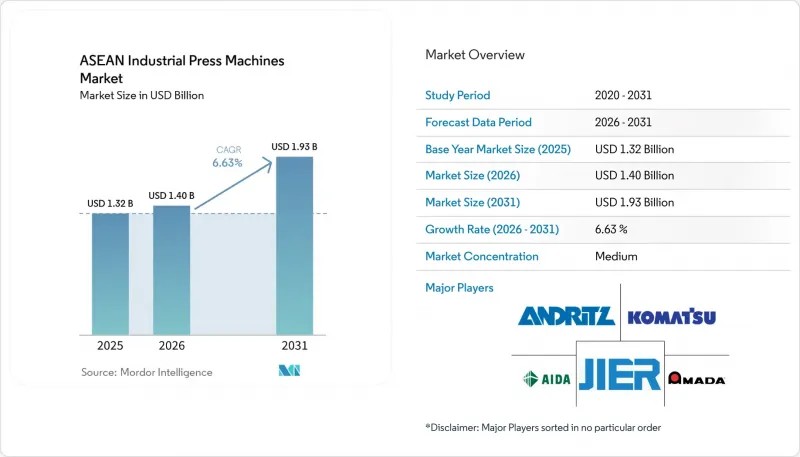
The region's manufacturing investment is supporting equipment purchases because new plants need stamping, forming, and joining systems. This report is Segmented by Drive Type (Mechanical, Servo-Mechanical, Hydraulic, Pneumatic, Others), by Capacity (Up To 100T, 101-500T, 501-1, 000T, 1, 001-2, 000T, Above 2, 000T), by Application (Stamping, Forging, Others), by End-Use (Automotive, Electronics, Medical, Others), and by Geography (Indonesia, Malaysia, Philippines, and More). The Market Forecasts are Provided in Terms of Value (USD).
ASEAN Industrial Press Machines Market Trends and Insights
China Plus One Manufacturing Diversification
Multinational producers are placing more production in ASEAN to reduce their dependence on China. The ASEAN Investment Report 2025 recorded USD 44 billion in manufacturing FDI during 2025. Greenfield commitments in electronics and electrical equipment rose 15% to USD 31 billion during the same year. New assembly and fabrication plants require stamping presses, progressive-die lines, and hydraulic forming systems. When a Tier 1 supplier establishes a site in Vietnam or Indonesia, local tooling and press-service activity tends to develop beside it. The ASEAN Secretariat also identified policy gaps, skills shortages, and infrastructure bottlenecks that can slow the conversion of announced investment into operating capacity.
Automotive and Electric Vehicle Component Localization
EV localization policies are shifting procurement from a replacement-led cycle toward new capital investment. Thailand's Board of Investment had approved 198 EV projects worth more than THB 137 billion, or USD 3.9 billion, as of May 2026. The projects covered vehicle assembly, batteries, energy storage, traction motors, battery management systems, power-control components, and charging infrastructure. Indonesia requires manufacturers that use duty-free EV import incentives to match imports with domestic production, with full compliance required by 2027. Malaysia ended completely built-up EV import incentives at the end of 2025 and retained completely knocked down vehicle incentives through 2027. Thailand's battery electric vehicle capacity utilization averaged 20% in 2025, while Indonesia remained below 15%, and the International Energy Agency expects utilization to rise during 2026 as local production becomes more important.
High Capital Cost and Extended Payback Periods
Servo and hydraulic systems in the 200-2,000 ton range can cost more than USD 300,000 and can exceed USD 3 million per unit. This cost is difficult for smaller fabricators to finance. Indonesia launched the Labor-Intensive Industrial Credit program in 2025, offering subsidized machinery modernization loans from IDR 500 million (USD 0.3 million) to IDR 10 billion (USD 0.6 million) with a 5% annual interest subsidy. The program had disbursed 16.72% of its IDR 549 billion (USD 32.76 million) ceiling as of May 2026, reaching 26 enterprises against a target of 293. It applies to textiles, footwear, furniture, and food, rather than the broader metalworking base that purchases industrial presses. In Vietnam, small supporting-industry enterprises borrow at 8-10% annually, while FDI enterprises can access parent-company financing at 1-3%, which can delay equipment upgrades.
Other drivers and restraints analyzed in the detailed report include:
- Electronics and Semiconductor Manufacturing Expansion
- Automation Adoption Amid Skilled-Labor Constraints
- Imported Controls, Hydraulics, Tooling, and Spare-Parts Dependence
For complete list of drivers and restraints, kindly check the Table Of Contents.
Segment Analysis
Conventional mechanical presses held 36.5% of the ASEAN industrial press machines market size in 2025. Their installed base reflects the established automotive stamping operations in Thailand, Indonesia, and Malaysia. Fabricators often select these proven systems because their initial cost is below that of premium servo alternatives and because operators are familiar with their fixed-cycle operating characteristics. Pneumatic presses remain relevant for light-duty punching and assembly work where compressed-air infrastructure already exists, particularly on electronics and consumer-appliance production lines. Hydraulic presses serve deep drawing, forging, and compression molding because controlled pressure and lower speeds suit these processes, including applications that require programmable pressure profiles.
Servo-mechanical presses are forecast to grow at an 8.2% CAGR through 2031, making them the fastest-growing drive type. EV battery trays and motor-core laminations need controlled force curves, die protection, programmable slide motion, energy recovery, and precise tonnage control during each forming cycle. AIDA Engineering has developed servo architectures across the 80-1,250 ton range. Its Johor manufacturing hub has served ASEAN automotive customers since 1997. Hybrid designs that combine servo drives and hydraulic accumulators are also suited to high-strength aluminum structural components where purely mechanical or hydraulic systems may not provide the required balance.
The 101-500 ton category held 40.6% of the ASEAN industrial press machines market in 2025, reflecting its broad role across the regional manufacturing base. It serves automotive panels, electronics enclosures, appliance frames, and structural brackets produced for vehicle, consumer durable, and industrial machinery supply chains. This range is offered in mechanical, hydraulic, and servo versions, giving buyers several configuration choices across suppliers from Japan, China, Europe, and Taiwan. It supports a large share of progressive-die and transfer-press work across regional industrial zones. Presses below 100 tons support connector stamping, lead-frame forming, small-part punching, and precision assembly for electronics, medical devices, and compact consumer products.
Presses above 2,000 tons are forecast to grow at a 6.8% CAGR through 2031, making them the fastest-growing capacity group. Localized large-panel production for EV platforms is the main source of demand, particularly where assemblers are developing body-in-white operations and domestic component supply. High-strength steel, aluminum crash structures, and battery enclosures need high forming force at production speed while maintaining repeatable part quality across long production runs. Yangli Group supplied 5,600-ton and 4,160-ton automated lines for Foton Motor, showing the scale used in vehicle body production. Its 3,750-ton TL4 transfer press can process high-strength steel body panels at up to 30 strokes per minute.
Complete Report Scope:
- By Drive / Actuation Technology
- Conventional Mechanical Presses
- Servo-Mechanical Presses
- Hydraulic Presses
- Pneumatic Presses
- Other and Hybrid Presses
- By Press Force / Capacity
- Up to 100 Tons
- 101-500 Tons
- 501-1,000 Tons
- 1,001-2,000 Tons
- Above 2,000 Tons
- By Application / Process
- Stamping, Blanking, and Punching
- Deep Drawing and Sheet Forming
- Forging
- Straightening and General Forming
- Compression Molding
- Powder Compaction
- Assembly, Press-Fitting, and Joining
- Other Press Applications
- By End-Use Industry
- Automotive and Transportation
- Aerospace and Defense
- Industrial Machinery and Equipment
- Electrical and Electronics
- Appliances and Consumer Durables
- Construction and Heavy Equipment
- Energy and Power Equipment
- Metal Products and General Manufacturing
- Medical and Precision Manufacturing
- Other End-Use Industries
- By Geography
- Indonesia
- Malaysia
- Philippines
- Thailand
- Vietnam
- Rest of ASEAN (Brunei Darussalam, Cambodia, Singapore, Lao People's Democratic Republic, Myanmar, etc.)
List of Companies Covered in this Report:
- AIDA Engineering, Ltd.
- Komatsu Industries Corporation
- ANDRITZ Schuler Group
- JIER Machine-Tool Group Co., Ltd.
- CHIN FONG MACHINE INDUSTRIAL CO., LTD.
- AMADA CO., LTD.
- Mitsubishi Heavy Industries, Ltd.
- Yangli Group Corporation Ltd.
- Fagor Arrasate S. Coop.
- TRUMPF SE + Co. KG
- Prima Industrie S.p.A.
- Salvagnini Italia S.p.A.
- Bystronic AG
- LVD Company NV
- Accurl CNC Machine (Anhui) Co., Ltd.
- Hefei Metalforming Intelligent Manufacturing Co., Ltd.
- Shibaura Machine Co., Ltd.
- Hyundai WIA Corporation
- FANUC CORPORATION
- AAPICO Hitech Public Company Limited
- Interplex Holdings Pte. Ltd.
Additional Benefits:
- The market estimate (ME) sheet in Excel format
- 3 months of analyst support
TABLE OF CONTENTS
1 INTRODUCTION
- 1.1 Study Assumptions and Market Definition
- 1.2 Scope of the Study
2 RESEARCH METHODOLOGY
3 EXECUTIVE SUMMARY
4 MARKET LANDSCAPE
- 4.1 Market Overview
- 4.2 Market Drivers
- 4.2.1 China Plus One Manufacturing Diversification
- 4.2.2 Automotive and Electric Vehicle Component Localization
- 4.2.3 Electronics and Semiconductor Manufacturing Expansion
- 4.2.4 Automation Adoption Amid Skilled-Labor Constraints
- 4.2.5 Cross-Border Press-Service and Engineering Hubs
- 4.2.6 Battery-Enclosure and Lightweight-Structure Forming Requirements
- 4.3 Market Restraints
- 4.3.1 High Capital Cost and Extended Payback Periods
- 4.3.2 Imported Controls, Hydraulics, Tooling, and Spare-Parts Dependence
- 4.3.3 Shortage of Press-Tooling and Advanced Maintenance Talent
- 4.3.4 Fragmented Cross-Border Aftermarket Support
- 4.4 Value and Supply-Chain Analysis
- 4.4.1 Raw Materials and Fabricated Press Frames
- 4.4.2 Drives, Hydraulics, Motors, and Control Systems
- 4.4.3 Dies, Tooling, and Die-Change Systems
- 4.4.4 Press-Machine Manufacturers
- 4.4.5 Automation and System Integrators
- 4.4.6 Distributors and Authorized Dealers
- 4.4.7 Installation, Retrofit, and Lifecycle Services
- 4.4.8 Heavy-Lift Logistics and Inland Transportation
- 4.5 Regulatory Landscape
- 4.5.1 Machine Safety and Guarding Requirements
- 4.5.2 Occupational Noise, Emissions, and Workplace Standards
- 4.5.3 Electrical, Hydraulic, and Functional Safety Compliance
- 4.5.4 Energy-Efficiency and Industrial Decarbonization Requirements
- 4.5.5 Cross-Border Trade and ASEAN Tariff Considerations
- 4.6 Technological Outlook
- 4.6.1 Mechanical, Hydraulic, and Servo Press Architectures
- 4.6.2 Servo-Hydraulic and Servo-Electric Drives
- 4.6.3 Robotic Transfer, Coil-Feed Automation, and In-Line Quality Control
- 4.6.4 IoT Monitoring, Predictive Maintenance, and Digital Integration
- 4.6.5 AI-Assisted Process Optimization and Die Management
- 4.6.6 Energy-Efficient and Low-Consumption Press Systems
- 4.7 Impact of Geopolitical and Trade Developments
- 4.7.1 Tariffs on Imported Presses and Critical Components
- 4.7.2 Supply-Chain Disruptions for Motors, Controls, and Hydraulic Components
- 4.7.3 Domestic Capacity for Large-Scale Press Manufacturing
5 MARKET SIZE AND GROWTH FORECASTS(Value, In USD Billion)
- 5.1 By Drive / Actuation Technology
- 5.1.1 Conventional Mechanical Presses
- 5.1.2 Servo-Mechanical Presses
- 5.1.3 Hydraulic Presses
- 5.1.4 Pneumatic Presses
- 5.1.5 Other and Hybrid Presses
- 5.2 By Press Force / Capacity
- 5.2.1 Up to 100 Tons
- 5.2.2 101-500 Tons
- 5.2.3 501-1,000 Tons
- 5.2.4 1,001-2,000 Tons
- 5.2.5 Above 2,000 Tons
- 5.3 By Application / Process
- 5.3.1 Stamping, Blanking, and Punching
- 5.3.2 Deep Drawing and Sheet Forming
- 5.3.3 Forging
- 5.3.4 Straightening and General Forming
- 5.3.5 Compression Molding
- 5.3.6 Powder Compaction
- 5.3.7 Assembly, Press-Fitting, and Joining
- 5.3.8 Other Press Applications
- 5.4 By End-Use Industry
- 5.4.1 Automotive and Transportation
- 5.4.2 Aerospace and Defense
- 5.4.3 Industrial Machinery and Equipment
- 5.4.4 Electrical and Electronics
- 5.4.5 Appliances and Consumer Durables
- 5.4.6 Construction and Heavy Equipment
- 5.4.7 Energy and Power Equipment
- 5.4.8 Metal Products and General Manufacturing
- 5.4.9 Medical and Precision Manufacturing
- 5.4.10 Other End-Use Industries
- 5.5 By Geography
- 5.5.1 Indonesia
- 5.5.2 Malaysia
- 5.5.3 Philippines
- 5.5.4 Thailand
- 5.5.5 Vietnam
- 5.5.6 Rest of ASEAN (Brunei Darussalam, Cambodia, Singapore, Lao People's Democratic Republic, Myanmar, etc.)
6 COMPETITIVE LANDSCAPE
- 6.1 Market Concentration
- 6.2 Strategic Moves
- 6.3 Market Share Analysis
- 6.4 Company Profiles (includes Global Level Overview, Market Level Overview, Core Segments, Financials as available, Strategic Information, Products and Services, Recent Developments)
- 6.4.1 AIDA Engineering, Ltd.
- 6.4.2 Komatsu Industries Corporation
- 6.4.3 ANDRITZ Schuler Group
- 6.4.4 JIER Machine-Tool Group Co., Ltd.
- 6.4.5 CHIN FONG MACHINE INDUSTRIAL CO., LTD.
- 6.4.6 AMADA CO., LTD.
- 6.4.7 Mitsubishi Heavy Industries, Ltd.
- 6.4.8 Yangli Group Corporation Ltd.
- 6.4.9 Fagor Arrasate S. Coop.
- 6.4.10 TRUMPF SE + Co. KG
- 6.4.11 Prima Industrie S.p.A.
- 6.4.12 Salvagnini Italia S.p.A.
- 6.4.13 Bystronic AG
- 6.4.14 LVD Company NV
- 6.4.15 Accurl CNC Machine (Anhui) Co., Ltd.
- 6.4.16 Hefei Metalforming Intelligent Manufacturing Co., Ltd.
- 6.4.17 Shibaura Machine Co., Ltd.
- 6.4.18 Hyundai WIA Corporation
- 6.4.19 FANUC CORPORATION
- 6.4.20 AAPICO Hitech Public Company Limited
- 6.4.21 Interplex Holdings Pte. Ltd.
7 MARKET OPPORTUNITIES AND FUTURE OUTLOOK
- 7.1 White-Space and Unmet-Need Assessment
- 7.1.1 Localized Aftermarket Service for Hydraulic and Servo Presses
- 7.1.2 Affordable Automation for Small and Medium-Sized Fabricators
- 7.1.3 Retrofit Packages for Legacy Mechanical Presses
- 7.1.4 Regional Tooling and Die-Engineering Capacity
- 7.1.5 Energy-Efficient Presses for High-Utilization Factories
- 7.1.6 Used-Equipment Inspection, Financing and Leasing
- 7.1.7 Cross-Border Spare-Parts Hubs

