PUBLISHER: Mordor Intelligence | PRODUCT CODE: 2163406

PUBLISHER: Mordor Intelligence | PRODUCT CODE: 2163406
Machine Vision Cable Assemblies - Market Share Analysis, Industry Trends & Statistics, Growth Forecasts (2026 - 2031)
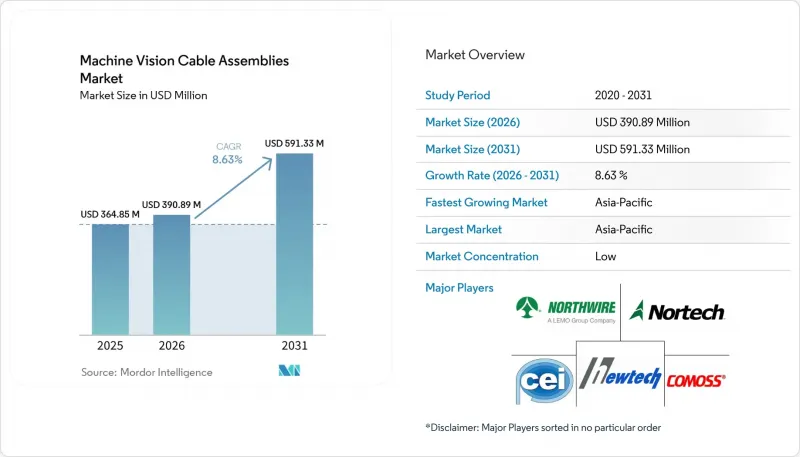
According to Mordor Intelligence, the machine vision cable assemblies market size is projected to expand from USD 364.85 million in 2025 to USD 390.89 million in 2026, and to USD 591.33 million by 2031, registering a CAGR of 8.63% between 2026 and 2031.
Global Machine Vision Cable Assemblies Market Trends and Insights
Expansion of High-Speed Machine Vision Interfaces
The CoaXPress Committee stated in July 2026 that v3.0 is expected to support 25 Gbps over coaxial copper and fiber, include CoaXPress over Fiber, and add forward error correction for optical paths. A 4-cable CXP-12 configuration can sustain 50 Gbps of aggregate bandwidth for demanding high-resolution inspection. That requirement can disqualify installed assemblies that do not meet 25 Gbps attenuation profiles. JIIA CXP-001 certification is a key requirement for assemblies specified in the new CoaXPress environment. The Machine Vision Cable Assemblies Market, therefore, has a tighter replacement window than a typical product upgrade because certification and performance requirements change together. Assemblers that already work within the JIIA standards framework can have an advantage while other suppliers complete their qualification.
Growth of Automated Inspection and Smart Factories
Cognex stated in May 2026 that more than 100 manufacturers moved from single-line artificial intelligence vision pilots to multi-site rollouts during the OneVision beta period. A rollout across multiple lines raises the number of camera connections, trigger cables, and interface assemblies compared with a single installation. The Machine Vision Cable Assemblies Market benefits when inspection programs move from pilot systems to standard equipment across facilities. Connected factory systems also increase the importance of cable specifications and documented performance. These requirements can favor specialty assemblers over suppliers of general industrial cable. The effect is not limited to the initial order; replacement, line expansion, and maintenance can continue after the first deployment.
High Migration Cost From Legacy Cabling
A production line moving from Camera Link to CoaXPress may need new frame grabbers, cable assemblies, and software validation. PCIe frame grabbers can cost USD 3,000-8,000 per slot, making the conversion difficult for smaller manufacturers. Automotive and medical device users can also need process requalification under IATF 16949 or FDA 21 CFR Part 820. Existing cells may reveal conduit constraints, controller firmware issues, or inadequate cable management after the project begins. These conditions are more common in North America and Europe, where the installed base of Camera Link is significant. The result is usually delayed demand rather than permanent cancellation, with upgrades shifting to a later purchase period.
Other drivers and restraints analyzed in the detailed report include:
- Rising Multi-Camera and High-Resolution Imaging Deployments
- Increasing Demand for High-Flex Robotic Cabling
- Bandwidth, Distance, EMI, and Flex-Life Tradeoffs
For complete list of drivers and restraints, kindly check the Table Of Contents.
Segment Analysis
GigE Vision and 10 GigE Vision accounted for the largest interface-type share at 34.81% in 2025. The installed Ethernet infrastructure supports additional inspection points without a full network replacement. Camera Link and Camera Link HS remain relevant for wafer metrology and continuous web inspection. USB3 Vision serves compact and cost-sensitive deployments. Legacy interfaces still create replacement demand where a full system change lacks a clear cost benefit.
CoaXPress is projected to expand at an 11.27% CAGR from 2026 to 2031 in the Machine Vision Cable Assemblies Industry. It supports high-megapixel tasks that are moving away from multi-cable Camera Link configurations. Basler identifies CoaXPress as an industrial camera interface with high transfer rates and stable connections. CoaXPress over Fiber can support long-reach and multi-camera applications under the v3.0 framework. JIIA compliance directs demand toward certified suppliers in the Machine Vision Cable Assemblies Market.
Copper cable assemblies led cable media with 38.57% share in 2025. Their position reflects power delivery capability and compatibility with GigE Vision and Camera Link installations. Coaxial assemblies serve CoaXPress systems requiring high-speed image transfer. Hybrid products pair fiber data transmission with copper power delivery. The use of copper, coaxial, hybrid, and fiber options reflects a gradual transition in technology.
Fiber-optic assemblies are projected to expand at an 11.73% CAGR from 2026 to 2031. The JIIA CoaXPress over Fiber v1.1 standard supports 40 Gbps over a single QSFP+ transceiver for up to 120 km, compared with 40 m over copper. Fiber avoids electromagnetic interference from motors and variable-frequency drives. Nortech Systems launched its Power over Fiber platform in April 2026 for camera, actuator, and sensor applications. The Machine Vision Cable Assemblies Market can therefore see demand for optical and hybrid cable assemblies rise in high-performance installations.
Complete Report Scope:
- By Interface Type
- Camera Link and Camera Link HS
- CoaXPress
- USB3 Vision
- GigE Vision and 10 GigE Vision
- Legacy Interfaces
- By Cable Media
- Copper Cable Assemblies
- Coaxial Cable Assemblies
- Fiber-Optic Cable Assemblies
- Hybrid Copper-Fiber Cable Assemblies
- By Cable Construction
- Static and Fixed-Installation Cable Assemblies
- High-Flex Cable Assemblies
- Continuous-Flex and Drag-Chain Cable Assemblies
- Torsion-Resistant Robotic Cable Assemblies
- Armored and Harsh-Environment Cable Assemblies
- By End-User Industry
- Automotive
- Semiconductor and Electronics
- Pharmaceutical and Medical Device
- Food and Beverage
- General Manufacturing and Industrial Machinery
- Logistics, Packaging and Transportation
- Other End-User Industries
- By Geography
- North America
- United States
- Canada
- Mexico
- South America
- Brazil
- Argentina
- Rest of South America
- Europe
- Germany
- United Kingdom
- France
- Italy
- Spain
- Rest of Europe
- Asia-Pacific
- China
- Japan
- India
- South Korea
- Rest of Asia-Pacific
- Middle East and Africa
- Middle East
- Saudi Arabia
- United Arab Emirates
- Turkey
- Rest of the Middle East
- Africa
- South Africa
- Nigeria
- Rest of Africa
- Middle East
- North America
Geography Analysis
Asia-Pacific accounted for 38.93% of the Machine Vision Cable Assemblies Market share in 2025 and is projected to expand at an 11.47% CAGR through 2031. China's Yangtze River Delta supports EV battery assembly and semiconductor backend packaging. South Korea and Taiwan use high-bandwidth CoaXPress and multi-camera GigE products in front-end semiconductor inspection. Japan's incentives and China's smart-manufacturing standards can shorten adoption timelines. India adds demand through smartphone display inspection and EV module assembly.
Europe is the second-largest regional market, supported by German automotive and machine-tool production. Digitalization programs, labor constraints, and scrap-reduction needs are driving the adoption of inspection automation. Germany's supplier network drives demand for CoaXPress and high-flex cable assemblies in EV battery and ADAS printed circuit board inspection. VDMA stated that German automation revenue is expected to decline 5% to EUR 14.1 billion (USD 15.8 billion) in 2026. Italy, France, the United Kingdom, and Spain add demand from pharmaceutical machinery, food processing, and logistics sorting.
North America has a mature base where interface upgrades outweigh greenfield installations. The United States hosts OEMs whose procurement specifications influence cable requirements throughout the supply chain. Canada and Mexico support automotive production with IATF 16949-aligned inspection practices. South America centers on Brazilian automotive and agricultural machinery inspection, while the Middle East and Africa are early-stage opportunities in food-processing and construction-materials inspection.
- 3M Company
- Alysium-Tech GmbH
- Components Express, Inc.
- Comoss Electronics Co., Ltd.
- Donghoo Tech Co., Limited
- Farsince Technology Co., Ltd.
- Hirakawa Hewtech Corp.
- HTK Europe
- Koincable Technology Co., Ltd.
- L-com, Inc.
- Link Srl
- Nemal Electronics, Inc.
- Newnex Technology Corporation
- Northwire, Inc.
- Oki Electric Cable Co., Ltd.
- Phase 1 Vision
- TKM Technologies, Inc.
- UniBrain Co., Ltd.
- Wanshih Electronic Co., Ltd.
- Nortech Systems, Incorporated
- Circuit Assembly Corporation
- IO Industries Inc.
- Optronis GmbH
- Mikrotron GmbH
Additional Benefits:
- The market estimate (ME) sheet in Excel format
- 3 months of analyst support
TABLE OF CONTENTS
1 INTRODUCTION
- 1.1 Study Assumptions and Market Definition
- 1.2 Scope of the Study
2 RESEARCH METHODOLOGY
3 EXECUTIVE SUMMARY
4 MARKET LANDSCAPE
- 4.1 Market Overview
- 4.2 Market Drivers
- 4.2.1 Expansion of High-Speed Machine Vision Interfaces
- 4.2.2 Growth of Automated Inspection and Smart Factories
- 4.2.3 Rising Multi-Camera and High-Resolution Imaging Deployments
- 4.2.4 Increasing Demand for High-Flex Robotic Cabling
- 4.2.5 Interface-Dense Retrofit Demand in Legacy Production Lines
- 4.2.6 Increasing Use of Long-Reach Optical and Hybrid Vision Links
- 4.3 Market Restraints
- 4.3.1 High Migration Cost From Legacy Cabling
- 4.3.2 Bandwidth, Distance, EMI, and Flex-Life Tradeoffs
- 4.3.3 Cable Qualification and Compliance Burden
- 4.3.4 Limited Standardization Across Camera, Frame Grabber, and Controller Ecosystems
- 4.4 Impact of Macroeconomic Factors on the Market
- 4.5 Industry Supply-Chain Analysis
- 4.6 Technology Outlook
- 4.7 Regulatory Landscape
- 4.8 Porter's Five Forces Analysis
- 4.8.1 Threat of New Entrants
- 4.8.2 Bargaining Power of Suppliers
- 4.8.3 Bargaining Power of Buyers
- 4.8.4 Threat of Substitutes
- 4.8.5 Intensity of Competitive Rivalry
5 MARKET SIZE AND GROWTH FORECASTS (VALUE)
- 5.1 By Interface Type
- 5.1.1 Camera Link and Camera Link HS
- 5.1.2 CoaXPress
- 5.1.3 USB3 Vision
- 5.1.4 GigE Vision and 10 GigE Vision
- 5.1.5 Legacy Interfaces
- 5.2 By Cable Media
- 5.2.1 Copper Cable Assemblies
- 5.2.2 Coaxial Cable Assemblies
- 5.2.3 Fiber-Optic Cable Assemblies
- 5.2.4 Hybrid Copper-Fiber Cable Assemblies
- 5.3 By Cable Construction
- 5.3.1 Static and Fixed-Installation Cable Assemblies
- 5.3.2 High-Flex Cable Assemblies
- 5.3.3 Continuous-Flex and Drag-Chain Cable Assemblies
- 5.3.4 Torsion-Resistant Robotic Cable Assemblies
- 5.3.5 Armored and Harsh-Environment Cable Assemblies
- 5.4 By End-User Industry
- 5.4.1 Automotive
- 5.4.2 Semiconductor and Electronics
- 5.4.3 Pharmaceutical and Medical Device
- 5.4.4 Food and Beverage
- 5.4.5 General Manufacturing and Industrial Machinery
- 5.4.6 Logistics, Packaging and Transportation
- 5.4.7 Other End-User Industries
- 5.5 By Geography
- 5.5.1 North America
- 5.5.1.1 United States
- 5.5.1.2 Canada
- 5.5.1.3 Mexico
- 5.5.2 South America
- 5.5.2.1 Brazil
- 5.5.2.2 Argentina
- 5.5.2.3 Rest of South America
- 5.5.3 Europe
- 5.5.3.1 Germany
- 5.5.3.2 United Kingdom
- 5.5.3.3 France
- 5.5.3.4 Italy
- 5.5.3.5 Spain
- 5.5.3.6 Rest of Europe
- 5.5.4 Asia-Pacific
- 5.5.4.1 China
- 5.5.4.2 Japan
- 5.5.4.3 India
- 5.5.4.4 South Korea
- 5.5.4.5 Rest of Asia-Pacific
- 5.5.5 Middle East and Africa
- 5.5.5.1 Middle East
- 5.5.5.1.1 Saudi Arabia
- 5.5.5.1.2 United Arab Emirates
- 5.5.5.1.3 Turkey
- 5.5.5.1.4 Rest of the Middle East
- 5.5.5.2 Africa
- 5.5.5.2.1 South Africa
- 5.5.5.2.2 Nigeria
- 5.5.5.2.3 Rest of Africa
- 5.5.5.1 Middle East
- 5.5.1 North America
6 COMPETITIVE LANDSCAPE
- 6.1 Market Concentration
- 6.2 Strategic Moves
- 6.3 Market Share Analysis
- 6.4 Company Profiles (includes Global Level Overview, Market Level Overview, Core Segments, Financials as available, Strategic Information, Market RankandShare, Products and Services, Recent Developments)
- 6.4.1 3M Company
- 6.4.2 Alysium-Tech GmbH
- 6.4.3 Components Express, Inc.
- 6.4.4 Comoss Electronics Co., Ltd.
- 6.4.5 Donghoo Tech Co., Limited
- 6.4.6 Farsince Technology Co., Ltd.
- 6.4.7 Hirakawa Hewtech Corp.
- 6.4.8 HTK Europe
- 6.4.9 Koincable Technology Co., Ltd.
- 6.4.10 L-com, Inc.
- 6.4.11 Link Srl
- 6.4.12 Nemal Electronics, Inc.
- 6.4.13 Newnex Technology Corporation
- 6.4.14 Northwire, Inc.
- 6.4.15 Oki Electric Cable Co., Ltd.
- 6.4.16 Phase 1 Vision
- 6.4.17 TKM Technologies, Inc.
- 6.4.18 UniBrain Co., Ltd.
- 6.4.19 Wanshih Electronic Co., Ltd.
- 6.4.20 Nortech Systems, Incorporated
- 6.4.21 Circuit Assembly Corporation
- 6.4.22 IO Industries Inc.
- 6.4.23 Optronis GmbH
- 6.4.24 Mikrotron GmbH
7 MARKET OPPORTUNITIES AND FUTURE OUTLOOK
- 7.1 White-Space and Unmet-Need Assessment

