PUBLISHER: Mordor Intelligence | PRODUCT CODE: 2163407

PUBLISHER: Mordor Intelligence | PRODUCT CODE: 2163407
Optical Coherence Tomography For Industrial Inspection - Market Share Analysis, Industry Trends & Statistics, Growth Forecasts (2026 - 2031)
According to Mordor Intelligence, the optical coherence tomography for Industrial Inspection Market size is projected to expand from USD 0.58 billion in 2025 to USD 0.64 billion in 2026, and to USD 1.09 billion by 2031, registering a CAGR of 11.24% between 2026 and 2031.
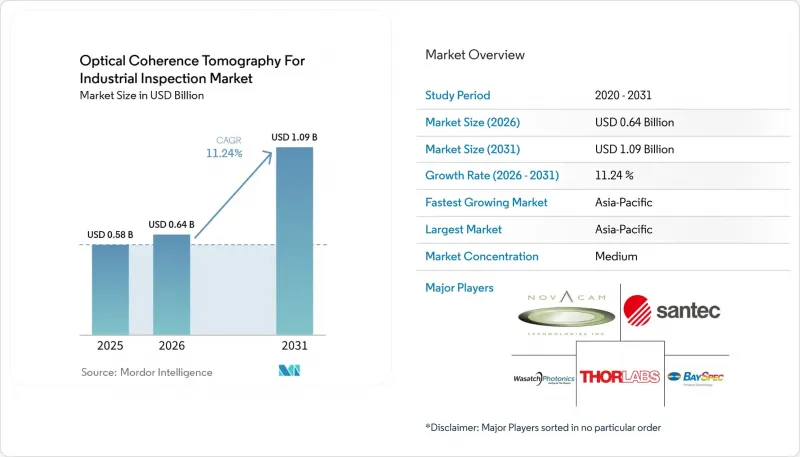
Global Optical Coherence Tomography For Industrial Inspection Market Trends and Insights
Semiconductor and Advanced Packaging Complexity
The Optical Coherence Tomography for Industrial Inspection Market benefits from the growing need for tighter inspection in 3D integrated circuits and advanced packaging. Hybrid bonding, fan-out wafer-level packaging, and multi-die stacks require close control of through-silicon vias and micro-bump connections. Conventional optical metrology can struggle when these structures require fast measurement at shallow depths. A 2026 chip-based swept-source OCT prototype measured wafer thickness with absolute errors below 2 µm and scanned without contact at a speed 11,000 times faster than contact profilometry. The result matters because contact methods can deform photoresist and contaminate active die surfaces. Bonding-interface inspection also has value when delamination below 20 µm passes electrical testing but later causes failures under thermal cycling.
Inline Quality Control and Industry 4.0 Integration
The Optical Coherence Tomography for Industrial Inspection Market is supported by manufacturers that need production data while parts are still on the line. OCT can provide micrometer-scale, subsurface images for immediate process feedback rather than relying on offline samples. A 2025 line-field spectral-domain OCT system reached 1,470 kHz scan rates and 100.2 dB sensitivity across an 8X8X2.7 mm volume in less than 1 second. This performance supports conveyor-speed inspection for display lamination, pharmaceutical coatings, and printed electronics. FPGA and GPU processing can turn the output into a defect flag in milliseconds. ISO/TC 261's work on additive manufacturing inspection also helps reduce validation uncertainty for new industrial users.
Limited Penetration in Opaque and Highly Scattering Materials
The Optical Coherence Tomography for Industrial Inspection Market faces physical depth limits in metals, carbon-fiber composites, and opaque coatings. OCT depends on ballistic photons, and scattering reduces the signal available from deeper layers. Near-infrared systems work well with polymers and glass but become less reliable in heavily pigmented substrates. The 2026 wind-turbine coating study found that near-infrared OCT could not image through primer layers that mid-infrared OCT penetrated. Mid-infrared OCT addresses this limitation but requires more complex sources, detectors, and laser-safety systems. Until those components become more accessible, users inspecting metal and high-scattering materials may continue to select laser ultrasonics or phased-array ultrasound.
Other drivers and restraints analyzed in the detailed report include:
- Non-Destructive Inspection of Multilayer Materials
- Coaxial OCT Monitoring of Laser Welding and Additive Manufacturing
- High System Integration and Application-Engineering Cost
For complete list of drivers and restraints, kindly check the Table Of Contents.
Segment Analysis
Swept-source OCT captured 46.38% of the Optical Coherence Tomography for Industrial Inspection Market share within technology revenue in 2025. Its long coherence length, low-sensitivity roll-off, and A-scan rates above 50 kHz enable inspection of multilayer coatings and adhesive bonds at production speeds. Spectral-domain OCT remains competitive for high-resolution, shallow-depth uses. Thorlabs reported axial resolution below 3.4 µm in air and A-scan rates up to 146 kHz for its Telesto(R) platform in July 2026. These capabilities suit printed circuit board coatings, wafer surfaces, and thin-film displays.
Polarization-sensitive OCT is projected to expand at a 13.84% CAGR through 2031, the highest rate among the technology categories. It measures birefringence using phase retardation and Stokes-vector analysis, helping users identify subsurface stress defects and microcracks. A 2025 polarization-multiplexed method achieved 33-45 dB artifact suppression in multilayer LCD imaging with orthogonally polarized reference beams. This method can serve foldable-display adhesives and smart-glass multilayers that need layer discrimination below 30 µm. Full-field OCT is gaining use in MEMS and mask inspection, while time-domain OCT remains relevant where 4-8 mm imaging depth outweighs speed.
Signal processing and control units accounted for 24.67% of the Optical Coherence Tomography for Industrial Inspection Market component revenue in 2025. FPGA and GPU architectures process image data at production speeds, while AI modules and closed-loop software can convert OCT into a process-control tool. Interferometers, fiber assemblies, scanning systems, and probes provide beam handling and positioning in industrial settings. Detectors, cameras, and spectrometers establish core sensitivity and speed limits. These components collectively determine platform suitability for each production environment.
Light sources are expected to expand at a 13.52% CAGR through 2031 as suppliers move toward swept-source and mid-infrared systems. The shift increases demand for tunable and supercontinuum sources for the inspection of polymer, composite, ceramic, and optoelectronic semiconductor materials. SuperLight Photonics introduced the SLP-1050 in January 2025 with 1,700-2,500 nm coverage and 2.75 µm axial resolution. Thorlabs demonstrated a MEMS VCSEL swept-source laser with selectable rates up to 400 kHz and imaging depth up to 38 mm. A 0.36 mm2 chip-based engine indicates a route toward smaller modules and a different component revenue mix.
Complete Report Scope:
- By Technology
- Time-Domain OCT
- Spectral-Domain OCT
- Swept-Source OCT
- Full-Field OCT
- Polarization-Sensitive OCT
- By Component
- Light Sources
- Interferometers and Fiber Assemblies
- Detectors and Cameras
- OCT Spectrometers
- Scanning Systems and Optical Probes
- Signal Processing and Control Units
- By Application
- Layer and Coating Thickness Measurement
- Internal Defect and Void Detection
- Surface Profiling and 3D Metrology
- Weld Penetration and Process Monitoring
- Seal, Bond, and Adhesive Inspection
- Material Characterization
- Microfluidic and Flow Measurement
- By End-User Industry
- Semiconductor and Advanced Electronics Manufacturing
- Automotive and Electric Vehicles
- Aerospace and Defense
- Additive Manufacturing
- Packaging, Films, and Printing
- Plastics, Composites, and Ceramics
- Pharmaceuticals and Medical Devices
- Solar and Energy Equipment
- Research Laboratories and Contract Testing
- Other End-User Industries
- By Geography
- North America
- United States
- Canada
- Mexico
- South America
- Brazil
- Argentina
- Rest of South America
- Europe
- Germany
- United Kingdom
- France
- Italy
- Spain
- Rest of Europe
- Asia-Pacific
- China
- Japan
- India
- South Korea
- Rest of Asia-Pacific
- Middle East and Africa
- Middle East
- Saudi Arabia
- United Arab Emirates
- Turkey
- Rest of the Middle East
- Africa
- South Africa
- Nigeria
- Rest of Africa
- Middle East
- North America
Geography Analysis
Asia-Pacific held 43.76% of the Optical Coherence Tomography for Industrial Inspection Market share in 2025 and is projected to expand at a 13.19% CAGR through 2031. The region encompasses semiconductor, display, and electric-vehicle battery production across South Korea, Japan, and China. South Korea generates demand for swept-source and spectral-domain OCT in layer inspection and surface profiling. Japan has an established supply base, and Santec displayed its Quantum OCT system at Expo 2025 Osaka in March 2025. China adds volume demand through semiconductor packaging and electric vehicle battery manufacturing.
North America and Europe are the second- and third-largest geographic blocks in the Optical Coherence Tomography for Industrial Inspection Market in 2026, respectively. The United States supports demand through semiconductor packaging and aerospace composite inspection. Canada-based Novacam Technologies Inc. makes swept-source OCT profilometry systems for aerospace, automotive, power generation, and electronics. Germany leads European use in automotive laser-welding monitoring and pharmaceutical coating inspection. France and the United Kingdom have aerospace composite programs where OCT is gaining use alongside ultrasonic inspection.
South America is at an earlier stage in the Optical Coherence Tomography for Industrial Inspection Market and is supplied largely with imported systems for pharmaceutical packaging and precision machining. The Middle East and Africa are the smallest regional blocks in 2026, although Saudi Arabia and the United Arab Emirates are investing in advanced manufacturing. South Africa's automotive sector is the most immediate industrial OCT opportunity on the continent. Limited local application engineering capacity constrains adoption across South America, the Middle East, and Africa.
- Santec Holdings Corporation
- Wasatch Photonics, Inc.
- Ibsen Photonics A/S
- KineoLabs, Inc.
- SuperLight Photonics ApS
- Clairvo Medical Co., Ltd.
- Lumedica, Inc.
- OptoRes GmbH
- OCT Imaging, Inc.
- BaySpec, Inc.
- I-Wave Corporation
- Tatsuta Electric Wire and Cable Co., Ltd.
- NKT Photonics A/S
- Menlo Systems GmbH
- Thorlabs, Inc.
- Novacam Technologies Inc.
- Lyncee Tec SA
- Wasatch Photonics Europe GmbH
- Optovue, Inc.
- Michelson Diagnostics Limited
Additional Benefits:
- The market estimate (ME) sheet in Excel format
- 3 months of analyst support
TABLE OF CONTENTS
1 INTRODUCTION
- 1.1 Study Assumptions and Market Definition
- 1.2 Scope of the Study
2 RESEARCH METHODOLOGY
3 EXECUTIVE SUMMARY
4 MARKET LANDSCAPE
- 4.1 Market Overview
- 4.2 Market Drivers
- 4.2.1 Semiconductor and Advanced Packaging Complexity
- 4.2.2 Inline Quality Control and Industry 4.0 Integration
- 4.2.3 Non-Destructive Inspection of Multilayer Materials
- 4.2.4 Coaxial OCT Monitoring of Laser Welding and Additive Manufacturing
- 4.2.5 OCT-Enabled Inspection of Contoured Composite Structures
- 4.2.6 Compact Line-Scan Engines Lowering OEM Integration Barriers
- 4.3 Market Restraints
- 4.3.1 Limited Penetration in Opaque and Highly Scattering Materials
- 4.3.2 High System Integration and Application-Engineering Cost
- 4.3.3 Limited Industrial Training Data for Defect Classification
- 4.3.4 Customer Validation Delays Caused by Process-Specific Calibration
- 4.4 Impact of Macroeconomic Factors on the Market
- 4.5 Industry Supply-Chain Analysis
- 4.6 Technology Outlook
- 4.7 Regulatory Landscape
- 4.8 Porter's Five Forces Analysis
- 4.8.1 Threat of New Entrants
- 4.8.2 Bargaining Power of Suppliers
- 4.8.3 Bargaining Power of Buyers
- 4.8.4 Threat of Substitutes
- 4.8.5 Intensity of Competitive Rivalry
5 MARKET SIZE AND GROWTH FORECASTS (VALUE)
- 5.1 By Technology
- 5.1.1 Time-Domain OCT
- 5.1.2 Spectral-Domain OCT
- 5.1.3 Swept-Source OCT
- 5.1.4 Full-Field OCT
- 5.1.5 Polarization-Sensitive OCT
- 5.2 By Component
- 5.2.1 Light Sources
- 5.2.2 Interferometers and Fiber Assemblies
- 5.2.3 Detectors and Cameras
- 5.2.4 OCT Spectrometers
- 5.2.5 Scanning Systems and Optical Probes
- 5.2.6 Signal Processing and Control Units
- 5.3 By Application
- 5.3.1 Layer and Coating Thickness Measurement
- 5.3.2 Internal Defect and Void Detection
- 5.3.3 Surface Profiling and 3D Metrology
- 5.3.4 Weld Penetration and Process Monitoring
- 5.3.5 Seal, Bond, and Adhesive Inspection
- 5.3.6 Material Characterization
- 5.3.7 Microfluidic and Flow Measurement
- 5.4 By End-User Industry
- 5.4.1 Semiconductor and Advanced Electronics Manufacturing
- 5.4.2 Automotive and Electric Vehicles
- 5.4.3 Aerospace and Defense
- 5.4.4 Additive Manufacturing
- 5.4.5 Packaging, Films, and Printing
- 5.4.6 Plastics, Composites, and Ceramics
- 5.4.7 Pharmaceuticals and Medical Devices
- 5.4.8 Solar and Energy Equipment
- 5.4.9 Research Laboratories and Contract Testing
- 5.4.10 Other End-User Industries
- 5.5 By Geography
- 5.5.1 North America
- 5.5.1.1 United States
- 5.5.1.2 Canada
- 5.5.1.3 Mexico
- 5.5.2 South America
- 5.5.2.1 Brazil
- 5.5.2.2 Argentina
- 5.5.2.3 Rest of South America
- 5.5.3 Europe
- 5.5.3.1 Germany
- 5.5.3.2 United Kingdom
- 5.5.3.3 France
- 5.5.3.4 Italy
- 5.5.3.5 Spain
- 5.5.3.6 Rest of Europe
- 5.5.4 Asia-Pacific
- 5.5.4.1 China
- 5.5.4.2 Japan
- 5.5.4.3 India
- 5.5.4.4 South Korea
- 5.5.4.5 Rest of Asia-Pacific
- 5.5.5 Middle East and Africa
- 5.5.5.1 Middle East
- 5.5.5.1.1 Saudi Arabia
- 5.5.5.1.2 United Arab Emirates
- 5.5.5.1.3 Turkey
- 5.5.5.1.4 Rest of the Middle East
- 5.5.5.2 Africa
- 5.5.5.2.1 South Africa
- 5.5.5.2.2 Nigeria
- 5.5.5.2.3 Rest of Africa
- 5.5.5.1 Middle East
- 5.5.1 North America
6 COMPETITIVE LANDSCAPE
- 6.1 Market Concentration
- 6.2 Strategic Moves
- 6.3 Market Share Analysis
- 6.4 Company Profiles (includes Global Level Overview, Market Level Overview, Core Segments, Financials as available, Strategic Information, Market RankandShare, Products and Services, Recent Developments)
- 6.4.1 Santec Holdings Corporation
- 6.4.2 Wasatch Photonics, Inc.
- 6.4.3 Ibsen Photonics A/S
- 6.4.4 KineoLabs, Inc.
- 6.4.5 SuperLight Photonics ApS
- 6.4.6 Clairvo Medical Co., Ltd.
- 6.4.7 Lumedica, Inc.
- 6.4.8 OptoRes GmbH
- 6.4.9 OCT Imaging, Inc.
- 6.4.10 BaySpec, Inc.
- 6.4.11 I-Wave Corporation
- 6.4.12 Tatsuta Electric Wire and Cable Co., Ltd.
- 6.4.13 NKT Photonics A/S
- 6.4.14 Menlo Systems GmbH
- 6.4.15 Thorlabs, Inc.
- 6.4.16 Novacam Technologies Inc.
- 6.4.17 Lyncee Tec SA
- 6.4.18 Wasatch Photonics Europe GmbH
- 6.4.19 Optovue, Inc.
- 6.4.20 Michelson Diagnostics Limited
7 MARKET OPPORTUNITIES AND FUTURE OUTLOOK
- 7.1 White-Space and Unmet-Need Assessment

