PUBLISHER: Mordor Intelligence | PRODUCT CODE: 2163457

PUBLISHER: Mordor Intelligence | PRODUCT CODE: 2163457
North Africa Poultry Meat - Market Share Analysis, Industry Trends & Statistics, Growth Forecasts (2026 - 2031)
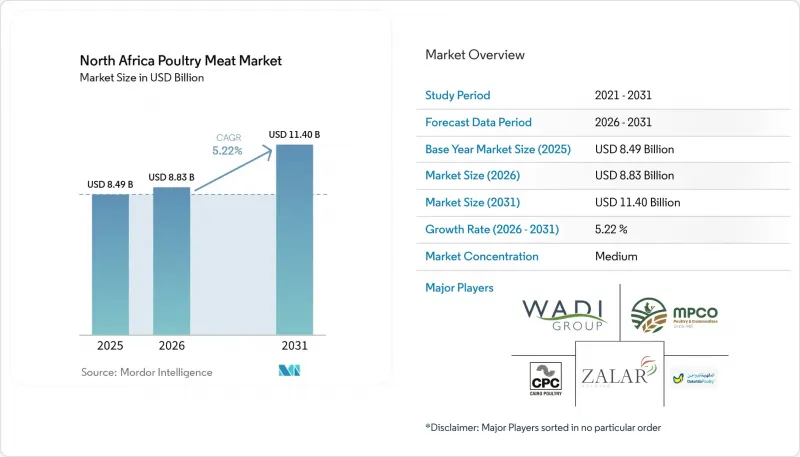
According to Mordor Intelligence, the North Africa poultry meat market size is expected to grow from USD 8.49 billion in 2025 to USD 8.83 billion in 2026 and is forecast to reach USD 11.40 billion by 2031 at a 5.22% CAGR over 2026-2031.
North Africa Poultry Meat Market Trends and Insights
Growing Consumption of Affordable Poultry Protein
The growing preference for poultry as an affordable source of animal protein continues to support the North Africa poultry meat market, driven by its cost advantage and favorable nutritional profile compared to other meat types. According to the Organisation for Economic Co-operation and Development (OECD) and Food and Agriculture Organization (FAO) Agricultural Outlook 2025-2034, global poultry consumption is projected to increase by approximately 21% by 2034, the highest growth among all major meat categories. The Outlook further projects that poultry will account for 62% of the additional meat consumed globally over the forecast period. Africa's meat consumption is expected to increase by 33% over the next decade, reflecting sustained regional demand for animal protein, with poultry expected to remain a key beneficiary due to its affordability. Additionally, poultry is projected to provide 45% of all protein consumed from meat sources globally by 2034, reinforcing its position as the most accessible animal protein for consumers.
Increasing Investment in Poultry Farming Technologies and Production Efficiency
Growing investment in poultry farming technologies and production efficiency is supporting the growth of the North Africa poultry meat market by improving the productivity and competitiveness of commercial poultry operations. Producers are increasingly adopting climate-controlled poultry houses, automated feeding and watering systems, precision nutrition, and improved flock management practices to optimize production performance and reduce operational losses. Advancements in poultry genetics and modern production techniques are also contributing to improved feed conversion efficiency, bird health, and production consistency. These investments are enabling poultry producers to improve operational efficiency while meeting the region's rising demand for poultry meat.
Feed Grain Import Dependence and Cost Volatility
Dependence on imported feed grains continues to restrain the growth of the North Africa poultry meat market by exposing producers to fluctuations in global commodity prices and supply chain disruptions. Poultry production in the region relies heavily on imported maize and soybean meal, which account for a significant share of overall production costs. Volatility in international feed grain markets can increase input costs, reduce producer margins, and create pricing uncertainty across the poultry value chain. These challenges are particularly significant for small and medium-sized producers with limited capacity to absorb rising feed costs or secure long-term supply contracts.
Other drivers and restraints analyzed in the detailed report include:
- Expansion of Modern Retail and Quick-Service Restaurant (QSR) Networks
- Government Support for Domestic Poultry Production and Food Security
- Avian Influenza Outbreaks and Biosecurity Challenges
For complete list of drivers and restraints, kindly check the Table Of Contents.
Segment Analysis
Chicken accounted for 74.55% of the North Africa poultry meat market by value in 2025, making it the largest product segment. This dominance is supported by its affordability, widespread consumer acceptance, and well-established production and distribution infrastructure across the region. Extensive commercial farming operations, integrated supply chains, and broad availability through retail and foodservice channels continue to strengthen chicken's market position. Its versatility across fresh, frozen, and processed product formats further contributes to sustained demand.
Turkey is projected to register the fastest CAGR of 6.05% during 2026-2031. Growth is supported by increasing consumer interest in diversified poultry products, expanding commercial turkey farming, and gradual improvements in breeding and production capabilities across the region. Government initiatives to strengthen domestic white meat production and investments in integrated poultry operations are also supporting the segment's expansion. Rising availability of turkey meat through organized retail and foodservice channels is expected to further drive market growth over the forecast period.
Complete Report Scope:
- By Product Type
- Chicken
- Turkey
- Others
- By Form
- Fresh/Chilled
- Frozen
- Canned
- Processed
- Nuggets
- Deli Meats
- Sausages
- Tenders/Marinated
- Meatballs
- Others
- By Distribution Channel
- On-Trade
- Hotels
- Restaurants
- Catering
- Off-Trade
- Supermarkets/Hypermarkets
- Convenience Stores
- Online Retail Channel
- Other Distribution Channel
- On-Trade
- By Geography
- Morocco
- Egypt
- Algeria
- Rest of North Africa
List of Companies Covered in this Report:
- Cairo Poultry Company
- Mansoura Poultry Company
- Dakahlia Poultry
- Wadi Group
- Al Fath Company
- Samy Ayed Group
- Zalar Holding
- Samrane Groupe Avicole
- Koutoubia Holding
- Mohemmane family group
- Dar El Fellous
- Diana Holding
- Maroc Dawajine
- Doux Maroc
- Les Grands Pres
- Pyramids Poultry
- Cairo 3A Poultry
- EIT-Montrade
- Cargill
- Elabed Meat & Poultry Co.
Additional Benefits:
- The market estimate (ME) sheet in Excel format
- 3 months of analyst support
TABLE OF CONTENTS
1 INTRODUCTION
- 1.1 Study Assumptions and Market Definition
- 1.2 Scope of the Study
2 RESEARCH METHODOLOGY
3 EXECUTIVE SUMMARY
4 MARKET LANDSCAPE
- 4.1 Market Overview
- 4.2 Market Drivers
- 4.2.1 Growing consumption of affordable poultry protein
- 4.2.2 Increasing investment in poultry farming technologies and production efficiency
- 4.2.3 Expansion of modern retail and quick-service restaurant (QSR) networks
- 4.2.4 Government support for domestic poultry production and food security
- 4.2.5 Expansion of cold-chain infrastructure and poultry processing capacity
- 4.2.6 Strengthening food safety standards and supply chain formalization
- 4.3 Market Restraints
- 4.3.1 Feed grain import dependence and cost volatility
- 4.3.2 Avian influenza outbreaks and biosecurity challenges
- 4.3.3 Power, water, and logistics constraints across poultry supply chains
- 4.3.4 High dependence on imported breeding stock and veterinary inputs
- 4.4 Supply Chain Analysis
- 4.5 Regulatory Landscape
- 4.6 Porter's Five Forces Analysis
- 4.6.1 Threat of New Entrants
- 4.6.2 Bargaining Power of Suppliers
- 4.6.3 Bargaining Power of Buyers
- 4.6.4 Threat of Substitutes
- 4.6.5 Industry Rivalry
5 MARKET SIZE AND GROWTH FORECASTS (VALUE AND VOLUME)
- 5.1 By Product Type
- 5.1.1 Chicken
- 5.1.2 Turkey
- 5.1.3 Others
- 5.2 By Form
- 5.2.1 Fresh/Chilled
- 5.2.2 Frozen
- 5.2.3 Canned
- 5.2.4 Processed
- 5.2.4.1 Nuggets
- 5.2.4.2 Deli Meats
- 5.2.4.3 Sausages
- 5.2.4.4 Tenders/Marinated
- 5.2.4.5 Meatballs
- 5.2.4.6 Others
- 5.3 By Distribution Channel
- 5.3.1 On-Trade
- 5.3.1.1 Hotels
- 5.3.1.2 Restaurants
- 5.3.1.3 Catering
- 5.3.2 Off-Trade
- 5.3.2.1 Supermarkets/Hypermarkets
- 5.3.2.2 Convenience Stores
- 5.3.2.3 Online Retail Channel
- 5.3.2.4 Other Distribution Channel
- 5.3.1 On-Trade
- 5.4 By Geography
- 5.4.1 Morocco
- 5.4.2 Egypt
- 5.4.3 Algeria
- 5.4.4 Rest of North Africa
6 COMPETITIVE LANDSCAPE
- 6.1 Market Concentration
- 6.2 Strategic Moves
- 6.3 Market Share Analysis
- 6.4 Company Profiles (includes Company Highlights, Core Segments, Financials (if available), Strategic Information, Market Share Analysis for key companies, Products, and Recent Developments)
- 6.4.1 Cairo Poultry Company
- 6.4.2 Mansoura Poultry Company
- 6.4.3 Dakahlia Poultry
- 6.4.4 Wadi Group
- 6.4.5 Al Fath Company
- 6.4.6 Samy Ayed Group
- 6.4.7 Zalar Holding
- 6.4.8 Samrane Groupe Avicole
- 6.4.9 Koutoubia Holding
- 6.4.10 Mohemmane family group
- 6.4.11 Dar El Fellous
- 6.4.12 Diana Holding
- 6.4.13 Maroc Dawajine
- 6.4.14 Doux Maroc
- 6.4.15 Les Grands Pres
- 6.4.16 Pyramids Poultry
- 6.4.17 Cairo 3A Poultry
- 6.4.18 EIT-Montrade
- 6.4.19 Cargill
- 6.4.20 Elabed Meat & Poultry Co.
7 MARKET OPPORTUNITIES AND FUTURE OUTLOOK

