PUBLISHER: Mordor Intelligence | PRODUCT CODE: 2163607

PUBLISHER: Mordor Intelligence | PRODUCT CODE: 2163607
Servo Presses - Market Share Analysis, Industry Trends & Statistics, Growth Forecasts (2026 - 2031)
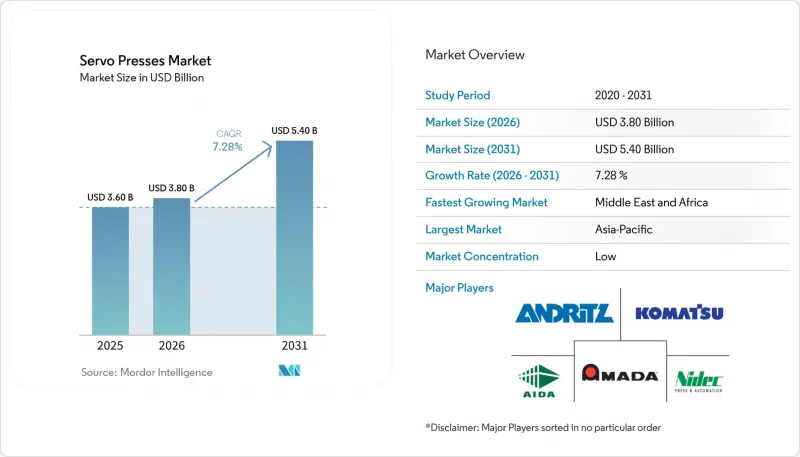
According to Mordor Intelligence, the servo presses market size was valued at USD 3.60 billion in 2025 and is estimated to grow from USD 3.80 billion in 2026 to reach USD 5.40 billion by 2031, at a CAGR of 7.28% during the forecast period (2026-2031).
Global Servo Presses Market Trends and Insights
Energy Efficiency and Lower Total Cost of Ownership
Energy efficiency became a stronger purchase factor in 2025 as industrial electricity costs and carbon reporting requirements increased. Servo systems use power during active forming cycles and can avoid the constant pump losses associated with hydraulic equipment. Tolomatic reported that electromechanical actuators required 4.4 times less energy than hydraulic counterparts in the applications it assessed. In January 2026, ANDRITZ Schuler introduced HFA plus+ fineblanking systems with servo-controlled hydraulic pump drives and double-digit energy efficiency improvements. These operating savings can shorten the payback period for high-use lines and support wider servo presses market adoption.
Automotive Electrification and Lightweight Component Manufacturing
Electric vehicle production requires parts that differ from those used in conventional powertrains. Battery enclosures, aluminum closures, and ultra-high-strength steel structures need motion profiles that can manage spring back and formability. A 25,000 kN heavy-duty servo press study found that post-calibration torque prediction error fell from 7.6% to 1.4% in automotive door-panel production. Servo press lines also reduce power use by 30-45% compared with conventional hydraulic stamping. AIDA Engineering installed a 300 metric ton direct-drive servo press at Wiegel's Silao, Mexico, facility in January 2026 for EV busbars, terminals, lead frames, and connectors. These requirements extend the servo presses market beyond replacement demand.
Higher Upfront Capital Cost
Servo presses cost more than comparable conventional systems because they use precision motors, encoders, regenerative drives, and multi-axis controllers. This difference is a material obstacle for small and medium-sized manufacturers with limited capital budgets. Safety hardware, certification, and integration work add to the purchase cost for some installations. ISO 16092-2:2025 sets safety requirements for mechanical presses, including servo-drive systems. The servo presses market will depend on suppliers proving that lower lifetime operating costs justify the initial premium.
Other drivers and restraints analyzed in the detailed report include:
- Rising Demand for High-Precision Metal Forming
- Industry 4.0 Integration and Traceable Quality Control
- Programming, Commissioning, and Skilled-Labor Requirements
For complete list of drivers and restraints, kindly check the Table Of Contents.
Segment Analysis
Straight-side or H-frame presses held 45% of the servo presses market share in 2025 and are also forecast to grow at an 8.50% CAGR through 2031. Their rigid construction limits angular deflection under eccentric loading. This is important for automotive body panels and heavy-gauge stampings that use multi-point tooling. The segment also recorded the highest projected growth among frame types through 2031. Larger bed sizes and synchronized tandem lines reinforce demand for this configuration in vehicle production.
C-frame or gap-frame presses continue to serve electronics assembly, appliance forming, and medium-tonnage precision work. Column and post-type systems support narrower uses in aerospace, powder compaction, and industrial machinery. Smaller equipment providers can use this demand to address medical and electronics customers. Straight-side systems nevertheless remain the core of the servo presses market size for high-force, high-accuracy applications. Frame selection is closely linked to the loading pattern and the tooling used on a production line. Straight-side systems are suited to work where a long bed, a large die, and stable guidance are needed. This makes them relevant to larger single-piece automotive stampings and tandem-line upgrades. C-frame equipment offers easier access for operators and automation in smaller precision applications. Column and post designs remain suitable where specialized forming conditions take priority over broad production volume.
Servo-mechanical metal forming presses held 48% of the servo presses market in 2025. They are established in high-speed automotive and appliance stamping. Their installed position reflects the need for reliable output in high-volume operations. Servo-hydraulic presses remain relevant for deep drawing and other high-force work. ANDRITZ Schuler's HFA plus+ systems show how servo-controlled hydraulic pump drives can improve efficiency in this category. Hybrid servo presses combine a servo primary drive with hydraulic die cushions for difficult automotive steel grades. The servo presses market industry is separating into high-force production systems and precision assembly systems. Assembly equipment is expanding more quickly as manufacturers add controlled joining and traceable production steps.
Electromechanical or electric servo assembly presses are forecast to grow at 11.6% CAGR through 2031. Battery-module joining, lead-frame forming, medical-device assembly, and connector insertion support this faster growth. Technology also reflects the production environment rather than tonnage alone. High-speed stamping lines require consistent cycle performance and integration with progressive dies. Assembly lines need precise force control so that sensitive components are not damaged during joining. Servo-hydraulic equipment remains valuable where deep drawing and demanding materials require hydraulic force characteristics. Hybrid equipment provides flexibility where a controlled primary stroke and die-cushion support are both needed. This range of choices lets suppliers serve both established stamping plants and newer precision assembly cells. The choice is particularly important when customers want to combine a new press with existing material handling and tooling.
Complete Report Scope:
- By Frame / Structural Configuration
- C-Frame / Gap-Frame Servo Presses
- Straight-Side / H-Frame Servo Presses
- Column / Post-Type Servo Presses
- Other Servo Press Configurations
- By Servo Press Technology / System Type
- Servo-Mechanical Metal Forming Presses
- Electromechanical / Electric Servo Assembly Presses
- Servo-Hydraulic Presses
- Hybrid Servo Presses
- By Press Force / Capacity
- Up to 10 Tons
- Above 10-100 Tons
- Above 100-500 Tons
- Above 500-1,000 Tons
- Above 1,000 Tons
- By Application
- Stamping, Blanking and Punching
- Deep Drawing and Sheet Forming
- Forging and Cold Forming
- Assembly, Press-Fitting and Joining
- Powder Compaction
- Other Precision and Specialized Pressing Applications
- By End User
- Automotive and Transportation
- Electrical and Electronics
- Aerospace and Defense
- Medical and Precision Devices
- Industrial Machinery and General Manufacturing
- Appliances and Consumer Durables
- Other End-Use Industries
- By Geography
- North America
- United States
- Canada
- Mexico
- South America
- Brazil
- Argentina
- Rest of South America
- Europe
- Germany
- Italy
- France
- United Kingdom
- Russia
- Spain
- Rest of Europe
- Asia-Pacific
- China
- Japan
- India
- South Korea
- Taiwan
- ASEAN (Singapore, Malaysia, Indonesia, Thailand, Vietnam, Philippines, Myanmar, Cambodia, Laos, and Brunei)
- Rest of Asia-Pacific
- Middle East and Africa
- Saudi Arabia
- United Arab Emirates
- Turkiye
- South Africa
- Egypt
- Nigeria
- Rest of Middle East and Africa
- North America
Geography Analysis
Asia-Pacific held 52.48% of the servo presses market in 2025. China supports demand through automotive production, electronics manufacturing, and investment in semiconductor capacity. Japan remains important because several servo press OEMs are headquartered there. South Korea and Taiwan add demand from semiconductor, display, and precision-electronics supply chains. Nidec Drive Technology opened a new press-machine assembly factory in Ritto, Shiga Prefecture, on April 15, 2026, doubling domestic capacity from 60 to 120 presses annually and extending maximum machine size from 150 to 330 tons. India, Thailand, Vietnam, and Indonesia also support regional demand as automotive and electronics supply chains expand.
Europe held a significant revenue position in 2025, led by Germany's automotive and Tier 1 supplier base. Italy's precision-mechanics sector and France's aerospace manufacturing base add to regional demand. The EU Machinery Regulation becomes mandatory on January 20, 2027, and supports equipment modernization decisions. ANDRITZ Schuler advanced its HFA plus+ fineblanking offering in January 2026. Fagor Arrasate and Funditec formed Primus Robotics in March 2026 to develop industrial humanoid robots for precision manufacturing. Poland, the Czech Republic, and Hungary add demand as automotive suppliers localize production.
North America recorded consistent demand in 2025, with the United States supported by Midwest automotive stamping, reshoring activity, and electronics assembly. Mexico gained importance in EV and e-mobility supply chains through new component production. The Middle East and Africa are forecast to grow at a 9% CAGR through 2031, the highest regional rate in the supplied research. Saudi industrial diversification, UAE advanced-manufacturing programs, and South African automotive assembly support this outlook. South America maintains demand through Brazil's automotive base, although high interest rates constrained capital spending in 2025. Regional strategies in the servo presses market must match equipment capacity, service coverage, and automation needs to local conditions.
- AIDA Engineering, Ltd.
- ANDRITZ Metals Forming / ANDRITZ Schuler
- Komatsu Industries Corp.
- Nidec Press & Automation (including Minster and ARISA)
- AMADA Group - AMADA PRESS SYSTEM / H&F Corporation
- Fagor Arrasate S. Coop.
- JIER Machine-Tool Group Co., Ltd.
- STAMTEC, Inc.
- SEYI / Shieh Yih Machinery Industry Co., Ltd.
- Chin Fong Machine Industrial Co., Ltd.
- SIMPAC Inc.
- Yangli Group
- Yamada Dobby Co., Ltd.
- Hoden Seimitsu Kako Kenkyusho Co., Ltd.
- Sutherland Presses
- AP&T Group
- ZANI S.p.A.
- TOX PRESSOTECHNIK GmbH & Co. KG
- Promess, Inc.
- Kistler Group
- Janome Corporation - Industrial Equipment
- SCHMIDT Technology GmbH
- Sanyo Machine Works, Ltd.
- ESTIC Corporation
- Dai-ichi Dentsu Ltd.
- CORETEC Inc.
Additional Benefits:
- The market estimate (ME) sheet in Excel format
- 3 months of analyst support
TABLE OF CONTENTS
1 INTRODUCTION
- 1.1 Study Assumptions and Market Definition
- 1.2 Scope of the Study
2 RESEARCH METHODOLOGY
3 EXECUTIVE SUMMARY
4 MARKET LANDSCAPE
- 4.1 Market Overview
- 4.2 Market Drivers
- 4.2.1 Energy Efficiency and Lower Total Cost of Ownership
- 4.2.2 Automotive Electrification and Lightweight Component Manufacturing
- 4.2.3 Rising Demand for High-Precision Metal Forming
- 4.2.4 Industry 4.0 Integration and Traceable Quality Control
- 4.2.5 Growth in Electronics and Precision Component Manufacturing
- 4.2.6 Replacement and Modernization of Conventional Press Installed Base
- 4.3 Market Restraints
- 4.3.1 Higher Upfront Capital Cost
- 4.3.2 Programming, Commissioning, and Skilled-Labor Requirements
- 4.3.3 Long Replacement Cycles for Existing Mechanical and Hydraulic Presses
- 4.3.4 Limitations in Ultra-High-Tonnage Applications
- 4.4 Value / Supply-Chain Analysis
- 4.4.1 Servo Motors, Drives and Control Components
- 4.4.2 Press Frames, Mechanical and Hydraulic Components
- 4.4.3 Servo Press Manufacturing and System Integration
- 4.4.4 Dies, Tooling, Automation, and Robotics Ecosystem
- 4.4.5 Distribution, Installation and Commissioning
- 4.4.6 Aftermarket, Software, Retrofit and Service Ecosystem
- 4.5 Regulatory Landscape
- 4.5.1 Machinery and Press Safety Standards
- 4.5.2 Functional Safety and Operator Protection Requirements
- 4.5.3 Energy Efficiency and Environmental Regulations
- 4.5.4 Industry-Specific Quality and Certification Requirements
- 4.6 Technological Outlook
- 4.6.1 Advanced Servo-Mechanical and Direct-Drive Technologies
- 4.6.2 Electromechanical Precision Press Technologies
- 4.6.3 Servo-Hydraulic and Hybrid Press Technologies
- 4.6.4 Closed-Loop Force, Position and Motion Control
- 4.6.5 Digital Connectivity and IIoT Integration
- 4.6.6 AI-Enabled Process Optimization and Predictive Maintenance
- 4.6.7 Energy Recovery and Regenerative Technologies
- 4.7 Industry and Manufacturing Trends
- 4.7.1 Growth of Flexible and High-Mix Manufacturing
- 4.7.2 Automation and Integrated Press Lines
- 4.7.3 Increasing Demand for Traceable and Precision Pressing
- 4.7.4 Sustainability and Energy-Efficiency Trends
- 4.8 Sustainability and Energy Efficiency
- 4.9 Impact of Geopolitical Developments on the Market
5 MARKET SIZE AND GROWTH FORECASTS
- 5.1 By Frame / Structural Configuration
- 5.1.1 C-Frame / Gap-Frame Servo Presses
- 5.1.2 Straight-Side / H-Frame Servo Presses
- 5.1.3 Column / Post-Type Servo Presses
- 5.1.4 Other Servo Press Configurations
- 5.2 By Servo Press Technology / System Type
- 5.2.1 Servo-Mechanical Metal Forming Presses
- 5.2.2 Electromechanical / Electric Servo Assembly Presses
- 5.2.3 Servo-Hydraulic Presses
- 5.2.4 Hybrid Servo Presses
- 5.3 By Press Force / Capacity
- 5.3.1 Up to 10 Tons
- 5.3.2 Above 10-100 Tons
- 5.3.3 Above 100-500 Tons
- 5.3.4 Above 500-1,000 Tons
- 5.3.5 Above 1,000 Tons
- 5.4 By Application
- 5.4.1 Stamping, Blanking and Punching
- 5.4.2 Deep Drawing and Sheet Forming
- 5.4.3 Forging and Cold Forming
- 5.4.4 Assembly, Press-Fitting and Joining
- 5.4.5 Powder Compaction
- 5.4.6 Other Precision and Specialized Pressing Applications
- 5.5 By End User
- 5.5.1 Automotive and Transportation
- 5.5.2 Electrical and Electronics
- 5.5.3 Aerospace and Defense
- 5.5.4 Medical and Precision Devices
- 5.5.5 Industrial Machinery and General Manufacturing
- 5.5.6 Appliances and Consumer Durables
- 5.5.7 Other End-Use Industries
- 5.6 By Geography
- 5.6.1 North America
- 5.6.1.1 United States
- 5.6.1.2 Canada
- 5.6.1.3 Mexico
- 5.6.2 South America
- 5.6.2.1 Brazil
- 5.6.2.2 Argentina
- 5.6.2.3 Rest of South America
- 5.6.3 Europe
- 5.6.3.1 Germany
- 5.6.3.2 Italy
- 5.6.3.3 France
- 5.6.3.4 United Kingdom
- 5.6.3.5 Russia
- 5.6.3.6 Spain
- 5.6.3.7 Rest of Europe
- 5.6.4 Asia-Pacific
- 5.6.4.1 China
- 5.6.4.2 Japan
- 5.6.4.3 India
- 5.6.4.4 South Korea
- 5.6.4.5 Taiwan
- 5.6.4.6 ASEAN (Singapore, Malaysia, Indonesia, Thailand, Vietnam, Philippines, Myanmar, Cambodia, Laos, and Brunei)
- 5.6.4.7 Rest of Asia-Pacific
- 5.6.5 Middle East and Africa
- 5.6.5.1 Saudi Arabia
- 5.6.5.2 United Arab Emirates
- 5.6.5.3 Turkiye
- 5.6.5.4 South Africa
- 5.6.5.5 Egypt
- 5.6.5.6 Nigeria
- 5.6.5.7 Rest of Middle East and Africa
- 5.6.1 North America
6 COMPETITIVE LANDSCAPE
- 6.1 Market Concentration
- 6.2 Strategic Moves
- 6.3 Market Share Analysis
- 6.4 Company Profiles (includes Global Level Overview, Market Level Overview, Core Segments, Financials as available, Strategic Information, Products and Services, Recent Developments)
- 6.4.1 AIDA Engineering, Ltd.
- 6.4.2 ANDRITZ Metals Forming / ANDRITZ Schuler
- 6.4.3 Komatsu Industries Corp.
- 6.4.4 Nidec Press & Automation (including Minster and ARISA)
- 6.4.5 AMADA Group - AMADA PRESS SYSTEM / H&F Corporation
- 6.4.6 Fagor Arrasate S. Coop.
- 6.4.7 JIER Machine-Tool Group Co., Ltd.
- 6.4.8 STAMTEC, Inc.
- 6.4.9 SEYI / Shieh Yih Machinery Industry Co., Ltd.
- 6.4.10 Chin Fong Machine Industrial Co., Ltd.
- 6.4.11 SIMPAC Inc.
- 6.4.12 Yangli Group
- 6.4.13 Yamada Dobby Co., Ltd.
- 6.4.14 Hoden Seimitsu Kako Kenkyusho Co., Ltd.
- 6.4.15 Sutherland Presses
- 6.4.16 AP&T Group
- 6.4.17 ZANI S.p.A.
- 6.4.18 TOX PRESSOTECHNIK GmbH & Co. KG
- 6.4.19 Promess, Inc.
- 6.4.20 Kistler Group
- 6.4.21 Janome Corporation - Industrial Equipment
- 6.4.22 SCHMIDT Technology GmbH
- 6.4.23 Sanyo Machine Works, Ltd.
- 6.4.24 ESTIC Corporation
- 6.4.25 Dai-ichi Dentsu Ltd.
- 6.4.26 CORETEC Inc.
7 MARKET OPPORTUNITIES AND FUTURE OUTLOOK
- 7.1 White-Space and Unmet-Need Assessment
- 7.1.1 High-Mix, Low-Volume Programmable Pressing Solutions
- 7.1.2 Precision Assembly and Joining Solutions
- 7.1.3 Digital Retrofit and Energy-Management Solutions
- 7.1.4 Higher-Force Servo and Hybrid Press Solutions
- 7.2 Future Outlook
- 7.2.1 Growing Adoption of Servo-Based Forming and Assembly Systems
- 7.2.2 Rising Demand from EV, Electronics and Precision Manufacturing
- 7.2.3 Increasing Automation and Connected Press Integration
- 7.2.4 Expansion of Servo-Hydraulic and Hybrid Press Technologies

