PUBLISHER: Mordor Intelligence | PRODUCT CODE: 2163608

PUBLISHER: Mordor Intelligence | PRODUCT CODE: 2163608
Europe Servo Presses - Market Share Analysis, Industry Trends & Statistics, Growth Forecasts (2026 - 2031)
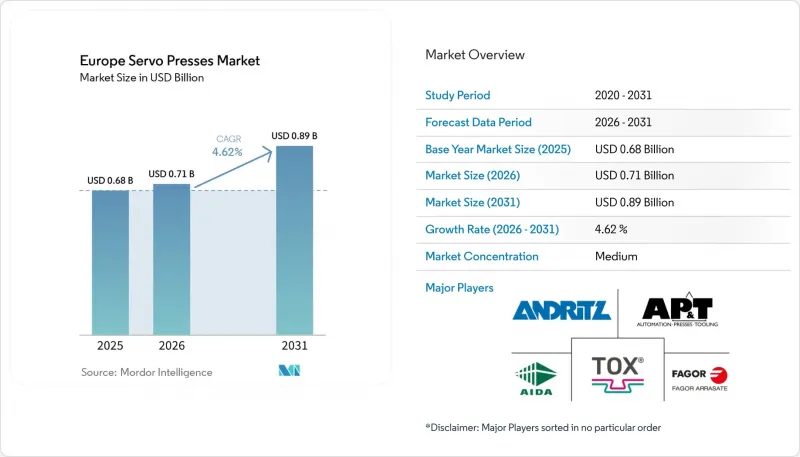
According to Mordor Intelligence, the Europe servo presses market size is expected to grow from USD 0.68 billion in 2025 to USD 0.71 billion in 2026 and is forecast to reach USD 0.89 billion by 2031 at 4.62% CAGR over 2026-2031.
Europe Servo Presses Market Trends and Insights
Electrification and the light-weighting of European vehicle platforms
European vehicle programs are increasing demand for forming systems that can handle stronger alloys and maintain closer dimensional control. Battery enclosures, EV body structures, and subframe parts place greater demands on slide motion and forming consistency than many legacy vehicle parts. BMW began series production of its Gen6 electric engine at Plant Steyr in August 2025 and committed USD 1.1 billion for e-drive development and production between 2022 and 2030. Toyota announced a USD 748 million expansion of its Kolin plant in September 2025 for its first European battery-electric vehicle production program. These projects support demand for precision lamination, rotor-stator assembly, and structural component forming. The Europe servo presses market, therefore, gains from vehicle programs that require both flexible press lines and reliable output at production speed.
Industry 4.0 Press-Shop Automation and Traceability
Traceability requirements are making data capture a necessary capability in automotive, aerospace, and battery supply chains. The SEAT and CUPRA PXL servo press at Martorell captures 3,000 data points for each stamping, supporting real-time production control and maintenance planning. ANDRITZ Schuler deployed its Metris Visual Die Protection system at Smart Press Shop in Germany in July 2025, where camera-based monitoring detects cracks and foreign objects before damage spreads. Audi also deployed a TUV-certified virtual programmable logic controller in its Bollinger Hofe body shop in 2025 using Siemens Edge Cloud 4 Production. These examples show why older presses without certified data systems may be less suitable for new contracts. This requirement gives the Europe servo presses market a replacement path that is based on quality records and safety, as well as equipment output.
High Upfront Capital Cost and Long Replacement Cycles
The cost of a fully configured servo system remains a barrier for smaller press-shop operators. Heavy press equipment can remain in use for 15-25 years, which encourages companies to defer replacement even when a newer system offers lower lifecycle costs. European Central Bank research found that a 1% energy-driven rise in industrial producer prices reduced European firms' capital expenditure by 4.1% after 1 year. European Investment Bank research published in 2025 also found that uncertainty about energy prices can discourage long-term climate and efficiency investment. Retrofit packages can reduce the immediate cost by retaining the installed frame, but they do not remove all funding pressure. This restraint limits replacement decisions in the Europe servo presses market, particularly among Tier-2 and Tier-3 suppliers.
Other drivers and restraints analyzed in the detailed report include:
- Energy-Efficient Replacement of Legacy Hydraulic and Mechanical Presses
- Battery, Bipolar-Plate, and E-Motor Lamination Production
- Payback Uncertainty Under Volatile European Energy Prices
For complete list of drivers and restraints, kindly check the Table Of Contents.
Segment Analysis
Straight-side and H-frame presses held 49.1% of the Europe servo presses market size by frame type in 2025. Their rigid structure supports large-format blanking, transfer operations, and deep drawing, where eccentric loads are common. Automotive body-in-white production remains the main reason these systems are specified for larger lines. The architecture is also suited to EV body structures and battery enclosures that use extended dies and stronger materials. C-frame and gap-frame machines remain important in lower-tonnage assembly, joining, and medical-device work because they provide three-sided die access. Column and post-type presses serve smaller precision forging and powder compaction uses, while other special geometries address aerospace composite work and specialized forming requirements.
Straight-side presses are also the fastest-growing frame category, registering a 5.7% CAGR through 2031 because large EV body-panel and structural-module programs use wide-table transfer lines. AP&T's 1,500-ton straight-side press line for VDL VDS shows the continuing need for high-capacity equipment that also manages energy use. The Martorell PXL press shows that high rigidity can be combined with 15 strokes per minute and 5-minute die changes. Demand for this configuration benefits when users need flexible motion profiles without compromising structural stability. Large multi-station dies also require a frame that can maintain alignment when loads are uneven across the working area. This need is especially relevant for extended battery and body components that combine several forming steps within a single production line. Competition increasingly rests on force-measurement resolution, programmable motion, and connected controls rather than frame mechanics alone. This keeps the straight-side format central to high-tonnage investment.
Servo-mechanical metal forming presses held 45.9% of the Europe servo presses market size by technology in 2025. They serve high-tonnage automotive body, forging, and structural uses where slide stiffness and load capacity are essential. Crankshaft and link mechanisms remain useful where forces exceed 1,000 tons, and all-electric machines have not matched the same operating range. Servo-hydraulic equipment also retains a role in deep drawing and hydroforming, especially where variable motion and hydraulic force are needed. Improved servo-pump drives have made these systems more efficient than conventional hydraulic power units. The technology mix, therefore, remains broad because the applications have different tonnage, precision, and cleanliness requirements.
Electromechanical and electric servo assembly presses are the fastest-growing technology category, registering an 8.8% CAGR through 2031. Medical devices, electronics, and precision power-module assembly favor oil-free systems with cleanroom suitability and accurate force control. SCHMIDT Technology's ServoPress 602 provides a maximum force of 300 N, position repeatability of +-1 µm, and force repeatability of 0.4 N for fine-mechanics work. These capabilities are useful where a small force variation can affect component quality or the record needed for batch release. They also reduce the risk that hydraulic oil contamination conflicts with clean manufacturing requirements. Hybrid systems provide an intermediate route for installed hydraulic frames because they can improve efficiency and programmability without requiring a full replacement. ANDRITZ Schuler introduced its HFA plus+ fine blanking series in January 2026 with a servo-controlled hydraulic-pump drive that improves energy efficiency by a double-digit percentage while raising stroke rates. The Europe servo presses industry is therefore seeing a gradual move toward all-electric systems in lower-tonnage precision applications. At the same time, mechanical and hybrid options retain a strong position in heavier work.
Complete Report Scope:
- By Frame / Structural Configuration
- C-Frame / Gap-Frame Servo Presses
- Straight-Side / H-Frame Servo Presses
- Column / Post-Type Servo Presses
- Other Servo Press Configurations
- By Servo Press Technology / System Type
- Servo-Mechanical Metal Forming Presses
- Electromechanical / Electric Servo Assembly Presses
- Servo-Hydraulic Presses
- Hybrid Servo Presses
- By Press Force / Capacity
- Up to 10 Tons
- Above 10-100 Tons
- Above 100-500 Tons
- Above 500-1,000 Tons
- Above 1,000 Tons
- By Application
- Stamping, Blanking, and Punching
- Deep Drawing and Sheet Forming
- Forging and Cold Forming
- Assembly, Press-Fitting and Joining
- Powder Compaction
- Other Precision and Specialized Pressing Applications
- By End User
- Automotive and Transportation
- Electrical and Electronics
- Aerospace and Defense
- Medical and Precision Devices
- Industrial Machinery and General Manufacturing
- Appliances and Consumer Durables
- Other End-Use Industries
- By Geography
- Germany
- Italy
- France
- United Kingdom
- Russia
- Spain
- Rest of Europe
List of Companies Covered in this Report:
- ANDRITZ Schuler Group
- AIDA Engineering, Ltd.
- Fagor Arrasate S. Coop.
- AP&T Group
- TOX PRESSOTECHNIK GmbH and Co. KG
- ANDRITZ Kaiser GmbH
- Zani S.p.A.
- BRUDERER AG
- Bosch Rexroth AG
- Kistler Group
- PROMESS Gesellschaft fur Montage- und Prufsysteme mbH
- SCHMIDT Technology GmbH
- Janome Industrial Equipment Europe GmbH
- IAI Industrieroboter GmbH
- RARUK Automation Ltd
- SINTOKOGIO, LTD.
- THK CO., LTD.
- Nidec-Shimpo Corporation
- AMADA CO., LTD.
- Komatsu Ltd.
- SEYI Presses Europe GmbH
- LVD Company NV
- Salvagnini Italia S.p.A.
- Prima Industrie S.p.A.
- FANUC Europe Corporation
- ABB Ltd.
- Gudel AG
Additional Benefits:
- The market estimate (ME) sheet in Excel format
- 3 months of analyst support
TABLE OF CONTENTS
1 INTRODUCTION
- 1.1 Study Assumptions and Market Definition
- 1.2 Scope of the Study
2 RESEARCH METHODOLOGY
3 EXECUTIVE SUMMARY
4 MARKET LANDSCAPE
- 4.1 Market Overview
- 4.2 Market Drivers
- 4.2.1 Electrification and Lightweighting of European Vehicle Platforms
- 4.2.2 Industry 4.0 Press-Shop Automation and Traceability
- 4.2.3 Energy-Efficient Servo Replacement of Legacy Hydraulic and Mechanical Presses
- 4.2.4 Battery, Bipolar-Plate, and E-Motor Lamination Production
- 4.2.5 Aerospace, medical, and precision-component manufacturing
- 4.2.6 Retrofit-Led Modernization of Installed Press Bases
- 4.3 Market Restraints
- 4.3.1 High Upfront Capital Cost and Long Replacement Cycles
- 4.3.2 Skilled Controls and Maintenance Workforce Shortage
- 4.3.3 Payback Uncertainty Under Volatile European Energy Prices
- 4.3.4 Imported Motion-Control Components and Cybersecurity Exposure
- 4.4 Value and Supply-Chain Analysis
- 4.4.1 Servo Motors, Drives, Encoders, and Control Hardware
- 4.4.2 Press Frame, Slide, Cushion, and Die Systems
- 4.4.3 Feeders, Destackers, Transfer Systems, and Robots
- 4.4.4 Integrators, Toolmakers, and Commissioning Partners
- 4.4.5 OEM and Tier-One Press-Shop Buyers
- 4.4.6 Spare Parts, Refurbishment, Remote Service, and Upgrades
- 4.5 Regulatory Landscape
- 4.5.1 EU Machinery Regulation and CE Conformity
- 4.5.2 Ecodesign, Energy Efficiency, and Motor-Drive Requirements
- 4.5.3 Industrial Emissions, Carbon Reporting, and Circularity Requirements
- 4.5.4 Functional Safety, Guarding, Noise, and Ergonomics
- 4.5.5 Data Governance, Connectivity, and Industrial Cybersecurity
- 4.6 Technological Outlook
- 4.6.1 Direct-Drive Servo, Twin-Servo, and Servo-Hydraulic Architectures
- 4.6.2 Pendular Stroke, Programmable Motion, and In-Die Operations
- 4.6.3 Regenerative Drives and Energy Monitoring
- 4.6.4 In-Die Sensing, Vision Inspection, and Force-Displacement Control
- 4.6.5 Digital Twins, Virtual Commissioning, and Predictive Maintenance
- 4.6.6 Retrofit Servo Kits and Hybrid Press Architectures
- 4.7 Industry and Manufacturing Trends
- 4.7.1 Growth of Flexible and High-Mix Manufacturing
- 4.7.2 Automation and Integrated Press Lines
- 4.7.3 Increasing Demand for Traceable and Precision Pressing
- 4.7.4 Sustainability and Energy-Efficiency Trends
- 4.8 Sustainability and Energy Efficiency
- 4.9 Impact of Geopolitical Developments on the Market
5 MARKET SIZE AND GROWTH FORECASTS
- 5.1 By Frame / Structural Configuration
- 5.1.1 C-Frame / Gap-Frame Servo Presses
- 5.1.2 Straight-Side / H-Frame Servo Presses
- 5.1.3 Column / Post-Type Servo Presses
- 5.1.4 Other Servo Press Configurations
- 5.2 By Servo Press Technology / System Type
- 5.2.1 Servo-Mechanical Metal Forming Presses
- 5.2.2 Electromechanical / Electric Servo Assembly Presses
- 5.2.3 Servo-Hydraulic Presses
- 5.2.4 Hybrid Servo Presses
- 5.3 By Press Force / Capacity
- 5.3.1 Up to 10 Tons
- 5.3.2 Above 10-100 Tons
- 5.3.3 Above 100-500 Tons
- 5.3.4 Above 500-1,000 Tons
- 5.3.5 Above 1,000 Tons
- 5.4 By Application
- 5.4.1 Stamping, Blanking, and Punching
- 5.4.2 Deep Drawing and Sheet Forming
- 5.4.3 Forging and Cold Forming
- 5.4.4 Assembly, Press-Fitting and Joining
- 5.4.5 Powder Compaction
- 5.4.6 Other Precision and Specialized Pressing Applications
- 5.5 By End User
- 5.5.1 Automotive and Transportation
- 5.5.2 Electrical and Electronics
- 5.5.3 Aerospace and Defense
- 5.5.4 Medical and Precision Devices
- 5.5.5 Industrial Machinery and General Manufacturing
- 5.5.6 Appliances and Consumer Durables
- 5.5.7 Other End-Use Industries
- 5.6 By Geography
- 5.6.1 Germany
- 5.6.2 Italy
- 5.6.3 France
- 5.6.4 United Kingdom
- 5.6.5 Russia
- 5.6.6 Spain
- 5.6.7 Rest of Europe
6 COMPETITIVE LANDSCAPE
- 6.1 Market Concentration
- 6.2 Strategic Moves
- 6.3 Market Share Analysis
- 6.4 Company Profiles (includes Global Level Overview, Market Level Overview, Core Segments, Financials as available, Strategic Information, Products and Services, Recent Developments)
- 6.4.1 ANDRITZ Schuler Group
- 6.4.2 AIDA Engineering, Ltd.
- 6.4.3 Fagor Arrasate S. Coop.
- 6.4.4 AP&T Group
- 6.4.5 TOX PRESSOTECHNIK GmbH and Co. KG
- 6.4.6 ANDRITZ Kaiser GmbH
- 6.4.7 Zani S.p.A.
- 6.4.8 BRUDERER AG
- 6.4.9 Bosch Rexroth AG
- 6.4.10 Kistler Group
- 6.4.11 PROMESS Gesellschaft fur Montage- und Prufsysteme mbH
- 6.4.12 SCHMIDT Technology GmbH
- 6.4.13 Janome Industrial Equipment Europe GmbH
- 6.4.14 IAI Industrieroboter GmbH
- 6.4.15 RARUK Automation Ltd
- 6.4.16 SINTOKOGIO, LTD.
- 6.4.17 THK CO., LTD.
- 6.4.18 Nidec-Shimpo Corporation
- 6.4.19 AMADA CO., LTD.
- 6.4.20 Komatsu Ltd.
- 6.4.21 SEYI Presses Europe GmbH
- 6.4.22 LVD Company NV
- 6.4.23 Salvagnini Italia S.p.A.
- 6.4.24 Prima Industrie S.p.A.
- 6.4.25 FANUC Europe Corporation
- 6.4.26 ABB Ltd.
- 6.4.27 Gudel AG
7 MARKET OPPORTUNITIES AND FUTURE OUTLOOK
- 7.1 White-Space and Unmet-Need Assessment
- 7.1.1 Mid-Market Retrofit Packages with Guaranteed Energy Baselines
- 7.1.2 Servo Presses for Battery Enclosures and Bipolar Plates
- 7.1.3 Low-Volume Flexible Cells for Tier-Two Suppliers
- 7.1.4 Cybersecure Remote-Service Bundles for Legacy Presses
- 7.1.5 Oil-Free Precision Joining for Medical and Electronics Production
- 7.2 Future Outlook
- 7.2.1 EV Battery and Lightweight Vehicle Components
- 7.2.2 Electronics, Semiconductor, and Connector Manufacturing
- 7.2.3 Smart-Factory Integration
- 7.2.4 Regionalization of Manufacturing Supply Chains
- 7.2.5 Aftermarket, Retrofit, and Service Revenue Pools

