PUBLISHER: Mordor Intelligence | PRODUCT CODE: 2184634

PUBLISHER: Mordor Intelligence | PRODUCT CODE: 2184634
Africa Yogurt - Market Share Analysis, Industry Trends & Statistics, Growth Forecasts (2026 - 2031)
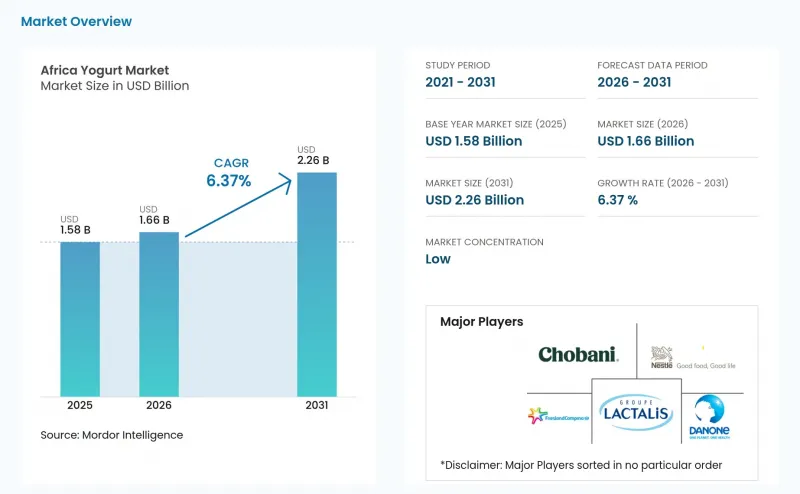
According to Mordor Intelligence, the Africa yogurt market size was valued at USD 1.58 billion in 2025 and estimated to grow from USD 1.66 billion in 2026 to reach USD 2.26 billion by 2031, at a CAGR of 6.37% during the forecast period (2026-2031).
Africa Yogurt Market Trends and Insights
Rising Consumer Awareness of Yogurt's Probiotic and Nutritional Benefits
Health-focused purchasing is increasing the relevance of probiotic and lactose-reduced yogurt in urban African households. The Africa yogurt market can serve people who have historically avoided conventional dairy because lactose nonpersistence is common across many African populations. This changes product development priorities from treating lactose intolerance only as a barrier to creating products that address a clear consumption need. Companies can build demand through plainly stated nutritional claims and products that fit familiar eating occasions. Research on tigernut, soybean, and cow-milk blends showed that locally relevant mixed formulations can gain consumer acceptance in West African trials. These findings support room for lower-cost functional products where imported plant ingredients would make pricing less accessible.
Growing Demand for Convenient and Ready-to-Eat Dairy Products
Urban growth is increasing demand for dairy products that can be consumed away from home or during short meal breaks. South Africa's urban population reached 70% in 2025, providing a large base for single-serve cups, pouches, and drinkable formats. Portable packs can help manufacturers reach commuters, students, and consumers shopping in convenience stores. The Africa yogurt market also has an opportunity to use ambient-stable formats in areas where refrigerated retail capacity remains limited. These formats reduce the dependence of distribution on continuous refrigeration at every selling point. Product and pack decisions must still balance shelf life, cost, food safety, and the local habits that favor either spoonable or drinkable yogurt.
Limited Cold-Chain Infrastructure and Refrigerated Distribution
Cold-chain coverage remains a persistent constraint on the Africa yogurt market, particularly outside major cities. Weak refrigeration can raise spoilage risk and limit the distance that chilled products travel from processing plants. The Global Cold Chain Alliance identifies investment, infrastructure, and operational capability as continuing issues for cold-chain development across Africa. Kenya's government began installing 230 bulk milk coolers across 40 counties in July 2025, which added upstream chilling capacity but did not remove the wider distribution challenge. Manufacturers need to match product formats with the actual reliability of power, equipment maintenance, and transport links in each market. Ambient and shelf-stable products offer one response, but they do not replace the need for refrigerated capacity for conventional yogurt lines.
Other drivers and restraints analyzed in the detailed report include:
- Rising Demand for Flavored and Fortified Yogurt Products
- Growing Demand for Affordable, Protein-Rich Foods
- Volatility in Raw Milk Prices and Availability
For complete list of drivers and restraints, kindly check the Table Of Contents.
Segment Analysis
Spoonable yogurt accounted for 66.34% of the Africa yogurt market in 2025, reflecting established household consumption across North Africa, South Africa, and East African cities. The format is familiar to consumers who use yogurt at breakfast, with meals, as a snack, and in family food routines. Its position is supported by supermarket shelves, a wide range of single-serve packs, family tubs, and established refrigerated merchandising in more developed retail settings. Manufacturers can maintain this base with dependable quality, practical portion sizes, recognizable flavors, and clear date marking that helps consumers assess freshness. The category still depends on refrigerated storage through much of the supply chain, from factory dispatch to the final retail display.
Drinkable yogurt is projected to grow at a 7.81% CAGR through 2031, which makes it the faster-growing type within the Africa yogurt market size. Single-serve drinks can be easier to consume while traveling, at school, or during work breaks. Ambient-stable packages can extend coverage into outlets without reliable chilled displays. This gives producers a route into smaller cities and informal retail areas that conventional yogurt may not reach. Lower revenue per liter may be offset by a larger potential consumer base and higher distribution reach.
Dairy-based yogurt held 88.37% of revenue in 2025, supported by existing dairy-farming systems and the established use of cow-milk fermentation. The segment benefits from familiar taste, broad availability, and manufacturing practices that processors already understand. Its performance, however, relies on stable milk supply, affordable inputs, and adequate cooling from farm to factory. Companies with local collection systems are better placed to control quality and reduce their dependence on imported ingredients. Dairy-based offerings will remain central where traditional milk consumption and formal retail are well developed.
Non-dairy based yogurt is forecast to grow at a 7.69% CAGR through 2031 in the Africa yogurt market. Interest comes from consumers seeking lactose-free options and products associated with health-focused diets. Tigernut and soybean blends offer a potential route to use ingredients familiar to West African consumers. This segment remains less established than dairy-based yogurt and requires reliable formulations, taste acceptance, and clear labeling. Local manufacturers that manage ingredient costs and build trust may have room to develop early positions.
Complete Report Scope:
- Type
- Drinkable Yogurt
- Spoonable Yogurt
- Source
- Dairy-based
- Non-dairy based
- Flavor
- Flavored
- Un-flavored
- Distribution Channel
- On-Trade
- Off-Trade
- Convenience Stores
- Specialist Retailers
- Supermarkets and Hypermarkets
- Online Retail Stores
- Others (Warehouse clubs, gas stations, etc.)
- By Geography
- South Africa
- Egypt
- Nigeria
- Morocco
- Algeria
- Kenya
- Rest of Africa
List of Companies Covered in this Report:
- Danone S.A.
- Nestle S.A.
- Royal FrieslandCampina NV
- Lactalis Group
- Chobani, LLC
- Brookside Dairy Limited
- Viju Industries Nigeria Limited
- Juhayna Food Industries
- Yakult Honsha Co., Ltd.
- Clover Industries Limited
- FAGE International S.A.
- Promasidor Holdings Limited
- Arla Foods amba
- Almarai Company
- Inyange Industries Ltd.
- Pearl Dairy Farms Limited
- New Kenya Co-operative Creameries Limited
- Chi Limited
- Delifrance
- Sodiaal International
Additional Benefits:
- The market estimate (ME) sheet in Excel format
- 3 months of analyst support
TABLE OF CONTENTS
1 INTRODUCTION
- 1.1 Study Assumptions and Market Definition
- 1.2 Scope of the Study
2 RESEARCH METHODOLOGY
3 EXECUTIVE SUMMARY
4 MARKET LANDSCAPE
- 4.1 Market Overview
- 4.2 Market Drivers
- 4.2.1 Rising Consumer Awareness of Yogurt's Probiotic and Nutritional Benefits
- 4.2.2 Growing Demand for Convenient and Ready-to-Eat Dairy Products
- 4.2.3 Rising Demand for Flavored and Fortified Yogurt Products
- 4.2.4 Growing Demand for Affordable, Protein-Rich Foods
- 4.2.5 Increasing Availability of Drinkable Yogurt and Single-Serve Packaging
- 4.2.6 Expansion of Domestic Dairy Processing and Local Yogurt Production
- 4.3 Market Restraints
- 4.3.1 Limited Cold Chain Infrastructure and Refrigerated Distribution
- 4.3.2 Volatility in Raw Milk Prices and Availability
- 4.3.3 High Energy Costs and Unreliable Electricity Supply
- 4.3.4 High Costs of Refrigerated Storage and Transportation
- 4.4 Consumer Behavior Analysis
- 4.5 Regulatory Landscape
- 4.6 Technological Outlook
- 4.7 Porter's Five Forces
- 4.7.1 Threat of New Entrants
- 4.7.2 Bargaining Power of Buyers
- 4.7.3 Bargaining Power of Suppliers
- 4.7.4 Threat of Substitutes
- 4.7.5 Competitive Rivalry
5 MARKET SIZE AND GROWTH FORECASTS (VALUE)
- 5.1 Type
- 5.1.1 Drinkable Yogurt
- 5.1.2 Spoonable Yogurt
- 5.2 Source
- 5.2.1 Dairy-based
- 5.2.2 Non-dairy based
- 5.3 Flavor
- 5.3.1 Flavored
- 5.3.2 Un-flavored
- 5.4 Distribution Channel
- 5.4.1 On-Trade
- 5.4.2 Off-Trade
- 5.4.2.1 Convenience Stores
- 5.4.2.2 Specialist Retailers
- 5.4.2.3 Supermarkets and Hypermarkets
- 5.4.2.4 Online Retail Stores
- 5.4.2.5 Others (Warehouse clubs, gas stations, etc.)
- 5.5 By Geography
- 5.5.1 South Africa
- 5.5.2 Egypt
- 5.5.3 Nigeria
- 5.5.4 Morocco
- 5.5.5 Algeria
- 5.5.6 Kenya
- 5.5.7 Rest of Africa
6 COMPETITIVE LANDSCAPE
- 6.1 Market Concentration
- 6.2 Strategic Moves
- 6.3 Market Share Analysis
- 6.4 Company Profiles (includes Company Highlights, Core Segments, Financials as available, Strategic Information, Market Rank/Share for key companies, Products and Services, and Recent Developments)
- 6.4.1 Danone S.A.
- 6.4.2 Nestle S.A.
- 6.4.3 Royal FrieslandCampina NV
- 6.4.4 Lactalis Group
- 6.4.5 Chobani, LLC
- 6.4.6 Brookside Dairy Limited
- 6.4.7 Viju Industries Nigeria Limited
- 6.4.8 Juhayna Food Industries
- 6.4.9 Yakult Honsha Co., Ltd.
- 6.4.10 Clover Industries Limited
- 6.4.11 FAGE International S.A.
- 6.4.12 Promasidor Holdings Limited
- 6.4.13 Arla Foods amba
- 6.4.14 Almarai Company
- 6.4.15 Inyange Industries Ltd.
- 6.4.16 Pearl Dairy Farms Limited
- 6.4.17 New Kenya Co-operative Creameries Limited
- 6.4.18 Chi Limited
- 6.4.19 Delifrance
- 6.4.20 Sodiaal International
7 MARKET OPPORTUNITIES AND FUTURE OUTLOOK

