PUBLISHER: Mordor Intelligence | PRODUCT CODE: 2187141

PUBLISHER: Mordor Intelligence | PRODUCT CODE: 2187141
Asia-Pacific Yogurt - Market Share Analysis, Industry Trends & Statistics, Growth Forecasts (2026 - 2031)
According to Mordor Intelligence, the Asia-Pacific yogurt market size is USD 55.27 billion in 2026, up from USD 51.75 billion in 2025, and is forecast to reach USD 76.95 billion by 2031 at a CAGR of 6.84%.
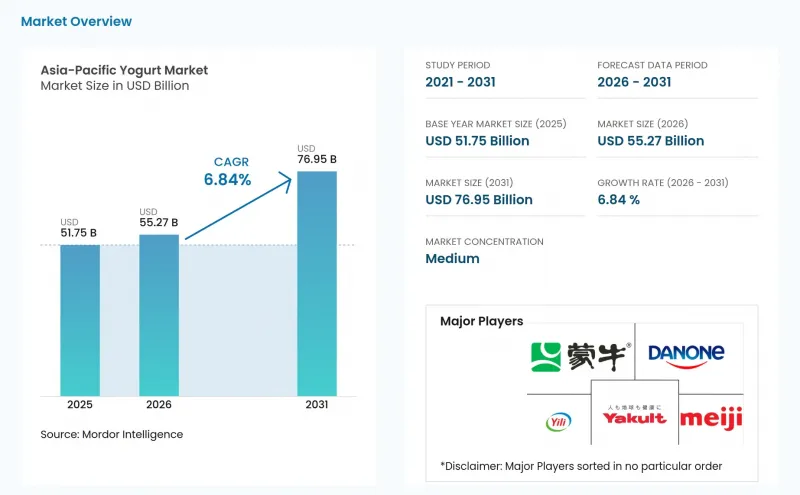
Asia-Pacific Yogurt Market Trends and Insights
Increasing Health Consciousness for Probiotics, Gut Health, and Immunity
The Asia-Pacific yogurt market is gaining from demand for foods that support gut health, digestion, and immunity. A 2025 peer-reviewed review described continued innovation in probiotic delivery systems, supporting the relevance of clinically supported strains in foods and beverages. The supplied research cites trials in which yogurt containing Lactobacillus rhamnosus GG or Bifidobacterium lactis BB-12 reduced glycemic variability by 8-12% over 12 weeks. China Mengniu Dairy received China SAMR blue-hat certification in December 2025 for its YoyiC Galacto-Oligosaccharides Probiotic Drink, following a 12-year development program. Such approvals allow brands to position qualifying products as regulated health foods rather than ordinary snacks. The Asia-Pacific yogurt market therefore gives an advantage to companies with established clinical, regulatory, and quality-control capabilities.
Product Innovation in Flavored, Low-Fat, Greek, and Functional Yogurts
The Asia-Pacific yogurt market is using new formulations to create occasions beyond breakfast and home consumption. Meiji introduced W Skin Care Yogurt in Japan in March 2025 with SC-2 lactic acid bacteria, collagen peptides, and sphingomyelin, supported by clinical trials involving 67 and 94 participants. The product was priced at JPY 156 per 112g serving, according to the supplied material. Meiji also introduced a functional yogurt for blood sugar management in October 2025 under Japan's FOSHU framework. Product development now covers flavored, low-fat, Greek, and functional products, while clean-label and low-sugar claims are important in urban premium channels. These innovations allow the Asia-Pacific yogurt market to serve personal-care, healthy-aging, and routine nutrition needs with more targeted products.
Inadequate Cold-Chain Infrastructure
The Asia-Pacific yogurt market remains constrained by gaps in temperature-controlled logistics across emerging economies. The Global Cold Chain Alliance reported in 2025 that per-capita cold-storage availability in Asia-Pacific remains below the United States and United Kingdom averages. The Philippines Department of Agriculture allocated USD 53 million in June 2025 for 100 cold-storage facilities, although the supplied material notes that the effort focused mainly on fruits and vegetables. In Indonesia, Indomaret operates 23,000 outlets, and Alfamart operates 19,000 outlets, but inter-island ambient distribution still dominates. Manufacturers consequently use UHT and shelf-stable products to reach rural consumers, even where that choice can limit probiotic positioning and per-unit value. The Asia-Pacific yogurt market is split between premium chilled products in large cities and shelf-stable alternatives in rural areas.
Other drivers and restraints analyzed in the detailed report include:
- Expansion of Plant-Based Yogurt Alternatives
- Growth in Drinkable Yogurt for On-the-Go Consumption
- High Lactose Intolerance Rates Limiting Traditional Dairy Yogurt Adoption
For complete list of drivers and restraints, kindly check the Table Of Contents.
Segment Analysis
Spoonable yogurt retained 58.42% of the Asia-Pacific yogurt market share in 2025, reflecting its established role in meals and cooking. Drinkable yogurt is forecast to grow at an 8.24% CAGR from 2026 to 2031, the highest rate in the type segmentation. In India, Amul dahi is used in marinades and raita, while consumers in Japan and Australia also treat spoonable products as controlled-portion breakfast foods. The two formats meet different needs, which helps preserve the scale of spoonable products while allowing drinkable products to add new occasions. The Asia-Pacific yogurt industry benefits when consumers can select familiar spoonable products for home use and portable products for daily travel.
Meiji launched Hokkaido Tokachi Milk Drinkable Yogurt LB81 Blueberry in September 2025 as the first flavored FOSHU-certified drinkable yogurt in Japan. This release linked flavor, functional certification, and convenience in one product. Drinkable formats compete directly with other functional beverages for commuter and mid-morning occasions. Their progress depends on reliable access to chilled shelves and refrigerated delivery. The Asia-Pacific yogurt market can use these formats to extend consumption frequency without displacing established spoonable use.
Dairy-based yogurt accounted for 92.33% of value in 2025, giving it a dominant position in the source segmentation. This share reflects cooperative and integrated supply systems operated by Amul in India, Fonterra in Oceania, and Yili and Mengniu in China. These systems reduce raw material costs and help dairy products compete on price. Non-dairy yogurt is forecast to grow at an 8.79% CAGR through 2031, led by soy-based products in China and Japan. The Asia-Pacific yogurt market size for dairy-based offerings is supported by existing production, familiar tastes, and broad retail availability.
The OECD-FAO Agricultural Outlook 2025-2034 identifies soy, almond, rice, and oat alternatives as increasingly popular in East Asia. These products can respond to lactose intolerance and dietary preferences while benefiting from ingredient familiarity in selected countries. The price difference between dairy and plant-based formulations remains wider in Asia-Pacific than in many Western markets. This limits disruption to gradual share gains through 2031 outside Australia and Singapore. The Asia-Pacific yogurt industry is therefore likely to retain dairy as its core while adding non-dairy choices for more specific consumer groups.
Complete Report Scope:
- By Type
- Drinkable Yogurt
- Spoonable Yogurt
- By Source
- Dairy-based
- Non-dairy based
- By Flavour
- Flavored
- Un-flavored
- By Distribution Channel
- On-trade
- Off-trade
- Convenience Stores
- Specialist Retailers
- Supermarkets and Hypermarkets
- On-line Retail
- Other Distribution Channels
- By Geography
- China
- Japan
- India
- Australia
- Indonesia
- Malaysia
- South Korea
- New Zealand
- Thailand
- Singapore
- Rest of Asia-Pacific
List of Companies Covered in this Report:
- Inner Mongolia Yili Industrial Group Co. Ltd
- China Mengniu Dairy Co. Ltd
- Yakult Honsha Co. Ltd
- Danone SA
- Nestle SA
- Meiji Dairies Corp.
- Gujarat Co-operative Milk Marketing Federation (Amul)
- Bulla Dairy Foods
- FAGE International SA
- Bright Dairy & Food Co. Ltd
- Chobani LLC
- Mother Dairy Fruit & Vegetable Pvt Ltd
- Fonterra Co-operative Group Ltd
- Parag Milk Foods Ltd
- Morinaga Milk Industry Co. Ltd
- Vinamilk
- Yakult Danone India Pvt Ltd
- Maeil Dairy Industry Co. Ltd
- Labanita (Saudi Dairy & Foodstuff Co.)
- Snow Brand Milk Products Co. Ltd
Additional Benefits:
- The market estimate (ME) sheet in Excel format
- 3 months of analyst support
TABLE OF CONTENTS
1 INTRODUCTION
- 1.1 Study Assumptions and Market Definition
- 1.2 Scope of the Study
2 RESEARCH METHODOLOGY
3 EXECUTIVE SUMMARY
4 MARKET LANDSCAPE
- 4.1 Market Overview
- 4.2 Market Drivers
- 4.2.1 Increasing health consciousness promotes yogurt for probiotics, gut health, and immunity benefits
- 4.2.2 Rising lactose intolerance drives demand for low-lactose or lactose-free yogurt variants
- 4.2.3 Product innovations like flavored, low-fat, Greek, and functional yogurts
- 4.2.4 Growing preference for clean-label and low-sugar options
- 4.2.5 Expansion of plant-based yogurt alternatives caters to vegan and flexitarian diets
- 4.2.6 Surge in drinkable yogurt popularity offers convenience for on-the-go consumption
- 4.3 Market Restraints
- 4.3.1 High lactose intolerance rates limit traditional dairy yogurt adoption
- 4.3.2 Consumer concerns over high sugar content in flavored yogurts
- 4.3.3 Inadequate cold-chain infrastructure
- 4.3.4 Taste and texture perceptions favor fresh dairy over processed yogurt
- 4.4 Consumer Behavior Analysis
- 4.5 Regulatory Landscape
- 4.6 Technological Outlook
- 4.7 Porter's Five Forces
- 4.7.1 Threat of New Entrants
- 4.7.2 Bargaining Power of Buyers/Consumers
- 4.7.3 Bargaining Power of Suppliers
- 4.7.4 Threat of Substitute Products
- 4.7.5 Intensity of Competitive Rivalry
5 MARKET SIZE AND GROWTH FORECASTS (VALUE)
- 5.1 By Type
- 5.1.1 Drinkable Yogurt
- 5.1.2 Spoonable Yogurt
- 5.2 By Source
- 5.2.1 Dairy-based
- 5.2.2 Non-dairy based
- 5.3 By Flavour
- 5.3.1 Flavored
- 5.3.2 Un-flavored
- 5.4 By Distribution Channel
- 5.4.1 On-trade
- 5.4.2 Off-trade
- 5.4.2.1 Convenience Stores
- 5.4.2.2 Specialist Retailers
- 5.4.2.3 Supermarkets and Hypermarkets
- 5.4.2.4 On-line Retail
- 5.4.2.5 Other Distribution Channels
- 5.5 By Geography
- 5.5.1 China
- 5.5.2 Japan
- 5.5.3 India
- 5.5.4 Australia
- 5.5.5 Indonesia
- 5.5.6 Malaysia
- 5.5.7 South Korea
- 5.5.8 New Zealand
- 5.5.9 Thailand
- 5.5.10 Singapore
- 5.5.11 Rest of Asia-Pacific
6 COMPETITIVE LANDSCAPE
- 6.1 Market Concentration
- 6.2 Strategic Moves
- 6.3 Market Ranking Analysis
- 6.4 Company Profiles (includes Global level Overview, Market level overview, Core Segments, Financials as available, Strategic Information, Market Rank/Share for key companies, Products & Services, and Recent Developments)
- 6.4.1 Inner Mongolia Yili Industrial Group Co. Ltd
- 6.4.2 China Mengniu Dairy Co. Ltd
- 6.4.3 Yakult Honsha Co. Ltd
- 6.4.4 Danone SA
- 6.4.5 Nestle SA
- 6.4.6 Meiji Dairies Corp.
- 6.4.7 Gujarat Co-operative Milk Marketing Federation (Amul)
- 6.4.8 Bulla Dairy Foods
- 6.4.9 FAGE International SA
- 6.4.10 Bright Dairy & Food Co. Ltd
- 6.4.11 Chobani LLC
- 6.4.12 Mother Dairy Fruit & Vegetable Pvt Ltd
- 6.4.13 Fonterra Co-operative Group Ltd
- 6.4.14 Parag Milk Foods Ltd
- 6.4.15 Morinaga Milk Industry Co. Ltd
- 6.4.16 Vinamilk
- 6.4.17 Yakult Danone India Pvt Ltd
- 6.4.18 Maeil Dairy Industry Co. Ltd
- 6.4.19 Labanita (Saudi Dairy & Foodstuff Co.)
- 6.4.20 Snow Brand Milk Products Co. Ltd
7 MARKET OPPORTUNITIES AND FUTURE OUTLOOK

