PUBLISHER: Mordor Intelligence | PRODUCT CODE: 2184663

PUBLISHER: Mordor Intelligence | PRODUCT CODE: 2184663
India Motor Insurance - Market Share Analysis, Industry Trends & Statistics, Growth Forecasts (2027 - 2032)
According to Mordor Intelligence, the India motor insurance market size is expected to increase from USD 10.23 billion in 2026 to USD 11.17 billion in 2027 and reach USD 17.43 billion by 2032, growing at a CAGR of 9.31% over 2027-2032.
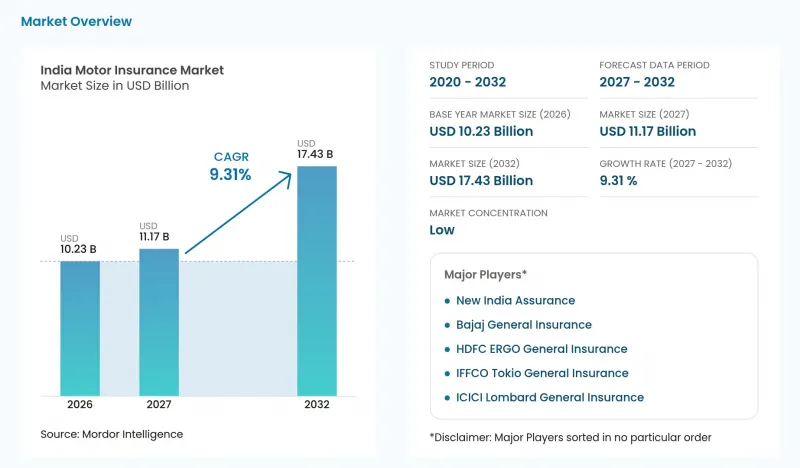
This report is segmented by Vehicle Type (Commercial and Personal), Insurance Type (Third Party and Comprehensive), and Distribution Channel (Brokers, Agents, Direct, Banks, and Other Distribution Channels). The market forecasts are provided in terms of value (USD), based on availability.
India Motor Insurance Market Trends and Insights
Rising vehicle ownership & new-vehicle sales growth
New-vehicle sales enlarge the flow of assets for which insurers can write cover, linking policy opportunities to vehicle purchasing activity. In Q2 FY2026-27, India's domestic passenger-vehicle sales grew 30.7% and commercial-vehicle sales grew 28.7% compared with Q2 FY2025-26. Two-wheeler sales rose 15.2% and three-wheeler sales increased 23.6% over the same comparison period, broadening the types of vehicles entering that insurable flow. For insurers, this creates an opportunity to establish coverage at the point of vehicle acquisition and develop a subsequent renewal relationship. SIAM also reported record domestic sales across all 4 categories in FY2025-26, so the subsequent Q2 gains expand the first-policy opportunity after a record sales year.
Mandatory third-party cover under Motor Vehicles Act & IRDAI enforcement
India's August 2026 Supreme Court directions responded to widespread uninsured vehicle use by strengthening enforcement and ordering longer cover terms for new cars and two-wheelers. Section 146 of the Motor Vehicles Act requires a valid third-party insurance policy for motor vehicles used in public places, subject to specified government-vehicle exemptions. On August 4, 2026, the Court directed real-time police insurance checks and integration of automatic number plate recognition with insurance databases for automatic e-challans. Such verification can make an existing legal obligation more consequential for owners who would otherwise leave vehicles uninsured. Once the camera and database links are deployed, an uninsured vehicle on a monitored road would trigger an automatic e-challan, extending enforcement beyond vehicles stopped by police.
Price-sensitive consumers favoring bare-minimum third-party policies
For a price-sensitive vehicle owner, the immediate payment can outweigh the value of additional protection when choosing the breadth of motor cover. If the purchase is confined to third-party liability, insurers cannot capture the additional premium associated with protection for the owner's vehicle. This constrains revenue per customer even where demand for a basic policy persists, separating access to insurance from willingness to pay for broader cover. An insurer seeking to widen protection must make the additional coverage worth its additional cost to that buyer. The remaining constraint is the owner's spending limit, which can leave vehicle-loss exposure with the customer even after a policy is purchased.
Other drivers and restraints analyzed in the detailed report include:
- Digital distribution & aggregator platforms expanding reach
- Higher demand for comprehensive cover amid climate-related loss events
- Rising fraudulent claims inflating loss ratios
For complete list of drivers and restraints, kindly check the Table Of Contents.
Segment Analysis
Commercial vehicle insurance accounted for a 53.71% share of the India motor insurance market size in 2026 as the largest segment and is forecast to be the fastest-growing segment at an 11.5% CAGR over 2027-2032. SIAM reported that domestic commercial-vehicle sales in India, excluding Daimler, rose 12.6% in FY2025-26 compared with FY2024-25. That sales flow creates potential insurance exposures for carriers serving commercial vehicles, connecting policy acquisition to purchases of vehicles used in business. The premium opportunity depends on the liabilities and vehicle risks transferred by operators, so sales growth creates an entry point without determining the value of the resulting insurance relationship.
Personal vehicle insurance presents a choice over protection depth, with distinct optional covers alongside a required base. The Supreme Court's August 4, 2026 judgment said IRDAI's four-layer private-vehicle structure was to be implemented, with mandatory third-party cover and optional occupant, personal-accident, and own-damage cover. Separating those choices can let an owner prioritize the risks transferred without treating all optional protection as an automatic consequence of the base policy. Each optional layer must earn its place through the buyer's particular risk needs, which makes clearly defined additional protection the route to deepen an existing private-vehicle relationship.
Complete Report Scope:
- By Vehicle Type
- Personal
- Commercial
- By Insurance Type
- Third Party
- Comprehensive
- By Distribution Channel
- Direct
- Agents
- Brokers
- Banks
- Other Distribution Channels
List of Companies Covered in this Report:
- New India Assurance
- ICICI Lombard General Insurance
- Bajaj General Insurance
- HDFC ERGO General Insurance
- IFFCO Tokio General Insurance
- United India Insurance
- Oriental Insurance
- SBI General Insurance
- IndusInd General Insurance
- Tata AIG General Insurance
- Cholamandalam MS General Insurance
- Generali Central Insurance
- Go Digit Insurance
- Acko General Insurance
- Magma General Insurance
- Universal Sompo General Insurance
- Liberty General Insurance
- Royal Sundaram General Insurance
- Zurich Kotak General Insurance
Additional Benefits:
- The market estimate (ME) sheet in Excel format
- 3 months of analyst support
TABLE OF CONTENTS
1 INTRODUCTION
- 1.1 Study Assumptions and Market Definition
- 1.2 Scope of the Study
2 RESEARCH METHODOLOGY
3 EXECUTIVE SUMMARY
4 MARKET LANDSCAPE
- 4.1 Market Overview
- 4.2 Market Drivers
- 4.2.1 Rising vehicle ownership & new-vehicle sales growth
- 4.2.2 Mandatory third-party cover under Motor Vehicles Act & IRDAI enforcement
- 4.2.3 Digital distribution & aggregator platforms expanding reach
- 4.2.4 Higher demand for comprehensive cover amid climate-related loss events
- 4.2.5 Telematics-based usage-based insurance pilots receiving regulatory support
- 4.2.6 Embedded micro-motor insurance via ride-hailing / e-commerce partnerships
- 4.3 Market Restraints
- 4.3.1 Price-sensitive consumers favoring bare-minimum third-party policies
- 4.3.2 Rising fraudulent claims inflating loss ratios
- 4.3.3 Data-privacy pushback slows telematics adoption
- 4.3.4 Spare-parts supply-chain inflation squeezing underwriting margins
- 4.4 Industry Value Chain Analysis
- 4.5 Regulatory Landscape
- 4.6 Technological Outlook
- 4.7 Porter's Five Forces Analysis
- 4.7.1 Threat of New Entrants
- 4.7.2 Bargaining Power of Suppliers
- 4.7.3 Bargaining Power of Buyers
- 4.7.4 Threat of Substitutes
- 4.7.5 Competitive Rivalry
5 MARKET SIZE AND GROWTH FORECASTS (VALUE)
- 5.1 By Vehicle Type
- 5.1.1 Personal
- 5.1.2 Commercial
- 5.2 By Insurance Type
- 5.2.1 Third Party
- 5.2.2 Comprehensive
- 5.3 By Distribution Channel
- 5.3.1 Direct
- 5.3.2 Agents
- 5.3.3 Brokers
- 5.3.4 Banks
- 5.3.5 Other Distribution Channels
6 COMPETITIVE LANDSCAPE
- 6.1 Market Concentration
- 6.2 Strategic Moves
- 6.3 Market Share Analysis
- 6.4 Company Profiles (includes Global level Overview, Market level overview, Core Segments, Financials as available, Strategic Information, Market Rank/Share for key companies, Products and Services, and Recent Developments)
- 6.4.1 New India Assurance
- 6.4.2 ICICI Lombard General Insurance
- 6.4.3 Bajaj General Insurance
- 6.4.4 HDFC ERGO General Insurance
- 6.4.5 IFFCO Tokio General Insurance
- 6.4.6 United India Insurance
- 6.4.7 Oriental Insurance
- 6.4.8 SBI General Insurance
- 6.4.9 IndusInd General Insurance
- 6.4.10 Tata AIG General Insurance
- 6.4.11 Cholamandalam MS General Insurance
- 6.4.12 Generali Central Insurance
- 6.4.13 Go Digit Insurance
- 6.4.14 Acko General Insurance
- 6.4.15 Magma General Insurance
- 6.4.16 Universal Sompo General Insurance
- 6.4.17 Liberty General Insurance
- 6.4.18 Royal Sundaram General Insurance
- 6.4.19 Zurich Kotak General Insurance
7 MARKET OPPORTUNITIES AND FUTURE OUTLOOK
- 7.1 White-Space and Unmet-Need Assessment

