PUBLISHER: Mordor Intelligence | PRODUCT CODE: 2114833

PUBLISHER: Mordor Intelligence | PRODUCT CODE: 2114833
Germany Motor Insurance - Market Share Analysis, Industry Trends & Statistics, Growth Forecasts (2026 - 2031)
According to Mordor Intelligence, the Germany motor insurance market size was valued at USD 57.28 billion in 2025 and estimated to grow from USD 58.86 billion in 2026 to reach USD 67.43 billion by 2031, at a CAGR of 2.75% during the forecast period (2026-2031).
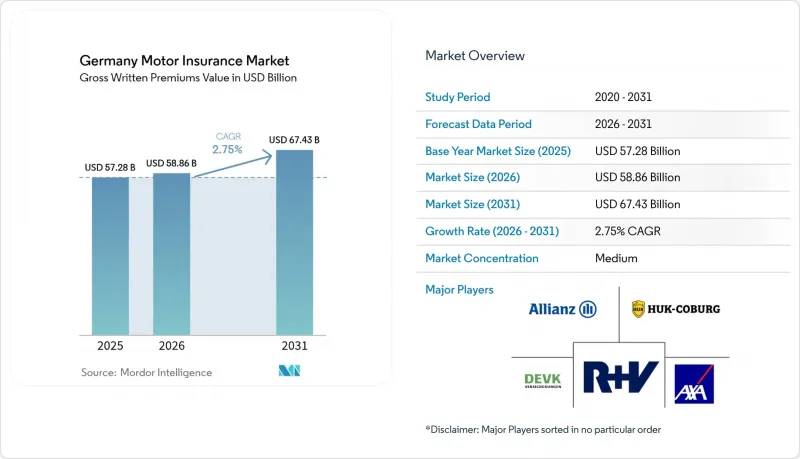
This report is Segmented by Vehicle Type (Personal, Commercial), Insurance Type (Third-Party, Comprehensive), Distribution Channel (Direct, Agents, Brokers, Banks, Other Distribution Channels), and Geography (Germany). The Market Forecasts are Provided in Terms of Value (USD).
Germany Motor Insurance Market Trends and Insights
Inflation-Linked Repair-Cost Catch-Up Pricing Boom
Workshop hourly rates averaged EUR 188 (USD 204) in 2024, an 8.6% surge that eclipsed headline inflation and triggered immediate tariff adjustments. Rising wage expectations for certified technicians, complex ADAS calibration labor, and intermittent parts shortages have driven average repair invoices from EUR 2,700 in 2017 to EUR 4,000 in 2023. German insurers booked over EUR 3 billion underwriting losses in 2023, prompting a 20% premium uplift in 2024 and another 8-11% slated for 2025. Because these increases merely recapture margin erosion rather than add new profit pools, carriers now deploy granular claims-data analytics and negotiated-rate preferred-supplier networks to contain future shocks. The pricing boom, therefore, supplies near-term revenue lift for the German motor insurance market while spotlighting the urgency of structural claims-expense reform.
EV-Specific Loss-Frequency Gap vs ICE
Insurance Europe reported that EVs register 5-10% lower third-party liability claim frequency yet incur 30-35% higher average repair costs, a duality rooted in sophisticated safety tech that prevents crashes but requires specialized fixes when incidents occur. German carriers have responded by creating EV-specific rating factors that account for kilowatt-hour battery size, thermal-runaway risk, and certified repair-shop scarcity. Early adopting regions such as Bavaria and Baden-Wurttemberg already concentrate warranty-extension add-ons covering battery degradation and high-voltage system diagnostics. While frequency benefits temper aggregate exposure, severity inflation compresses combined ratios unless premiums keep pace. Consequently, insurers with accurate EV segmentation models secure profitable footholds as the German motor insurance market electrifies.
Rising Spare-Parts Monopolistic Pricing Power
Original-equipment makers continue to enforce design patents that restrict aftermarket access to bumpers, hoods, fenders, and headlamps, allowing them to maintain double-digit mark-ups on many high-volume parts. These mark-ups translate directly into higher loss severity because body-shop invoices must reflect both the expensive component and the labor time needed to fit it. The 2024 EU repair-clause legislation seeks to foster competition by legalizing replica visible parts and could unlock up to EUR 720 million in consumer savings once fully implemented. Insurers, however, must first vet new suppliers, set up certification protocols, and negotiate quality guarantees, which introduces near-term administrative overhead. Luxury marques retain broader intellectual-property protections, meaning policyholders with premium vehicles will see limited price relief even after the rule change. Until a robust aftermarket emerges, high parts costs will continue to widen combined ratios and force carriers to push through tariff increases to protect solvency margins.
Other drivers and restraints analyzed in the detailed report include:
- Telematics-Driven Pricing Sophistication
- Aggregator-Fueled Customer Churn Cycle
- Claims-Inflation Profit Squeeze
For complete list of drivers and restraints, kindly check the Table Of Contents.
Segment Analysis
Personal cars remain the backbone of Germany's motor-insurance portfolio, capturing 72.35% of premiums in 2025 because nearly every one of the country's 48 million passenger vehicles must, by law, carry at least third-party liability cover. Most owners also upgrade to comprehensive policies that reimburse glass breakage, hail dents, vandalism, and theft-risks that resonate in densely parked urban streets and along storm-prone southern corridors. Persistently high ownership rates, stable household incomes, and inexpensive credit keep policy volumes large, yet structural headwinds are emerging. Younger city dwellers lean toward subscription mobility and car-sharing fleets that eliminate the need for an individual policy, while local governments expand low-emission zones and public-transport incentives that further depress private-car mileage. Insurers, therefore, see slower top-line growth in personal lines and are testing usage-based add-ons, instant deductible adjustments, and in-app reward programs to keep digitally minded drivers engaged.
Commercial motor, by contrast, is the growth engine, projected to advance at a 3.39% CAGR through 2031 as parcel-service vans, ride-hail fleets, and electrified last-mile cargo bikes multiply across Germany's logistics hubs. E-commerce giants, supermarket chains, and pharmaceutical distributors now operate data-rich telematics dashboards that log every acceleration spike and charging session, feeding insurers a continuous risk signal they can price in near real time. Fleet managers tap these insights to reroute around congestion, schedule predictive maintenance, and coach drivers toward safer habits, collectively shrinking accident frequency and lowering loss ratios. Battery warranties, depot-charging liability, and cross-border Green Card extensions have become standard riders, while specialized wording now covers autonomous-driving pilots on closed industrial campuses. Together, these product tweaks show how commercial lines are evolving from a simple indemnity purchase into a broader risk-management partnership between carriers and corporate mobility operators.
Complete Report Scope:
- By Vehicle Type (Value)
- Personal
- Commercial
- By Insurance Type (Value)
- Third-Party
- Comprehensive
- By Distribution Channel (Value)
- Direct
- Agents
- Brokers
- Banks
- Other Distribution Channels
List of Companies Covered in this Report:
- Allianz
- HUK-Coburg
- AXA Germany
- R+V Versicherung
- DEVK
- LVM Versicherung
- Provinzial
- Zurich Germany
- Ergo
- Generali Deutschland
- Gothaer
- HDI (Talanx)
- Wurttembergische
- Signal Iduna
- VHV Gruppe
- KRAVAG (R+V)
- Debeka
- HanseMerkur
- AdmiralDirekt (Itzehoer)
- Friday (Baloise)
Additional Benefits:
- The market estimate (ME) sheet in Excel format
- 3 months of analyst support
TABLE OF CONTENTS
1 Table of Contents - Germany Motor Insurance Market
2 Introduction
- 2.1 Study Assumptions & Market Definition
- 2.2 Scope of the Study
3 Research Methodology
4 Executive Summary
5 Market Landscape
- 5.1 Market Overview
- 5.2 Market Drivers
- 5.2.1 Inflation-linked repair-cost catch-up pricing boom
- 5.2.2 EV-specific loss-frequency gap vs ICE
- 5.2.3 Telematics-driven pricing sophistication
- 5.2.4 Aggregator-fuelled customer churn cycle
- 5.2.5 OEM subscription partnerships
- 5.2.6 Usage-based micro-policies for last-mile fleets
- 5.3 Market Restraints
- 5.3.1 Rising spare-parts monopolistic pricing power
- 5.3.2 Claims-inflation profit squeeze
- 5.3.3 ADAS repair complexity outpacing technical skills
- 5.3.4 Climate-driven hail-event clustering risk
- 5.4 Value / Supply-Chain Analysis
- 5.5 Regulatory Landscape
- 5.6 Technological Outlook
- 5.7 Porter's Five Forces
- 5.7.1 Threat of New Entrants
- 5.7.2 Bargaining Power of Suppliers
- 5.7.3 Bargaining Power of Buyers
- 5.7.4 Threat of Substitutes
- 5.7.5 Competitive Rivalry
6 Market Size & Growth Forecasts
- 6.1 By Vehicle Type (Value)
- 6.1.1 Personal
- 6.1.2 Commercial
- 6.2 By Insurance Type (Value)
- 6.2.1 Third-Party
- 6.2.2 Comprehensive
- 6.3 By Distribution Channel (Value)
- 6.3.1 Direct
- 6.3.2 Agents
- 6.3.3 Brokers
- 6.3.4 Banks
- 6.3.5 Other Distribution Channels
7 Competitive Landscape
- 7.1 Market Concentration
- 7.2 Strategic Moves
- 7.3 Market Share Analysis
- 7.4 Company Profiles (includes Global level Overview, Market level overview, Core Segments, Financials as available, Strategic Information, Market Rank/Share for key companies, Products & Services, and Recent Developments)
- 7.4.1 Allianz
- 7.4.2 HUK-Coburg
- 7.4.3 AXA Germany
- 7.4.4 R+V Versicherung
- 7.4.5 DEVK
- 7.4.6 LVM Versicherung
- 7.4.7 Provinzial
- 7.4.8 Zurich Germany
- 7.4.9 Ergo
- 7.4.10 Generali Deutschland
- 7.4.11 Gothaer
- 7.4.12 HDI (Talanx)
- 7.4.13 Wurttembergische
- 7.4.14 Signal Iduna
- 7.4.15 VHV Gruppe
- 7.4.16 KRAVAG (R+V)
- 7.4.17 Debeka
- 7.4.18 HanseMerkur
- 7.4.19 AdmiralDirekt (Itzehoer)
- 7.4.20 Friday (Baloise)
8 Market Opportunities & Future Outlook
- 8.1 White-space & Unmet-Need Assessment

