PUBLISHER: Mordor Intelligence | PRODUCT CODE: 2119886

PUBLISHER: Mordor Intelligence | PRODUCT CODE: 2119886
Europe Car Insurance - Market Share Analysis, Industry Trends & Statistics, Growth Forecasts (2026 - 2031)
According to Mordor Intelligence, Europe car insurance market size in 2026 is estimated at USD 133.99 billion, growing from 2025 value of USD 129.68 billion with 2031 projections showing USD 157.92 billion, growing at 3.32% CAGR over 2026-2031.
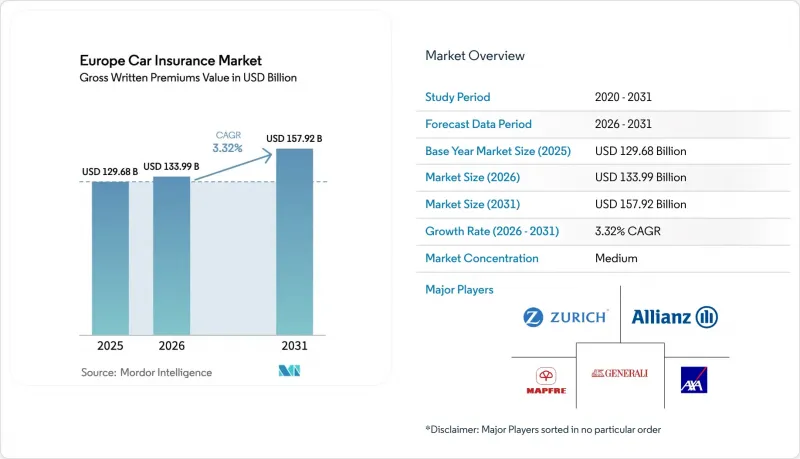
This report is Segmented by Vehicle Type (Personal, Commercial), Insurance Type (Third-Party, Comprehensive), Distribution Channel (Direct, Agents, Brokers, Banks, Other Distribution Channels), and Geography (United Kingdom, Germany, France, Spain, Italy, BENELUX, NORDICS, Rest of Europe). The Market Forecasts are Provided in Terms of Value (USD).
Europe Car Insurance Market Trends and Insights
EU-wide Compulsory Motor-Liability Law Sustains Baseline Demand
European motor insurance relies on a legal framework that obligates every vehicle owner to hold third-party liability cover, ensuring the Europe car insurance market remains insulated from macroeconomic cycles. The 2024 Insurance Recovery and Resolution Directive formalized failure-resolution mechanisms, boosting consumer confidence and curbing systemic risk across borders. Harmonized enforcement under the European Insurance and Occupational Pensions Authority (EIOPA) sustains renewal volumes even when disposable incomes tighten, because non-compliance can lead to fines, vehicle impoundment, or registration suspension. This consistent policy base allows insurers to scale digital investments, knowing core premium flows are predictable. However, rate-setting freedom is curtailed as several regulators condition approval on social objectives, such as affordability for low-income drivers, which prevents carriers from passing the full burden of claims inflation through to customers. To offset this constraint, many insurers deploy usage-based products that maintain regulatory compliance while rewarding safer behavior with lower pricing bands. The resulting alignment of incentives supports both road-safety goals and stable premium growth.
ADAS Technology Mandates Drive Claims Cost Inflation
Mandatory ADAS features introduced under the General Safety Regulation 2 for all new cars from July 2024 materially increased repair complexity and labor times. Sophisticated sensors housed behind bumpers or windshields require recalibration after even minor collisions, sending average repair invoices 20-30% higher than on pre-regulation vehicles. German insurers reported combined underwriting losses of more than EUR 3 billion in 2023, with HUK-Coburg alone posting a EUR 500 million deficit attributed largely to ADAS-related spare-part costs. The expense is compounded by the limited availability of manufacturer-certified technicians, elongating key-to-key cycle times and pushing up courtesy-car costs. While collision frequency is starting to decline due to automatic emergency braking, the higher severity of each incident offsets these gains, forcing actuaries to recast frequency-severity assumptions in pricing models. Insurers with direct repair-network agreements negotiate bulk discounts on lidar modules and camera units, clawing back a portion of the incremental outlay. Others experiment with refurbished sensors and aftermarket calibration rigs to preserve loss-ratio targets without breaching type-approval standards.
Price Competition Through Comparison Platforms Pressures Margins
Digital aggregators empower shoppers to obtain more than 50 quotes within seconds, homogenizing products and encouraging an almost mechanical focus on the lowest price. In the United Kingdom, average personal-car premiums fell 17% during 2025, the steepest annual contraction since 2014, as insurers slashed rates to hold share. The churn rate approached 40%, forcing carriers to pump marketing budgets into retention emails, auto-renewal incentives, and app-based loyalty perks that dilute net acquisition savings. Smaller underwriters with limited brand recognition often accept loss-making business in hopes of cross-selling ancillary covers, a tactic that raises long-term solvency concerns. The transparency also exposes historical pricing inequities; regulators have intervened to outlaw "price walking," narrowing the gap between new-business and renewal quotes and compressing lifetime-value calculations. Larger insurers leverage machine-learning price-optimization engines, but the arms race raises IT costs, eroding margin advantages. Unless carriers can innovate beyond price-through bundled ADAS calibration services or EV-specific warranties, the comparison-site dynamic will remain a formidable drag on the Europe car insurance market's profitability.
Other drivers and restraints analyzed in the detailed report include:
- Personal Contract Purchase Growth Expands Comprehensive Coverage Demand
- Vehicle Parc Expansion and Aging Demographics Support Volume Growth
- Regulatory Pricing Constraints Limit Premium Adjustment Flexibility
For complete list of drivers and restraints, kindly check the Table Of Contents.
Segment Analysis
Commercial vehicles generated only 21.94% of written premium in 2025, yet are forecast to expand faster than any other class, clocking a 4.63% CAGR through 2031 as Europe accelerates toward net-zero targets. EU heavy-duty CO2 regulations mandate a 45% emissions cut by 2030, spurring logistics operators to acquire battery-electric vans priced up to 80% higher than diesel equivalents. Higher asset values translate to larger insured sums, while battery-fire risk, charger-downtime exposure, and limited repair-shop familiarity increase loss volatility. Insurers respond by packaging risk-management services such as thermal-runaway monitoring, mobile charging, and scheduled battery diagnostics, capturing fee income alongside premiums. Fleet managers appreciate the holistic offerings, bolstering renewal affinities that offset lower margins in commoditized personal lines.
Personal policies sustained 78.06% of the Europe car insurance market in 2025, underpinned by mandatory cover laws and stable vehicle-ownership rates across mature economies. Nevertheless, personal lines face relentless price competition; average U.K. personal-motor premiums compressed 17% in 2025 due to aggregator influence. Insurers mitigate attrition by introducing pay-per-mile products that entice urban drivers who clock limited mileage. Telematics-enabled young-driver programs record accident reductions that support differentiated pricing, maintaining relevance even under stringent rate-approval regimes. Over time, the interplay of electrification and usage-based pricing will reshape personal-line profitability ladders, pushing analytics-savvy carriers to the forefront of the Europe car insurance market.
Complete Report Scope:
- By Vehicle Type (Value)
- Personal
- Commercial
- By Insurance Type (Value)
- Third-Party
- Comprehensive
- By Distribution Channel (Value)
- Direct
- Agents
- Brokers
- Banks
- Other Distribution Channels
- By Country (Value)
- United Kingdom
- Germany
- France
- Spain
- Italy
- BENELUX
- NORDICS
- Rest of Europe
List of Companies Covered in this Report:
- AXA SA
- Allianz SE
- Generali Group
- Zurich Insurance Group
- MAPFRE SA
- Aviva plc
- RSA Insurance Group
- Admiral Group plc
- Direct Line Group
- Groupama
- Talanx (HDI)
- Covea
- Gjensidige Forsikring
- Tryg A/S
- Sampo (If P&C)
- UnipolSai Assicurazioni
- Baloise Group
- Aegon NV
- LV= (Liverpool Victoria)
- ERGO Group
Additional Benefits:
- The market estimate (ME) sheet in Excel format
- 3 months of analyst support
TABLE OF CONTENTS
1 Introduction
- 1.1 Study Assumptions & Market Definition
- 1.2 Scope of the Study
2 Research Methodology
3 Executive Summary
4 Market Landscape
- 4.1 Market Overview
- 4.2 Market Drivers
- 4.2.1 EU-wide compulsory motor-liability law keeps demand non-discretionary
- 4.2.2 Rising repair costs for ADAS-equipped vehicles inflate average premiums
- 4.2.3 Growth in personal leasing/PCP contracts expands need for comprehensive covers
- 4.2.4 Increasing vehicle parc and higher average vehicle age boost policy volumes
- 4.2.5 Rapid adoption of usage-based/telematics insurance across Europe lifts premium pools
- 4.2.6 Digital claims processing & AI-driven underwriting improve customer experience and retention
- 4.3 Market Restraints
- 4.3.1 Price wars fuelled by comparison sites erode underwriting margins
- 4.3.2 Regulatory caps on premium hikes and bonus-malus restrictions limit pricing power
- 4.3.3 Persistently low investment yields constrain insurers' overall profitability
- 4.3.4 Soft new-car sales in key markets temper expansion of the insured base
- 4.4 Value / Supply-Chain Analysis
- 4.5 Regulatory Landscape
- 4.6 Technological Outlook
- 4.7 Porter's Five Forces
- 4.7.1 Threat of New Entrants
- 4.7.2 Bargaining Power of Buyers
- 4.7.3 Bargaining Power of Suppliers
- 4.7.4 Threat of Substitutes
- 4.7.5 Intensity of Competitive Rivalry
5 Market Size & Growth Forecasts
- 5.1 By Vehicle Type (Value)
- 5.1.1 Personal
- 5.1.2 Commercial
- 5.2 By Insurance Type (Value)
- 5.2.1 Third-Party
- 5.2.2 Comprehensive
- 5.3 By Distribution Channel (Value)
- 5.3.1 Direct
- 5.3.2 Agents
- 5.3.3 Brokers
- 5.3.4 Banks
- 5.3.5 Other Distribution Channels
- 5.4 By Country (Value)
- 5.4.1 United Kingdom
- 5.4.2 Germany
- 5.4.3 France
- 5.4.4 Spain
- 5.4.5 Italy
- 5.4.6 BENELUX
- 5.4.7 NORDICS
- 5.4.8 Rest of Europe
6 Competitive Landscape
- 6.1 Market Concentration
- 6.2 Strategic Moves
- 6.3 Market Share Analysis
- 6.4 Company Profiles (includes Global level Overview, Market level overview, Core Segments, Financials as available, Strategic Information, Market Rank/Share for key companies, Products & Services, and Recent Developments)
- 6.4.1 AXA SA
- 6.4.2 Allianz SE
- 6.4.3 Generali Group
- 6.4.4 Zurich Insurance Group
- 6.4.5 MAPFRE SA
- 6.4.6 Aviva plc
- 6.4.7 RSA Insurance Group
- 6.4.8 Admiral Group plc
- 6.4.9 Direct Line Group
- 6.4.10 Groupama
- 6.4.11 Talanx (HDI)
- 6.4.12 Covea
- 6.4.13 Gjensidige Forsikring
- 6.4.14 Tryg A/S
- 6.4.15 Sampo (If P&C)
- 6.4.16 UnipolSai Assicurazioni
- 6.4.17 Baloise Group
- 6.4.18 Aegon NV
- 6.4.19 LV= (Liverpool Victoria)
- 6.4.20 ERGO Group
7 Market Opportunities & Future Outlook
- 7.1 Growth in Green Insurance Products for Electric Vehicles (EVs)
- 7.2 Micro-Insurance for Mobility-as-a-Service (MaaS)

