PUBLISHER: Mordor Intelligence | PRODUCT CODE: 2184713

PUBLISHER: Mordor Intelligence | PRODUCT CODE: 2184713
India Electronics Manufacturing Services - Market Share Analysis, Industry Trends & Statistics, Growth Forecasts (2027 - 2032)
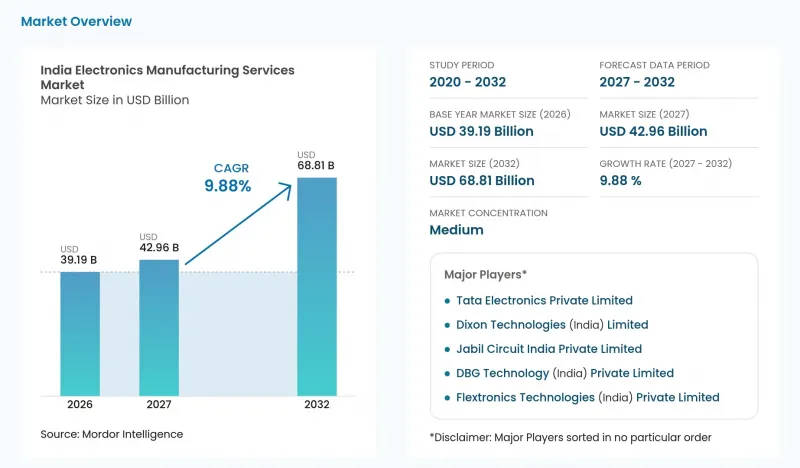
According to Mordor Intelligence, the India electronics manufacturing services market size is expected to increase from USD 39.19 billion in 2026 to USD 42.96 billion in 2027 and reach USD 68.81 billion by 2032, growing at a CAGR of 9.88% over 2027-2032.
This report is segmented by Service Type (Electronics Manufacturing Services and more), Business Model (Contract Manufacturing and more), Manufacturing Process (Surface Mount Technology and more), and End-user (Consumer Electronics and more). The market forecasts are provided in terms of value (USD), based on availability.
India Electronics Manufacturing Services Market Trends and Insights
Government Incentives Under PLI 2.0 and Component Schemes
Component incentives can make assembly expansion more practical by supporting the suppliers needed around a finished-device factory. As of August 2026, the Electronics Component Manufacturing Scheme had approved 106 projects across 15 Indian states, with production underway at 38 approved plants. That operating subset gives electronics manufacturers a production base to consider when developing domestic sourcing arrangements. Under the Large Scale Electronics Manufacturing and IT Hardware 2.0 PLI schemes, 59 companies reported incremental production in fiscal 2025-26 through December 2025. Together, these programs address component supply and finished-product manufacturing. Further starts among approved component projects could widen an assembler's local sourcing choices, making plant commissioning the step that adds potential suppliers beyond the operating base.
China-Plus-One Outsourcing Shift to India
In March 2025, Apple shipped a record of about 600 tons of iPhones from India to the United States after stepping up production ahead of US tariffs. In September 2026, Foxconn and Tata Electronics factories in India were making iPhone 18 Pro and Pro Max models for export ahead of their global sales launch. This example connects an Indian production location with the timing requirements of an international device program, widening the practical case for geographic diversification. India's broader electronics production value rose 15.8% in fiscal 2025-26 compared with fiscal 2024-25. For manufacturers seeking additional outsourcing business, the strategic value lies in demonstrating readiness for a customer's launch schedule, alongside the ability to supply substantial production volumes.
Dependence on Imported Semiconductors and Components
Assembly expansion cannot remove the exposure created by dependence on overseas chip production. In its May 2026 report, NITI Aayog estimated that imports met 90-95% of India's semiconductor consumption. It warned that disruptions among concentrated global suppliers could trigger shortages affecting industries including consumer electronics. For consumer-electronics assemblers, this potential interruption makes dependable chip availability as consequential as adding finished-product capacity. By September 18, 2026, 5 Indian semiconductor plants had commenced commercial production, supplying domestic needs and exports, according to the Ministry of Electronics and Information Technology. Even with those domestic plants producing, overseas chip availability can limit the delivery commitments an EMS provider makes, regardless of assembly space.
Other drivers and restraints analyzed in the detailed report include:
- Vertical Integration Into Component Manufacturing Boosting Value-Add
- Rising Domestic Demand for Smart Devices and EV Electronics
- Skill Shortages in High-Precision Electronics Assembly
For complete list of drivers and restraints, kindly check the Table Of Contents.
Segment Analysis
The electronics manufacturing services segment accounted for a 72.3% share of the India electronics manufacturing services market size in 2026 and is the fastest-growing segment, with a 10.3% CAGR over 2027-2032. This largest segment's scale is illustrated by Dixon Technologies' reported annual smartphone production capacity of 65 million units in India for fiscal 2025-26. Such capacity can allow brand customers to contract for production without creating a comparable manufacturing operation themselves. Dixon reports that capacity as serving both domestic and global brands, so its use depends on orders from several brand customers.
At the customer-program level, manufacturing services can extend into semiconductor assembly and test alongside finished-device production. Tata Electronics announced in February 2026 that it would manufacture Qualcomm Automotive Modules at its Jagiroad, Assam facility for Indian and global automakers. The planned applications included digital cockpits, infotainment, connectivity and intelligent vehicle systems. Qualcomm is the module provider and Tata Electronics is the announced manufacturing partner, placing an Indian EMS provider inside a global automotive platform's network of module manufacturers.
Contract manufacturing represented a 61.59% India electronics manufacturing services market share in 2026, making it the largest segment. By May 20, 2025, Dixon's wholly owned subsidiary Padget Electronics Private Limited had started manufacturing Alcatel smartphones under a contract with NxtCell India Private Limited. The arrangement separates the contracting counterparty from the manufacturing entity and the consumer-facing brand, illustrating how a single production program can involve distinct commercial roles. For a brand-linked program, this structure creates a position for an EMS specialist through manufacturing execution, without requiring the supplier to own the device brand.
Hybrid, turnkey and other business models form the fastest-growing segment, with a 10.45% CAGR forecast over 2027-2032. Kaynes Technology India Limited attributed 51% of consolidated revenue in the first quarter of fiscal 2026-27 to OEM-turnkey printed circuit board assembly, under a business classification subject to change. Original design manufacturing involves a different development role, illustrated by Aimtron Electronics Limited's June 2025 agreement for a US digital-infrastructure buyer's transformer-free uninterruptible power supply system. Aimtron was to lead end-to-end development, with engineering and manufacturing planned in India. Choosing between these models can hinge on how much product-development responsibility a buyer transfers with the manufacturing assignment.
Complete Report Scope:
- By Service Type
- Electronics Manufacturing Services
- PCB Assembly
- Electromechanical Assembly/Box Build
- Prototyping
- Other Electronics Manufacturing Services
- Engineering Services
- Test and Development Implementation Services
- Logistics Services
- Other Service Types
- Electronics Manufacturing Services
- By Business Model
- Contract Manufacturing (CM)
- Original Design Manufacturing (ODM)
- Hybrid / Turnkey / Other Business Models
- By Manufacturing Process
- Surface Mount Technology (SMT)
- Through-Hole Technology (THT)
- Advanced Packaging / Hybrid Processes
- By End-user
- Mobile Devices (Smartphones and Tablets)
- Consumer Electronics
- Computer (PCs/Desktop/Laptops)
- Industrial
- Automotive
- Communication
- Lighting
- Medical
- Other End-users
List of Companies Covered in this Report:
- Dixon Technologies (India) Limited
- Bharat FIH Limited
- Foxconn Hon Hai Technology India Mega Development Private Limited
- Tata Electronics Private Limited
- DBG Technology (India) Private Limited
- Flextronics Technologies (India) Private Limited
- Tata Electronics Systems Solutions Private Limited
- Tata Electronics Products and Solutions Private Limited
- Samsung India Electronics Private Limited
- Jabil Circuit India Private Limited
- Sanmina-SCI India Private Limited
- Kaynes Technology India Limited
- Syrma SGS Technology Limited
- Avalon Technologies Limited
- Elin Electronics Limited
- Centum Electronics Limited
- Cyient DLM Limited
- Amber Enterprises India Limited
- SFO Technologies Private Limited
- Bhagwati Products Limited
Additional Benefits:
- The market estimate (ME) sheet in Excel format
- 3 months of analyst support
TABLE OF CONTENTS
1 INTRODUCTION
- 1.1 Study Assumptions and Market Definition
- 1.2 Scope of the Study
2 RESEARCH METHODOLOGY
3 EXECUTIVE SUMMARY
4 MARKET LANDSCAPE
- 4.1 Market Overview
- 4.2 Market Drivers
- 4.2.1 Government Incentives Under PLI 2.0 and Component Schemes
- 4.2.2 China-Plus-One Outsourcing Shift to India
- 4.2.3 Vertical Integration Into Component Manufacturing Boosting Value-Add
- 4.2.4 Rising Domestic Demand for Smart Devices and EV Electronics
- 4.2.5 Expansion of Export-Oriented Production-Linked Incentives
- 4.2.6 Adoption of Industry 4.0 Automation in Indian Factories
- 4.3 Market Restraints
- 4.3.1 Dependence on Imported Semiconductors and Components
- 4.3.2 Skill Shortages in High-Precision Electronics Assembly
- 4.3.3 Policy Uncertainty Post-PLI Phase-Out
- 4.3.4 Intensifying Price Competition Driving Margin Compression
- 4.4 Industry Value Chain Analysis
- 4.5 Regulatory Landscape
- 4.6 Technological Outlook
- 4.7 Porter's Five Forces Analysis
- 4.7.1 Threat of New Entrants
- 4.7.2 Bargaining Power of Suppliers
- 4.7.3 Bargaining Power of Buyers
- 4.7.4 Threat of Substitutes
- 4.7.5 Competitive Rivalry
- 4.8 Impact of Macroeconomic Factors on the Market
5 MARKET SIZE AND GROWTH FORECASTS (VALUE)
- 5.1 By Service Type
- 5.1.1 Electronics Manufacturing Services
- 5.1.1.1 PCB Assembly
- 5.1.1.2 Electromechanical Assembly/Box Build
- 5.1.1.3 Prototyping
- 5.1.1.4 Other Electronics Manufacturing Services
- 5.1.2 Engineering Services
- 5.1.3 Test and Development Implementation Services
- 5.1.4 Logistics Services
- 5.1.5 Other Service Types
- 5.1.1 Electronics Manufacturing Services
- 5.2 By Business Model
- 5.2.1 Contract Manufacturing (CM)
- 5.2.2 Original Design Manufacturing (ODM)
- 5.2.3 Hybrid / Turnkey / Other Business Models
- 5.3 By Manufacturing Process
- 5.3.1 Surface Mount Technology (SMT)
- 5.3.2 Through-Hole Technology (THT)
- 5.3.3 Advanced Packaging / Hybrid Processes
- 5.4 By End-user
- 5.4.1 Mobile Devices (Smartphones and Tablets)
- 5.4.2 Consumer Electronics
- 5.4.3 Computer (PCs/Desktop/Laptops)
- 5.4.4 Industrial
- 5.4.5 Automotive
- 5.4.6 Communication
- 5.4.7 Lighting
- 5.4.8 Medical
- 5.4.9 Other End-users
6 COMPETITIVE LANDSCAPE
- 6.1 Market Concentration
- 6.2 Strategic Moves
- 6.3 Market Share Analysis
- 6.4 Company Profiles (includes Global level Overview, Market level overview, Core Segments, Financials as available, Strategic Information, Market Rank/Share for key companies, Products and Services, and Recent Developments)
- 6.4.1 Dixon Technologies (India) Limited
- 6.4.2 Bharat FIH Limited
- 6.4.3 Foxconn Hon Hai Technology India Mega Development Private Limited
- 6.4.4 Tata Electronics Private Limited
- 6.4.5 DBG Technology (India) Private Limited
- 6.4.6 Flextronics Technologies (India) Private Limited
- 6.4.7 Tata Electronics Systems Solutions Private Limited
- 6.4.8 Tata Electronics Products and Solutions Private Limited
- 6.4.9 Samsung India Electronics Private Limited
- 6.4.10 Jabil Circuit India Private Limited
- 6.4.11 Sanmina-SCI India Private Limited
- 6.4.12 Kaynes Technology India Limited
- 6.4.13 Syrma SGS Technology Limited
- 6.4.14 Avalon Technologies Limited
- 6.4.15 Elin Electronics Limited
- 6.4.16 Centum Electronics Limited
- 6.4.17 Cyient DLM Limited
- 6.4.18 Amber Enterprises India Limited
- 6.4.19 SFO Technologies Private Limited
- 6.4.20 Bhagwati Products Limited
7 MARKET OPPORTUNITIES AND FUTURE OUTLOOK
- 7.1 White-Space and Unmet-Need Assessment

