PUBLISHER: Mordor Intelligence | PRODUCT CODE: 2184730

PUBLISHER: Mordor Intelligence | PRODUCT CODE: 2184730
North America Roofing - Market Share Analysis, Industry Trends & Statistics, Growth Forecasts (2026 - 2031)
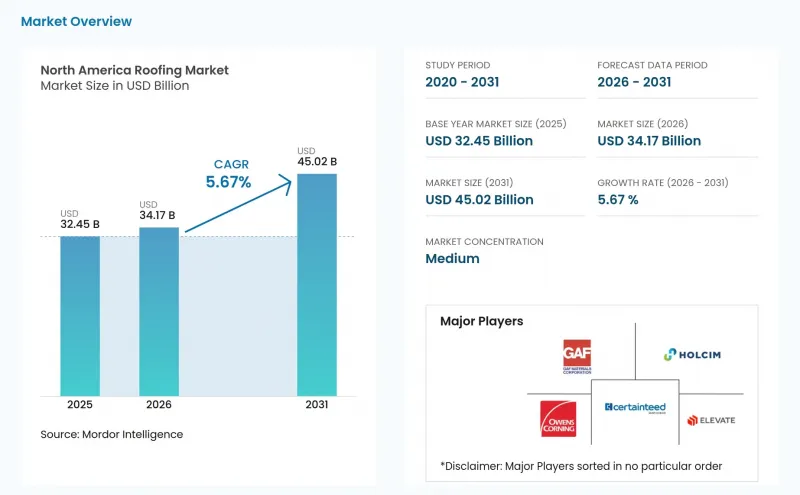
According to Mordor Intelligence, the North America roofing market size was valued at USD 32.45 billion in 2025 and is estimated to grow from USD 34.17 billion in 2026 to reach USD 45.02 billion by 2031, at a CAGR of 5.67% during the forecast period (2026-2031).
North America Roofing Market Trends and Insights
Aging Roof Stock and Sustained Reroofing Intensity
The North America roofing market continues to benefit from the large wave of roofs installed during the housing expansion of the 1990s and early 2000s, many of which are now deep into replacement years. That demand is less tied to consumer sentiment than many building products categories because roof failure or visible deterioration usually forces action within a limited time window. The labor outlook supports this view, as the US Bureau of Labor Statistics expects roofer employment to grow by 6% from 2024 to 2034 and to see 12,700 openings per year over the decade. Commercial demand shows the same pattern, with Carlisle noting that reroofing accounted for nearly 70% of its commercial roofing business in late 2025. This makes the North America roofing market more stable than categories that depend mostly on new building starts.
Severe-Weather and Hail Resilience Upgrades
The North America roofing market is also being boosted by a clear shift toward products that reduce storm-related losses and insurance claims. The Insurance Institute for Business & Home Safety, or IBHS, reported that the FORTIFIED program passed 100,000 designations in May 2026, and more than half of those designations were achieved in the last 3 years. That pace shows that resilience has moved from an optional premium feature to a standard consideration in many storm-prone areas. Carriers have reinforced the trend by offering meaningful discounts for qualifying roofs, which makes the upgrade case easier for homeowners and property managers. As a result, the North America roofing market is seeing faster adoption of impact-resistant shingles, better fastening methods, and higher-specification replacement systems.
Asphalt, Metal, and Installed-Cost Inflation
The North America roofing market still faces margin pressure from raw material and installed-cost inflation, especially in price-sensitive residential work. The Producer Price Index for Asphalt Paving and Roofing Materials Manufacturing rose to 377.7 in January 2026 from 365.2 in December 2025, which shows how quickly petroleum-linked costs can move through the supply chain. Contractors often face a difficult timing issue because materials can reset faster than customer budgets or insurance allowances. Installed pricing also remains elevated when crews are scarce, suggesting labor inflation can persist even as commodity costs soften. This does not remove demand from the North America roofing market, but it can delay project starts and compress contractor profitability.
Other drivers and restraints analyzed in the detailed report include:
- Cool-Roof and Energy-Code Compliance
- Warehouse, Data-Center, and Public-Infrastructure Buildouts
- Skilled-Labor Shortages and Installation Bottlenecks
For complete list of drivers and restraints, kindly check the Table Of Contents.
Segment Analysis
Asphalt shingles accounted for 58.6% of revenue in 2025, keeping them the defining material category in the North America roofing market. That lead reflects a long-established fit with detached housing, broad installer familiarity, and a lower upfront cost than many alternative systems. The category is also moving up in value, not just in volume, because resilience standards and insurer preferences are pushing more buyers toward premium architectural and impact-resistant lines. In February 2026, GAF expanded national availability of Timberline Ultra High Definition shingles with a Class 4 impact rating under Underwriters Laboratories 2218, and TAMKO introduced HailGuard with a hail warranty in the same month. These launches show how the North America roofing market is raising the performance floor inside its largest material segment.
Single-ply membranes are forecast to grow at a 7.26% CAGR through 2031, making them the fastest-moving material group in the North America roofing market. Demand is being supported by data centers, logistics facilities, and other low-slope projects where speed of installation, seam quality, and long-term energy performance matter. Thermoplastic Polyolefin, or TPO, Ethylene Propylene Diene Monomer, or EPDM, and Polyvinyl Chloride, or PVC, remain the key products in this group. Modified bitumen stays relevant in demanding climates, while metal roofing continues to gain acceptance where durability and insurance economics justify the higher initial cost. The broader North America roofing industry is therefore seeing a shift toward a mix, where asphalt maintains the largest base while membranes and metal capture more of the premium and commercial opportunities.
Complete Report Scope:
- By Material Type
- Asphalt Shingles
- Clay & Concrete Tiles
- Metal Roofing
- Bituminous / Modified Bitumen Membranes
- Single-Ply Membranes (TPO, EPDM, and PVC)
- Wood
- Others
- By Construction Type
- New Construction
- Reroofing and Replacement
- By Application
- Residential
- Commercial
- Industrial
- Institutional
- Others
- By Country
- United States
- Canada
- Mexico
List of Companies Covered in this Report:
- GAF Materials Corporation
- Owens Corning
- CertainTeed LLC
- Holcim Building Envelope
- Elevate Commercial Roofing Systems
- Carlisle Construction Materials
- SOPREMA Inc.
- Sika Corporation
- Johns Manville
- IKO Industries Ltd.
- TAMKO Building Products LLC
- Atlas Roofing Corporation
- Duro-Last Inc.
- Malarkey Roofing Products
- Westlake Royal Roofing Solutions
- Eagle Roofing Products
- Polyglass U.S.A., Inc.
- Siplast
- PABCO Roofing Products
- Henry Company
Additional Benefits:
- The market estimate (ME) sheet in Excel format
- 3 months of analyst support
TABLE OF CONTENTS
1 Introduction
- 1.1 Study Assumptions & Market Definition
- 1.2 Scope of the Study
2 Research Methodology
3 Executive Summary
4 Market Landscape
- 4.1 Market Overview
- 4.2 Market Drivers
- 4.2.1 Aging roof stock and reroofing intensity
- 4.2.2 Severe-weather and hail resilience upgrades
- 4.2.3 Cool-roof and energy-code compliance
- 4.2.4 Warehouse, data-center, and public-infrastructure buildouts
- 4.2.5 Insurer-backed FORTIFIED and Class-4 adoption
- 4.2.6 AI and drone claims workflows shortening replacement cycles
- 4.3 Market Restraints
- 4.3.1 Asphalt, metal, and installed-cost inflation
- 4.3.2 Skilled-labor shortages and installation bottlenecks
- 4.3.3 Limited tear-off recycling and landfill pressure
- 4.3.4 Insurance documentation and code-compliance burden
- 4.4 Value / Supply-Chain Analysis
- 4.5 Regulatory Landscape
- 4.6 Technological Outlook
- 4.7 Cost Structure Analysis
- 4.8 Replacement Market Dynamics
- 4.9 Porter's Five Forces
- 4.9.1 Threat of New Entrants
- 4.9.2 Bargaining Power of Suppliers
- 4.9.3 Bargaining Power of Buyers
- 4.9.4 Threat of Substitutes
- 4.9.5 Competitive Rivalry
5 Market Size & Growth Forecasts (Value)
- 5.1 By Material Type
- 5.1.1 Asphalt Shingles
- 5.1.2 Clay & Concrete Tiles
- 5.1.3 Metal Roofing
- 5.1.4 Bituminous / Modified Bitumen Membranes
- 5.1.5 Single-Ply Membranes (TPO, EPDM, and PVC)
- 5.1.6 Wood
- 5.1.7 Others
- 5.2 By Construction Type
- 5.2.1 New Construction
- 5.2.2 Reroofing and Replacement
- 5.3 By Application
- 5.3.1 Residential
- 5.3.2 Commercial
- 5.3.3 Industrial
- 5.3.4 Institutional
- 5.3.5 Others
- 5.4 By Country
- 5.4.1 United States
- 5.4.2 Canada
- 5.4.3 Mexico
6 Competitive Landscape
- 6.1 Market Concentration
- 6.2 Strategic Moves
- 6.3 Company Profiles {(includes Global level Overview, Market level overview, Core Segments, Financials as available, Strategic Information, Market Rank/Share for key companies, Products & Services, and Recent Developments)}
- 6.3.1 GAF Materials Corporation
- 6.3.2 Owens Corning
- 6.3.3 CertainTeed LLC
- 6.3.4 Holcim Building Envelope
- 6.3.5 Elevate Commercial Roofing Systems
- 6.3.6 Carlisle Construction Materials
- 6.3.7 SOPREMA Inc.
- 6.3.8 Sika Corporation
- 6.3.9 Johns Manville
- 6.3.10 IKO Industries Ltd.
- 6.3.11 TAMKO Building Products LLC
- 6.3.12 Atlas Roofing Corporation
- 6.3.13 Duro-Last Inc.
- 6.3.14 Malarkey Roofing Products
- 6.3.15 Westlake Royal Roofing Solutions
- 6.3.16 Eagle Roofing Products
- 6.3.17 Polyglass U.S.A., Inc.
- 6.3.18 Siplast
- 6.3.19 PABCO Roofing Products
- 6.3.20 Henry Company
7 Market Opportunities & Future Outlook
- 7.1 White-space & unmet-need assessment

