PUBLISHER: Mordor Intelligence | PRODUCT CODE: 2184731

PUBLISHER: Mordor Intelligence | PRODUCT CODE: 2184731
Europe Roofing - Market Share Analysis, Industry Trends & Statistics, Growth Forecasts (2026 - 2031)
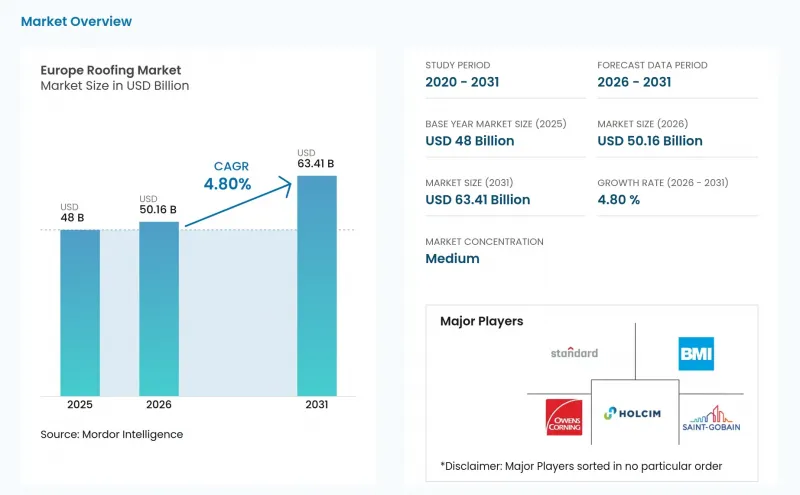
According to Mordor Intelligence, the Europe roofing market size is projected to expand from USD 48 billion in 2025 and USD 50.16 billion in 2026 to USD 63.41 billion by 2031, registering a CAGR of 4.80% between 2026 and 2031.
Europe Roofing Market Trends and Insights
EU Renovation Wave and EPBD Near-Zero-Energy Retrofit Mandates
The revised EPBD is a central demand driver for the Europe roofing market because it links building upgrades to national energy targets. It requires member states to renovate the 16% worst-performing nonresidential buildings by 2030 and reduce residential primary energy consumption by 16% by the same year. Roof insulation and envelope work can help owners meet these targets because the roof is a major point of heat loss. Member states must introduce renovation-passport schemes by May 2026, giving building owners phased plans that can include later roof improvements. The Commission assessed 15 National Building Renovation Plans in July 2026, which set primary-energy reduction targets ranging from 24% to 73% by 2050. This makes demand less dependent on short-term housing starts and more connected to planned building upgrades.
National Climate-Neutrality Targets Accelerating Cool-Roof and Green-Roof Adoption
Climate targets are changing roof specifications across the Europe roofing market, especially for public and larger commercial buildings. The EPBD recognizes green roofs and cool roofs as measures that can reduce heating and cooling needs. Biosolar roofs combine vegetation with photovoltaic panels and can reduce panel-surface temperatures, supporting electricity output and system life. Germany has maintained green-roof support and requirements since 1998, while municipalities in the Netherlands, Austria, and Switzerland use comparable approaches. The directive also requires solar installations on new public nonresidential buildings from 2026 and on existing nonresidential buildings above 250 square meters from 2030. Wienerberger completed its acquisition of the remaining stake in GSE Integration in July 2025, bringing in-roof photovoltaic technology into its European roofing offer.
Energy-Price Volatility Raising Bitumen and PVC Input Costs
Feedstock volatility creates an immediate margin risk for producers in the Europe roofing market. Bitumen costs are tied to crude oil and refinery output, while thermoplastic polyolefin, or TPO, and polyvinyl chloride, or PVC, resin costs follow propylene and ethylene markets. Changes in supply conditions can complicate purchasing decisions for membrane producers that cannot lock in stable costs. Energy surcharges on membrane contracts can then reach contractors and make retrofit budgets less predictable. Bituminous and modified-bitumen membranes are especially exposed because manufacturing depends on both crude-oil prices and natural-gas costs. This exposure can delay discretionary retrofit decisions when project budgets must be revised.
Other drivers and restraints analyzed in the detailed report include:
- Rising Hailstorm and Wildfire Frequency In Southern And Central Europe Driving Impact-Resistant Systems
- Circular-Economy Regulation Pushing Recyclable and Bio-Based Roofing Materials
- Stringent CE Marking, REACH, And Fire-Classification Compliance Costs
For complete list of drivers and restraints, kindly check the Table Of Contents.
Segment Analysis
Clay and concrete tiles accounted for 36.2% of the Europe roofing market in 2025, making them the largest material category. Their durability, thermal mass, and fit with heritage requirements support replacement demand across the large stock of pitched residential roofs in France, Italy, and Spain. Wienerberger completed the Terreal acquisition in March 2024, adding 28 production sites and the Creaton brand to its clay-tile and pitched-roof operations. Bituminous membranes remain important for flat commercial roofs, where waterproofing performance remains the first requirement.
Metal roofing is the fastest-growing material, with a forecast CAGR of 6.4% from 2026 to 2031. Lighter weight can make metal systems useful for older frames that cannot easily support heavier replacements. Standing-seam and concealed-fix profiles can also simplify photovoltaic mounting and speed installation when labor is limited. Single-ply systems, including TPO, ethylene propylene diene monomer, or EPDM, and PVC membranes, are gaining use on larger industrial roofs because they work with drainage layouts and solar installations. Asphalt shingles and wood continue to serve narrower residential renovation needs where design preference or heritage rules matter. The Europe roofing industry is moving toward materials that connect roof performance with energy and solar requirements.
Complete Report Scope:
- By Material Type
- Asphalt Shingles
- Clay & Concrete Tiles
- Metal Roofing
- Bituminous / Modified Bitumen Membranes
- Single-Ply Membranes (TPO, EPDM, and PVC)
- Wood
- Others
- By Construction Type
- New Construction
- Reroofing and Replacement
- By Application
- Residential
- Commercial
- Industrial
- Institutional
- Others
- By Countries
- Germany
- United Kingdom
- France
- Italy
- Spain
- Rest of Europe
List of Companies Covered in this Report:
- Standard Industries
- BMI Group
- Owens Corning
- Holcim
- Saint-Gobain
- SOPREMA Group
- Sika AG
- Johns Manville
- IKO Industries
- Wienerberger AG
- Etex Group
- TechnoNICOL Corporation
- Carlisle Companies
- Standard Industries
- Icopal (BMI Group)
- Braas Monier (Edilians)
Additional Benefits:
- The market estimate (ME) sheet in Excel format
- 3 months of analyst support
TABLE OF CONTENTS
1 Introduction
- 1.1 Study Assumptions & Market Definition
- 1.2 Scope of the Study
2 Research Methodology
3 Executive Summary
4 Market Landscape
- 4.1 Market Overview
- 4.2 Market Drivers
- 4.2.1 EU Renovation Wave and EPBD near-zero-energy retrofit mandates
- 4.2.2 National climate-neutrality targets accelerating cool-roof and green-roof adoption
- 4.2.3 Rising hailstorm and wildfire frequency in Southern and Central Europe driving impact-resistant systems
- 4.2.4 Circular-economy regulation pushing recyclable and bio-based roofing materials
- 4.2.5 Heritage-building restoration codes sustaining demand for specialty clay and slate systems
- 4.2.6 Consolidation of regional roofing contractors expanding installation capacity
- 4.3 Market Restraints
- 4.3.1 Stringent CE marking, REACH and fire-classification compliance costs
- 4.3.2 Energy-price volatility raising bitumen and PVC input costs
- 4.3.3 Aging skilled-tradesperson workforce in Western Europe
- 4.3.4 Slow permitting cycles for historic and protected-building renovations
- 4.4 Value / Supply-Chain Analysis
- 4.5 Regulatory Landscape
- 4.6 Technological Outlook
- 4.7 Cost Structure Analysis
- 4.8 Trend and impacts of Roofing on Replacements
- 4.9 Porter's Five Forces Analysis
- 4.9.1 Threat of New Entrants
- 4.9.2 Bargaining Power of Suppliers
- 4.9.3 Bargaining Power of Buyers
- 4.9.4 Threat of Substitutes
- 4.9.5 Competitive Rivalry
5 Market Size & Growth Forecasts (Value USD Billion)
- 5.1 By Material Type
- 5.1.1 Asphalt Shingles
- 5.1.2 Clay & Concrete Tiles
- 5.1.3 Metal Roofing
- 5.1.4 Bituminous / Modified Bitumen Membranes
- 5.1.5 Single-Ply Membranes (TPO, EPDM, and PVC)
- 5.1.6 Wood
- 5.1.7 Others
- 5.2 By Construction Type
- 5.2.1 New Construction
- 5.2.2 Reroofing and Replacement
- 5.3 By Application
- 5.3.1 Residential
- 5.3.2 Commercial
- 5.3.3 Industrial
- 5.3.4 Institutional
- 5.3.5 Others
- 5.4 By Countries
- 5.4.1 Germany
- 5.4.2 United Kingdom
- 5.4.3 France
- 5.4.4 Italy
- 5.4.5 Spain
- 5.4.6 Rest of Europe
6 Competitive Landscape
- 6.1 Market Concentration
- 6.2 Strategic Moves
- 6.3 Company Profiles {(includes Global level Overview, Market level overview, Core Segments, Financials as available, Strategic Information, Market Rank/Share for key companies, Products & Services, and Recent Developments)}
- 6.3.1 Standard Industries
- 6.3.2 BMI Group
- 6.3.3 Owens Corning
- 6.3.4 Holcim
- 6.3.5 Saint-Gobain
- 6.3.6 SOPREMA Group
- 6.3.7 Sika AG
- 6.3.8 Johns Manville
- 6.3.9 IKO Industries
- 6.3.10 Wienerberger AG
- 6.3.11 Etex Group
- 6.3.12 TechnoNICOL Corporation
- 6.3.13 Carlisle Companies
- 6.3.14 Standard Industries
- 6.3.15 Icopal (BMI Group)
- 6.3.16 Braas Monier (Edilians)
7 Market Opportunities & Future Outlook
- 7.1 White-space & unmet-need assessment

