PUBLISHER: Mordor Intelligence | PRODUCT CODE: 2187788

PUBLISHER: Mordor Intelligence | PRODUCT CODE: 2187788
United States Roofing - Market Share Analysis, Industry Trends & Statistics, Growth Forecasts (2027 - 2032)
According to Mordor Intelligence, the United States roofing market size was valued at USD 34.66 billion in 2026 and estimated to grow from USD 36.74 billion in 2027 to reach USD 48.43 billion by 2032, at a CAGR of 5.68% during the forecast period (2027-2032).
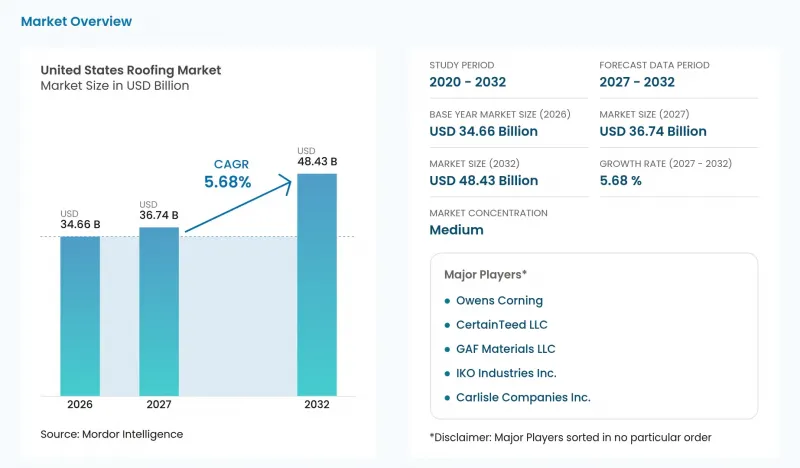
This report is segmented by Material Type (Asphalt Shingles, Single-Ply Membranes, and more), Construction Type (Reroofing and Replacement and New Construction), Application (Residential, Commercial, and more), and Geography (South East, Mid West, and more). The market forecasts are provided in terms of value (USD), based on availability.
United States Roofing Market Trends and Insights
Aging roof stock and higher replacement cycles sustaining reroofing demand
The installed roof's remaining service life can create replacement demand independently of a new building decision. In Verisk's participating-insurer data, approximately 29% of US homes with asphalt shingles had less than 4 years of remaining useful roof life in 2025. That concentration near the end of service life makes condition-led replacement a recurring source of potential projects. The work can address buildings already in use, so its timing depends on roof condition rather than the creation of new floor area. The near-term sales task is therefore condition assessment that identifies which roofs within this cohort need full replacement and which can continue in service.
Storm and hail events increasing insurance-funded repairs and re-roof activity
Hail can concentrate reroofing demand even when the broader claims cycle weakens. In Verisk's participating-insurer data, catastrophe hail represented 33% of roofing claims in 2025 and primarily drove the increase in catastrophe-claim volume. Overall roof-claim volume nevertheless fell nearly 20% that year. State Farm paid more than USD 5.6 billion in US hail-related claims in 2025 across affected property, including homes and vehicles. For roofing contractors, these findings point to event-specific repair opportunities rather than uniform expansion across all insured roofs. Claim activity can therefore support a repair pipeline, with the commercial outcome determined by the roof work that insurers and property owners actually authorize.
Skilled labor shortages limiting contractor capacity and raising installation costs
Qualified crews can constrain roofing delivery independently of material availability. In Roofing Contractor's 2025 subscriber survey, 36% of commercial roofers identified finding qualified workers as a challenge. Separately, KPMG's 2026 summary of roofing survey findings reported increasing labor costs among 55% of surveyed US roofers in 2025. The availability problem limits how much work a contractor can undertake, while the cost problem raises the labor expense attached to that work. Adding more roofing-material supply cannot by itself expand the number of skilled crews available to install it. Owners can therefore face both a narrower installation window and a higher labor bill, even when a suitable roof system is available.
Other drivers and restraints analyzed in the detailed report include:
- Energy-efficiency upgrades boosting demand for cool roofs and better insulation systems
- Growth in logistics warehouses and data centers expanding commercial roofing installations
- Volatility in asphalt shingles, metal, and insulation input prices pressuring margins
For complete list of drivers and restraints, kindly check the Table Of Contents.
Segment Analysis
Asphalt shingles accounted for a 58.3% share of the United States roofing market size in 2026, making it the largest segment. Owens Corning estimated 2025 US asphalt-shingle volume at 143 million squares, excluding component shingles such as hip and ridge and starter strips. That material scale gives producers a substantial base over which to apply process improvements, linking small per-square changes to a large product category. Changes in material use or installation effort per square can therefore affect the economics of a wide annual workload, even without shifting to another material. Asphalt-shingle contractors can seek gains by improving execution within an established covering, concentrating technical effort on the large volume already served by that material.
Single-ply membranes (TPO, EPDM, and PVC) are forecast to be the fastest-growing segment, at a 7.35% CAGR during 2027-2032. In February 2026, Sika Corporation USA broke ground on a single-ply thermoplastic membrane plant in Sealy, Texas, with operations then expected in spring 2027. Its timing places prospective thermoplastic membrane output near the beginning of the forecast period, aligning the supply plan with future project demand. A producer can use a dedicated plant to support a specific membrane offer, while contractors seeking that work would need to deliver the corresponding roof assemblies. The addressable opportunity is therefore in thermoplastic roof projects that match the planned output, concentrating the investment's effect within the wider single-ply category.
Complete Report Scope:
- By Material Type
- Asphalt Shingles
- Clay & Concrete Tiles
- Metal Roofing
- Bituminous / Modified Bitumen Membranes
- Single-Ply Membranes (TPO, EPDM, and PVC)
- Wood
- Others
- By Construction Type
- New Construction
- Reroofing and Replacement
- By Application
- Residential
- Commercial
- Industrial
- Institutional
- Others
- By Geography
- North East
- Mid West
- South East
- West
- South West
List of Companies Covered in this Report:
- GAF Materials LLC
- Owens Corning
- CertainTeed LLC
- Carlisle Companies Inc.
- IKO Industries Inc.
- TAMKO Building Products
- Johns Manville
- Elevate Commercial Roofing Systems (Amrize)
- Sika AG
- Soprema Group
- Atlas Roofing Corporation
- QXO, Inc.
- CentiMark Corporation
- Tecta America
- Flynn Group of Companies
- Baker Roofing Company
- Nations Roof
- IronHead Roofing
- Malarkey Roofing Products
- Best Contracting Services
Additional Benefits:
- The market estimate (ME) sheet in Excel format
- 3 months of analyst support
TABLE OF CONTENTS
1 INTRODUCTION
- 1.1 Study Assumptions and Market Definition
- 1.2 Scope of the Study
2 RESEARCH METHODOLOGY
3 EXECUTIVE SUMMARY
4 MARKET LANDSCAPE
- 4.1 Market Overview
- 4.2 Market Drivers
- 4.2.1 Aging roof stock and higher replacement cycles sustaining reroofing demand
- 4.2.2 Storm and hail events increasing insurance-funded repairs and re-roof activity
- 4.2.3 Energy-efficiency upgrades boosting demand for cool roofs and better insulation systems
- 4.2.4 Growth in logistics warehouses and data centers expanding commercial roofing installations
- 4.2.5 Adoption of solar-ready and rooftop PV-integrated roofing increasing upgrade spending
- 4.3 Market Restraints
- 4.3.1 Skilled labor shortages limiting contractor capacity and raising installation costs
- 4.3.2 Volatility in asphalt shingles, metal, and insulation input prices pressuring margins
- 4.3.3 Permitting, insurance, and warranty requirements extending project timeline
- 4.4 Industry Value Chain Analysis
- 4.5 Regulatory Landscape
- 4.6 Technological Outlook
- 4.7 Porter's Five Forces Analysis
- 4.7.1 Threat of New Entrants
- 4.7.2 Bargaining Power of Suppliers
- 4.7.3 Bargaining Power of Buyers
- 4.7.4 Threat of Substitutes
- 4.7.5 Competitive Rivalry
5 MARKET SIZE AND GROWTH FORECASTS (VALUE)
- 5.1 By Material Type
- 5.1.1 Asphalt Shingles
- 5.1.2 Clay & Concrete Tiles
- 5.1.3 Metal Roofing
- 5.1.4 Bituminous / Modified Bitumen Membranes
- 5.1.5 Single-Ply Membranes (TPO, EPDM, and PVC)
- 5.1.6 Wood
- 5.1.7 Others
- 5.2 By Construction Type
- 5.2.1 New Construction
- 5.2.2 Reroofing and Replacement
- 5.3 By Application
- 5.3.1 Residential
- 5.3.2 Commercial
- 5.3.3 Industrial
- 5.3.4 Institutional
- 5.3.5 Others
- 5.4 By Geography
- 5.4.1 North East
- 5.4.2 Mid West
- 5.4.3 South East
- 5.4.4 West
- 5.4.5 South West
6 COMPETITIVE LANDSCAPE
- 6.1 Market Concentration
- 6.2 Strategic Moves
- 6.3 Market Share Analysis
- 6.4 Company Profiles (includes Global level Overview, Market level overview, Core Segments, Financials as available, Strategic Information, Market Rank/Share for key companies, Products and Services, and Recent Developments)
- 6.4.1 GAF Materials LLC
- 6.4.2 Owens Corning
- 6.4.3 CertainTeed LLC
- 6.4.4 Carlisle Companies Inc.
- 6.4.5 IKO Industries Inc.
- 6.4.6 TAMKO Building Products
- 6.4.7 Johns Manville
- 6.4.8 Elevate Commercial Roofing Systems (Amrize)
- 6.4.9 Sika AG
- 6.4.10 Soprema Group
- 6.4.11 Atlas Roofing Corporation
- 6.4.12 QXO, Inc.
- 6.4.13 CentiMark Corporation
- 6.4.14 Tecta America
- 6.4.15 Flynn Group of Companies
- 6.4.16 Baker Roofing Company
- 6.4.17 Nations Roof
- 6.4.18 IronHead Roofing
- 6.4.19 Malarkey Roofing Products
- 6.4.20 Best Contracting Services
7 MARKET OPPORTUNITIES AND FUTURE OUTLOOK
- 7.1 White-Space and Unmet-Need Assessment

