PUBLISHER: Mordor Intelligence | PRODUCT CODE: 2184967

PUBLISHER: Mordor Intelligence | PRODUCT CODE: 2184967
Nursing Education - Market Share Analysis, Industry Trends & Statistics, Growth Forecasts (2026 - 2031)
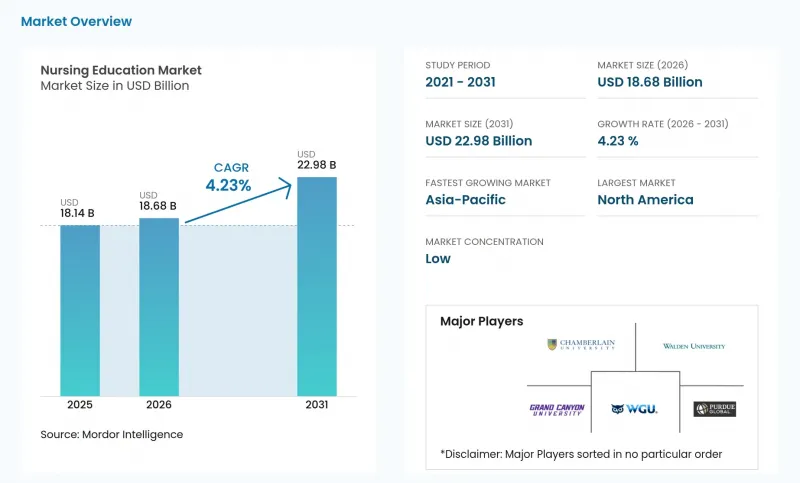
According to Mordor Intelligence, the global nursing education market was valued at USD 18.14 billion in 2025 and estimated to grow from USD 18.68 billion in 2026 to reach USD 22.98 billion by 2031, at a CAGR of 4.23% during the forecast period (2026 - 2031).
Global Nursing Education Market Trends and Insights
Rising Global Shortage of Qualified Nurses
The Global Nursing Education Market is driven by a persistent workforce deficit across regions. A significant nursing shortage has been reported globally, with a large proportion of nurses concentrated in countries representing less than half of the world's population. This imbalance continues to elevate training demand in underserved areas while sustaining replacement needs in developed systems with high retirement rates. In the United States, employment for registered nurses is expected to grow steadily over the next decade, with workforce replacement alone supporting consistent enrollment demand. The market remains closely tied to policy and supply constraints rather than discretionary factors, ensuring resilience even during periods of reduced education spending.
Expansion of Online and Hybrid Nursing Programs
The growth of online and hybrid formats remains a key factor in the expansion of the Global Nursing Education Market. These formats allow institutions to address physical capacity limitations while upholding clinical standards. Enrollment in nursing schools has shown consistent growth, reflecting the increasing adoption of models that improve access and streamline pathways to licensure. Hybrid structures are particularly effective, as they enable theoretical learning to be conducted online while practical training is supported through simulations and partner facilities. This approach is especially advantageous for working professionals and career changers, as flexible schedules reduce barriers to continuing education and sustain demand in the market. The competitiveness of programs now depends more on clinical partnerships, learner support, and ensuring accessible completion pathways rather than solely focusing on campus-based offerings.
High Tuition Costs and Learner Financing Constraints
Challenges related to tuition and financing continue to affect the Global Nursing Education Market, particularly in postgraduate and advanced practice programs, where program costs are higher. A decline in the percentage of young individuals aspiring to become nurses has been observed, reflecting concerns about the return on investment in nursing education. Educational institutions are addressing these issues by offering financing support instead of waiting for policy changes. For instance, Western Governors University's ReNEW Fund highlights how affordability has shifted from being solely a social policy concern to a competitive factor. The market is expected to favor providers that offer flexible program delivery while minimizing financial barriers, especially for learners sensitive to costs.
Other drivers and restraints analyzed in the detailed report include:
- Growing Demand for Advanced Practice and Specialized Nursing Skills
- Expansion of Nursing Simulation, Virtual Labs, and Digital Assessment Tools
- Faculty Shortages and Aging Nurse Educator Workforce
For complete list of drivers and restraints, kindly check the Table Of Contents.
Segment Analysis
Undergraduate nursing programs accounted for 51.83% of the Global Nursing Market size in 2025, highlighting the importance of entry-level education. Entry-level Bachelor of Science in Nursing (BSN) enrollment in the United States rose to 267,889 students in 2025, a 4.9% increase from the previous year, marking three consecutive years of growth after a decline in 2022. The BSN pathway continues to grow as hospitals in 23 United States either required or strongly preferred this credential for initial hiring, reducing the role of associate degree programs. Diploma and certificate programs remain relevant in lower-income regions where four-year degree requirements are not yet standard, sustaining undergraduate program scale while addressing cost-sensitive systems.
Postgraduate and advanced nursing programs are the fastest-growing segment in the Global Nursing Education Market, projected to grow at a 5.62% compound annual growth rate (CAGR) through 2031. Doctor of Nursing Practice (DNP) enrollment increased to 44,976 in 2025, a 5.9% year-over-year rise, while master's program enrollment grew by 4.8% to 146,718 students. Practice-focused DNP pathways are expanding, while research-focused PhD enrollment continues to decline, reflecting a preference for credentials aligned with workforce roles, clinical autonomy, and leadership opportunities. Postgraduate program growth is reshaping the market's future composition, though undergraduate programs remain the largest revenue contributor.
Complete Report Scope:
- By Program Type
- Diploma & Certificate Nursing Programs
- Undergraduate Nursing Programs (Associate Degree + BSN)
- Postgraduate & Advanced Nursing Programs
- Doctoral Nursing Programs (PhD, DNP)
- By Delivery Mode
- Traditional Classroom-Based
- Online Nursing Education
- Blended Learning
- By End User
- Individual Students
- Healthcare Organizations & Employers
- Government & Public Institutions
- By Geography
- North America
- United States
- Canada
- Mexico
- South America
- Brazil
- Peru
- Chile
- Argentina
- Rest of South America
- Europe
- United Kingdom
- Germany
- France
- Spain
- Italy
- BENELUX (Belgium, Netherlands, and Luxembourg)
- NORDICS (Denmark, Finland, Iceland, Norway, and Sweden)
- Rest of Europe
- Asia-Pacific
- India
- China
- Japan
- Australia
- South Korea
- South East Asia (Singapore, Malaysia, Thailand, Indonesia, Vietnam, and Philippines)
- Rest of Asia-Pacific
- Middle East and Africa
- United Arab Emirates
- Saudi Arabia
- South Africa
- Nigeria
- Rest of Middle East and Africa
- North America
Geography Analysis
North America accounted for 35.72% of the Global Nursing Education Market in 2025, driven by the United States' large nursing workforce, extensive university infrastructure, and consistent replacement demand. Registered nurse employment in the United States is projected to grow 5% from 2024 to 2034, with 189,100 annual job openings expected. Capacity challenges persist, as shown by record application volumes and the rejection of qualified applicants due to faculty and clinical resource constraints. Canada supports stable enrollment through public healthcare demand and established university systems.
Europe remains a mature market, with growth driven by workforce replacement needs and regulatory requirements. The United Kingdom is a key market, with King's College London ranked among the top 2 globally in nursing in 2026. Germany, France, Spain, and Italy face medium-term replacement demand due to aging healthcare workforces, while stricter accreditation and public funding limit private sector expansion. BENELUX and Nordic countries prioritize stable institutional investment through national competency frameworks.
Asia Pacific is the fastest-growing region, with a projected 5.83% CAGR through 2031. Growth is driven by large populations, workforce shortages, and interest in internationally benchmarked training. Penn Nursing's Vietnam partnership established the first ACEN-accredited nursing program in the country, aligning curricula with global standards. Africa faces educational deficits, creating demand for new nursing programs. This aligns with World Health Organization findings on uneven nurse distribution and underserved populations. The Global Nursing Education Market relies on capacity creation, regulatory alignment, and access-focused delivery models rather than demand generation alone.
- Chamberlain University
- Walden University
- Western Governors University
- Grand Canyon University
- Purdue University Global
- Frontier Nursing University
- University of Edinburgh School of Health in Social Science
- Capella University
- Johns Hopkins University
- University of Pennsylvania
- University of California, Los Angeles
- University of Michigan School of Nursing
- University of Toronto
- University of Sydney
- University of North Carolina at Chapel Hill
- University of Washington
- Emory University
- Monash University
- Duke University School of Nursing
- King's College London
Additional Benefits:
- The market estimate (ME) sheet in Excel format
- 3 months of analyst support
TABLE OF CONTENTS
1 Introduction
- 1.1 Study Assumptions and Market Definition
- 1.2 Scope of the Study
2 Research Methodology
3 Executive Summary
4 Market Landscape
- 4.1 Market Overview
- 4.2 Market Drivers
- 4.2.1 Rising Global Shortage of Qualified Nurses
- 4.2.2 Expansion of Online and Hybrid Nursing Programs
- 4.2.3 Growing Demand for Advanced Practice and Specialized Nursing Skills
- 4.2.4 Expansion of Nursing Simulation, Virtual Labs, and Digital Assessment Tools
- 4.2.5 Government Funding, Scholarships, and Workforce Pipeline Programs
- 4.2.6 Rising Cross-Border Mobility and International Curriculum Alignment
- 4.3 Market Restraints
- 4.3.1 High Tuition Costs and Learner Financing Constraints
- 4.3.2 Faculty Shortages and Aging Nurse Educator Workforce
- 4.3.3 Limited Clinical Placement Capacity and Hospital Partnership Bottlenecks
- 4.3.4 Accreditation Complexity and Cross-Jurisdiction Curriculum Compliance Burden
- 4.4 Value Chain / Supply Chain Analysis
- 4.5 Regulatory Landscape
- 4.6 Technological Outlook
- 4.7 Porter's Five Forces Analysis
- 4.7.1 Threat of New Entrants
- 4.7.2 Bargaining Power of Buyers
- 4.7.3 Bargaining Power of Suppliers
- 4.7.4 Threat of Substitutes
- 4.7.5 Competitive Rivalry
5 Market Size & Growth Forecasts (USD, Value)
- 5.1 By Program Type
- 5.1.1 Diploma & Certificate Nursing Programs
- 5.1.2 Undergraduate Nursing Programs (Associate Degree + BSN)
- 5.1.3 Postgraduate & Advanced Nursing Programs
- 5.1.4 Doctoral Nursing Programs (PhD, DNP)
- 5.2 By Delivery Mode
- 5.2.1 Traditional Classroom-Based
- 5.2.2 Online Nursing Education
- 5.2.3 Blended Learning
- 5.3 By End User
- 5.3.1 Individual Students
- 5.3.2 Healthcare Organizations & Employers
- 5.3.3 Government & Public Institutions
- 5.4 By Geography
- 5.4.1 North America
- 5.4.1.1 United States
- 5.4.1.2 Canada
- 5.4.1.3 Mexico
- 5.4.2 South America
- 5.4.2.1 Brazil
- 5.4.2.2 Peru
- 5.4.2.3 Chile
- 5.4.2.4 Argentina
- 5.4.2.5 Rest of South America
- 5.4.3 Europe
- 5.4.3.1 United Kingdom
- 5.4.3.2 Germany
- 5.4.3.3 France
- 5.4.3.4 Spain
- 5.4.3.5 Italy
- 5.4.3.6 BENELUX (Belgium, Netherlands, and Luxembourg)
- 5.4.3.7 NORDICS (Denmark, Finland, Iceland, Norway, and Sweden)
- 5.4.3.8 Rest of Europe
- 5.4.4 Asia-Pacific
- 5.4.4.1 India
- 5.4.4.2 China
- 5.4.4.3 Japan
- 5.4.4.4 Australia
- 5.4.4.5 South Korea
- 5.4.4.6 South East Asia (Singapore, Malaysia, Thailand, Indonesia, Vietnam, and Philippines)
- 5.4.4.7 Rest of Asia-Pacific
- 5.4.5 Middle East and Africa
- 5.4.5.1 United Arab Emirates
- 5.4.5.2 Saudi Arabia
- 5.4.5.3 South Africa
- 5.4.5.4 Nigeria
- 5.4.5.5 Rest of Middle East and Africa
- 5.4.1 North America
6 Competitive Landscape
- 6.1 Market Concentration
- 6.2 Strategic Moves
- 6.3 Market Share Analysis
- 6.4 Company Profiles (includes Global Level Overview, Market Level Overview, Core Segments, Financials as available, Strategic Information, Market Rank/Share, Products and Services, Recent Developments)
- 6.4.1 Chamberlain University
- 6.4.2 Walden University
- 6.4.3 Western Governors University
- 6.4.4 Grand Canyon University
- 6.4.5 Purdue University Global
- 6.4.6 Frontier Nursing University
- 6.4.7 University of Edinburgh School of Health in Social Science
- 6.4.8 Capella University
- 6.4.9 Johns Hopkins University
- 6.4.10 University of Pennsylvania
- 6.4.11 University of California, Los Angeles
- 6.4.12 University of Michigan School of Nursing
- 6.4.13 University of Toronto
- 6.4.14 University of Sydney
- 6.4.15 University of North Carolina at Chapel Hill
- 6.4.16 University of Washington
- 6.4.17 Emory University
- 6.4.18 Monash University
- 6.4.19 Duke University School of Nursing
- 6.4.20 King's College London
7 Market Opportunities & Future Outlook
- 7.1 Market Opportunities
- 7.1.1 Accelerated Online-to-Clinical Bridge Programs
- 7.1.1.1 Employer-Sponsored Upskilling for Working Nurses
- 7.1.2 White-space and Unmet-Need Assessment
- 7.1.1 Accelerated Online-to-Clinical Bridge Programs

