PUBLISHER: Mordor Intelligence | PRODUCT CODE: 2185145

PUBLISHER: Mordor Intelligence | PRODUCT CODE: 2185145
Cross-Border E-Commerce Customs Clearance Services - Market Share Analysis, Industry Trends & Statistics, Growth Forecasts (2026 - 2031)
According to Mordor Intelligence, the cross-border e-commerce customs clearance services market size was valued at USD 12.97 billion in 2025 and is estimated to grow from USD 13.88 billion in 2026 to reach USD 20.20 billion by 2031, at a CAGR of 7.80% during the forecast period (2026-2031).
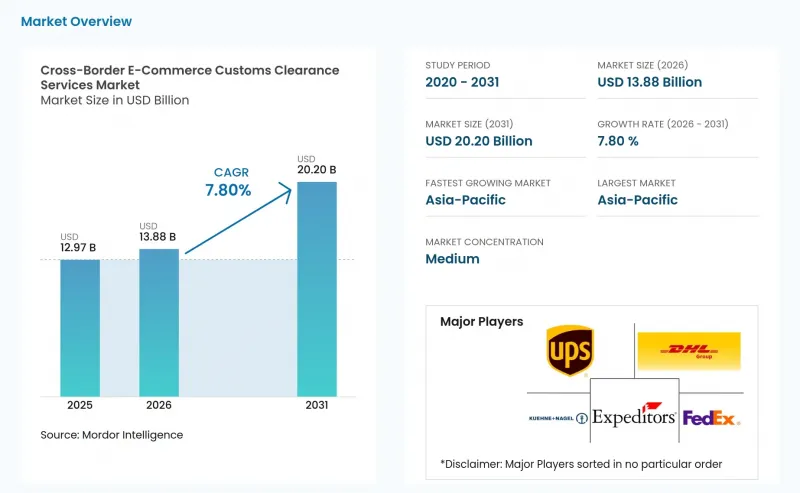
The cross-border e-commerce customs clearance services market is being reshaped by the end of duty-free treatment for many low-value shipments in the United States and the European Union. This report is Segmented by Service Type (Import, Export, and More), by Business Model (B2B, B2C, and C2C), by Mode of Transport (Air, Sea, Road, Rail, Postal, and Multimodal), by Product Category (Apparel, Electronics, Food, and More), and by Geography (North America, South America, Europe, Asia-Pacific, and MEA). The Market Forecasts are Provided in Terms of Value (USD).
Global Cross-Border E-Commerce Customs Clearance Services Market Trends and Insights
Cross-Border Parcel Volume Expansion
The cross-border e-commerce customs clearance services market benefits from continued growth in parcel movements between origin and destination countries. Asia-Pacific accounted for nearly two-thirds of global e-commerce sales, according to the Asian Development Bank. This concentration increases the need for customs documentation, duty calculation, and pre-arrival filing in the region's export corridors. Customs authorities face capacity limits as parcel volumes rise, which creates demand for licensed providers that can prepare formal entries and operate bonded storage. China's April 2026 trade facilitation action plan introduced 29 measures across 45 cities to improve clearance speed, compliance costs, and certificate issuance. These measures support a larger upstream flow of parcels entering organized export channels.
Mandatory Duty-Paid and Formal-Entry Workflows
The cross-border e-commerce customs clearance services market is gaining traction from parcels that now require formal processing. The United States ended duty-free de minimis treatment for China and Hong Kong in May 2025 and extended the suspension to all countries in August 2025. The United States Customs and Border Protection reported that de minimis shipment volumes declined from 1.36 billion in FY2024 to 942.5 million in FY2025. The remaining shipments require more detailed classification, duty payment, and filing activity. The European Union's USD 3.25 flat duty for eligible low-value consignments adds a separate processing requirement for goods entering its customs area. The Import Control System 2 requires advanced cargo information across road, rail, air, maritime, and postal transport, making accurate data submission central to clearance operations.
Tariff Volatility and Duty Stacking
Frequent tariff changes increase the workload for providers that manage cross-border entries. The World Trade Organization stated in 2025 that wider trade policy uncertainty could reduce global merchandise trade volumes by up to 1.5 percentage points. Changes in origin rules, product tariffs, and country rates make static compliance databases less reliable. Brokers may need to conduct post-entry corrections or duty refund work after the rules change. This work can raise revenue but also increase operating costs and customer uncertainty. Providers that guarantee landed costs at checkout face direct exposure when their duty schedules do not reflect the latest treatment.
Other drivers and restraints analyzed in the detailed report include:
- Marketplace and Direct-to-Consumer Internationalization
- Automated Classification and Landed-Cost Automation
- Fragmented Country Rules and Licensing Requirements
For complete list of drivers and restraints, kindly check the Table Of Contents.
Segment Analysis
Import customs clearance held 39.40% of the cross-border e-commerce customs clearance services market share in 2025. The segment reflects the large flow of consumer goods from Asian manufacturing centers to North America, Europe, and the Middle East. The change in low-value entry treatment in the United States and Europe has increased the number of shipments needing classification, duty payment, and broker submission. Export customs clearance is the next major activity because sellers need support with origin documentation and outbound declarations. India's courier export reforms and China's trade facilitation measures help move more exports through organized clearance channels. Transit and in-bond clearance serve specialized routes where cargo passes through an intermediate market without domestic entry.
Customs compliance and advisory has the highest forecast CAGR at 9.50% from 2026 to 2031. This service supports classification, country-of-origin assessment, tariff treatment, and compliance planning for shipments that no longer qualify for simplified treatment. The European customs reform raises the value of advisory support for platforms that take responsibility for import formalities. Duty and tax management is becoming more closely linked to advisory work because landed-cost programs need current duty data and post-entry reconciliation. Providers with both brokerage and advisory capability can manage the complete filing cycle. This creates a stronger service proposition than a basic document-submission model.
B2C held 53.69% of the cross-border e-commerce customs clearance services market size in 2025 and has the highest forecast CAGR at 9.34% through 2031. De minimis reform reduced some direct parcel flows into the United States, but the shipments that remain generate customs revenue per formal entry. The United States Customs and Border Protection recorded a decline in air freight bills of lading from 1.1 billion in FY2024 to 794.8 million in FY2025. High-volume sellers are also moving inventory into destination-country warehouses before individual orders are fulfilled. This shift creates demand for bonded warehousing, bulk import entries, and periodic customs processing. It also moves some B2C clearance work from the final parcel to the upstream inventory shipment.
B2B services support merchants moving stock to regional distribution centers for local fulfillment. This model is gaining relevance as brands alter fulfillment patterns after the United States and European policy changes. C2C is smaller by share, but digital platforms are incorporating duty calculation and documentation into their checkout processes. The European Union's approach places platform responsibility closer to the point of sale for many imports. That shift increases the role of outsourced customs support for marketplaces. It also makes compliance capability a practical requirement for cross-border peer-to-peer commerce.
Complete Report Scope:
- By Service Type
- Import Customs Clearance
- Export Customs Clearance
- Transit & In-Bond Customs Clearance
- Duty & Tax Management
- Customs Compliance & Advisory
- Other Customs Clearance Services
- By Business Model
- Business-to-Business (B2B)
- Business-to-Consumer (B2C)
- Consumer-to-Consumer (C2C)
- By Mode of Transport
- Air
- Sea
- Cross-Border Road
- Rail
- Postal Network
- Multimodal
- By Product Category
- Apparel & Footwear
- Automotive Parts & Accessories
- Consumer Electronics & Electrical Products
- Food & Beverages
- Health, Beauty & Personal Care
- Home & Household Products
- Industrial & Commercial Products
- Other Product Categories
- By Geography
- North America
- United States
- Canada
- Mexico
- South America
- Brazil
- Argentina
- Peru
- Chile
- Rest of South America
- Europe
- Germany
- United Kingdom
- France
- Italy
- Spain
- Russia
- Nordics (Denmark, Finland, Iceland, Norway, and Sweden)
- Rest of Europe
- Asia-Pacific
- China
- India
- Japan
- South Korea
- Australia
- Southeast Asia (ASEAN)
- Rest of Asia-Pacific
- Middle East and Africa
- Saudi Arabia
- United Arab Emirates
- Qatar
- South Africa
- Nigeria
- Egypt
- Rest of Middle East and Africa
- North America
Geography Analysis
Asia-Pacific held 31.40% of the cross-border e-commerce customs clearance services market share in 2025 and has the highest forecast CAGR at 9.52% through 2031. The region combines large export manufacturing bases with rising consumer imports. China, India, South Korea, Japan, and Southeast Asian economies contribute different origin and destination flows. China's trade facilitation program supports faster clearance, lower compliance costs, and improved certificate issuance across 45 cities. India has made policy changes that support organized courier exports and inventory-based cross-border selling.
North America is the second-largest regional market within the Cross-border e-commerce customs clearance services market. The United States suspension of de minimis treatment changed the entry profile for low-value shipments. The declared value of the United States-bound de minimis shipments declined from USD 64.6 billion in FY2024 to USD 48.1 billion in FY2025. The remaining flows create more formal entry activity per shipment. Mexico supports continuing demand along the United States and Mexico corridor through its role in nearshoring and regional distribution.
Europe has a significant share because it receives large volumes of parcels from China and other Asian exporters. The USD 3.25 flat duty, wider Import Control System 2 coverage, and customs reform have increased both formal entry requirements and advisory needs. Germany, the United Kingdom, and France require country-specific knowledge of product safety, tax reporting, and authorized trader procedures. South America, the Middle East, and Africa are smaller but growing areas where local licensing and valuation rules support demand for specialist customs providers.
- A.P. Moller - Maersk
- AIT Worldwide Logistics, Inc.
- Aramex PJSC
- DHL Group
- C.H. Robinson Worldwide, Inc.
- Customs Support Group B.V.
- DSV A/S
- Expeditors International of Washington, Inc.
- FedEx Corporation
- Flexport, Inc.
- GEODIS
- Kuehne+Nagel
- Livingston International Inc.
- Nippon Express Holdings, Inc.
- Rhenus Group
- SEKO Logistics
- Sinotrans Limited
- United Parcel Service, Inc.
- Zonos, Inc.
Additional Benefits:
- The market estimate (ME) sheet in Excel format
- 3 months of analyst support
TABLE OF CONTENTS
1 INTRODUCTION
- 1.1 Study Assumptions and Market Definition
- 1.2 Scope of the Study
2 RESEARCH METHODOLOGY
3 EXECUTIVE SUMMARY
4 MARKET LANDSCAPE
- 4.1 Market Overview
- 4.2 Market Drivers
- 4.2.1 Cross-Border Parcel Volume Expansion
- 4.2.2 Mandatory Duty-Paid and Formal-Entry Workflows
- 4.2.3 Marketplace and Direct-to-Consumer Internationalization
- 4.2.4 Structured Pre-Arrival Data and Platform Accountability
- 4.2.5 SME Adoption of Outsourced Customs Operations
- 4.2.6 AI-Assisted Classification and Landed-Cost Automation
- 4.3 Market Restraints
- 4.3.1 Tariff Volatility and Duty Stacking
- 4.3.2 Poor SKU-Level Data and Misclassification Liability
- 4.3.3 Fragmented Country Rules and Licensing Requirements
- 4.3.4 Postal and Carrier Exception-Handling Bottlenecks
- 4.4 Value / Supply-Chain Analysis
- 4.5 Regulatory Landscape
- 4.6 Technological Outlook
- 4.7 Porter's Five Forces Analysis
- 4.7.1 Bargaining Power of Suppliers
- 4.7.2 Bargaining Power of Buyers
- 4.7.3 Threat of New Entrants
- 4.7.4 Threat of Substitutes
- 4.7.5 Competitive Rivalry
- 4.8 Impact of Geopolitical Events on the Market
5 Market Size & Growth Forecasts (Value in USD)
- 5.1 By Service Type
- 5.1.1 Import Customs Clearance
- 5.1.2 Export Customs Clearance
- 5.1.3 Transit & In-Bond Customs Clearance
- 5.1.4 Duty & Tax Management
- 5.1.5 Customs Compliance & Advisory
- 5.1.6 Other Customs Clearance Services
- 5.2 By Business Model
- 5.2.1 Business-to-Business (B2B)
- 5.2.2 Business-to-Consumer (B2C)
- 5.2.3 Consumer-to-Consumer (C2C)
- 5.3 By Mode of Transport
- 5.3.1 Air
- 5.3.2 Sea
- 5.3.3 Cross-Border Road
- 5.3.4 Rail
- 5.3.5 Postal Network
- 5.3.6 Multimodal
- 5.4 By Product Category
- 5.4.1 Apparel & Footwear
- 5.4.2 Automotive Parts & Accessories
- 5.4.3 Consumer Electronics & Electrical Products
- 5.4.4 Food & Beverages
- 5.4.5 Health, Beauty & Personal Care
- 5.4.6 Home & Household Products
- 5.4.7 Industrial & Commercial Products
- 5.4.8 Other Product Categories
- 5.5 By Geography
- 5.5.1 North America
- 5.5.1.1 United States
- 5.5.1.2 Canada
- 5.5.1.3 Mexico
- 5.5.2 South America
- 5.5.2.1 Brazil
- 5.5.2.2 Argentina
- 5.5.2.3 Peru
- 5.5.2.4 Chile
- 5.5.2.5 Rest of South America
- 5.5.3 Europe
- 5.5.3.1 Germany
- 5.5.3.2 United Kingdom
- 5.5.3.3 France
- 5.5.3.4 Italy
- 5.5.3.5 Spain
- 5.5.3.6 Russia
- 5.5.3.7 Nordics (Denmark, Finland, Iceland, Norway, and Sweden)
- 5.5.3.8 Rest of Europe
- 5.5.4 Asia-Pacific
- 5.5.4.1 China
- 5.5.4.2 India
- 5.5.4.3 Japan
- 5.5.4.4 South Korea
- 5.5.4.5 Australia
- 5.5.4.6 Southeast Asia (ASEAN)
- 5.5.4.7 Rest of Asia-Pacific
- 5.5.5 Middle East and Africa
- 5.5.5.1 Saudi Arabia
- 5.5.5.2 United Arab Emirates
- 5.5.5.3 Qatar
- 5.5.5.4 South Africa
- 5.5.5.5 Nigeria
- 5.5.5.6 Egypt
- 5.5.5.7 Rest of Middle East and Africa
- 5.5.1 North America
6 COMPETITIVE LANDSCAPE
- 6.1 Market Concentration
- 6.2 Key Strategic Moves in the Market
- 6.3 Market Share Analysis
- 6.4 Company Profiles (includes Global Level Overview, Market Level Overview, Core Segments, Financials as available, Strategic Information, Geographic/Network Coverage, Products and Services, Recent Developments)
- 6.4.1 A.P. Moller - Maersk
- 6.4.2 AIT Worldwide Logistics, Inc.
- 6.4.3 Aramex PJSC
- 6.4.4 DHL Group
- 6.4.5 C.H. Robinson Worldwide, Inc.
- 6.4.6 Customs Support Group B.V.
- 6.4.7 DSV A/S
- 6.4.8 Expeditors International of Washington, Inc.
- 6.4.9 FedEx Corporation
- 6.4.10 Flexport, Inc.
- 6.4.11 GEODIS
- 6.4.12 Kuehne+Nagel
- 6.4.13 Livingston International Inc.
- 6.4.14 Nippon Express Holdings, Inc.
- 6.4.15 Rhenus Group
- 6.4.16 SEKO Logistics
- 6.4.17 Sinotrans Limited
- 6.4.18 United Parcel Service, Inc.
- 6.4.19 Zonos, Inc.
7 MARKET OPPORTUNITIES AND FUTURE OUTLOOK
- 7.1 White-Space and Unmet-Need Assessment

