PUBLISHER: Mordor Intelligence | PRODUCT CODE: 2185183

PUBLISHER: Mordor Intelligence | PRODUCT CODE: 2185183
India Modern Methods Of Construction - Market Share Analysis, Industry Trends & Statistics, Growth Forecasts (2027 - 2032)
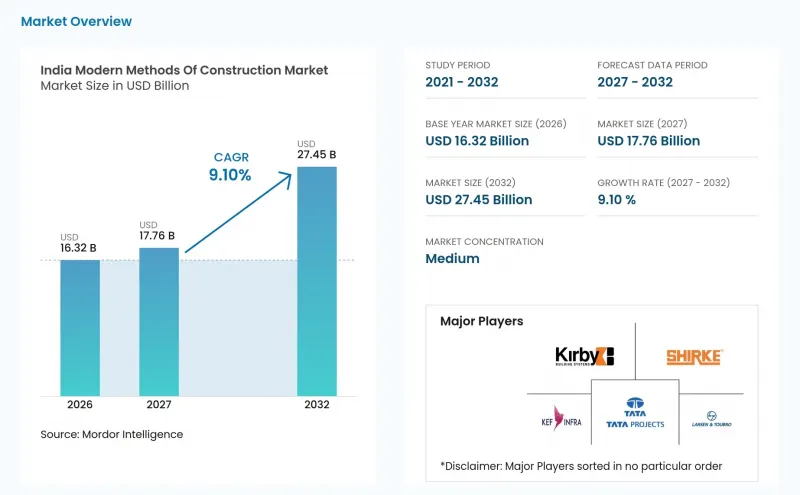
According to Mordor Intelligence, the India modern methods of construction market size is projected to be USD 16.32 billion in 2026, USD 17.76 billion in 2027, and reach USD 27.45 billion by 2032, growing at a CAGR of 9.10% from 2027 to 2032.
India Modern Methods Of Construction Market Trends and Insights
Urban Housing and Rental-Housing Shortages
India's shortage of affordable urban homes gives India's modern construction market a large volume case. The supply-to-demand ratio across 8 major cities declined from 1.05 in 2019 to 0.36 in 2025, which indicates a persistent gap between available homes and demand. UN-Habitat places the existing affordable urban housing shortage at 9.6 million units and expects cumulative demand to reach 30 million units by 2030; Mumbai's price-to-income ratio of 14.3 shows why many median-income households cannot access formal ownership. Factory production can shorten building cycles by 30% to 50%, which makes it relevant for projects operating under public delivery targets. The India modern methods of construction market benefits when housing providers need consistent delivery across repetitive unit designs.
Government Affordable-Housing and Infrastructure Programs
Government procurement is a central source of demand for India's modern methods of construction market. Under the combined PMAY-U and PMAY-U 2.0 programs, more than 1.25 crore homes have been sanctioned, and more than 1 crore homes have been completed and delivered as of August 2026. PMAY-U 2.0, launched in September 2024, seeks to support 1 crore additional beneficiaries by 2029. Its Technology Innovation Grant and the Housing Technology Challenge India have placed precast and 3D printing systems within formal housing delivery programs. The government has also approved demonstration housing projects in Chhattisgarh, Puducherry, and Rajasthan to show cost-effective construction technologies. These programs encourage contractors to use repeatable systems when project schedules and quality checks are closely monitored.
Skilled-Labor Shortages and Schedule Compression
A shortage of skilled workers is increasing the value of controlled factory work in India's modern methods of construction market. India's construction sector faces a shortage of 2 million skilled workers, including carpenters, electricians, plumbers, masons, and formwork specialists. The Project Management Institute projects that India will need 395,000 additional construction project professionals by 2035. Limited access to trained trades can extend project schedules and increase the chance of rework when less experienced workers replace specialists. Off-site systems move more work into a managed production environment and reduce the number of skilled activities required at a project site. L&T has linked labor cost and skill scarcity to a global modularization opportunity of USD 100 billion to USD 150 billion over 5 years.
Other drivers and restraints analyzed in the detailed report include:
- Rapid Expansion of Industrial, Data-Center, and Logistics Assets
- Fragmented State-Level Approval and Building Code Systems
- Limited Heavy-Module Transport and Crane Infrastructure
For complete list of drivers and restraints, kindly check the Table Of Contents.
Segment Analysis
Prefabricated & modular construction held a 98.70% share in 2026. This established segment includes panelized systems, volumetric modules, and hybrid configurations used in housing, light commercial buildings, and institutional facilities. Light gauge steel panels, structural insulated panels, and timber-frame panels support projects that need a fast enclosure and consistent detailing. Precast concrete, steel-framed, and timber-framed volumetric units are used for repetitive buildings such as staff housing, student accommodation, and hotels. Hybrid systems retain a conventional structural frame while shifting panels and fit-out work into factories.
The Ministry of Housing and Urban Affairs has approved demonstration housing projects in Chhattisgarh, Puducherry, and Rajasthan under PMAY-U 2.0, which supports verified construction methods in public housing. EPACK Prefab Technologies reported 45% revenue growth in its prefab business in the financial year 2026, reaching INR 15,253 million, equivalent to USD 182 million in supplied material. 3D construction is the fastest-growing construction type, with a 31.80% CAGR projected through 2032. Demonstration projects planned for Goa, Nagpur, and Thiruvananthapuram are intended to move 3D concrete printing beyond pilots. Andhra Pradesh has also launched a PMAY-G pilot for 177 3D-printed homes in Guntur district, with CSIR-CBRI support and an outlay of INR 13.9 crore, equivalent to USD 1.7 million in the supplied material.
Complete Report Scope:
- By Construction Type
- Prefabricated & Modular Construction
- Panelized Systems
- Structural Insulated Panels (SIPs)
- Timber/Wood Frame Panels
- Light Gauge Steel (LGS) Panels
- Others
- Volumetric Modules
- Steel-Framed Volumetric Modules
- Timber-Framed Volumetric Modules
- Concrete (Precast/Monolithic) Volumetric Modules
- Others
- Hybrid Modular Construction
- Panelized Systems
- 3D Construction
- Extrusion Method
- Power Bonding Method
- Others
- Other Construction Methods
- Prefabricated & Modular Construction
- By Material Type
- Concrete
- Glass
- Metal
- Timber
- Other Material Type
- By Application
- Residential
- Commercial
- Other Application (Industrial, Institutional, Energy and Utilities, Infrastructure)
- By Cities
- Mumbai Metropolitan Region
- Delhi NCR
- Pune
- Bengaluru
- Hyderabad
- Chennai
- Kolkata
- Ahmedabad
- Rest of India
List of Companies Covered in this Report:
- Larsen & Toubro Limited
- Tata Projects Limited
- B. G. Shirke Construction Technology Pvt. Ltd.
- Kirby Building Systems and Structures India Private Limited
- KEF Infra
- Everest Industries Limited
- Pennar Industries Limited
- Magicrete Building Solutions
- Shapoorji Pallonji Group
- EPACK Prefab Technologies Limited
- Interarch Building Solutions Limited
- Tata BlueScope Steel Private Limited
- Zamil Steel Buildings India Private Limited
- Jindal Buildsys Limited
- Godrej Construction
- Mivan India
- Elematic India
- PERI India Private Limited
- RMD Kwikform India Private Limited
- Speed 4 Prefab Solutions
Additional Benefits:
- The market estimate (ME) sheet in Excel format
- 3 months of analyst support
TABLE OF CONTENTS
1 Introduction
- 1.1 Study Assumptions and Market Definition
- 1.2 Scope of the Study
2 Research Methodology
3 Executive Summary
4 Market Landscape
- 4.1 Market Overview
- 4.2 Market Drivers
- 4.2.1 Urban Housing and Rental-Housing Shortages
- 4.2.2 Government Affordable-Housing and Infrastructure Programs
- 4.2.3 Skilled-Labor Shortages and Schedule Compression
- 4.2.4 Rapid Expansion of Industrial, Data-Center, and Logistics Assets
- 4.2.5 Growing Adoption of BIM, DfMA, and Precast Systems
- 4.2.6 Demand for Cost-Controlled Construction in Tier-2 and Tier-3 Cities
- 4.3 Market Restraints
- 4.3.1 Fragmented State-Level Approval and Building-Code Systems
- 4.3.2 Limited Heavy-Module Transport and Crane Infrastructure
- 4.3.3 Low Factory Utilization Risk Outside Major Corridors
- 4.3.4 Buyer Preference for Conventional On-Site Construction
- 4.4 Value Chain Analysis
- 4.5 Regulatory Landscape
- 4.6 Technological Outlook
- 4.7 Customer and Buyer Landscape
- 4.7.1 Developers and Housebuilders
- 4.7.2 Government and Public-Sector Buyers
- 4.7.3 Main Contractors and Engineering Procurement Construction Firms
- 4.7.4 Healthcare, Education, Hospitality, and Industrial Asset Owners
- 4.7.5 Buyer Decision Criteria and Adoption Barriers
- 4.8 Insights into Prefabricated Construction Technologies
- 4.8.1 Insulated Precast System
- 4.8.2 Insulated Concrete Forms
- 4.8.3 Formwork/Tunnel Formwork
- 4.8.4 Concrete Modular
- 4.8.5 Modular Light Gauge Steel
- 4.8.6 Structural Light Gauge Steel
- 4.8.7 Autoclaved Aerated Concrete
- 4.9 Industry Attractiveness - Porter's Five Forces Analysis
- 4.9.1 Bargaining Power of Suppliers
- 4.9.2 Bargaining Power of Buyers
- 4.9.3 Threat of New Entrants
- 4.9.4 Threat of Substitutes
- 4.9.5 Intensity of Competitive Rivalry
5 Market Size and Growth Forecasts
- 5.1 By Construction Type
- 5.1.1 Prefabricated & Modular Construction
- 5.1.1.1 Panelized Systems
- 5.1.1.1.1 Structural Insulated Panels (SIPs)
- 5.1.1.1.2 Timber/Wood Frame Panels
- 5.1.1.1.3 Light Gauge Steel (LGS) Panels
- 5.1.1.1.4 Others
- 5.1.1.2 Volumetric Modules
- 5.1.1.2.1 Steel-Framed Volumetric Modules
- 5.1.1.2.2 Timber-Framed Volumetric Modules
- 5.1.1.2.3 Concrete (Precast/Monolithic) Volumetric Modules
- 5.1.1.2.4 Others
- 5.1.1.3 Hybrid Modular Construction
- 5.1.1.1 Panelized Systems
- 5.1.2 3D Construction
- 5.1.2.1 Extrusion Method
- 5.1.2.2 Power Bonding Method
- 5.1.2.3 Others
- 5.1.3 Other Construction Methods
- 5.1.1 Prefabricated & Modular Construction
- 5.2 By Material Type
- 5.2.1 Concrete
- 5.2.2 Glass
- 5.2.3 Metal
- 5.2.4 Timber
- 5.2.5 Other Material Type
- 5.3 By Application
- 5.3.1 Residential
- 5.3.2 Commercial
- 5.3.3 Other Application (Industrial, Institutional, Energy and Utilities, Infrastructure)
- 5.4 By Cities
- 5.4.1 Mumbai Metropolitan Region
- 5.4.2 Delhi NCR
- 5.4.3 Pune
- 5.4.4 Bengaluru
- 5.4.5 Hyderabad
- 5.4.6 Chennai
- 5.4.7 Kolkata
- 5.4.8 Ahmedabad
- 5.4.9 Rest of India
6 Competitive Landscape
- 6.1 Market Concentration
- 6.2 Strategic Moves
- 6.3 Company Profiles (includes Global Level Overview, Market Level Overview, Core Segments, Financials as available, Strategic Information, Market Rank/Share, Products and Services, Recent Developments)
- 6.3.1 Larsen & Toubro Limited
- 6.3.2 Tata Projects Limited
- 6.3.3 B. G. Shirke Construction Technology Pvt. Ltd.
- 6.3.4 Kirby Building Systems and Structures India Private Limited
- 6.3.5 KEF Infra
- 6.3.6 Everest Industries Limited
- 6.3.7 Pennar Industries Limited
- 6.3.8 Magicrete Building Solutions
- 6.3.9 Shapoorji Pallonji Group
- 6.3.10 EPACK Prefab Technologies Limited
- 6.3.11 Interarch Building Solutions Limited
- 6.3.12 Tata BlueScope Steel Private Limited
- 6.3.13 Zamil Steel Buildings India Private Limited
- 6.3.14 Jindal Buildsys Limited
- 6.3.15 Godrej Construction
- 6.3.16 Mivan India
- 6.3.17 Elematic India
- 6.3.18 PERI India Private Limited
- 6.3.19 RMD Kwikform India Private Limited
- 6.3.20 Speed 4 Prefab Solutions
7 Market Opportunities & Future Outlook
- 7.1 White-space and Unmet-Need Assessment

