PUBLISHER: Mordor Intelligence | PRODUCT CODE: 2185190

PUBLISHER: Mordor Intelligence | PRODUCT CODE: 2185190
Indonesia Modern Methods Of Construction - Market Share Analysis, Industry Trends & Statistics, Growth Forecasts (2027 - 2032)
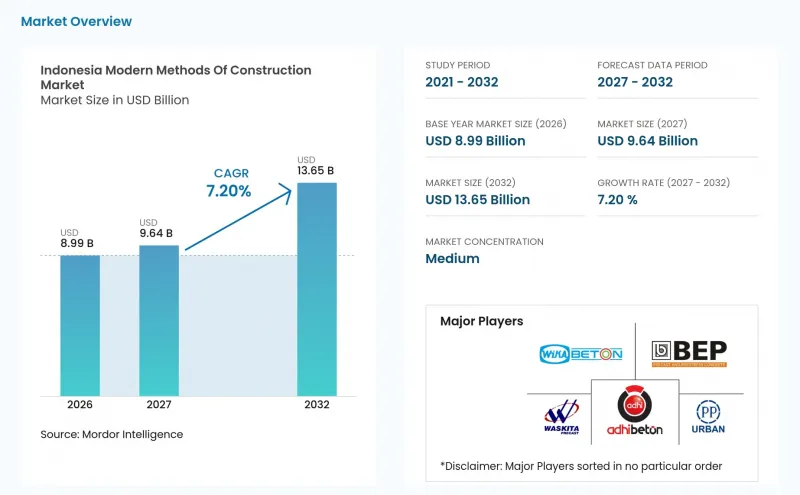
According to Mordor Intelligence, the Indonesia modern methods of construction market size was valued at USD 8.99 billion in 2026 and is estimated to grow from USD 9.64 billion in 2027 to reach USD 13.65 billion by 2032, at a CAGR of 7.20% during the forecast period (2027-2032).
Indonesia Modern Methods Of Construction Market Trends and Insights
Urban Housing Demand in Java and Secondary Cities
Indonesia's housing backlog stands at 9.9 million units, and 26.9 million households live in substandard homes, which keeps the need for affordable housing visible in both major cities and smaller urban areas. The 3 Million Homes Program allocated a 2026 budget for 790,000 units, and 324,213 units had been completed by mid-June. This volume favors systems that can repeat a proven design across many sites without requiring each project team to recreate the full construction process. Density in the Java-Bali corridor also favors panelized and volumetric approaches for compact residential buildings, where schedule certainty and a controlled production process can be more valuable than a fully site-built approach. A 2026 expert survey identified building standardization as the leading prerequisite for construction automation in mass housing. The Indonesia modern methods of construction market can benefit when housing programs translate standardized designs into recurring component orders.
National Infrastructure and New-Capital Development
Nusantara development provides a major non-Java project pipeline for the Indonesia modern methods of construction market. It places a large program in a location distant from the main Java manufacturing clusters. Parliament approved USD 333.5 million for Nusantara development in 2027 as part of planned funding across 2025-2028. The legislative and judicial complexes reached 16% construction progress in October 2026 and have a 2028 completion target. PT PP, PT Adhi Karya, and PT Jaya Konstruksi secured work for government buildings in the new capital, showing that large contractors are incorporating modern construction management methods into public projects. Resource and industrial locations in Kalimantan, Sulawesi, and Sumatra also require workforce housing that can be deployed with limited local site capacity, particularly where contractors must house employees before broader site infrastructure is complete. PT Adhi Karya's contract to build 74 Nutrition Supply and Processing Centers in 7 provinces using modular methods illustrates this need for repeatable, distributed delivery.
Inter-Island Shipping and Last-Mile Delivery Costs
Large modular components are difficult to move across an archipelago when shipping routes are designed mainly for consumer goods and food. The Sea Toll program carried 32,732 twenty-foot equivalent units across 104 ports in 2025, but its subsidies did not generally cover oversized construction freight. A 2026 Evergreen Journal study reported vessel utilization of 55-65% on eastern Indonesian routes, below the 80% threshold for commercial viability. Higher freight costs can remove some of the time advantage that factory-built systems offer because oversized components require coordinated shipping, handling, and final delivery rather than ordinary freight arrangements. Skills are another limitation because fewer than 10% of Indonesia's 8.2 million construction workers hold recognized competency certificates. The Ministry of Public Works is developing a registry for qualified technology applicators, but registration does not itself create local installation capacity.
Other drivers and restraints analyzed in the detailed report include:
- Precast Adoption for Repetitive Residential and Infrastructure Projects
- Demand for Disaster-Resilient and Climate-Adapted Buildings
- Permitting Variation Across Provinces and Municipalities
For complete list of drivers and restraints, kindly check the Table Of Contents.
Segment Analysis
Prefabricated & modular construction held 93.2% of the Indonesia modern methods of construction market share in 2026. The result reflects the use of established off-site methods in housing, infrastructure, and workforce accommodation. Panelized systems include light gauge steel panels, structural insulated panels, and timber-frame panels for low-rise residential projects. Volumetric modules are used more often where projects need repeatable rooms or remote-site housing. Hybrid modular systems also give institutional projects flexibility across different floor plans. The Indonesia modern methods of construction market therefore remains centered on methods that contractors already understand and can procure at scale. The installed base of precast production and contractor experience supports this position. The category can keep its lead even as newer methods gain more attention.
3D construction is the fastest-growing method at 28.40% CAGR through 2032. PT Modula Tiga Dimensi received a Technology Clearing Letter from the Ministry of Public Works for 3D Construction Printing in 2025, and its model house was certified for earthquake zones with an Sds value of 1.2g or less. Indocement and Modula3D established a Collaborative Hub at Citeureup in August 2025 to demonstrate commercial 3D construction printing. Indocement stated that the approach can reduce wall construction time by up to 70% and complete a simple house in 6 days. Autoconz 3DCP received a 68.3% domestic component certification for its 3D printing mortar, which supports eligibility for government procurement. These steps move 3D construction from a demonstration activity toward regulated project use. The Indonesia modern methods of construction market will still need installer capability and repeat project volumes for wider adoption.
Complete Report Scope:
- By Construction Type
- Prefabricated & Modular Construction
- Panelized Systems
- Structural Insulated Panels (SIPs)
- Timber/Wood Frame Panels
- Light Gauge Steel (LGS) Panels
- Others
- Volumetric Modules
- Steel-Framed Volumetric Modules
- Timber-Framed Volumetric Modules
- Concrete (Precast/Monolithic) Volumetric Modules
- Others
- Hybrid Modular Construction
- Panelized Systems
- 3D Construction
- Extrusion Method
- Power Bonding Method
- Others
- Other Construction Methods
- Prefabricated & Modular Construction
- By Material Type
- Concrete
- Glass
- Metal
- Timber
- Other Material Type
- By Application
- Residential
- Commercial
- Other Application (Industrial, Institutional, Energy and Utilities, Infrastructure)
- By Geography
- Java
- Sumatra
- Kalimantan
- Sulawesi
- Bali and Nusa Tenggara
- Rest of Indonesia
List of Companies Covered in this Report:
- PT Wijaya Karya Beton Tbk
- PT Waskita Beton Precast Tbk
- PT Beton Elemenindo Perkasa
- PT Adhi Persada Beton
- PT PP Urban
- PT Wijaya Karya Bangunan Gedung Tbk (WIKA Gedung)
- PT Nova Modular Indonesia
- Life House Modular
- AMODA
- PT Prefab Bajatama Internasional
- PT Risjadson Bhumi Nusantara (RCON)
- HAMURE
- PT Wijaya Karya (Persero) Tbk
- PT PP (Persero) Tbk
- PT Adhi Karya (Persero) Tbk
- PT Total Bangun Persada Tbk
- PT Jaya Konstruksi Manggala Pratama Tbk
- PT Nusa Raya Cipta Tbk
- PT Hutama Karya (Persero)
- PT Brantas Abipraya (Persero)
Additional Benefits:
- The market estimate (ME) sheet in Excel format
- 3 months of analyst support
TABLE OF CONTENTS
1 Introduction
- 1.1 Study Assumptions and Market Definition
- 1.2 Scope of the Study
2 Research Methodology
3 Executive Summary
4 Market Landscape
- 4.1 Market Overview
- 4.2 Market Drivers
- 4.2.1 Urban Housing Demand in Java and Secondary Cities
- 4.2.2 National Infrastructure and New-Capital Development
- 4.2.3 Fast-Track Workforce Housing and Industrial Facilities
- 4.2.4 Precast Adoption for Repetitive Residential and Infrastructure Projects
- 4.2.5 Construction Productivity Needs Across an Island Geography
- 4.2.6 Demand for Disaster-Resilient and Climate-Adapted Buildings
- 4.3 Market Restraints
- 4.3.1 Inter-Island Shipping and Last-Mile Delivery Costs
- 4.3.2 Limited Regional Factory and Skilled-Installer Coverage
- 4.3.3 Permitting Variation Across Provinces and Municipalities
- 4.3.4 Exposure to Currency, Material-Price, and Financing Volatility
- 4.4 Value Chain Analysis
- 4.5 Regulatory Landscape
- 4.6 Technological Outlook
- 4.7 Customer and Buyer Landscape
- 4.7.1 Developers and Housebuilders
- 4.7.2 Government and Public-Sector Buyers
- 4.7.3 Main Contractors and Engineering Procurement Construction Firms
- 4.7.4 Healthcare, Education, Hospitality, and Industrial Asset Owners
- 4.7.5 Buyer Decision Criteria and Adoption Barriers
- 4.8 Insights into Prefabricated Construction Technologies
- 4.8.1 Insulated Precast System
- 4.8.2 Insulated Concrete Forms
- 4.8.3 Formwork/Tunnel Formwork
- 4.8.4 Concrete Modular
- 4.8.5 Modular Light Gauge Steel
- 4.8.6 Structural Light Gauge Steel
- 4.8.7 Autoclaved Aerated Concrete
- 4.9 Industry Attractiveness - Porter's Five Forces Analysis
- 4.9.1 Bargaining Power of Suppliers
- 4.9.2 Bargaining Power of Consumers
- 4.9.3 Threat of New Entrants
- 4.9.4 Threat of Substitutes
- 4.9.5 Intensity of Competitive Rivalry
5 Market Size and Growth Forecasts
- 5.1 By Construction Type
- 5.1.1 Prefabricated & Modular Construction
- 5.1.1.1 Panelized Systems
- 5.1.1.1.1 Structural Insulated Panels (SIPs)
- 5.1.1.1.2 Timber/Wood Frame Panels
- 5.1.1.1.3 Light Gauge Steel (LGS) Panels
- 5.1.1.1.4 Others
- 5.1.1.2 Volumetric Modules
- 5.1.1.2.1 Steel-Framed Volumetric Modules
- 5.1.1.2.2 Timber-Framed Volumetric Modules
- 5.1.1.2.3 Concrete (Precast/Monolithic) Volumetric Modules
- 5.1.1.2.4 Others
- 5.1.1.3 Hybrid Modular Construction
- 5.1.1.1 Panelized Systems
- 5.1.2 3D Construction
- 5.1.2.1 Extrusion Method
- 5.1.2.2 Power Bonding Method
- 5.1.2.3 Others
- 5.1.3 Other Construction Methods
- 5.1.1 Prefabricated & Modular Construction
- 5.2 By Material Type
- 5.2.1 Concrete
- 5.2.2 Glass
- 5.2.3 Metal
- 5.2.4 Timber
- 5.2.5 Other Material Type
- 5.3 By Application
- 5.3.1 Residential
- 5.3.2 Commercial
- 5.3.3 Other Application (Industrial, Institutional, Energy and Utilities, Infrastructure)
- 5.4 By Geography
- 5.4.1 Java
- 5.4.2 Sumatra
- 5.4.3 Kalimantan
- 5.4.4 Sulawesi
- 5.4.5 Bali and Nusa Tenggara
- 5.4.6 Rest of Indonesia
6 Competitive Landscape
- 6.1 Market Concentration
- 6.2 Strategic Moves
- 6.3 Company Profiles (includes Global Level Overview, Market Level Overview, Core Segments, Financials as available, Strategic Information, Market Rank/Share, Products and Services, Recent Developments)
- 6.3.1 PT Wijaya Karya Beton Tbk
- 6.3.2 PT Waskita Beton Precast Tbk
- 6.3.3 PT Beton Elemenindo Perkasa
- 6.3.4 PT Adhi Persada Beton
- 6.3.5 PT PP Urban
- 6.3.6 PT Wijaya Karya Bangunan Gedung Tbk (WIKA Gedung)
- 6.3.7 PT Nova Modular Indonesia
- 6.3.8 Life House Modular
- 6.3.9 AMODA
- 6.3.10 PT Prefab Bajatama Internasional
- 6.3.11 PT Risjadson Bhumi Nusantara (RCON)
- 6.3.12 HAMURE
- 6.3.13 PT Wijaya Karya (Persero) Tbk
- 6.3.14 PT PP (Persero) Tbk
- 6.3.15 PT Adhi Karya (Persero) Tbk
- 6.3.16 PT Total Bangun Persada Tbk
- 6.3.17 PT Jaya Konstruksi Manggala Pratama Tbk
- 6.3.18 PT Nusa Raya Cipta Tbk
- 6.3.19 PT Hutama Karya (Persero)
- 6.3.20 PT Brantas Abipraya (Persero)
7 Market Opportunities & Future Outlook
- 7.1 White-Space and Unmet-Need Assessment

