PUBLISHER: Mordor Intelligence | PRODUCT CODE: 2185893

PUBLISHER: Mordor Intelligence | PRODUCT CODE: 2185893
India Beer - Market Share Analysis, Industry Trends & Statistics, Growth Forecasts (2027 - 2032)
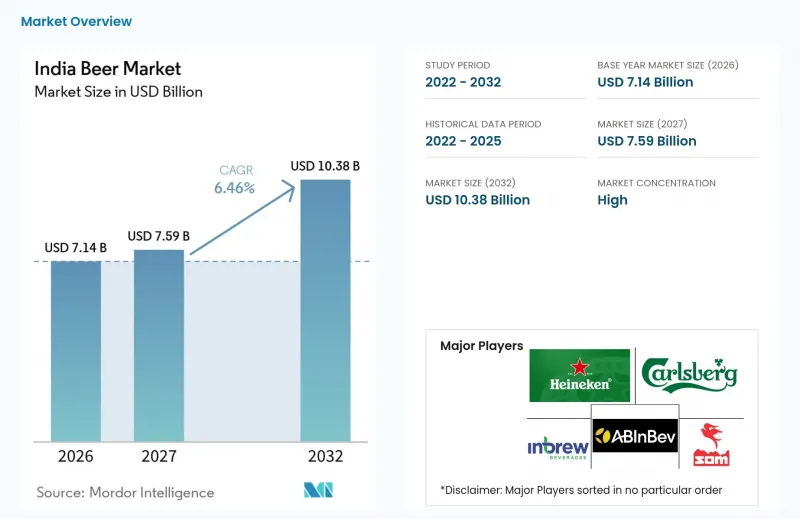
According to Mordor Intelligence, the Indian beer market size was valued at USD 7.14 billion in 2026 and estimated to grow from USD 7.59 billion in 2027 to reach USD 10.38 billion by 2032, at a CAGR of 6.46% during the forecast period (2027-2032).
India Beer Market Trends and Insights
Rising Demand for Premium and Super-Premium Beer Across Urban Markets
Premium beer is moving from a narrow urban niche into a larger value pool in the Indian beer market, especially where licensed retail and hospitality infrastructure are established. United Breweries has stated that it expects premium portfolio growth of 20-25% annually over the next 3-5 years, supporting continued investment in product assortment, retail execution, and brand visibility. Carlsberg reported that premium beer accounted for 43% of its Maharashtra volume mix in the first half of 2025, indicating stronger acceptance of higher-priced products in the state. This gives brewers reason to prioritize states where the availability of coolers, licensed outlets, entertainment venues, and consumer spending support a premium offering. Premium sales also give companies greater scope to invest in better packaging, outlet presentation, and locally produced international labels. The Indian beer market depends not only on greater beer consumption, but also on more occasions where consumers accept a better product mix.
Increasing Disposable Incomes and Consumer Willingness to Trade Up
Rising incomes support trade-up when premium beer is visible, served cold, and available through trusted licensed outlets. SOM Distilleries reported stronger premium adoption in tier-2 cities and linked it to premium walk-in stores and on-premise outlets, indicating that retail quality shapes demand as much as income alone. United Breweries expanded its premium cooler footprint to 37,000 stores by the second quarter of fiscal year 2026, up from 15,000 previously. Wider cooling coverage makes a premium choice more practical, as the product is ready for consumption at the point of purchase. It also lets brewers deepen sales in existing urban centers rather than relying solely on expansion into new states. As tier-2 preferences shift toward tier-1 consumption patterns, the Indian beer market gains access to potential premium buyers without expanding into untapped rural territories.
High State Excise Duties and Disproportionate Taxation on Beer
Beer's structural tax disadvantage relative to spirits is the market's most persistent demand suppressor. Excise duties on beer range from 65% ad valorem in West Bengal to 235% of manufacturing cost for strong beer in Maharashtra under the 2026 government schedules, per state notifications compiled by GST Munshi in 2026, with Rajasthan levying 200% of ex-brewery price on strong beer. The Brewers Association of India has consistently noted that alcohol in beer is taxed at a higher effective per-unit rate than in spirits, a structural inequity that limits beer's price competitiveness against hard liquor in the mass-market tier. India's constitutional framework, which places alcoholic beverages outside GST under Article 366(12A), gives each of India's 28 states full autonomy to set distinct excise structures, creating 36 separate compliance environments unique among consumer categories. Karnataka's May 2026 AIB duty reform is credible proof of concept that rationalization is achievable, but replication requires sustained political will in states where alcohol excise is among the top three revenue sources.
Other drivers and restraints analyzed in the detailed report include:
- Growth in Dining, Hospitality, and Entertainment Occasions
- Increasing Availability of International Premium Beer Brands
- Volatility in Barley, Malt, Hops and Other Brewing Ingredient Costs
For complete list of drivers and restraints, kindly check the Table Of Contents.
Segment Analysis
Lager held 42.23% of the Indian beer market share in 2026, making it the largest product type. Its lead reflects established mass-market brands, broad cold-chain coverage, and familiarity among consumers who prefer a straightforward beer choice. Strong lager above 5% ABV represented close to 80% of total beer volume, according to Carlsberg's India presentation. The segment provides the volume base for brewery utilization, licensed retail distribution, and brand extensions, while ales, wheat beers, and specialty products add choice through craft and food-led venues. Lager's broad acceptance therefore rests on consumer habit, accessible pricing, and a supply system designed for high-volume mainstream sales.
Non/low alcoholic beer is forecast to grow at a 7.32% CAGR between 2027 and 2032, the fastest rate among product types. Moderation widens the potential audience by serving regular beer drinkers on selected occasions and consumers seeking an adult beverage without a full-strength option. Local launches of non-alcoholic variants show that established brewers see a credible role for the category in urban consumption occasions. Craft operators are also entering the category with low-alcohol wheat beer formats, broadening the choice available to consumers seeking moderation. Product classification, labeling requirements, and state rules will determine the pace at which this segment reaches more locations.
Standard beer accounted for 67.28% of the Indian beer market size in 2026. The segment remains important because a large consumer base is price sensitive and buys through traditional licensed stores. United Breweries stated that the economy and mainstream categories should grow at low single-digit rates while remaining essential to broader category participation. Standard brands support different price points within each state and benefit from strong lager preferences and established returnable glass bottle systems. The segment remains the volume anchor, enabling brewers to serve consumers beyond affluent neighborhoods and leading on-premise locations.
Premium beer is expected to expand at a 7.68% CAGR through 2032, the highest rate by category. It is supported by younger urban consumers, more premium-licensed stores, and wider availability of global and locally produced labels. Carlsberg has positioned its Carlsberg brand as a premium choice while maintaining Tuborg's appeal among younger consumers. Premiumization supports investment in visual merchandising, cooling equipment, and differentiated packs that can improve the purchase experience. The Indian beer market can increase value through this category even if mainstream volume growth stays more modest.
Complete Report Scope:
- By Product Type
- Ale
- Lager
- Non/Low Alcoholic Beer
- Other Beer Types
- By Category
- Standard
- Premium
- By Packaging Type
- Bottles
- Cans
- Others
- By Distribution Channel
- On-Trade
- Off-Trade
- Specialty/Liquor Stores
- Other Off-Trade Channels
List of Companies Covered in this Report:
- Heineken NV
- Anheuser-Busch InBev NV
- Carlsberg A/S
- Inbrew Beverages Pvt Ltd
- Som Distilleries & Breweries Ltd
- DeVANS Modern Breweries Limited
- Sona Beverages Private Limited
- Mount Shivalik Breweries Limited
- Grano69 Beverages Private Limited
- White Rhino Brewing Co.
- Arbor Brewing Company India
- Gateway Brewing Company
- SNJ Breweries Private Limited
- Mohan Meakin Limited
- Lilasons Breweries Private Limited
- KALS Breweries Private Limited
- Goa Brewing Co. Private Limited
- Ironhill India Private Limited
- Medusa Beverages Private Limited
- Latambarcem Brewers Private Limited
Additional Benefits:
- The market estimate (ME) sheet in Excel format
- 3 months of analyst support
TABLE OF CONTENTS
1 INTRODUCTION
- 1.1 Study Assumptions and Market Definition
- 1.2 Scope of the Study
2 RESEARCH METHODOLOGY
3 EXECUTIVE SUMMARY
4 MARKET DYNAMICS
- 4.1 Market Overview
- 4.2 Market Drivers
- 4.2.1 Rising Demand for Premium and Super-Premium Beer Across Urban Markets
- 4.2.2 Increasing Disposable Incomes and Consumer Willingness to Trade Up
- 4.2.3 Growth in Dining, Hospitality and Entertainment Occasions
- 4.2.4 Increasing Availability of International Premium Beer Brands
- 4.2.5 Growing Product Innovation in Wheat Beer, IPA and Flavored Beer
- 4.2.6 Increasing Adoption of Convenient Canned Beer Formats
- 4.3 Market Restraints
- 4.3.1 High State Excise Duties and Disproportionate Taxation on Beer
- 4.3.2 Fragmented State-wise Alcohol Regulations and Licensing Requirements
- 4.3.3 Restrictions on Alcohol Advertising, Brand Promotion and Marketing
- 4.3.4 Volatility in Barley, Malt, Hops and Other Brewing Ingredient Costs
- 4.4 Supply Chain Analysis
- 4.5 Regulatory Landscape
- 4.6 Technological Outlook
- 4.7 Consumer Behavior Analysis
- 4.8 Porter's Five Forces
- 4.8.1 Threat of New Entrants
- 4.8.2 Bargaining Power of Buyers/Consumers
- 4.8.3 Bargaining Power of Suppliers
- 4.8.4 Threat of Substitute Products
- 4.8.5 Intensity of Competitive Rivalry
5 MARKET SIZE AND GROWTH FORECASTS (VALUE AND VOLUME)
- 5.1 By Product Type
- 5.1.1 Ale
- 5.1.2 Lager
- 5.1.3 Non/Low Alcoholic Beer
- 5.1.4 Other Beer Types
- 5.2 By Category
- 5.2.1 Standard
- 5.2.2 Premium
- 5.3 By Packaging Type
- 5.3.1 Bottles
- 5.3.2 Cans
- 5.3.3 Others
- 5.4 By Distribution Channel
- 5.4.1 On-Trade
- 5.4.2 Off-Trade
- 5.4.2.1 Specialty/Liquor Stores
- 5.4.2.2 Other Off-Trade Channels
6 COMPETITIVE LANDSCAPE
- 6.1 Market Concentration
- 6.2 Strategic Moves
- 6.3 Market Ranking Analysis
- 6.4 Company Profiles (includes Global level Overview, Market level overview, Core Segments, Financials, Strategic Information, Market Rank/Share, Products and Services, Recent Developments)
- 6.4.1 Heineken NV
- 6.4.2 Anheuser-Busch InBev NV
- 6.4.3 Carlsberg A/S
- 6.4.4 Inbrew Beverages Pvt Ltd
- 6.4.5 Som Distilleries & Breweries Ltd
- 6.4.6 DeVANS Modern Breweries Limited
- 6.4.7 Sona Beverages Private Limited
- 6.4.8 Mount Shivalik Breweries Limited
- 6.4.9 Grano69 Beverages Private Limited
- 6.4.10 White Rhino Brewing Co.
- 6.4.11 Arbor Brewing Company India
- 6.4.12 Gateway Brewing Company
- 6.4.13 SNJ Breweries Private Limited
- 6.4.14 Mohan Meakin Limited
- 6.4.15 Lilasons Breweries Private Limited
- 6.4.16 KALS Breweries Private Limited
- 6.4.17 Goa Brewing Co. Private Limited
- 6.4.18 Ironhill India Private Limited
- 6.4.19 Medusa Beverages Private Limited
- 6.4.20 Latambarcem Brewers Private Limited
7 MARKET OPPORTUNITIES AND FUTURE TRENDS

