PUBLISHER: Mordor Intelligence | PRODUCT CODE: 2185901

PUBLISHER: Mordor Intelligence | PRODUCT CODE: 2185901
Managed Incident Response and Threat Hunting Services - Market Share Analysis, Industry Trends & Statistics, Growth Forecasts (2027 - 2032)
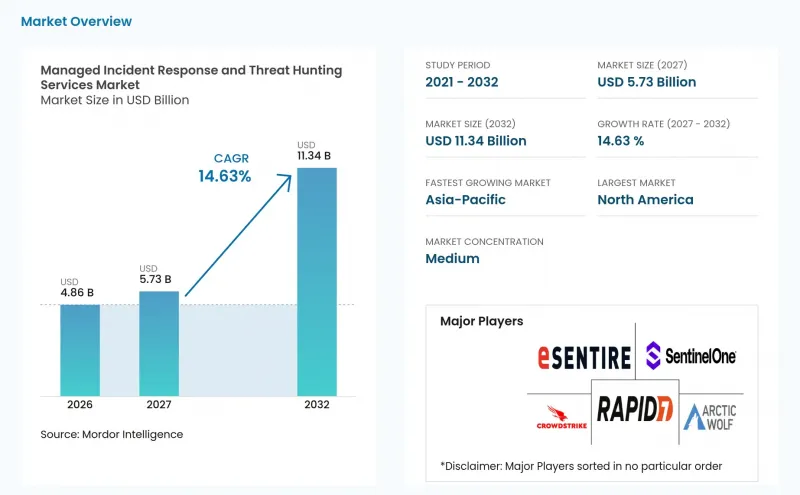
According to Mordor Intelligence, the managed incident response and threat hunting services market size is expected to grow from USD 4.86 billion in 2026 to USD 5.73 billion in 2027 and is forecast to reach USD 11.34 billion by 2032 at 14.63% CAGR over 2027-2032.
Global Managed Incident Response and Threat Hunting Services Market Trends and Insights
Escalating Multi-Vector Cyberattacks and Ransomware Extortion
The FBI's Internet Crime Complaint Center recorded USD 20.9 billion in cybercrime losses during 2025, 26% higher than in 2024. The report also recorded more than 2,100 ransomware incidents affecting critical infrastructure. Verizon found ransomware in 44% of investigated breaches in 2025, after a 37% annual increase in ransomware involvement. It also reported a 34% increase in the exploitation of vulnerabilities as an initial access route. The managed incident response and threat hunting services market benefits from continuous monitoring and human-led response, which address the period between initial access and material damage.
Cybersecurity Talent Shortages and Analyst Burnout
ISC2 found that 59% of cybersecurity professionals reported critical or significant skills needs in 2025, compared with 44% in 2024. The same study found that 48% of respondents felt exhausted by the effort required to keep up with emerging threats. ISACA reported that 58% of organizations considered their security teams understaffed and 61% had unfilled cybersecurity roles. ISACA also found that 68% of respondents considered cybersecurity jobs more stressful than 5 years earlier. The managed incident response and threat hunting services market, therefore, serves as a practical way to add coverage without requiring organizations to hire and retain a full 24/7 analyst team.
High Premium Retainer Costs for Small and Medium Enterprises
Enterprise-oriented service models create an affordability barrier for smaller organizations. Small and medium-sized businesses account for more than 90% of enterprises globally, yet budget and resource constraints can limit their cybersecurity coverage. The same research identified automation of 60-80% of low-level incident handling as a potential route to more economical 24/7 coverage. Smaller firms may also struggle to justify recurring monitoring costs when their security programs remain limited. This restraint concentrates current demand in large and upper-mid-market organizations while encouraging providers to introduce modular entry tiers.
Other drivers and restraints analyzed in the detailed report include:
- Expanding Cloud, Hybrid IT, and Identity Attack Surfaces
- Expanding Regulatory and Incident-Disclosure Mandates
- Cross-Border Data Sovereignty and Log Residency Requirements
For complete list of drivers and restraints, kindly check the Table Of Contents.
Segment Analysis
Managed Detection and Response held 29.71% of service-type revenue in 2026. This share reflects demand for continuous detection and human-led response when periodic assessments cannot address active ransomware campaigns. Proactive Threat Hunting is projected to expand at a 19.73% CAGR from 2027 to 2032, the fastest rate among service types. IBM reported that attackers are shifting toward cloud and identity pathways, increasing the value of teams that search for suspicious behavior before an incident escalates.
The managed incident response and threat hunting services market size for this service mix is also supported by Managed Incident Response Retainers, which provide reserved specialist capacity for organizations without internal response teams. Digital Forensics and Incident Analytics supports the need for documented incident timelines and evidence. Containment, Remediation, and Recovery help organizations return systems to operation after an event. Readiness, Planning, and Tabletop Exercises are relevant in regulated sectors that need evidence of preparedness. These related services complement core MDR rather than replacing it.
Fully managed services held 39.42% of revenue in 2026, making them the largest delivery model. The position reflects the challenge of maintaining 24/7 coverage where organizations lack deep internal resources. Co-Managed deployments are projected to expand at a 17.61% CAGR from 2027 to 2032, the fastest delivery-model rate. This model allows clients to retain their internal security operations center investments while adding outside analysts and specialized investigation support.
On-Demand and retainer-based arrangements serve organizations that prefer spending tied to defined incidents or outcomes. Hybrid Managed configurations are gaining relevance for regulated organizations that need local data controls alongside specialist skills. Arctic Wolf introduced the Aurora Agentic SOC at RSAC 2026, combining automation with analyst work on more complex investigations. Interoperability with SIEM, SOAR, and ticketing systems is becoming an important procurement factor. The Managed incident response and threat hunting services market is, therefore, rewarding providers that can support both client-owned tools and provider-operated platforms.
Complete Report Scope:
- By Service Type
- Managed Detection and Response
- Managed Incident Response Retainers
- Proactive Threat Hunting
- Digital Forensics and Incident Analytics
- Containment, Remediation, and Recovery
- Readiness, Planning, and Tabletop Exercises
- By Delivery Model
- Fully Managed
- Co-Managed
- On-Demand and Retainer-Based
- Hybrid Managed
- By Organization Size
- Large Enterprises
- Small and Medium Enterprises
- By Security Coverage Domain
- Endpoint and Server Security
- Network and Perimeter Security
- Cloud Workload and SaaS Security
- Identity and Access Security
- Application and API Security
- OT, IoT, and Medical-Device Security
- By End-User Industry
- Banking, Financial Services and Insurance (BFSI)
- IT and Telecommunications
- Healthcare and Life Sciences
- Government and Public Sector
- Industrial Manufacturing
- Retail and E-Commerce
- Other End-User Industries
- By Geography
- North America
- United States
- Canada
- Mexico
- South America
- Brazil
- Argentina
- Rest of South America
- Europe
- Germany
- United Kingdom
- France
- Italy
- Spain
- Rest of Europe
- Asia-Pacific
- China
- Japan
- India
- South Korea
- Rest of Asia-Pacific
- Middle East
- Saudi Arabia
- United Arab Emirates
- Turkey
- Rest of Middle East
- Africa
- South Africa
- Nigeria
- Egypt
- Rest of Africa
- North America
Geography Analysis
North America held 41.64% of revenue in 2026, the largest regional share. The region has a high concentration of SEC-regulated public companies, persistent cybersecurity staffing pressure, and mature procurement of managed security services. The FBI attributed 58% of globally disclosed ransomware attacks in 2025 to U.S.-based targets. Canada's financial and energy sectors are extending adoption as cybersecurity requirements change, while Mexico is emerging as a demand center alongside nearshoring activity.
Europe is shaped by DORA, NIS2, and GDPR-related obligations that require formal detection and reporting programs. The European Union Cyber Resilience Act broadens the compliance-driven buyer base to industrial and consumer-product manufacturers. South America is gaining momentum in Brazil as LGPD enforcement supports cybersecurity investment by financial institutions and e-commerce operators. The Middle East is supported by cybersecurity frameworks in Saudi Arabia and the United Arab Emirates, while Africa is at an earlier stage of adoption, with South Africa serving as its most developed market.
Asia-Pacific is projected to expand at a 19.86% CAGR from 2027 to 2032, the fastest regional rate. The Asia-Pacific Managed incident response and threat hunting services market size is supported by digital transformation, sovereign data requirements, and limited in-country cybersecurity talent. India, Singapore, and South Korea each have jurisdiction-specific rules that create compliance triggers for managed detection procurement. Japan's managed security services activity is also supported by demand for endpoint monitoring and cloud security operations. Providers that offer regional data processing and local delivery capabilities can better serve the varied requirements across the Asia-Pacific.
- CrowdStrike Holdings, Inc.
- Arctic Wolf Networks, Inc.
- Rapid7, Inc.
- eSentire Inc.
- SentinelOne, Inc.
- Secureworks, Inc.
- Red Canary, Inc.
- Expel, Inc.
- ReliaQuest, LLC
- Kroll, LLC
- Proficio, Inc.
- Trustwave Holdings, Inc.
- Binary Defense Systems, Inc.
- NTT Security Holdings Corporation
- NCC Group plc
- Sophos Group plc
- Palo Alto Networks, Inc. (Unit 42)
- Mandiant (Google LLC)
- IBM Corporation (IBM X-Force)
- Accenture plc
- Deloitte Touche Tohmatsu Ltd.
- Ernst and Young Global Ltd.
- PricewaterhouseCoopers LLP
- Booz Allen Hamilton Inc.
- BAE Systems plc
Additional Benefits:
- The market estimate (ME) sheet in Excel format
- 3 months of analyst support
TABLE OF CONTENTS
1 INTRODUCTION
- 1.1 Study Assumptions and Market Definition
- 1.2 Scope of the Study
2 RESEARCH METHODOLOGY
3 EXECUTIVE SUMMARY
4 MARKET LANDSCAPE
- 4.1 Market Overview
- 4.2 Impact of Macroeconomic Factors on the Market
- 4.3 Market Drivers
- 4.3.1 Escalating Multi-Vector Cyberattacks and Ransomware Extortion
- 4.3.2 Cybersecurity Talent Shortages and Analyst Burnout
- 4.3.3 Expanding Cloud, Hybrid IT, and Identity Attack Surfaces
- 4.3.4 Expanding Regulatory and Incident-Disclosure Mandates
- 4.3.5 Cyber-Insurance Controls and Premium Incentives
- 4.3.6 OT, IoT, and Medical-Device Convergence
- 4.4 Market Restraints
- 4.4.1 High Premium Retainer Costs for Small and Medium Enterprises
- 4.4.2 Cross-Border Data Sovereignty and Log Residency Requirements
- 4.4.3 Multi-Vendor Integration Complexity and Alert Normalization
- 4.4.4 Limited Organization-Specific Context in Outsourced SOC Operations
- 4.5 Industry Value Chain Analysis
- 4.6 Regulatory Landscape
- 4.7 Porter's Five Forces Analysis
- 4.7.1 Bargaining Power of Suppliers
- 4.7.2 Bargaining Power of Buyers
- 4.7.3 Threat of New Entrants
- 4.7.4 Threat of Substitutes
- 4.7.5 Competitive Rivalry
5 MARKET SIZE AND GROWTH FORECASTS (VALUE)
- 5.1 By Service Type
- 5.1.1 Managed Detection and Response
- 5.1.2 Managed Incident Response Retainers
- 5.1.3 Proactive Threat Hunting
- 5.1.4 Digital Forensics and Incident Analytics
- 5.1.5 Containment, Remediation, and Recovery
- 5.1.6 Readiness, Planning, and Tabletop Exercises
- 5.2 By Delivery Model
- 5.2.1 Fully Managed
- 5.2.2 Co-Managed
- 5.2.3 On-Demand and Retainer-Based
- 5.2.4 Hybrid Managed
- 5.3 By Organization Size
- 5.3.1 Large Enterprises
- 5.3.2 Small and Medium Enterprises
- 5.4 By Security Coverage Domain
- 5.4.1 Endpoint and Server Security
- 5.4.2 Network and Perimeter Security
- 5.4.3 Cloud Workload and SaaS Security
- 5.4.4 Identity and Access Security
- 5.4.5 Application and API Security
- 5.4.6 OT, IoT, and Medical-Device Security
- 5.5 By End-User Industry
- 5.5.1 Banking, Financial Services and Insurance (BFSI)
- 5.5.2 IT and Telecommunications
- 5.5.3 Healthcare and Life Sciences
- 5.5.4 Government and Public Sector
- 5.5.5 Industrial Manufacturing
- 5.5.6 Retail and E-Commerce
- 5.5.7 Other End-User Industries
- 5.6 By Geography
- 5.6.1 North America
- 5.6.1.1 United States
- 5.6.1.2 Canada
- 5.6.1.3 Mexico
- 5.6.2 South America
- 5.6.2.1 Brazil
- 5.6.2.2 Argentina
- 5.6.2.3 Rest of South America
- 5.6.3 Europe
- 5.6.3.1 Germany
- 5.6.3.2 United Kingdom
- 5.6.3.3 France
- 5.6.3.4 Italy
- 5.6.3.5 Spain
- 5.6.3.6 Rest of Europe
- 5.6.4 Asia-Pacific
- 5.6.4.1 China
- 5.6.4.2 Japan
- 5.6.4.3 India
- 5.6.4.4 South Korea
- 5.6.4.5 Rest of Asia-Pacific
- 5.6.5 Middle East
- 5.6.5.1 Saudi Arabia
- 5.6.5.2 United Arab Emirates
- 5.6.5.3 Turkey
- 5.6.5.4 Rest of Middle East
- 5.6.6 Africa
- 5.6.6.1 South Africa
- 5.6.6.2 Nigeria
- 5.6.6.3 Egypt
- 5.6.6.4 Rest of Africa
- 5.6.1 North America
6 COMPETITIVE LANDSCAPE
- 6.1 Market Concentration
- 6.2 Strategic Moves
- 6.3 Market Share Analysis
- 6.4 Company Profiles (includes Global Level Overview, Market Level Overview, Core Segments, Financials as available, Strategic Information, Market Rank/Share, Products and Services, Recent Developments)
- 6.4.1 CrowdStrike Holdings, Inc.
- 6.4.2 Arctic Wolf Networks, Inc.
- 6.4.3 Rapid7, Inc.
- 6.4.4 eSentire Inc.
- 6.4.5 SentinelOne, Inc.
- 6.4.6 Secureworks, Inc.
- 6.4.7 Red Canary, Inc.
- 6.4.8 Expel, Inc.
- 6.4.9 ReliaQuest, LLC
- 6.4.10 Kroll, LLC
- 6.4.11 Proficio, Inc.
- 6.4.12 Trustwave Holdings, Inc.
- 6.4.13 Binary Defense Systems, Inc.
- 6.4.14 NTT Security Holdings Corporation
- 6.4.15 NCC Group plc
- 6.4.16 Sophos Group plc
- 6.4.17 Palo Alto Networks, Inc. (Unit 42)
- 6.4.18 Mandiant (Google LLC)
- 6.4.19 IBM Corporation (IBM X-Force)
- 6.4.20 Accenture plc
- 6.4.21 Deloitte Touche Tohmatsu Ltd.
- 6.4.22 Ernst and Young Global Ltd.
- 6.4.23 PricewaterhouseCoopers LLP
- 6.4.24 Booz Allen Hamilton Inc.
- 6.4.25 BAE Systems plc
7 MARKET OPPORTUNITIES AND FUTURE OUTLOOK
- 7.1 White-Space and Unmet-Need Assessment
- 7.2 Future Outlook, 2027-2032

