PUBLISHER: Mordor Intelligence | PRODUCT CODE: 2185936

PUBLISHER: Mordor Intelligence | PRODUCT CODE: 2185936
Managed Network Threat Hunting Services - Market Share Analysis, Industry Trends & Statistics, Growth Forecasts (2027 - 2032)
According to Mordor Intelligence, the managed network threat hunting services market size is valued at USD 3.44 billion in 2026 and is projected to reach USD 6.43 billion by 2032, expanding at a CAGR of 11.57% during 2027-2032.
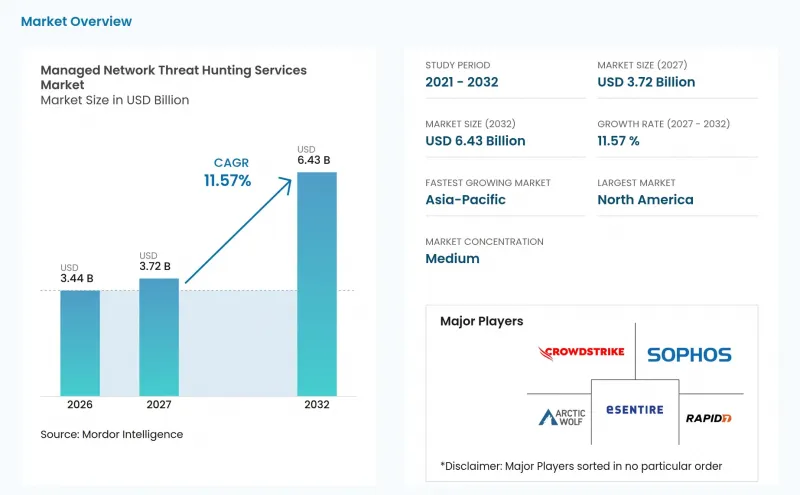
Global Managed Network Threat Hunting Services Market Trends and Insights
Rising Frequency and Sophistication of Network Intrusions
The managed network threat hunting services market is supported by intrusions that are continuous and designed to avoid signature-based detection. CrowdStrike reported that vishing intrusions doubled and device-code phishing attempts increased 15 times in the first half of 2026. It also reported that China-nexus groups exploited disclosed vulnerabilities within 24 hours, reducing the time available for patching and conventional monitoring. The SANS survey found that 41% of respondents detected nation-state activity through proactive hunting, while living-off-the-land techniques appeared in 76% of nation-state attacks. CISA documented a 2025 case in which standard user accounts could reach SCADA VLANs at a U.S. critical infrastructure organization, showing how weak IT-to-OT separation can leave critical operations exposed. This pattern makes rapid evidence collection and analyst validation central to an effective service. These conditions increase the value of services that examine behavior across network traffic and related telemetry.
Shortage of Skilled Threat-Hunting Personnel
The managed network threat-hunting services market also benefits from a shortage of experienced personnel capable of investigating complex activity. ISC2 found that 59% of security professionals reported critical or significant skills needs in 2025, up from 44% in 2024, with cloud security and AI-assisted investigation among the leading gaps. The SANS survey identified staffing shortages as the leading barrier to effective threat hunting, cited by 61% of respondents. The same survey showed that outsourced hunting declined from 37% to 30% among respondents. This combination indicates that some organizations are moving work in-house even while specialist skills remain scarce. Providers that use automation to prioritize evidence and reserve human review for higher-value cases can help clients sustain broader coverage.
False-Positive Fatigue and Analyst Burnout
False positives can weaken the operational case for the managed network threat hunting services market when a provider forwards excessive alerts without context. Devo found that 83% of surveyed SOC professionals were overwhelmed by alert volume and false positives. Its survey also found that 57% identified excessive false positives as their main operational challenge. Analysts were reported to spend more than 25% of their working time on non-actionable triage. That workload takes attention away from the hypothesis-led investigation that distinguishes threat hunting from alert forwarding. It can also weaken a client's confidence when many notifications do not result in confirmed findings. Services that improve detection quality and automate early triage are better placed to show meaningful operational value.
Other drivers and restraints analyzed in the detailed report include:
- Expansion of Hybrid Cloud and SaaS Attack Surfaces
- Regulatory and Cyber-Insurance Pressure for Continuous Monitoring
- Integration Complexity Across Multi-Vendor Security Stacks
For complete list of drivers and restraints, kindly check the Table Of Contents.
Segment Analysis
Fully managed delivery held 33.21% of revenue in 2026. The model transfers both daily operations and specialist analysis to an external provider. This is relevant where internal teams cannot recruit or retain enough experienced hunters. SANS found that 61% of respondents considered staffing shortages the leading barrier to effective hunting. Co-managed and hybrid services remain relevant for enterprises that already operate a SOC but need help outside core hours or within specialized OT environments.
Continuous threat hunting is projected to expand at an 11.87% CAGR through 2032. It replaces periodic campaigns with a persistent review of incoming telemetry. CrowdStrike reported that AI agent-triggered detections increased at a rate 2.5 times that of human-triggered detections on its OverWatch platform. ReliaQuest stated that lateral movement can occur in as little as 4 minutes. These conditions reduce the usefulness of infrequent hunting exercises and strengthen demand for continuous service tiers.
Cloud-based delivery accounted for 41.27% of the managed network threat hunting services market size in 2026. The deployment model is suited to organizations operating several cloud environments and SaaS applications. Arctic Wolf entered a strategic collaboration agreement with AWS in October 2025 to integrate the Aurora Platform with AWS security telemetry and the Open Cybersecurity Schema Framework. This type of integration places hunting capability closer to cloud security evidence. It also helps providers normalize data across cloud, SaaS, and on-premises environments.
Cloud-based delivery is projected to expand at an 11.83% CAGR through 2032, the highest rate among deployment models. On-premises delivery remains important for government and defense users who cannot route classified telemetry through external cloud systems. Hybrid environments remain relevant where workloads are split across local and cloud infrastructure. Air-gapped and sovereign deployments form a smaller but strategically important category for critical infrastructure and defense operators. Endace introduced a high-capacity packet-capture model in September 2025, which it said offered sustained 60 Gbps recording and up to 3 petabytes of storage in 5 RU. Lower capture costs can improve the feasibility of hunting in isolated network settings.
Complete Report Scope:
- By Service Model
- Fully Managed Threat Hunting
- Co-Managed Threat Hunting
- Hybrid Managed Threat Hunting
- Incident-Driven Threat Hunting
- Continuous Threat Hunting
- By Deployment
- Cloud-Based
- On-Premises
- Hybrid Cloud
- Air-Gapped and Sovereign Environments
- By Organization Size
- Large Enterprises
- Small and Medium-Sized Enterprises
- By Network and Telemetry Scope
- Physical Enterprise Networks
- Cloud and SaaS Networks
- Operational Technology and Industrial Control Systems
- Software-Defined and Virtual Networks
- Identity, Endpoint and Network Cross-Domain Telemetry
- By Industry Vertical
- Banking, Financial Services and Insurance
- Government and Defense
- Energy and Utilities
- Information Technology and Telecommunications
- Healthcare and Life Sciences
- Manufacturing
- Other Industry Verticals
- By Geography
- North America
- United States
- Canada
- Mexico
- South America
- Brazil
- Argentina
- Rest of South America
- Europe
- Germany
- United Kingdom
- France
- Italy
- Rest of Europe
- Asia-Pacific
- China
- Japan
- India
- South Korea
- Rest of Asia-Pacific
- Middle East and Africa
- Saudi Arabia
- United Arab Emirates
- South Africa
- Egypt
- Rest of Middle East and Africa
- North America
Geography Analysis
North America accounted for 41.66% of revenue in 2026. The United States has a strong demand for federal cybersecurity guidance, SEC reporting rules, defense-related compliance requirements, and mature cyber-insurance practices, which increase the need for evidence of proactive monitoring. Canada is a significant secondary market in financial services and energy, while Mexico presents an emerging opportunity as near-shoring expands industrial OT environments. CISA's 2025 advisory on IT-to-OT segmentation failures at a U.S. critical infrastructure organization highlights the unaddressed gaps that managed providers can address.
Europe is the second-largest regional market. Germany, the United Kingdom, and France are the principal contributors, and the NIS2 Directive has broadened the scope of organizations subject to cybersecurity obligations across essential sectors. Industrial companies in Germany are showing greater interest in OT-specific network hunting as automotive and machinery supply chains face higher cyber risk. Nomios launched Guardian xMDR in April 2026 from a Dutch SOC, using Palo Alto Networks Cortex XDR for the Benelux and wider European market. GDPR-related data limits are encouraging providers to invest in local processing capabilities, which can raise entry requirements while improving the position of established operators.
Asia-Pacific is projected to expand at a 12.14% CAGR through 2032, making it the fastest-growing region. Demand is supported by digitalization, state-sponsored activity, sovereign SOC requirements, and shortages of qualified personnel. India's incident-reporting requirements, Japan's active cyber defense measures, South Korea's financial-sector compliance rules, and China's PIPL restrictions are influencing delivery design across the region. The Middle East and Africa are secondary growth regions as Saudi Arabia and the UAE invest in sovereign SOC infrastructure, while South Africa and Egypt drive early adoption in finance and government. South America is led by Brazil, where the LGPD and financial-sector regulation support demand for continuous monitoring.
- CrowdStrike Holdings, Inc.
- Arctic Wolf Networks, Inc.
- Sophos Limited
- Rapid7, Inc.
- eSentire, Inc.
- Palo Alto Networks, Inc.
- Cisco Systems, Inc.
- IBM Corporation
- Fortinet, Inc.
- SentinelOne, Inc.
- Red Canary, Inc.
- Expel, Inc.
- Bitdefender SRL
- Deepwatch, Inc.
- Critical Start, Inc.
- Binary Defense Systems, Inc.
- Kroll, LLC
- LevelBlue, Inc.
- ESET, spol. s r.o.
- Trend Micro Incorporated
- Darktrace Holdings plc
- Vectra AI, Inc.
- ExtraHop Networks, Inc.
- ReliaQuest Holdings, LLC
Additional Benefits:
- The market estimate (ME) sheet in Excel format
- 3 months of analyst support
TABLE OF CONTENTS
1 INTRODUCTION
- 1.1 Study Assumptions and Market Definition
- 1.2 Scope of the Study
2 RESEARCH METHODOLOGY
3 EXECUTIVE SUMMARY
4 MARKET LANDSCAPE
- 4.1 Market Overview
- 4.2 Market Drivers
- 4.2.1 Rising Frequency and Sophistication of Network Intrusions
- 4.2.2 Shortage of Skilled Threat-Hunting Personnel
- 4.2.3 Expansion of Hybrid Cloud and SaaS Attack Surfaces
- 4.2.4 Regulatory and Cyber-Insurance Pressure for Continuous Monitoring
- 4.2.5 Encrypted East-West Traffic in Operational Technology Environments
- 4.2.6 MSSP Bundling of Network Telemetry With XDR and SOC Automation
- 4.3 Market Restraints
- 4.3.1 False-Positive Fatigue and Analyst Burnout
- 4.3.2 Integration Complexity Across Multi-Vendor Security Stacks
- 4.3.3 Data-Residency Restrictions on Cross-Border Telemetry
- 4.3.4 100 GbE Packet-Capture Cost at Industrial and Air-Gapped Sites
- 4.4 Industry Value Chain Analysis
- 4.5 Impact of Macroeconomic Factors on the Market
- 4.6 Regulatory Landscape
- 4.7 Technological Outlook
- 4.8 Porter's Five Forces Analysis
- 4.8.1 Threat of New Entrants
- 4.8.2 Bargaining Power of Suppliers
- 4.8.3 Bargaining Power of Buyers
- 4.8.4 Threat of Substitutes
- 4.8.5 Competitive Rivalry
5 MARKET SIZE AND GROWTH FORECASTS (VALUE)
- 5.1 By Service Model
- 5.1.1 Fully Managed Threat Hunting
- 5.1.2 Co-Managed Threat Hunting
- 5.1.3 Hybrid Managed Threat Hunting
- 5.1.4 Incident-Driven Threat Hunting
- 5.1.5 Continuous Threat Hunting
- 5.2 By Deployment
- 5.2.1 Cloud-Based
- 5.2.2 On-Premises
- 5.2.3 Hybrid Cloud
- 5.2.4 Air-Gapped and Sovereign Environments
- 5.3 By Organization Size
- 5.3.1 Large Enterprises
- 5.3.2 Small and Medium-Sized Enterprises
- 5.4 By Network and Telemetry Scope
- 5.4.1 Physical Enterprise Networks
- 5.4.2 Cloud and SaaS Networks
- 5.4.3 Operational Technology and Industrial Control Systems
- 5.4.4 Software-Defined and Virtual Networks
- 5.4.5 Identity, Endpoint and Network Cross-Domain Telemetry
- 5.5 By Industry Vertical
- 5.5.1 Banking, Financial Services and Insurance
- 5.5.2 Government and Defense
- 5.5.3 Energy and Utilities
- 5.5.4 Information Technology and Telecommunications
- 5.5.5 Healthcare and Life Sciences
- 5.5.6 Manufacturing
- 5.5.7 Other Industry Verticals
- 5.6 By Geography
- 5.6.1 North America
- 5.6.1.1 United States
- 5.6.1.2 Canada
- 5.6.1.3 Mexico
- 5.6.2 South America
- 5.6.2.1 Brazil
- 5.6.2.2 Argentina
- 5.6.2.3 Rest of South America
- 5.6.3 Europe
- 5.6.3.1 Germany
- 5.6.3.2 United Kingdom
- 5.6.3.3 France
- 5.6.3.4 Italy
- 5.6.3.5 Rest of Europe
- 5.6.4 Asia-Pacific
- 5.6.4.1 China
- 5.6.4.2 Japan
- 5.6.4.3 India
- 5.6.4.4 South Korea
- 5.6.4.5 Rest of Asia-Pacific
- 5.6.5 Middle East and Africa
- 5.6.5.1 Saudi Arabia
- 5.6.5.2 United Arab Emirates
- 5.6.5.3 South Africa
- 5.6.5.4 Egypt
- 5.6.5.5 Rest of Middle East and Africa
- 5.6.1 North America
6 COMPETITIVE LANDSCAPE
- 6.1 Market Concentration
- 6.2 Strategic Moves
- 6.3 Market Share Analysis
- 6.4 Company Profiles (includes Global Level Overview, Market Level Overview, Core Segments, Financials as available, Strategic Information, Market Rank/Share, Products and Services, Recent Developments)
- 6.4.1 CrowdStrike Holdings, Inc.
- 6.4.2 Arctic Wolf Networks, Inc.
- 6.4.3 Sophos Limited
- 6.4.4 Rapid7, Inc.
- 6.4.5 eSentire, Inc.
- 6.4.6 Palo Alto Networks, Inc.
- 6.4.7 Cisco Systems, Inc.
- 6.4.8 IBM Corporation
- 6.4.9 Fortinet, Inc.
- 6.4.10 SentinelOne, Inc.
- 6.4.11 Red Canary, Inc.
- 6.4.12 Expel, Inc.
- 6.4.13 Bitdefender SRL
- 6.4.14 Deepwatch, Inc.
- 6.4.15 Critical Start, Inc.
- 6.4.16 Binary Defense Systems, Inc.
- 6.4.17 Kroll, LLC
- 6.4.18 LevelBlue, Inc.
- 6.4.19 ESET, spol. s r.o.
- 6.4.20 Trend Micro Incorporated
- 6.4.21 Darktrace Holdings plc
- 6.4.22 Vectra AI, Inc.
- 6.4.23 ExtraHop Networks, Inc.
- 6.4.24 ReliaQuest Holdings, LLC
7 MARKET OPPORTUNITIES AND FUTURE OUTLOOK
- 7.1 White-Space and Unmet-Need Assessment

