PUBLISHER: Mordor Intelligence | PRODUCT CODE: 2186039

PUBLISHER: Mordor Intelligence | PRODUCT CODE: 2186039
Managed Cloud Threat Hunting Services - Market Share Analysis, Industry Trends & Statistics, Growth Forecasts (2027 - 2032)
According to Mordor Intelligence, the managed cloud threat hunting services market size is projected to expand from USD 1.43 billion in 2026 and USD 1.72 billion in 2027 to USD 4.39 billion by 2032, registering a CAGR of 20.61% between 2027 and 2032.
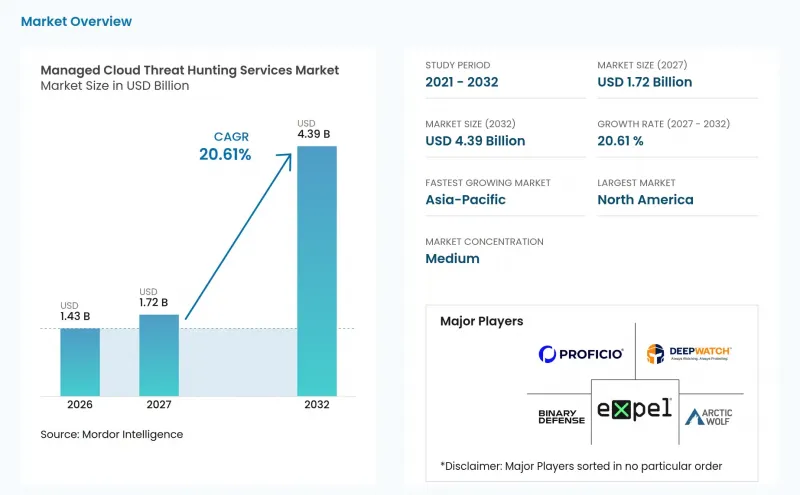
Global Managed Cloud Threat Hunting Services Market Trends and Insights
Expanding Cloud Attack Surfaces Multiply Entry Points Faster Than Defenses Scale
Cloud infrastructure now changes continually as organizations add workloads, service accounts, and third-party application programming interfaces. Microsoft reported an 87% rise in campaigns targeting Azure customer environments through destructive actions in 2025, while more than 40% of ransomware incidents involved hybrid cloud elements. Multi-cloud environments make the issue harder because security teams must interpret different logs, permissions, and configurations across environments. The 2025 SANS survey found that 63% of respondents identified environmental complexity as their main cloud security management challenge. The same survey found that 77% rated cloud-native tools as only somewhat effective or less in complex multi-cloud settings. These conditions make cross-cloud correlation a basic requirement in the managed cloud threat hunting services market.
Living-Off-The-Land Techniques Exploit Native Cloud Tools To Avoid Signature Detection
Living-off-the-land activity uses legitimate services and administrative tools in ways that resemble normal operations. Bitdefender found such techniques in 84% of high-severity incidents and 85% of managed detection and response incidents in its analysis of 700,000 security incidents. CISA identified cloud-specific examples in 2025, including credential extraction through instance metadata services, misuse of cloud command-line tools, scheduled automation, and identity token manipulation. These actions are difficult to identify through fixed signatures because the underlying tools are trusted. The 2025 SANS threat hunting survey found that 76% of nation-state attacks used living-off-the-land methods. This pattern supports behavioral analysis by the managed cloud threat hunting services market.
Specialist Scarcity Limits Managed-Service Providers' Capacity To Scale Delivery
The shortage that drives outsourcing also limits service providers' capacity. The 2025 SANS threat hunting survey found that 61% of respondents viewed skilled staffing shortages as their main barrier to successful threat hunting, ahead of tooling and budget constraints. Providers must recruit from the same limited pool of experienced cloud analysts as their clients. Platforms are using automation for Tier 1 and Tier 2 investigation tasks so experienced staff can concentrate on deeper investigation. Smaller specialists may struggle to fund those platform investments. The restraint may favor scaled platforms in the managed cloud threat hunting services market.
Other drivers and restraints analyzed in the detailed report include:
- AI-Assisted Detection and Investigation Automation
- Specialist Talent Shortages Push Organizations Toward Outsourced Hunting Models
- Cross-Border Data-Sovereignty Mandates Restrict Telemetry Centralization and Hunting Scope
For complete list of drivers and restraints, kindly check the Table Of Contents.
Segment Analysis
Cloud infrastructure threat-hunting services held 44.31% of the managed cloud threat-hunting services market share in 2026. The segment supports visibility across compute instances, container clusters, serverless functions, and cloud storage. Large cloud estates generate extensive application programming interface activity that cannot be reviewed effectively through native logging alone. Managed teams correlate asset, configuration, and runtime information to identify privilege escalation, lateral movement, and data exfiltration. These capabilities make infrastructure monitoring the foundation of most managed engagements.
Identity and access threat hunting services are projected to grow at a 21.68% CAGR through 2032. CrowdStrike recorded a 136% year-over-year rise in cloud intrusions in 2025, while Red Canary reported a near 500% increase in cloud account detections in the first half of 2025. Microsoft expanded Defender for Identity coverage to Okta identities in June 2025, establishing cross-platform identity monitoring across Active Directory, Entra ID, and Okta. Application and application programming interface threat hunting is gaining ground as firms deploy microservices and third-party integrations. Data security hunting remains smaller in scope, but data access and exfiltration monitoring gain importance when regulated information is held in cloud environments.
Public cloud accounted for 65.12% of the managed cloud threat-hunting services market in 2026. This position reflects the widespread use of Amazon Web Services, Microsoft Azure, and Google Cloud for enterprise workloads. Managed providers have developed mature integrations for these environments. Prebuilt telemetry connections and familiar cloud services make it easier to introduce managed hunting. Public cloud, therefore, remains the primary volume source for the managed cloud threat-hunting services market.
Hybrid cloud is projected to grow at a 22.04% CAGR through 2032. Presidio found that 54% of organizations used hybrid cloud as their main deployment strategy in 2025, up from 43% in the prior year. Hybrid estates require teams to join telemetry from on-premises systems with cloud-native activity, and 67% of SANS respondents struggled to integrate cloud security tools into the wider security stack. Private cloud use continues in banking, defense, and utilities, where shared public infrastructure may not meet residency or control requirements. Providers that cover private and hybrid environments can address customers with complex architectures, even when delivery is less economical than a hyperscaler-native model.
Complete Report Scope:
- By Security Coverage
- Cloud Infrastructure Threat Hunting Services
- Identity and Access Threat Hunting Services
- Application and API Threat Hunting Services
- Data Security Threat Hunting Services
- By Deployment Mode
- Public Cloud
- Private Cloud
- Hybrid Cloud
- By Organization Size
- Large Enterprises
- Small and Medium Enterprises
- By End-User Industry
- Banking, Financial Services, and Insurance (BFSI)
- Government and Public Administration
- Healthcare and Life Sciences
- IT and Telecommunication
- Industrial Manufacturing
- Retail and E-commerce
- Energy and Utilities
- Other End-User Industries
- By Geography
- North America
- United States
- Canada
- Mexico
- South America
- Brazil
- Argentina
- Rest of South America
- Europe
- Germany
- United Kingdom
- France
- Italy
- Russia
- Rest of Europe
- Asia-Pacific
- China
- Japan
- India
- South Korea
- Rest of Asia-Pacific
- Middle East
- Saudi Arabia
- United Arab Emirates
- Rest of Middle East
- Africa
- South Africa
- Nigeria
- Rest of Africa
- North America
Geography Analysis
North America accounted for 35.88% of the managed cloud threat-hunting services market share in 2026. The region has a large population of cloud-native enterprises and a mature ecosystem of managed security providers. United States public companies must disclose material cybersecurity incidents within 4 business days after determining materiality under the Securities and Exchange Commission's rule. The United States talent gap further supports the use of managed services.
Europe is the second-largest regional grouping, led by Germany, the United Kingdom, and France. The NIS2 Directive, which took effect in October 2024, extended cybersecurity risk management and reporting requirements to more essential entities. This wider scope increases the number of organizations that need formal security capabilities. The European Union Data Act also seeks to reduce barriers to cloud switching and promote data portability. South America remains an emerging area of demand, supported by cloud modernization among financial institutions.
Asia-Pacific is projected to grow at a 21.35% CAGR through 2032. Demand comes from cloud adoption by financial institutions and public agencies, as well as shortages of experienced security staff. Japan is moving from managed endpoint detection and response toward services that offer contextual hunting rather than alert monitoring alone. In China, critical infrastructure rules under the Cybersecurity Law and Network Security Grading Protection 2.0 support demand for continuous detection and response. Sovereign cloud programs in Gulf Cooperation Council states and financial technology growth in South Africa support demand for services suited to less mature security environments.
- Arctic Wolf Networks, Inc.
- Binary Defense Systems, Inc.
- BlueVoyant LLC
- CrowdStrike Holdings, Inc.
- Deepwatch, Inc.
- eSentire, Inc.
- Expel, Inc.
- Huntress Labs Incorporated
- LevelBlue Holdings, Inc.
- Mitiga Security, Inc.
- Pondurance, LLC
- Proficio, Inc.
- Rapid7, Inc.
- Red Canary, Inc.
- ReliaQuest Holdings, LLC
- Secureworks Corp.
- SentinelOne, Inc.
- Sophos Limited
- UnderDefense, Inc.
- Zscaler, Inc.
Additional Benefits:
- The market estimate (ME) sheet in Excel format
- 3 months of analyst support
TABLE OF CONTENTS
1 INTRODUCTION
- 1.1 Study Assumptions and Market Definition
- 1.2 Scope of the Study
2 RESEARCH METHODOLOGY
3 EXECUTIVE SUMMARY
4 MARKET LANDSCAPE
- 4.1 Market Overview
- 4.2 Market Drivers
- 4.2.1 Increasing Cloud Attack-Surface Complexity
- 4.2.2 Escalating Adversary Use of Living-off-the-Land Techniques
- 4.2.3 Cloud-Native Workload and Identity Telemetry Expansion
- 4.2.4 AI-Assisted Detection and Investigation Automation
- 4.2.5 Cyber-Resilience and Disclosure Mandates
- 4.2.6 Specialist Talent Shortages Driving Managed-Service Adoption
- 4.3 Market Restraints
- 4.3.1 Shortage of Cloud Threat-Hunting Specialists
- 4.3.2 Data-Sovereignty Restrictions on Cross-Border Telemetry
- 4.3.3 Integration Friction Across Legacy and Multi-Cloud Stacks
- 4.3.4 Alert Fatigue and Difficulty Demonstrating Return on Investment
- 4.4 Industry Value Chain Analysis
- 4.5 Regulatory Landscape
- 4.6 Technological Outlook
- 4.7 Porter's Five Forces Analysis
- 4.7.1 Bargaining Power of Suppliers
- 4.7.2 Bargaining Power of Buyers
- 4.7.3 Threat of New Entrants
- 4.7.4 Threat of Substitutes
- 4.7.5 Competitive Rivalry
- 4.8 Impact of Macroeconomic Factors on the Market
5 MARKET SIZE AND GROWTH FORECASTS (VALUE)
- 5.1 By Security Coverage
- 5.1.1 Cloud Infrastructure Threat Hunting Services
- 5.1.2 Identity and Access Threat Hunting Services
- 5.1.3 Application and API Threat Hunting Services
- 5.1.4 Data Security Threat Hunting Services
- 5.2 By Deployment Mode
- 5.2.1 Public Cloud
- 5.2.2 Private Cloud
- 5.2.3 Hybrid Cloud
- 5.3 By Organization Size
- 5.3.1 Large Enterprises
- 5.3.2 Small and Medium Enterprises
- 5.4 By End-User Industry
- 5.4.1 Banking, Financial Services, and Insurance (BFSI)
- 5.4.2 Government and Public Administration
- 5.4.3 Healthcare and Life Sciences
- 5.4.4 IT and Telecommunication
- 5.4.5 Industrial Manufacturing
- 5.4.6 Retail and E-commerce
- 5.4.7 Energy and Utilities
- 5.4.8 Other End-User Industries
- 5.5 By Geography
- 5.5.1 North America
- 5.5.1.1 United States
- 5.5.1.2 Canada
- 5.5.1.3 Mexico
- 5.5.2 South America
- 5.5.2.1 Brazil
- 5.5.2.2 Argentina
- 5.5.2.3 Rest of South America
- 5.5.3 Europe
- 5.5.3.1 Germany
- 5.5.3.2 United Kingdom
- 5.5.3.3 France
- 5.5.3.4 Italy
- 5.5.3.5 Russia
- 5.5.3.6 Rest of Europe
- 5.5.4 Asia-Pacific
- 5.5.4.1 China
- 5.5.4.2 Japan
- 5.5.4.3 India
- 5.5.4.4 South Korea
- 5.5.4.5 Rest of Asia-Pacific
- 5.5.5 Middle East
- 5.5.5.1 Saudi Arabia
- 5.5.5.2 United Arab Emirates
- 5.5.5.3 Rest of Middle East
- 5.5.6 Africa
- 5.5.6.1 South Africa
- 5.5.6.2 Nigeria
- 5.5.6.3 Rest of Africa
- 5.5.1 North America
6 COMPETITIVE LANDSCAPE
- 6.1 Market Concentration
- 6.2 Strategic Moves
- 6.3 Market Share Analysis
- 6.4 Company Profiles (includes Global Level Overview, Market Level Overview, Core Segments, Financials as available, Strategic Information, Market Rank/Share, Products and Services, Recent Developments)
- 6.4.1 Arctic Wolf Networks, Inc.
- 6.4.2 Binary Defense Systems, Inc.
- 6.4.3 BlueVoyant LLC
- 6.4.4 CrowdStrike Holdings, Inc.
- 6.4.5 Deepwatch, Inc.
- 6.4.6 eSentire, Inc.
- 6.4.7 Expel, Inc.
- 6.4.8 Huntress Labs Incorporated
- 6.4.9 LevelBlue Holdings, Inc.
- 6.4.10 Mitiga Security, Inc.
- 6.4.11 Pondurance, LLC
- 6.4.12 Proficio, Inc.
- 6.4.13 Rapid7, Inc.
- 6.4.14 Red Canary, Inc.
- 6.4.15 ReliaQuest Holdings, LLC
- 6.4.16 Secureworks Corp.
- 6.4.17 SentinelOne, Inc.
- 6.4.18 Sophos Limited
- 6.4.19 UnderDefense, Inc.
- 6.4.20 Zscaler, Inc.
7 MARKET OPPORTUNITIES AND FUTURE OUTLOOK
- 7.1 White-Space and Unmet-Need Assessment

