PUBLISHER: Mordor Intelligence | PRODUCT CODE: 2186078

PUBLISHER: Mordor Intelligence | PRODUCT CODE: 2186078
Fortified Yogurt - Market Share Analysis, Industry Trends & Statistics, Growth Forecasts (2027 - 2032)
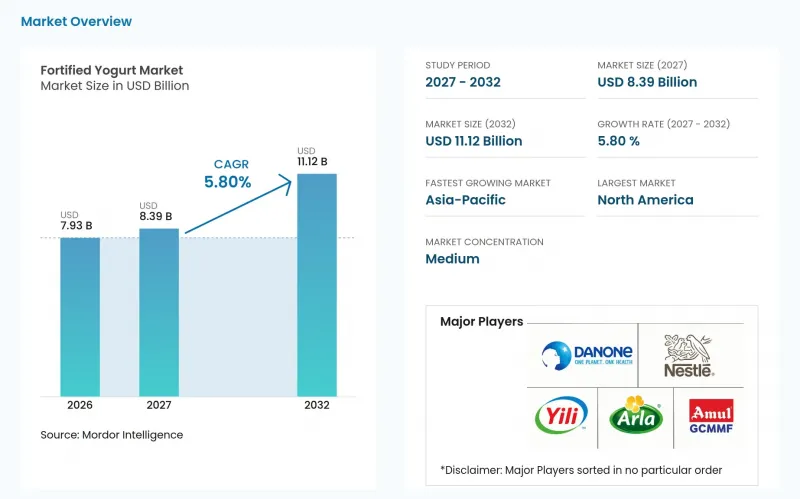
According to Mordor Intelligence, the global fortified yogurt market is valued at USD 7.93 billion in 2026 and is projected to reach USD 11.12 billion by 2032, following a CAGR of 5.80% during 2027-2032.
Global Fortified Yogurt Market Trends and Insights
Rising Awareness of Micronutrient Deficiencies
Growing awareness of inadequate micronutrient intake creates opportunities for fortified yogurt to deliver selected vitamins and minerals through a familiar food format. A 2024 global modelling analysis estimated that more than five billion people had inadequate dietary intake of iodine, vitamin E, and calcium, highlighting the broader nutritional relevance of food fortification. Although these estimates cover the general population rather than yogurt consumers specifically, they support the potential role of fortified foods in addressing nutritional gaps. Manufacturers can differentiate their products through targeted nutrient combinations, clear nutrition labelling, and formulations aligned with recognised dietary needs. This creates opportunities to position fortified yogurt as a convenient component of everyday nutrition.
Growing Demand for Functional Dairy Products
Functional dairy products combine conventional nutritional value with additional attributes such as added vitamins, minerals, protein, and beneficial cultures. This positioning allows yogurt manufacturers to differentiate their offerings beyond flavour, texture, and basic dairy nutrition. Fortified yogurt can serve multiple consumption occasions, including breakfast, snacking, and everyday nutritional supplementation. Manufacturers can expand their portfolios through differentiated formulations and targeted nutritional benefits while maintaining taste, affordability, and product convenience. These factors support opportunities for functional dairy innovation across established and developing markets.
High Production Costs and Premium Prices
Fortified yogurt can incur additional costs from vitamin and mineral ingredients, specialised cultures, formulation trials, quality testing, and production controls. Refrigerated storage and distribution further increase operational requirements compared with products that do not require continuous temperature control. These costs can translate into higher retail prices, potentially limiting adoption among price-sensitive consumers and in markets where conventional yogurt is more affordable. Manufacturers can address this challenge through efficient ingredient sourcing, formulation optimisation, production scale, and differentiated product positioning. Maintaining a balance between nutritional benefits and affordability is essential to broaden the consumer base.
Other drivers and restraints analyzed in the detailed report include:
- Increasing Demand for Probiotic Yogurt for Digestive Health
- Rising Preference for Protein-Enriched Yogurt
- Nutrient Stability and Sensory Challenges
For complete list of drivers and restraints, kindly check the Table Of Contents.
Segment Analysis
Spoonable yogurt accounted for 57.40% of the fortified yogurt market in 2026, making it the largest product-type segment. Its leading position reflects the established consumption format of yogurt as a breakfast food, snack, and vehicle for added nutrients. Spoonable products also accommodate a range of formulations, including probiotic, vitamin-fortified, mineral-enriched, and high-protein varieties, allowing manufacturers to serve different nutritional needs within a familiar format.
Drinkable yogurt is projected to be the fastest-growing product-type segment, with a CAGR of 6.90% from 2027 to 2032. Its portability and suitability for consumption outside the home support its potential across convenience-oriented occasions. Manufacturers can also develop drinkable formulations with added cultures, vitamins, and protein to differentiate products. For the fortified yogurt market size assessment, the distinction between spoonable and drinkable formats is important because each supports different consumption occasions and formulation requirements.
Probiotic-fortified yogurt accounted for 35.70% of the fortified yogurt market in 2026, making it the largest supplied category by nutrient positioning. Probiotic formulations align yogurt with digestive-wellness positioning while retaining its role as an everyday dairy food. Manufacturers can differentiate products through culture selection, formulation quality, and clear communication of permitted product benefits, while maintaining culture viability and acceptable taste throughout shelf life.
Probiotic-fortified yogurt is also projected to be the fastest-growing category within nutrient positioning, with a CAGR of 8.50% from 2027 to 2032. This growth outlook points to opportunities for manufacturers to develop products combining live cultures with other nutritional attributes, provided that formulation compatibility and labelling requirements are addressed. The nutrient-positioning segmentation also includes vitamins, minerals, and protein, each serving different nutritional objectives. The supplied figures establish probiotic-fortified yogurt's 2026 lead and forecast growth, but do not provide individual market shares for the other categories.
Complete Report Scope:
- By Product Type
- Spoonable yogurt
- Drinkable yogurt
- Greek and high-protein yogurt
- Other fortified yogurt
- By nutrient Positioning
- Vitamins
- Minerals
- Probiotics and prebiotics
- Protein
- By customer demographic
- Children
- Adults
- Pregnant and lactating women
- Older adults
- By distribution channel
- Off-Trade
- Hypermarkets and Supermarkets
- Convenience Stores
- Discounters
- Online Retail Stores
- Other off-trade channels
- On-Trade
- Off-Trade
- By Geography
- North America
- United States
- Canada
- Mexico
- Rest of North America
- Europe
- United Kingdom
- Germany
- France
- Italy
- Spain
- Sweden
- Belgium
- Poland
- Netherlands
- Europe
- Asia-Pacific
- China
- Japan
- India
- Thailand
- Singapore
- Indonesia
- Korea
- Australia
- Rest of Asia-Pacific
- South America
- Brazil
- Argentina
- Colombia
- Peru
- Chile
- Rest of South America
- Middle East and Africa
- South Africa
- Saudi Arabia
- United Arab Emirates
- Nigeria
- Egypt
- Morocco
- Turkey
- Rest of Middle East and Africa
- North America
Geography Analysis
North America was the largest regional market for fortified yogurt in 2026, accounting for 34.80% of the global market. The region's established dairy industry, availability of functional dairy products, and consumer interest in protein-enriched and probiotic yogurt support demand for fortified formulations. Manufacturers can differentiate their portfolios through targeted nutritional benefits, convenient packaging, and product variants designed for different consumer groups. The verified 2025 regional market share has not been provided, so the 2026 figure is used for the regional comparison.
Asia-Pacific is projected to be the fastest-growing regional market, with a CAGR of 8.90% from 2027 to 2032. Opportunities are supported by the potential to expand access to fortified dairy products, rising interest in convenient nutritional foods, and product development tailored to local dietary preferences. China, India, Japan, Indonesia, and other markets within the region have different dairy-consumption patterns, distribution infrastructure, and regulatory requirements, creating varied opportunities for manufacturers. Market expansion will depend on product affordability, appropriate formulations, refrigerated distribution, and compliance with local food-fortification and labelling regulations.
Across the global market, regional strategies need to reflect differences in consumer needs, retail infrastructure, and product affordability. North America offers an established market for differentiated fortified yogurt products, while Asia-Pacific presents the strongest forecast growth opportunity among the supplied regional comparisons. Europe, South America, and the Middle East and Africa also provide opportunities for product development and distribution expansion, but country-level market shares and growth rates have not been supplied.
- Danone S.A.
- Nestle S.A.
- Yili Group
- Arla Foods amba
- GCMMF (Amul)
- Fonterra Co-operative Group
- FrieslandCampina
- Inner Mongolia Mengniu Dairy
- Lactalis Group
- Yakult Honsha Co., Ltd.
- Chobani LLC
- Vinamilk
- Yeo Hiap Seng
- Morinaga Milk Industry Co., Ltd.
- Abbott Laboratories
- China Feihe Ltd.
- Grupo Lala
- Clover Industries
- Dairy Farmers of America
- General Mills, Inc.
Additional Benefits:
- The market estimate (ME) sheet in Excel format
- 3 months of analyst support
TABLE OF CONTENTS
1 INTRODUCTION
- 1.1 Study Assumptions and Market Definition
- 1.2 Scope of the Study
2 RESEARCH METHODOLOGY
3 EXECUTIVE SUMMARY
4 MARKET LANDSCAPE
- 4.1 Market Overview
- 4.2 Market Drivers
- 4.2.1 Rising awareness of micronutrient deficiencies
- 4.2.2 Growing demand for functional dairy products
- 4.2.3 Increasing demand for probiotic yogurt for digestive health
- 4.2.4 Rising preference for protein-enriched yogurt
- 4.2.5 Innovation in age-specific fortified yogurt products
- 4.2.6 Expanding online and modern retail distribution
- 4.3 Market Restraints
- 4.3.1 High production costs and premium prices
- 4.3.2 Nutrient stability and sensory challenges
- 4.3.3 Regulatory requirements for fortification and labeling
- 4.3.4 Refrigeration requirements and limited shelf life
- 4.4 Consumer Behaviour Analysis
- 4.5 Value and Supply-Chain Analysis
- 4.6 Regulatory Landscape
- 4.7 Technological Outlook
- 4.8 Porter's Five Forces Analysis
- 4.8.1 Threat of New Entrants
- 4.8.2 Bargaining Power of Buyers
- 4.8.3 Bargaining Power of Suppliers
- 4.8.4 Threat of Substitutes
- 4.8.5 Competitive Rivalry
5 MARKET SIZE AND GROWTH FORECASTS (VALUE AND VOLUME)
- 5.1 By Product Type
- 5.1.1 Spoonable yogurt
- 5.1.2 Drinkable yogurt
- 5.1.3 Greek and high-protein yogurt
- 5.1.4 Other fortified yogurt
- 5.2 By nutrient Positioning
- 5.2.1 Vitamins
- 5.2.2 Minerals
- 5.2.3 Probiotics and prebiotics
- 5.2.4 Protein
- 5.3 By customer demographic
- 5.3.1 Children
- 5.3.2 Adults
- 5.3.3 Pregnant and lactating women
- 5.3.4 Older adults
- 5.4 By distribution channel
- 5.4.1 Off-Trade
- 5.4.1.1 Hypermarkets and Supermarkets
- 5.4.1.2 Convenience Stores
- 5.4.1.3 Discounters
- 5.4.1.4 Online Retail Stores
- 5.4.1.5 Other off-trade channels
- 5.4.2 On-Trade
- 5.4.1 Off-Trade
- 5.5 By Geography
- 5.5.1 North America
- 5.5.1.1 United States
- 5.5.1.2 Canada
- 5.5.1.3 Mexico
- 5.5.1.4 Rest of North America
- 5.5.2 Europe
- 5.5.2.1 United Kingdom
- 5.5.2.2 Germany
- 5.5.2.3 France
- 5.5.2.4 Italy
- 5.5.2.5 Spain
- 5.5.2.6 Sweden
- 5.5.2.7 Belgium
- 5.5.2.8 Poland
- 5.5.2.9 Netherlands
- 5.5.2.10 Europe
- 5.5.3 Asia-Pacific
- 5.5.3.1 China
- 5.5.3.2 Japan
- 5.5.3.3 India
- 5.5.3.4 Thailand
- 5.5.3.5 Singapore
- 5.5.3.6 Indonesia
- 5.5.3.7 Korea
- 5.5.3.8 Australia
- 5.5.3.9 Rest of Asia-Pacific
- 5.5.4 South America
- 5.5.4.1 Brazil
- 5.5.4.2 Argentina
- 5.5.4.3 Colombia
- 5.5.4.4 Peru
- 5.5.4.5 Chile
- 5.5.4.6 Rest of South America
- 5.5.5 Middle East and Africa
- 5.5.5.1 South Africa
- 5.5.5.2 Saudi Arabia
- 5.5.5.3 United Arab Emirates
- 5.5.5.4 Nigeria
- 5.5.5.5 Egypt
- 5.5.5.6 Morocco
- 5.5.5.7 Turkey
- 5.5.5.8 Rest of Middle East and Africa
- 5.5.1 North America
6 COMPETITIVE LANDSCAPE
- 6.1 Market Concentration
- 6.2 Strategic Moves
- 6.3 Market Share Analysis
- 6.4 Company Profiles (includes Global level Overview, Market level overview, Core Business Segments, Financials, Headcount, Key Information, Market Rank, Market Share, Products and Services, and analysis of Recent Developments)
- 6.4.1 Danone S.A.
- 6.4.2 Nestle S.A.
- 6.4.3 Yili Group
- 6.4.4 Arla Foods amba
- 6.4.5 GCMMF (Amul)
- 6.4.6 Fonterra Co-operative Group
- 6.4.7 FrieslandCampina
- 6.4.8 Inner Mongolia Mengniu Dairy
- 6.4.9 Lactalis Group
- 6.4.10 Yakult Honsha Co., Ltd.
- 6.4.11 Chobani LLC
- 6.4.12 Vinamilk
- 6.4.13 Yeo Hiap Seng
- 6.4.14 Morinaga Milk Industry Co., Ltd.
- 6.4.15 Abbott Laboratories
- 6.4.16 China Feihe Ltd.
- 6.4.17 Grupo Lala
- 6.4.18 Clover Industries
- 6.4.19 Dairy Farmers of America
- 6.4.20 General Mills, Inc.
7 MARKET OPPORTUNITIES AND FUTURE OUTLOOK

