PUBLISHER: Mordor Intelligence | PRODUCT CODE: 2187254

PUBLISHER: Mordor Intelligence | PRODUCT CODE: 2187254
Dairy Products - Market Share Analysis, Industry Trends & Statistics, Growth Forecasts (2027 - 2032)
According to Mordor Intelligence, the dairy products market size is estimated at USD 1.01 trillion in 2026 and is projected to be USD 1.06 trillion in 2027, reaching USD 1.34 trillion by 2032, growing at a CAGR of 4.85% from 2027 to 2032.
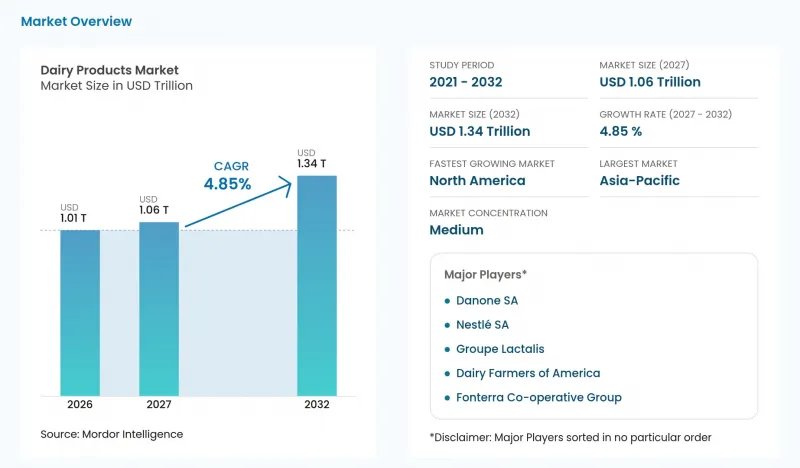
This report is segmented by Product Type (Milk, Yogurt, Cream, Cheese, Dairy Desserts, Butter, Others, and Sour Milk Drinks), Distribution Channel (Off-trade and On-trade), and Geography (Asia-Pacific, Europe, North America, South America, and Middle East and Africa). The market forecasts are provided in terms of value (USD), based on availability.
Global Dairy Products Market Trends and Insights
Increasing demand for probiotic and functional dairy
Fermented probiotic foods can support specialist scale when physical sales accompany growth in revenue. Lifeway Foods, a US supplier of kefir and fermented probiotic foods, reported company-wide net sales growth of 24.1% in Q2 2026 compared with Q2 2025. It described that performance as volume-led and reported its 27th consecutive quarter of year-over-year growth. Repeated volume-led growth gives a processor an operating history against which to size an expansion, because output requirements follow units sold rather than selling prices alone. Lifeway's company-wide result shows commercial momentum at a specialist supplier of kefir and fermented probiotic foods.
Growing availability of dairy variants for dietary needs
Dietary variants can broaden dairy sales while allowing suppliers to differentiate within the same dietary requirement. US retail lactose-free milk volume increased from 208.2 million gallons in 2021 to 282.4 million in the 52 weeks ending December 2025. Within that population, the high-protein variant rose from 60.1 million gallons to 98.1 million over the same period. These volumes support a commercial distinction between simply removing lactose and combining that adjustment with a protein-focused formulation. Circana data reported by FoodNavigator in July 2026 showed US lactose-free milk sales up 7.3% by value and 4.1% by volume over the prior year, while conventional milk volume fell 0.4%.
Rising lactose intolerance and dairy sensitivities
Perceived digestive intolerance can remove buyers from the dairy category before suppliers compete over the attributes of individual products. In a survey of adults in selected Peruvian cities from April to June 2026, 203 of 1,619 participants reported no dairy consumption. Among those nonconsumers, 46.8% cited perceived lactose intolerance as a reason for avoidance. For producers, avoidance of the entire category removes multiple potential product sales simultaneously, making the concern a customer-acquisition constraint across dairy formats. Expanding assortment alone can therefore divide existing dairy spending without bringing these nonconsumers back into the customer base.
Other drivers and restraints analyzed in the detailed report include:
- Rising use of dairy ingredients in packaged foods
- Government support for dairy development and supply stability
- High volatility in raw milk prices
For complete list of drivers and restraints, kindly check the Table Of Contents.
Segment Analysis
Milk accounted for a 62.39% share of the dairy products market size in 2026, making it the largest segment. Almarai reported a first-place position and 67.5% value share in Saudi Arabia's fresh-milk business in 2025, illustrating an established national supplier position. The company also said its 2024 long-life dairy line expansions enabled it to bring 22% of production volumes back from external suppliers in 2025. Bringing production in-house changes who performs manufacturing rather than establishing additional consumer purchases. Almarai's fresh-milk position and dairy insourcing together show how a national milk incumbent can combine consumer reach with control over manufacturing value.
Yogurt is forecast to be the fastest-growing segment, with a CAGR of 5.6% from 2027 to 2032. US production of plain and flavored yogurt totaled 5.29 billion pounds in 2025, 8.5% above 2024. Sour milk drinks showed a distinct retail development in Norway, where kefir sales volume in grocery and service retail rose 40.8% from 2023 to 2025, compared with 7.2% for sour milk overall. That contrast gives Norwegian suppliers a reason to prioritize kefir within their sour milk drink offerings. For yogurt processors, the added US output increases the volume that must find buyers through retail and foodservice channels.
Complete Report Scope:
- By Product Type
- Butter
- Salted Butter
- Unsalted Butter
- Cheese
- Natural Cheese
- Cheddar
- Cottage
- Feta
- Parmesan
- Others
- Processed Cheese
- Natural Cheese
- Cream
- Fresh Cream
- Cooking Cream
- Whipping Cream
- Others
- Dairy Desserts
- Ice Cream
- Cheesecakes
- Frozen Desserts
- Others
- Milk
- Condensed milk
- Flavored Milk
- Fresh Milk
- UHT Milk (Ultra-High Temperature Milk)
- Powdered Milk
- Others
- Yogurt
- Drinkable
- Spoonable
- Sour Milk Drinks
- Others
- Butter
- By Distribution Channel
- On-trade
- Off-trade
- Convenience Stores
- Specialist Retailers
- Supermarkets/Hypermarkets
- Online Retail
- Others
- By Geography
- North America
- United States
- Canada
- Mexico
- Rest of North America
- Europe
- Germany
- United Kingdom
- Italy
- France
- Spain
- Netherlands
- Poland
- Belgium
- Sweden
- Rest of Europe
- Asia-Pacific
- China
- India
- Japan
- Australia
- Indonesia
- South Korea
- Thailand
- Singapore
- Rest of Asia-Pacific
- South America
- Brazil
- Argentina
- Colombia
- Chile
- Peru
- Rest of South America
- Middle East and Africa
- South Africa
- Saudi Arabia
- United Arab Emirates
- Nigeria
- Egypt
- Morocco
- Turkey
- Rest of Middle East and Africa
- North America
Geography Analysis
Asia-Pacific accounted for a 36.77% share of the dairy products market size in 2026, making it the largest regional market. The US Department of Agriculture forecast India's domestic fluid-milk consumption at 221.4 million metric tons in calendar year 2026. China's farm-level milk output reached 40.91 million metric tons in 2025, providing a substantial input base for dairy processing. India's forecast is more than 2% above its 2025 level of 216.5 million metric tons, whereas China's farm milk output rose 0.3% in 2025. For processors seeking additional fluid-milk sales, India's forecast consumption increase provides a more direct commercial signal than the scale of China's farm milk output.
North America is forecast to be the fastest-growing regional market, with a CAGR of 5.85% from 2027 to 2032. US domestic disappearance, a proxy for consumption, increased from 2014 to 2025 on both milk-fat and skim-solids milk-equivalent bases. In May 2026, Hiland Dairy began production at its expanded Tyler, Texas, facility, adding dairy-processing and filling capabilities with initial runs, final checks, and ramp-up in progress. For regional suppliers, domestic use and the added filling and storage capacity at Tyler provide a route to serve customers across Texas and surrounding markets.
Europe's processing base includes the EU, which produced 10.8 million metric tons of cheese and 2.7 million metric tons of milk powder in 2025. Those outlets can give milk suppliers more than one path into finished dairy products. In South America, Brazil's ultra-high-temperature (UHT) milk, milk-powder, yogurt, and cheese supply chains are closely interconnected. In the Middle East and Africa, South African retail quantities and prices both rose across all 9 dairy products evaluated from April 2025 to March 2026.
- Almarai Company
- Arla Foods Amba
- China Mengniu Dairy Co.
- Dairy Farmers of America
- Danone SA
- Fonterra Co-operative Group
- Groupe Lactalis
- Gujarat Cooperative Milk Marketing Federation Ltd.
- Tillamook County Creamery Association
- Nestle SA
- Saputo Inc.
- The Magnum Ice Cream Company N.V.
- Royal FrieslandCampina N.V.
- Vinamilk
- Agropur Cooperative
- Meiji Co., Ltd.
- Bel SA
- Unternehmensgruppe Theo Muller
- DMK Group
- Grupo Lala, S.A.B. de C.V.
Additional Benefits:
- The market estimate (ME) sheet in Excel format
- 3 months of analyst support
TABLE OF CONTENTS
1 INTRODUCTION
- 1.1 Study Assumptions and Market Definition
- 1.2 Scope of the Study
2 RESEARCH METHODOLOGY
3 EXECUTIVE SUMMARY
4 MARKET LANDSCAPE
- 4.1 Market Overview
- 4.2 Market Drivers
- 4.2.1 Increasing demand for probiotic and functional dairy
- 4.2.2 Growing availability of dairy variants for dietary needs
- 4.2.3 Rising use of dairy ingredients in packaged foods
- 4.2.4 Government support for dairy development and supply stability
- 4.2.5 Increasing adoption of sustainable and ethical dairy options
- 4.2.6 Expansion of lactose-digestive aids supporting dairy intake
- 4.3 Market Restraints
- 4.3.1 Rising lactose intolerance and dairy sensitivities
- 4.3.2 High volatility in raw milk prices
- 4.3.3 Increasing competition from plant-based alternatives
- 4.3.4 Frequent quality and adulteration issues
- 4.4 Industry Value Chain Analysis
- 4.5 Regulatory Landscape
- 4.6 Technological Outlook
- 4.7 Porter's Five Forces Analysis
- 4.7.1 Threat of New Entrants
- 4.7.2 Bargaining Power of Suppliers
- 4.7.3 Bargaining Power of Buyers
- 4.7.4 Threat of Substitutes
- 4.7.5 Competitive Rivalry
5 MARKET SIZE AND GROWTH FORECASTS (VALUE)
- 5.1 By Product Type
- 5.1.1 Butter
- 5.1.1.1 Salted Butter
- 5.1.1.2 Unsalted Butter
- 5.1.2 Cheese
- 5.1.2.1 Natural Cheese
- 5.1.2.1.1 Cheddar
- 5.1.2.1.2 Cottage
- 5.1.2.1.3 Feta
- 5.1.2.1.4 Parmesan
- 5.1.2.1.5 Others
- 5.1.2.2 Processed Cheese
- 5.1.2.1 Natural Cheese
- 5.1.3 Cream
- 5.1.3.1 Fresh Cream
- 5.1.3.2 Cooking Cream
- 5.1.3.3 Whipping Cream
- 5.1.3.4 Others
- 5.1.4 Dairy Desserts
- 5.1.4.1 Ice Cream
- 5.1.4.2 Cheesecakes
- 5.1.4.3 Frozen Desserts
- 5.1.4.4 Others
- 5.1.5 Milk
- 5.1.5.1 Condensed milk
- 5.1.5.2 Flavored Milk
- 5.1.5.3 Fresh Milk
- 5.1.5.4 UHT Milk (Ultra-High Temperature Milk)
- 5.1.5.5 Powdered Milk
- 5.1.5.6 Others
- 5.1.6 Yogurt
- 5.1.6.1 Drinkable
- 5.1.6.2 Spoonable
- 5.1.7 Sour Milk Drinks
- 5.1.8 Others
- 5.1.1 Butter
- 5.2 By Distribution Channel
- 5.2.1 On-trade
- 5.2.2 Off-trade
- 5.2.2.1 Convenience Stores
- 5.2.2.2 Specialist Retailers
- 5.2.2.3 Supermarkets/Hypermarkets
- 5.2.2.4 Online Retail
- 5.2.2.5 Others
- 5.3 By Geography
- 5.3.1 North America
- 5.3.1.1 United States
- 5.3.1.2 Canada
- 5.3.1.3 Mexico
- 5.3.1.4 Rest of North America
- 5.3.2 Europe
- 5.3.2.1 Germany
- 5.3.2.2 United Kingdom
- 5.3.2.3 Italy
- 5.3.2.4 France
- 5.3.2.5 Spain
- 5.3.2.6 Netherlands
- 5.3.2.7 Poland
- 5.3.2.8 Belgium
- 5.3.2.9 Sweden
- 5.3.2.10 Rest of Europe
- 5.3.3 Asia-Pacific
- 5.3.3.1 China
- 5.3.3.2 India
- 5.3.3.3 Japan
- 5.3.3.4 Australia
- 5.3.3.5 Indonesia
- 5.3.3.6 South Korea
- 5.3.3.7 Thailand
- 5.3.3.8 Singapore
- 5.3.3.9 Rest of Asia-Pacific
- 5.3.4 South America
- 5.3.4.1 Brazil
- 5.3.4.2 Argentina
- 5.3.4.3 Colombia
- 5.3.4.4 Chile
- 5.3.4.5 Peru
- 5.3.4.6 Rest of South America
- 5.3.5 Middle East and Africa
- 5.3.5.1 South Africa
- 5.3.5.2 Saudi Arabia
- 5.3.5.3 United Arab Emirates
- 5.3.5.4 Nigeria
- 5.3.5.5 Egypt
- 5.3.5.6 Morocco
- 5.3.5.7 Turkey
- 5.3.5.8 Rest of Middle East and Africa
- 5.3.1 North America
6 COMPETITIVE LANDSCAPE
- 6.1 Market Concentration
- 6.2 Strategic Moves
- 6.3 Market Share Analysis
- 6.4 Company Profiles (includes Global level Overview, Market level overview, Core Segments, Financials as available, Strategic Information, Market Rank/Share for key companies, Products and Services, and Recent Developments)
- 6.4.1 Almarai Company
- 6.4.2 Arla Foods Amba
- 6.4.3 China Mengniu Dairy Co.
- 6.4.4 Dairy Farmers of America
- 6.4.5 Danone SA
- 6.4.6 Fonterra Co-operative Group
- 6.4.7 Groupe Lactalis
- 6.4.8 Gujarat Cooperative Milk Marketing Federation Ltd.
- 6.4.9 Tillamook County Creamery Association
- 6.4.10 Nestle SA
- 6.4.11 Saputo Inc.
- 6.4.12 The Magnum Ice Cream Company N.V.
- 6.4.13 Royal FrieslandCampina N.V.
- 6.4.14 Vinamilk
- 6.4.15 Agropur Cooperative
- 6.4.16 Meiji Co., Ltd.
- 6.4.17 Bel SA
- 6.4.18 Unternehmensgruppe Theo Muller
- 6.4.19 DMK Group
- 6.4.20 Grupo Lala, S.A.B. de C.V.
7 MARKET OPPORTUNITIES AND FUTURE OUTLOOK
- 7.1 White-Space and Unmet-Need Assessment

