PUBLISHER: Mordor Intelligence | PRODUCT CODE: 2187138

PUBLISHER: Mordor Intelligence | PRODUCT CODE: 2187138
Philippines Renewable Energy - Market Share Analysis, Industry Trends & Statistics, Growth Forecasts (2027 - 2032)
According to Mordor Intelligence, the Philippines renewable energy market size is projected to expand from 14.45 gigawatt in 2026 and 17.18 gigawatt in 2027 to 39.87 gigawatt by 2032, registering a CAGR of 18.34% between 2027 and 2032.
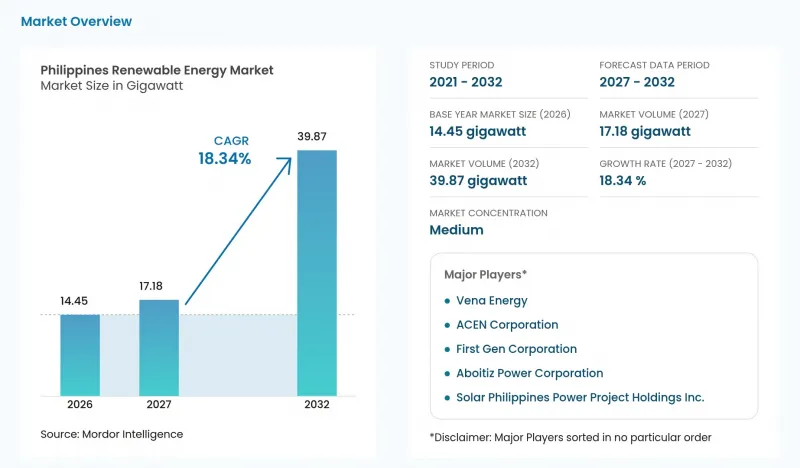
This report is segmented by Technology (Hydropower, Solar Energy, Geothermal, Wind Energy, Bioenergy, and Ocean Energy) and End-User (Utilities, Commercial and Industrial, and Residential). The market forecasts are provided in terms of volume (gigawatt), based on availability.
Philippines Renewable Energy Market Trends and Insights
Renewable Portfolio Standards & Feed-in Tariffs
Tariff-funded payments give eligible renewable generators a revenue route that can support investment in additional grid-supplying capacity. The Energy Regulatory Commission authorized the National Transmission Corporation, the fund administrator, to collect the 2026 Feed-in-Tariff Allowance from January 2026 billing. Under the 2026 decision, eligible generators are paid for actual generation volume supplied to the grid. The Department of Energy (DOE) project list neither guarantees final tariff eligibility nor restricts payments to the listed projects. A project delayed in grid connection earns no tariff support before supplying electricity, so transmission access determines when an eligible investment can begin capturing this revenue.
Declining Solar-PV & Wind Turbine Capex
Lower equipment costs can improve renewable project economics without producing an equivalent reduction in the price of delivered electricity. The International Renewable Energy Agency (IRENA) reported that cheaper equipment and lower installed costs helped reduce global onshore wind generation costs in 2025. Solar PV's global levelized cost of electricity was unchanged, as a higher cost of capital and slightly lower capacity factors offset the equipment and installation benefits. The 2025 global weighted-average levelized cost was USD 33 per MWh for onshore wind and USD 44 per MWh for solar PV. This global cost contrast strengthens the investment case for additional Philippine onshore wind capacity more directly than for solar expansion, where equipment savings did not lower the generation-cost benchmark.
Grid Congestion & Limited Transmission Capacity
Securing transmission access can delay the commercial value of investment in renewable generating equipment. The OECD's 2026 survey described difficult transmission access for renewable developers and over 160 projects awaiting National Grid Corporation of the Philippines (NGCP) System Impact Studies, with backlog clearance potentially taking an additional year. NGCP conducts these studies as part of the process for obtaining transmission-network access. A developer therefore faces a separate approval sequence even when a generation design and customer opportunity are already defined. New applicants carry the added exposure, since the OECD noted that the backlog could cause them further delays.
Other drivers and restraints analyzed in the detailed report include:
- Rising Electricity Demand & High Retail Tariffs
- Corporate PPAs from BPO/IT Hubs
- Regulatory Uncertainty around CREZ Auctions
For complete list of drivers and restraints, kindly check the Table Of Contents.
Segment Analysis
Hydropower accounted for a 38.9% share of the Philippines renewable energy market size in 2026. First Gen's hydro-platform revenue rose 8.4% between the first quarters of 2025 and 2026. The increase largely reflected higher generation at its FG Hydro plants, which increased spot-market sales and capacity available for ancillary services in the Reserve Market. Lower generation at Casecnan, another plant in First Gen's hydro platform, partly offset that revenue gain. Operators in the largest segment can earn from electricity sales while offering available capacity for reserve services, giving usable operating flexibility a role in installed-asset value.
Ocean energy, covering tidal and wave technologies, is forecast to be the fastest-growing segment, with a CAGR of 106% between 2027 and 2032. The forecast implies commercialization from an undeveloped tidal industry, since no commercial tidal power facility operated in Southeast Asia in June 2026. A 2025 Ateneo study identified the San Bernardino, San Juanico, and Cebu straits in the Visayas as potential tidal-stream generation sites. For tidal developers, realizing that growth requires commercial projects, with the potential Visayas sites offering a starting point for assessing where entry could occur. Bioenergy, by contrast, had an operating cogeneration example in the 8 MW expansion associated with Central Azucarera de San Antonio as of April 17, 2026.
Complete Report Scope:
- By Technology
- Solar Energy (PV and CSP)
- Wind Energy (Onshore and Offshore)
- Hydropower (Small, Large, PSH)
- Bioenergy
- Geothermal
- Ocean Energy (Tidal and Wave)
- By End-User
- Utilities
- Commercial and Industrial
- Residential
List of Companies Covered in this Report:
- Aboitiz Power Corporation
- ACEN Corporation
- Solar Philippines Power Project Holdings Inc.
- Vena Energy
- First Gen Corporation
- Energy Development Corporation (EDC)
- SN Aboitiz Power Group
- Alternergy Holdings Corp.
- Trina Solar Co. Ltd.
- Vestas Wind Systems A/S
- Solenergy Systems Inc.
- Solaric Corp.
- National Power Corporation (NPC)
- Philippine Geothermal Production Company Inc.
- Meralco PowerGen Corp.
- Siemens Gamesa Renewable Energy
- Nexif Ratch Energy
- Kepco Philippines Holdings
- Enfinity Global Inc.
- Sharp Energy Solutions
Additional Benefits:
- The market estimate (ME) sheet in Excel format
- 3 months of analyst support
TABLE OF CONTENTS
1 INTRODUCTION
- 1.1 Study Assumptions and Market Definition
- 1.2 Scope of the Study
2 RESEARCH METHODOLOGY
3 EXECUTIVE SUMMARY
4 MARKET LANDSCAPE
- 4.1 Market Overview
- 4.2 Market Drivers
- 4.2.1 Renewable Portfolio Standards & Feed-in Tariffs
- 4.2.2 Declining Solar-PV & Wind Turbine Capex
- 4.2.3 Rising Electricity Demand & High Retail Tariffs
- 4.2.4 Corporate PPAs from BPO/IT Hubs
- 4.2.5 Grid Upgrades via JICA-funded Projects
- 4.2.6 Disaster-resilient Island & Micro-grid Programs
- 4.3 Market Restraints
- 4.3.1 Grid Congestion & Limited Transmission Capacity
- 4.3.2 Regulatory Uncertainty around CREZ Auctions
- 4.3.3 Typhoon-driven Insurance Cost Escalation
- 4.3.4 Land-use Conflicts with Agrarian Reform Lands
- 4.4 Industry Value Chain Analysis
- 4.5 Regulatory Landscape
- 4.6 Technological Outlook
- 4.7 Porter's Five Forces Analysis
- 4.7.1 Threat of New Entrants
- 4.7.2 Bargaining Power of Suppliers
- 4.7.3 Bargaining Power of Buyers
- 4.7.4 Threat of Substitutes
- 4.7.5 Competitive Rivalry
- 4.8 PESTLE Analysis
5 MARKET SIZE AND GROWTH FORECASTS (VOLUME)
- 5.1 By Technology
- 5.1.1 Solar Energy (PV and CSP)
- 5.1.2 Wind Energy (Onshore and Offshore)
- 5.1.3 Hydropower (Small, Large, PSH)
- 5.1.4 Bioenergy
- 5.1.5 Geothermal
- 5.1.6 Ocean Energy (Tidal and Wave)
- 5.2 By End-User
- 5.2.1 Utilities
- 5.2.2 Commercial and Industrial
- 5.2.3 Residential
6 COMPETITIVE LANDSCAPE
- 6.1 Market Concentration
- 6.2 Strategic Moves
- 6.3 Market Share Analysis
- 6.4 Company Profiles (includes Global level Overview, Market level overview, Core Segments, Financials as available, Strategic Information, Market Rank/Share for key companies, Products and Services, and Recent Developments)
- 6.4.1 Aboitiz Power Corporation
- 6.4.2 ACEN Corporation
- 6.4.3 Solar Philippines Power Project Holdings Inc.
- 6.4.4 Vena Energy
- 6.4.5 First Gen Corporation
- 6.4.6 Energy Development Corporation (EDC)
- 6.4.7 SN Aboitiz Power Group
- 6.4.8 Alternergy Holdings Corp.
- 6.4.9 Trina Solar Co. Ltd.
- 6.4.10 Vestas Wind Systems A/S
- 6.4.11 Solenergy Systems Inc.
- 6.4.12 Solaric Corp.
- 6.4.13 National Power Corporation (NPC)
- 6.4.14 Philippine Geothermal Production Company Inc.
- 6.4.15 Meralco PowerGen Corp.
- 6.4.16 Siemens Gamesa Renewable Energy
- 6.4.17 Nexif Ratch Energy
- 6.4.18 Kepco Philippines Holdings
- 6.4.19 Enfinity Global Inc.
- 6.4.20 Sharp Energy Solutions
7 MARKET OPPORTUNITIES AND FUTURE OUTLOOK
- 7.1 White-Space and Unmet-Need Assessment

