PUBLISHER: Mordor Intelligence | PRODUCT CODE: 2187143

PUBLISHER: Mordor Intelligence | PRODUCT CODE: 2187143
Coffee - Market Share Analysis, Industry Trends & Statistics, Growth Forecasts (2027 - 2032)
According to Mordor Intelligence, the coffee market size is estimated at USD 185.7 billion in 2026 and is projected to be USD 195.3 billion in 2027, reaching USD 247.7 billion by 2032, growing at a CAGR of 4.87% from 2027 to 2032.
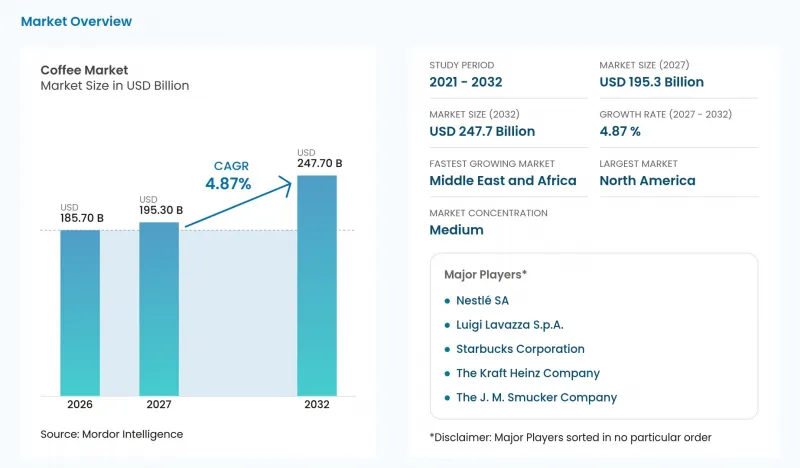
The coffee market volume is estimated at 11.03 million tonnes in 2026 and is projected to be 11.2 million tonnes in 2027, reaching 12.07 million tonnes by 2032, growing at a CAGR of 1.5% from 2027 to 2032. This report is segmented by Product Type (Ground Coffee, Instant Coffee, and more), Distribution Channel (Off-trade and On-trade), Coffee Species (Arabica, Robusta, and more), Origin (Mixed and Single Origin/Specialty), and Geography (North America, Europe, and more). The market forecasts are provided in terms of value (USD) and volume (tonnes), based on availability.
Global Coffee Market Trends and Insights
Rising demand for specialty and premium coffee
Specialty demand expands the commercial role of coffee preparation, because an espresso-based drink can carry a distinct proposition beyond the underlying beans. In June 2026, 47% of U.S. adults had an espresso-based beverage in the past week, up 17.5% since 2022. Espresso-based beverages included lattes, cappuccinos and caffe mochas. An established audience for this preparation family gives roasters a reason to develop coffee propositions around the drinks cafes serve. Cafe operators can therefore make repeatable beverage execution part of the specialty investment case, with roasting and preparation serving the same drink proposition.
Growing coffee culture among millennials and Gen Z
Younger adults provide an established audience for specialty coffee, giving suppliers a basis for age-specific product positioning. In the spring 2026 U.S. survey, collected January 5 to 20, 69% of adults aged 25 to 39 had specialty coffee in the past week. The corresponding figure for adults aged 18 to 24 was 50%. This contrast separates a majority-participation specialty audience from an age band evenly divided on past-week use. Adults aged 25 to 39 consequently offer the broader demonstrated starting audience for a specialty supplier choosing an initial proposition for one of these 2 age groups.
Volatility in coffee bean prices
Trading around New York's July options and futures deadlines drove a global coffee-price spike beginning in early June 2026. In July, Expana analyst Oliver Broster described his impression that high prices and an anticipated large Brazilian crop discouraged small and medium roasters from securing future supply through futures contracts. As the July deadline approached, the roasters entered the market to fix contracts. For roasters, postponing coverage can concentrate purchasing into a deadline even when prices discourage longer commitments. In fiscal 2025, Starbucks used forward, futures and collar contracts to hedge "C" price exposure under price-to-be-fixed green-coffee contracts and forecast demand without fixed-price or price-to-be-fixed purchasing commitments. The remaining commercial constraint is the cost of committing to supply when contract timing leaves little freedom to defer.
Other drivers and restraints analyzed in the detailed report include:
- Booming RTD/cold-brew consumption
- Sustainability and ethical sourcing awareness
- Tariffs and European Union Deforestation Regulation barriers
For complete list of drivers and restraints, kindly check the Table Of Contents.
Segment Analysis
Ground coffee accounted for a 32.76% share of the coffee market size in 2026. Highlands inaugurated its first Vietnamese coffee roasting and grinding factory on April 15, 2025, for roasted and ground products serving domestic and export markets. The largest segment's supply base can therefore include combined roasting and grinding investments serving domestic and export outlets. Ground-coffee expansion can consequently depend on building domestic and export outlets for the same processing base, so added factory capability has more than one commercial destination.
Ready-to-drink (RTD) coffee is the fastest-growing segment, with a projected CAGR of 7.2% from 2027 to 2032. Black Rifle Coffee Company reported sales-weighted U.S. single-serve RTD distribution of 52.4% in the 4 weeks ending June 27, 2026, versus 53.4% a year earlier. Nielsen's category included Monster-Java, and the measure weighted distribution by total store sales across tracked retail and convenience channels. The decline makes distribution execution a constraint within the growth case even where the brand has a substantial retail presence. RTD brands can pursue more purchases within their existing reach while treating additional distribution as a separate commercial objective.
Off-trade was the largest segment, with an 80.26% share in 2026. Grocery stores were the leading U.S. channel for coffee purchases for in-home preparation in June 2026. This provides a concrete household-purchasing route through which packaged-coffee suppliers can reach buyers outside a dedicated coffee-service setting. For those suppliers, retail access and the proposition for preparation at home belong to the same commercial decision, since the outlet brings the coffee into the household. Grocery access is consequently a route to the at-home customer relationship, giving packaged-coffee brands a way to serve consumption without owning the preparation venue.
On-trade is the fastest-growing segment, with a projected CAGR of 5.74% from 2027 to 2032. In June 2026, 38% of U.S. past-day coffee drinkers consumed coffee out of home, the highest level since January 2020. Among U.S. past-week out-of-home coffee buyers, 55% ordered at a drive-through and a record 40% ordered through an app in June 2026. Those pathways make access to the prepared drink part of the service proposition, connecting coffee demand with how the order reaches the operator. The expansion opportunity for operators includes convenient ordering alongside the beverage itself, so an additional cafe counter is only one possible way to serve that audience.
Complete Report Scope:
- By Product Type
- Whole-bean
- Ground Coffee
- Instant Coffee
- Ready-to-Drink (RTD)
- Coffee Pod and Capsules
- By Distribution Channel
- On-trade
- Off-trade
- Supermarkets/Hypermarkets
- Convenience Stores
- Specialist Retailers
- Online Retail
- Other Off-trade Channels
- By Coffee Species
- Arabica
- Robusta
- Liberica
- Others
- By Origin
- Single Origin/Specialty
- Mixed
- By Geography
- North America
- United States
- Canada
- Mexico
- Rest of North America
- South America
- Brazil
- Colombia
- Argentina
- Rest of South America
- Europe
- Germany
- United Kingdom
- France
- Italy
- Spain
- Russia
- Netherlands
- Rest of Europe
- Asia-Pacific
- China
- Japan
- India
- South Korea
- Australia
- Indonesia
- Vietnam
- Malaysia
- Singapore
- Rest of Asia-Pacific
- Middle East and Africa
- United Arab Emirates
- Saudi Arabia
- Turkey
- South Africa
- Egypt
- Kuwait
- Ethiopia
- Rest of Middle East and Africa
- North America
Geography Analysis
North America held a 23.62% coffee market share in 2026, making it the largest geography. USDA estimated U.S. domestic coffee consumption at 25.55 million 60-kilogram bags and Canadian consumption at 5.05 million bags on the same basis in marketing year 2025/26. Separately, 66% of U.S. adults had coffee in the past day in June 2026, indicating a broad consumer base alongside substantial national consumption volumes. North American suppliers therefore have room to build differentiated coffee propositions inside a broad established demand base, alongside the task of serving substantial consumption in 2 national markets.
Middle East and Africa is the fastest-growing geography, with a projected CAGR of 7.8% from 2027 to 2032. Saudi Arabia imported USD 235.3 million of roasted, non-decaffeinated coffee in 2025, establishing a substantial country-level route for finished roasted products. In October 2025, Nonda Coffee, a brand of Nonda Commodities Limited in Uganda, launched a single-origin coffee cafe in Riyadh. The opening illustrates how an African producer-country brand can create a direct coffee-service foothold within another country in the region, bringing origin identity into the customer offer. For regional coffee suppliers, growth can therefore be pursued through both established import channels and origin-branded retail service, with the route chosen shaping how the coffee reaches its final buyer.
Across the remaining regions, local product preferences and processing roles create different coffee opportunities. In South America, Peru's domestic consumption was estimated at 305,000 60-kilogram bags for 2026/27, including 230,000 bags of soluble coffee and 75,000 bags of roasted and ground coffee. European companies import green coffee for local roasting, while Swiss consumption was approximately 9 kilograms per person on a green-coffee basis in 2025. In Asia-Pacific, Vietnamese consumers show a home-brewing trend involving high-quality and specialty coffee, including premium Robusta and Arabica. These distinctions give suppliers separate commercial tasks, from serving Peru's soluble-coffee demand to reaching European roasters and Vietnamese households seeking differentiated coffee for preparation at home.
- Nestle SA
- UCC Ueshima Coffee Co.
- Starbucks Corporation
- The Kraft Heinz Company
- Luigi Lavazza S.p.A.
- Massimo Zanetti Beverage Group SpA
- The J. M. Smucker Company
- Tata Consumer Products
- Coava Coffee Roasters
- Tchibo GmbH
- Louis Dreyfus Company Coffee
- TGL Company
- Trung Nguyen Legend Group
- Mayora Group (Kopiko)
- The Coca-Cola Company
- Unilever PLC
- Zino Davidoff Group
- Sleepy Owl Coffee
- Bewley's Limited
- Strauss Group
Additional Benefits:
- The market estimate (ME) sheet in Excel format
- 3 months of analyst support
TABLE OF CONTENTS
1 INTRODUCTION
- 1.1 Study Assumptions and Market Definition
- 1.2 Scope of the Study
2 RESEARCH METHODOLOGY
3 EXECUTIVE SUMMARY
4 MARKET LANDSCAPE
- 4.1 Market Overview
- 4.2 Market Drivers
- 4.2.1 Rising demand for specialty and premium coffee
- 4.2.2 Growing coffee culture among millennials and Gen Z
- 4.2.3 Booming RTD/cold-brew consumption
- 4.2.4 Sustainability and ethical sourcing awareness
- 4.2.5 Corporate and workplace coffee solutions
- 4.2.6 Influence of social media and influencer marketing
- 4.3 Market Restraints
- 4.3.1 Volatility in coffee bean prices
- 4.3.2 Tariffs and European Union Deforestation Regulation barriers
- 4.3.3 Regulatory pressure and import/export restrictions
- 4.3.4 Consumer concerns over caffeine and health risks
- 4.4 Industry Value Chain Analysis
- 4.5 Regulatory Landscape
- 4.6 Technological Outlook
- 4.7 Porter's Five Forces Analysis
- 4.7.1 Threat of New Entrants
- 4.7.2 Bargaining Power of Suppliers
- 4.7.3 Bargaining Power of Buyers
- 4.7.4 Threat of Substitutes
- 4.7.5 Competitive Rivalry
5 MARKET SIZE AND GROWTH FORECASTS (VALUE AND VOLUME)
- 5.1 By Product Type
- 5.1.1 Whole-bean
- 5.1.2 Ground Coffee
- 5.1.3 Instant Coffee
- 5.1.4 Ready-to-Drink (RTD)
- 5.1.5 Coffee Pod and Capsules
- 5.2 By Distribution Channel
- 5.2.1 On-trade
- 5.2.2 Off-trade
- 5.2.2.1 Supermarkets/Hypermarkets
- 5.2.2.2 Convenience Stores
- 5.2.2.3 Specialist Retailers
- 5.2.2.4 Online Retail
- 5.2.2.5 Other Off-trade Channels
- 5.3 By Coffee Species
- 5.3.1 Arabica
- 5.3.2 Robusta
- 5.3.3 Liberica
- 5.3.4 Others
- 5.4 By Origin
- 5.4.1 Single Origin/Specialty
- 5.4.2 Mixed
- 5.5 By Geography
- 5.5.1 North America
- 5.5.1.1 United States
- 5.5.1.2 Canada
- 5.5.1.3 Mexico
- 5.5.1.4 Rest of North America
- 5.5.2 South America
- 5.5.2.1 Brazil
- 5.5.2.2 Colombia
- 5.5.2.3 Argentina
- 5.5.2.4 Rest of South America
- 5.5.3 Europe
- 5.5.3.1 Germany
- 5.5.3.2 United Kingdom
- 5.5.3.3 France
- 5.5.3.4 Italy
- 5.5.3.5 Spain
- 5.5.3.6 Russia
- 5.5.3.7 Netherlands
- 5.5.3.8 Rest of Europe
- 5.5.4 Asia-Pacific
- 5.5.4.1 China
- 5.5.4.2 Japan
- 5.5.4.3 India
- 5.5.4.4 South Korea
- 5.5.4.5 Australia
- 5.5.4.6 Indonesia
- 5.5.4.7 Vietnam
- 5.5.4.8 Malaysia
- 5.5.4.9 Singapore
- 5.5.4.10 Rest of Asia-Pacific
- 5.5.5 Middle East and Africa
- 5.5.5.1 United Arab Emirates
- 5.5.5.2 Saudi Arabia
- 5.5.5.3 Turkey
- 5.5.5.4 South Africa
- 5.5.5.5 Egypt
- 5.5.5.6 Kuwait
- 5.5.5.7 Ethiopia
- 5.5.5.8 Rest of Middle East and Africa
- 5.5.1 North America
6 COMPETITIVE LANDSCAPE
- 6.1 Market Concentration
- 6.2 Strategic Moves
- 6.3 Market Share Analysis
- 6.4 Company Profiles (includes Global level Overview, Market level overview, Core Segments, Financials as available, Strategic Information, Market Rank/Share for key companies, Products and Services, and Recent Developments)
- 6.4.1 Nestle SA
- 6.4.2 UCC Ueshima Coffee Co.
- 6.4.3 Starbucks Corporation
- 6.4.4 The Kraft Heinz Company
- 6.4.5 Luigi Lavazza S.p.A.
- 6.4.6 Massimo Zanetti Beverage Group SpA
- 6.4.7 The J. M. Smucker Company
- 6.4.8 Tata Consumer Products
- 6.4.9 Coava Coffee Roasters
- 6.4.10 Tchibo GmbH
- 6.4.11 Louis Dreyfus Company Coffee
- 6.4.12 TGL Company
- 6.4.13 Trung Nguyen Legend Group
- 6.4.14 Mayora Group (Kopiko)
- 6.4.15 The Coca-Cola Company
- 6.4.16 Unilever PLC
- 6.4.17 Zino Davidoff Group
- 6.4.18 Sleepy Owl Coffee
- 6.4.19 Bewley's Limited
- 6.4.20 Strauss Group
7 MARKET OPPORTUNITIES AND FUTURE OUTLOOK
- 7.1 White-Space and Unmet-Need Assessment

