PUBLISHER: Mordor Intelligence | PRODUCT CODE: 2187174

PUBLISHER: Mordor Intelligence | PRODUCT CODE: 2187174
Vietnam Coffee - Market Share Analysis, Industry Trends & Statistics, Growth Forecasts (2027 - 2032)
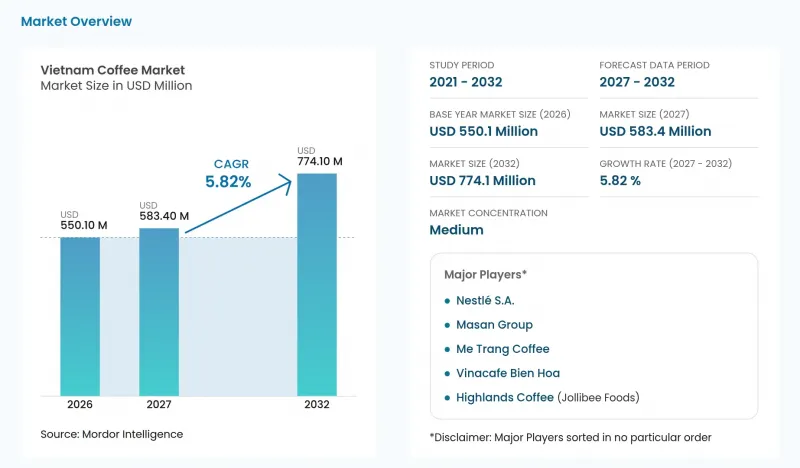
According to Mordor Intelligence, the Vietnam coffee market size was valued at USD 550.1 million in 2026 and estimated to grow from USD 583.4 million in 2027 to reach USD 774.1 million by 2032, at a CAGR of 5.82% during the forecast period (2027-2032).
This report is segmented by Product Type (Instant Coffee, Ground Coffee, Ready-to-Drink, Whole Bean, and Coffee Pods and Capsules), Coffee Type (Robusta, Arabica, and Others), Category (Conventional and Specialty), and Distribution Channel (Off-trade and On-trade). The market forecasts are provided in terms of value (USD), based on availability.
Vietnam Coffee Market Trends and Insights
Expansion of Cafe Chains and Franchise Models
Cafe-chain expansion is widening the number of places where Vietnamese consumers can buy prepared coffee. Highlands Coffee opened 134 stores in 2025, reaching 985 cafes by December 31, including 38 in the Philippines and the remainder in Vietnam. Trung Nguyen Franchising opened 7 E-Coffee spaces across Ho Chi Minh City, Khanh Hoa, Nghe An and Tay Ninh on December 24, 2025 under its coffee franchise model. Phuc Long Heritage also reported 202 standalone stores outside WinCommerce at year-end 2025. These networks lower access friction for office workers and commuters while giving roasters more outlets for premium and functional formats. Franchise replication converts local concepts into repeatable demand, although operators must protect consistency as store density rises.
Product Innovation with functional blends
Functional blends are adding new purchase occasions beyond traditional roast profiles. In 2025, Masan Consumer introduced a Wake-Up 247 Latte-style coffee energy drink with real coffee extract and B vitamins through its Manchester City collaboration in Vietnam. Trung Nguyen Legend offers G7 Collagen Coffee, a low-caffeine instant blend enriched with collagen and polyphenol compounds, while King Coffee sells a Vietnam-origin instant cappuccino blend with collagen, cherry blossom extract and strawberry powder. These examples let brands target energy, beauty and lower-caffeine preferences through familiar instant and ready-to-drink formats. Brands that pair familiar preparation with clear functional positioning can add purchase occasions without asking consumers to change how they prepare coffee.
Smallholder Fragmentation
Smallholder fragmentation raises the cost of assembling verifiable coffee supplies. A 2026 EU/GIZ study found Vietnamese coffee plots are often 1 to 2 hectares spread across multiple parcels, while mapping and digital-tool gaps make buyer verification difficult. Tropenbos Viet Nam reported that more than 90% of farmers sell exclusively to middlemen and that over 3,000 traders collect coffee. The same briefing says coffee from high-risk areas is routinely excluded when long, mixed chains prevent acceptable traceability and supply integrity. JDE Peet's and Intimex Dak Nong operated a 2024-2029 project in Dak Nong's Krong No and Dak Glong, targeting 10,000 smallholders with GPS field books, training and nurseries, distributing 37,189 intercropping seedlings in 2025. That support can improve documentation, but fragmented onboarding still leaves buyers carrying coordination costs and some farms exposed to exclusion.
Other drivers and restraints analyzed in the detailed report include:
- Sustainability and Traceability
- Growth of Specialty and Premium Coffee Culture
- Supply Chain Disruptions
For complete list of drivers and restraints, kindly check the Table Of Contents.
Segment Analysis
Instant Coffee accounted for a 36.9% share of the Vietnam Coffee Market size in 2026. Cốc Cốc's 2025 survey of sachet and canned coffee users found 69% had tried instant coffee products, up from 65% in 2024. That combination lets manufacturers serve routine household occasions without requiring specialized preparation infrastructure. Brands can extend the base with sachets, cappuccino mixes and functional variants while preserving familiar preparation. Rising trial among sachet and canned coffee users points to a widening base of instant buyers behind its volume lead.
Ready-to-Drink is the fastest-growing segment at a 7.3% CAGR during 2027-2032. In Northern Vietnam, 47% of surveyed coffee users cited mental alertness and 47% convenience as reasons for drinking canned or bottled coffee in 2025. Chilled portability fits commuting, school and workplace occasions where brewing time is limited. Producers can use cans and bottles to introduce flavor, dairy and functional cues without requiring equipment. That operating mix makes cold placement a channel decision rather than a product afterthought.
Robusta represented an 81.27% Vietnam Coffee Market share in 2026. USDA forecasts Vietnam's MY 2026/27 output at 32.5 million 60-kg bags of green-bean equivalent, including 31.4 million Robusta bags. Harvested Robusta area is forecast at 644,000 hectares in MY 2026/27, up from 630,200 hectares in MY 2025/26. That scale supports blends, soluble products and foodservice recipes that need consistent body and supply.
Arabica is forecast to grow fastest at a 6.35% CAGR during 2027-2032. Phuc Sinh Son La markets Blue Son La and Cascara Blu Son La Arabica products that the EU and United States markets have rated highly. VICOFA reported Arabica exports of 58,500 metric tons worth USD 387.7 million in January-August 2026. Quang Trị's Department of Agriculture and Environment reported roughly 400 to 500 equivalent Liberica hectares in 2026, mainly in Hướng Phung, Khe Sanh and Tan Lập, expanding with market demand and showing Others' distinct demand. The 400 to 500 equivalent hectares in Quang Trị show that differentiated demand can support small origin pockets alongside Arabica's export base.
Complete Report Scope:
- By Product Type
- Whole Bean
- Ground Coffee
- Instant Coffee
- Coffee Pods and Capsules
- Ready-to-Drink
- By Coffee Type
- Arabica
- Robusta
- Others
- By Category
- Conventional
- Specialty (Organic/Single-Origin)
- By Distribution Channel
- On-trade
- Off-trade
- Supermarkets/Hypermarkets
- Convenience Stores
- Specialty Stores
- Online Retail
- Other Off-trade channels
List of Companies Covered in this Report:
- Nestle S.A.
- Vinacafe Bien Hoa
- Trung Nguyen Legend
- Highlands Coffee (Jollibee Foods)
- Starbucks Corporation
- Me Trang Coffee
- The Coffee House
- Phuc Long Coffee and Tea
- Caffe Bene
- Len's Coffee
- JDE Peet's
- Masan Group
- Lavazza
- Kido Group (Tiamo Coffee)
- Nguyen Chat Coffee
- Copper Cow Coffee
- Anni Coffee
- Gloria Jean's Coffees
- Metrang Coffee
- Bosgaurus Coffee Roasters
Additional Benefits:
- The market estimate (ME) sheet in Excel format
- 3 months of analyst support
TABLE OF CONTENTS
1 INTRODUCTION
- 1.1 Study Assumptions and Market Definition
- 1.2 Scope of the Study
2 RESEARCH METHODOLOGY
3 EXECUTIVE SUMMARY
4 MARKET LANDSCAPE
- 4.1 Market Overview
- 4.2 Market Drivers
- 4.2.1 Expansion of Cafe Chains and Franchise Models
- 4.2.2 Product Innovation with functional blends
- 4.2.3 Sustainability and Traceability
- 4.2.4 Growth of Specialty and Premium Coffee Culture
- 4.2.5 Rise of Home Brewing and Convenience Formats
- 4.2.6 Tech-Enabled Customer Experience
- 4.3 Market Restraints
- 4.3.1 Smallholder Fragmentation
- 4.3.2 Supply Chain Disruptions
- 4.3.3 Price Volatility and Market Uncertainty
- 4.3.4 Regulatory Uncertainty and Trade Barriers
- 4.4 Industry Value Chain Analysis
- 4.5 Regulatory Landscape
- 4.6 Technological Outlook
- 4.7 Porter's Five Forces Analysis
- 4.7.1 Threat of New Entrants
- 4.7.2 Bargaining Power of Suppliers
- 4.7.3 Bargaining Power of Buyers
- 4.7.4 Threat of Substitutes
- 4.7.5 Competitive Rivalry
5 MARKET SIZE AND GROWTH FORECASTS (VALUE)
- 5.1 By Product Type
- 5.1.1 Whole Bean
- 5.1.2 Ground Coffee
- 5.1.3 Instant Coffee
- 5.1.4 Coffee Pods and Capsules
- 5.1.5 Ready-to-Drink
- 5.2 By Coffee Type
- 5.2.1 Arabica
- 5.2.2 Robusta
- 5.2.3 Others
- 5.3 By Category
- 5.3.1 Conventional
- 5.3.2 Specialty (Organic/Single-Origin)
- 5.4 By Distribution Channel
- 5.4.1 On-trade
- 5.4.2 Off-trade
- 5.4.2.1 Supermarkets/Hypermarkets
- 5.4.2.2 Convenience Stores
- 5.4.2.3 Specialty Stores
- 5.4.2.4 Online Retail
- 5.4.2.5 Other Off-trade channels
6 COMPETITIVE LANDSCAPE
- 6.1 Market Concentration
- 6.2 Strategic Moves
- 6.3 Market Share Analysis
- 6.4 Company Profiles (includes Global level Overview, Market level overview, Core Segments, Financials as available, Strategic Information, Market Rank/Share for key companies, Products and Services, and Recent Developments)
- 6.4.1 Nestle S.A.
- 6.4.2 Vinacafe Bien Hoa
- 6.4.3 Trung Nguyen Legend
- 6.4.4 Highlands Coffee (Jollibee Foods)
- 6.4.5 Starbucks Corporation
- 6.4.6 Me Trang Coffee
- 6.4.7 The Coffee House
- 6.4.8 Phuc Long Coffee and Tea
- 6.4.9 Caffe Bene
- 6.4.10 Len's Coffee
- 6.4.11 JDE Peet's
- 6.4.12 Masan Group
- 6.4.13 Lavazza
- 6.4.14 Kido Group (Tiamo Coffee)
- 6.4.15 Nguyen Chat Coffee
- 6.4.16 Copper Cow Coffee
- 6.4.17 Anni Coffee
- 6.4.18 Gloria Jean's Coffees
- 6.4.19 Metrang Coffee
- 6.4.20 Bosgaurus Coffee Roasters
7 MARKET OPPORTUNITIES AND FUTURE OUTLOOK
- 7.1 White-Space and Unmet-Need Assessment

