PUBLISHER: Mordor Intelligence | PRODUCT CODE: 2187246

PUBLISHER: Mordor Intelligence | PRODUCT CODE: 2187246
China Coffee - Market Share Analysis, Industry Trends & Statistics, Growth Forecasts (2027 - 2032)
According to Mordor Intelligence, the China coffee market size is estimated at USD 5.8 billion in 2026 and is projected to be USD 6.14 billion in 2027, reaching USD 8.04 billion by 2032, growing at a CAGR of 5.54% from 2027 to 2032.
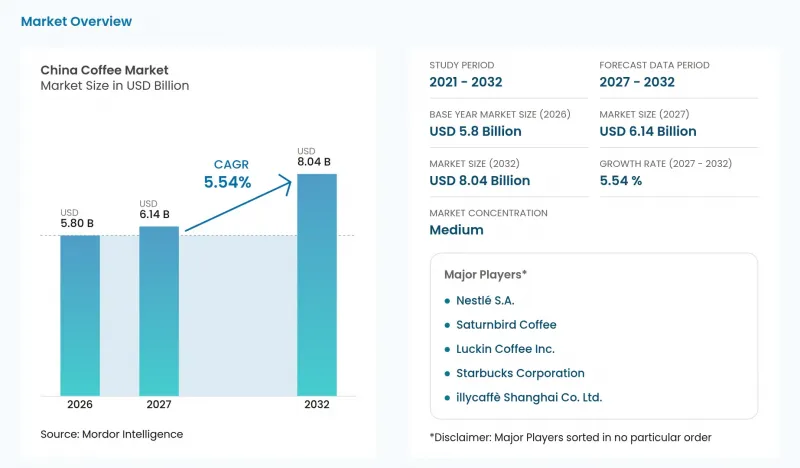
This report is segmented by Product Type (Instant Coffee, Ready-to-Drink Coffee, and more), Flavor (Plain and Flavored), Category Type (Conventional and Specialty), Bean Type (Arabica, Robusta, and more), Distribution Channel (Off-Trade and On-Trade), and Geography (Eastern China, Southern China, and more). The market forecasts are provided in terms of value (USD), based on availability.
China Coffee Market Trends and Insights
Rising interest in specialty, gourmet, and artisanal coffee
Specialty coffee operators can develop demand through distinctive preparation as well as a wider urban footprint. A March 2025 CBNData survey in Shanghai's Jing'an District found above-average cold brew and pour-over preferences within its primarily student "Self-Expression" consumer cohort. On October 13, 2026, Blue Bottle Coffee had specialty cafes under renovation in Beijing, Nanjing and Wuhan. Its existing mainland network comprised 14 cafes in Shanghai, Shenzhen and Hangzhou at that date. The survey locates preparation-specific interest within one Shanghai district, while Blue Bottle's renovation projects would extend specialty cafe access beyond its existing mainland cities.
Expansion of cafe culture
Cafe culture can expand through new consumption settings as well as additional outlets serving familiar routines. Starbucks China reported in July 2025 that it had recently opened stores in Jiuzhaigou, Zhangye and Dunhuang tourist destinations. These completed openings placed its cafe offer within travel settings, creating another route through which operators could serve coffee customers. For destination cafes, the commercial proposition can center on the visit itself, allowing a coffee purchase to accompany an activity outside the customer's usual neighborhood. This gives cafe expansion a demand mechanism distinct from simply increasing the density of competing outlets along an established urban shopping street.
Fluctuations in global coffee bean prices
Bean-price volatility can constrain coffee demand indirectly by making the cost of supplying an affordable cup less predictable. In its 2025 annual report, Luckin Coffee Inc. said rising coffee bean prices had affected raw material costs. The company usually enters fixed-price supplier agreements lasting one year, but significant market fluctuations may lead to renegotiation. Contract coverage therefore cannot be treated as complete protection against a change in input economics. If costs rise after agreements expire or because of market fluctuations, Luckin says its business and operating results could be adversely affected. For coffee operators facing that exposure, maintaining an accessible selling price can leave less room to absorb higher bean costs.
Other drivers and restraints analyzed in the detailed report include:
- Increasing popularity of homegrown brands
- Rising preference for convenience
- Persistent health concerns over caffeine
For complete list of drivers and restraints, kindly check the Table Of Contents.
Segment Analysis
Instant coffee accounted for a 63.7% share of the China coffee market size in 2026, making it the largest segment. In March 2026, Hogood Coffee reported annual instant-coffee capacity of 25,000 metric tons. The company also claimed national leadership in industrial instant coffee powder production and sales volume. For brands developing an instant-coffee offer, that processing scale can provide an industrial foundation for supplying the product beyond individual coffeehouse locations. The commercial strength to develop is broad availability supported by manufacturing scale, giving instant coffee a route to buyers that does not require a cafe to prepare each purchase.
Coffee pods and capsules are the fastest-growing segment, with a projected CAGR of 9.55% from 2027 to 2032. By June 2026, Guangzhou Gelingfu Food Technology Co., Ltd. had established collaborations with China Southern Airlines and Jinlongyu. Its factory could produce 200,000 ambient coffee-liquid capsules daily at full production. For capsule suppliers, this example shows that named business collaborators and daily production capacity for a specific capsule format can matter alongside the coffee itself. Those relationships create a potential business-customer route for the format, with commercial value depending on converting production capability into a repeatable use for the coffee product.
Plain coffee represented a 59.71% China coffee market share in 2026, making it the largest segment. In May 2025, Nongfu Spring launched TANBING's 0.9-liter low-temperature, sugar-free ready-to-drink black coffee at Sam's Club. The product topped the Sam's Club app's New Arrivals Popularity Chart upon launch. For a plain-coffee supplier, this example connects a specific black-coffee product with a named retail channel, providing a product identity beyond an added flavor claim. The commercial role of plain coffee can therefore include a defined retail pack and channel proposition, rather than only a flavor-neutral option on a cafe menu.
Flavored coffee is the fastest-growing segment, with a projected CAGR of 6.15% from 2027 to 2032. Luckin Coffee reported that its Coconut Milk Latte surpassed 1.9 billion cups in cumulative sales from its 2021 launch through the end of 2025. The company said it introduced new variations each year to expand this product series. This provides a product-development model in which a recognizable base drink can support additional variations within the same family. For flavored-coffee sellers, a named product family can connect innovation with an established purchase history, giving a new variation a commercial reference beyond its flavor alone.
Complete Report Scope:
- By Product Type
- Whole-bean
- Ground Coffee
- Instant Coffee
- Coffee Pods and Capsules
- Ready-to-Drink (RTD) Coffee
- By Flavor
- Plain
- Flavored
- By Category Type
- Conventional
- Specialty (Organic/Single-Origin)
- By Bean Type
- Arabica
- Robusta
- Others
- By Distribution Channel
- On-Trade
- Off-Trade
- Supermarkets/Hypermarkets
- Specialty Stores
- Convenience Stores
- Online Retail Stores
- Other Distribution Channels
- By Geography
- Eastern China
- Southern China
- Northern China
List of Companies Covered in this Report:
- Nestle S.A.
- Starbucks Corporation
- Luckin Coffee Inc.
- JAB Holding Company
- Luigi Lavazza S.p.A.
- TH International Limited (Tims China)
- Hainan Lisun Investment Co., Ltd.
- Dehong Hogood Coffee Co., Ltd.
- UCC Ueshima Coffee Co., Ltd.
- The Coca-Cola Company (Costa)
- Strauss Group Ltd.
- illycaffe Shanghai Co. Ltd.
- Trung Nguyen Coffee
- Zhejiang Lixing Technology Co., Ltd. (Nowwa Coffee)
- Saturnbird Coffee
- Pacific Coffee
- Cotti Coffee
- NOC Coffee Co
- Gloria Jean's Coffees
- PT Mayora Indah Tbk (Coffee)
Additional Benefits:
- The market estimate (ME) sheet in Excel format
- 3 months of analyst support
TABLE OF CONTENTS
1 INTRODUCTION
- 1.1 Study Assumptions and Market Definition
- 1.2 Scope of the Study
2 RESEARCH METHODOLOGY
3 EXECUTIVE SUMMARY
4 MARKET LANDSCAPE
- 4.1 Market Overview
- 4.2 Market Drivers
- 4.2.1 Rising interest in specialty, gourmet, and artisanal coffee
- 4.2.2 Expansion of cafe culture
- 4.2.3 Increasing popularity of homegrown brands
- 4.2.4 Rising preference for convenience
- 4.2.5 Government incentives for Yunnan coffee farming
- 4.2.6 Growing health and wellness trends
- 4.3 Market Restraints
- 4.3.1 Fluctuations in global coffee bean prices
- 4.3.2 Persistent health concerns over caffeine
- 4.3.3 Stringent food safety and regulatory compliance
- 4.3.4 Strong cultural preference for tea in rural areas
- 4.4 Industry Value Chain Analysis
- 4.5 Regulatory Landscape
- 4.6 Technological Outlook
- 4.7 Porter's Five Forces Analysis
- 4.7.1 Threat of New Entrants
- 4.7.2 Bargaining Power of Suppliers
- 4.7.3 Bargaining Power of Buyers
- 4.7.4 Threat of Substitutes
- 4.7.5 Competitive Rivalry
5 MARKET SIZE AND GROWTH FORECASTS (VALUE)
- 5.1 By Product Type
- 5.1.1 Whole-bean
- 5.1.2 Ground Coffee
- 5.1.3 Instant Coffee
- 5.1.4 Coffee Pods and Capsules
- 5.1.5 Ready-to-Drink (RTD) Coffee
- 5.2 By Flavor
- 5.2.1 Plain
- 5.2.2 Flavored
- 5.3 By Category Type
- 5.3.1 Conventional
- 5.3.2 Specialty (Organic/Single-Origin)
- 5.4 By Bean Type
- 5.4.1 Arabica
- 5.4.2 Robusta
- 5.4.3 Others
- 5.5 By Distribution Channel
- 5.5.1 On-Trade
- 5.5.2 Off-Trade
- 5.5.2.1 Supermarkets/Hypermarkets
- 5.5.2.2 Specialty Stores
- 5.5.2.3 Convenience Stores
- 5.5.2.4 Online Retail Stores
- 5.5.2.5 Other Distribution Channels
- 5.6 By Geography
- 5.6.1 Eastern China
- 5.6.2 Southern China
- 5.6.3 Northern China
6 COMPETITIVE LANDSCAPE
- 6.1 Market Concentration
- 6.2 Strategic Moves
- 6.3 Market Share Analysis
- 6.4 Company Profiles (includes Global level Overview, Market level overview, Core Segments, Financials as available, Strategic Information, Market Rank/Share for key companies, Products and Services, and Recent Developments)
- 6.4.1 Nestle S.A.
- 6.4.2 Starbucks Corporation
- 6.4.3 Luckin Coffee Inc.
- 6.4.4 JAB Holding Company
- 6.4.5 Luigi Lavazza S.p.A.
- 6.4.6 TH International Limited (Tims China)
- 6.4.7 Hainan Lisun Investment Co., Ltd.
- 6.4.8 Dehong Hogood Coffee Co., Ltd.
- 6.4.9 UCC Ueshima Coffee Co., Ltd.
- 6.4.10 The Coca-Cola Company (Costa)
- 6.4.11 Strauss Group Ltd.
- 6.4.12 illycaffe Shanghai Co. Ltd.
- 6.4.13 Trung Nguyen Coffee
- 6.4.14 Zhejiang Lixing Technology Co., Ltd. (Nowwa Coffee)
- 6.4.15 Saturnbird Coffee
- 6.4.16 Pacific Coffee
- 6.4.17 Cotti Coffee
- 6.4.18 NOC Coffee Co
- 6.4.19 Gloria Jean's Coffees
- 6.4.20 PT Mayora Indah Tbk (Coffee)
7 MARKET OPPORTUNITIES AND FUTURE OUTLOOK
- 7.1 White-Space and Unmet-Need Assessment

