PUBLISHER: Mordor Intelligence | PRODUCT CODE: 2187177

PUBLISHER: Mordor Intelligence | PRODUCT CODE: 2187177
Indonesia Plastics - Market Share Analysis, Industry Trends & Statistics, Growth Forecasts (2027 - 2032)
According to Mordor Intelligence, the Indonesia plastics market size is expected to increase from 7.76 million tons in 2026 to 8.11 million tons in 2027 and reach 10.01 million tons by 2032, growing at a CAGR of 4.31% over 2027-2032.
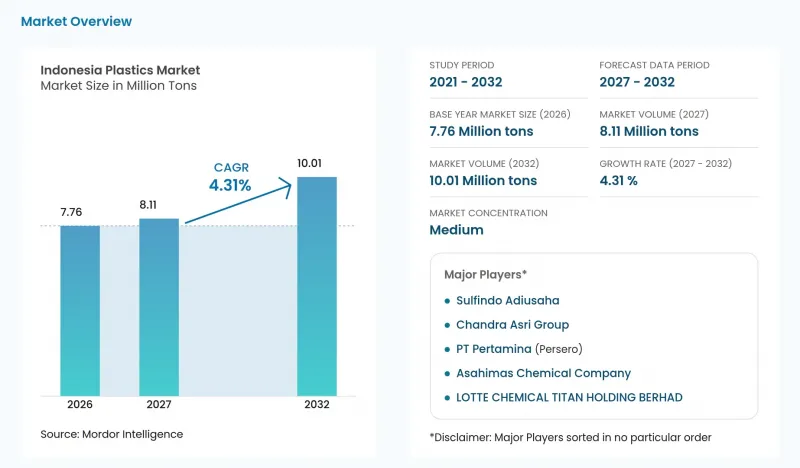
This report is segmented by Type (Traditional Plastics, Bioplastics, and more), Technology (Injection Molding, Extrusion, and more), and Application (Packaging, Automotive and Transportation, and more). The market forecasts are provided in terms of volume (tons), based on availability.
Indonesia Plastics Market Trends and Insights
Expansion of downstream petro-complexes (Cilegon, Tuban)
Domestic petrochemical expansion can support plastics demand by creating a local production base for downstream conversion. LOTTE Chemical Indonesia completed construction of its Cilegon complex in May 2025, with annual polypropylene capacity of 350,000 metric tons. At the November 6, 2025 inauguration, Indonesia's energy and mineral resources minister projected a 70% domestic and 30% overseas marketing split for the Cilegon complex's total production capacity. The ministry also projected replacement of up to USD 1.4 billion in annual petrochemical imports. On April 8, 2026, LOTTE Chemical Indonesia reported reduced production after Strait of Hormuz disruption affected naphtha and LPG availability and forced procurement-route changes. The expansion gives polypropylene processors a domestic supply option, but realizing that capacity depends on feedstock availability.
Lightweight auto-parts adoption by OEMs
In Indonesia, an OEM considering an injection-molded bumper in place of a heavier design creates a potential lightweighting route for resin demand. That opportunity depends on meeting the bumper's impact and surface requirements with the proposed polymer formulation. The component supplier would need to qualify the molded part, rather than treat lower material weight as sufficient proof of suitability. Resin demand would increase only where the qualified substitution adds polymer content to vehicles entering production. The commercial opening lies in winning the material specification for a defined bumper program, with demand tied to that program's production rather than a general preference for lighter vehicles.
Potential excise on single-use plastic bags
An excise on single-use plastic bags would place a product-specific cost burden on converters serving retail shopping-bag buyers. If buyers responded by reducing bag use or changing formats, the effect could move upstream through lower resin requirements for the affected product. The exposure would be concentrated in any taxed bag format, making the precise product definition commercially significant. Converters could respond with alternative formats, but redesigning an offer would not remove the cost of serving an application that remained taxable. The remaining risk would be a narrower viable outlet for bag-resin suppliers as any tax-induced cost increases reached converters and their customers.
Other drivers and restraints analyzed in the detailed report include:
- E-commerce logistics boom needing durable secondary packs
- Mandatory EPR and waste-segregation pilots fueling recyclable resin demand
- Carbon-pricing scheme raising energy costs
For complete list of drivers and restraints, kindly check the Table Of Contents.
Segment Analysis
Traditional plastics accounted for a 74.87% share of the Indonesia plastics market size in 2026. Polytama Propindo produced 266,262 metric tons of polypropylene resin in Indonesia in 2025. Its Masplene resin is used in products including medical-mask materials, rice sacks, packaging, and household plastic goods. For this largest segment, that spread of uses connects producer throughput with several different converting businesses, creating multiple potential destinations for established polypropylene output.
Bioplastics is the fastest-growing segment, with a forecast CAGR of 5.85% over 2027-2032. CJ Biomaterials, a business of CJ CheilJedang, produces the bioplastic amorphous PHA at its Pasuruan facility in Indonesia. The company's commercial model includes selling PHA pellets to downstream companies that melt and mold them into products. Because outside companies mold CJ Biomaterials' pellets into products, expanding PHA sales depends on their conversion demand, making product development at the molding stage a route to bioplastics growth.
Complete Report Scope:
- By Type
- Traditional Plastics
- Polyethylene (PE)
- Polypropylene (PP)
- Polyvinyl Chloride (PVC)
- Polystyrene (PS)
- Engineering Plastics
- Polyethylene Terephthalate (PET)
- Polyamides
- Polycarbonates
- Styrene Copolymers (ABS and SAN)
- Polybutylene Terephthalate (PBT)
- Fluoropolymers
- Polyoxymethylene (POM)
- Polymethyl Methacrylate (PMMA)
- Other Engineering Plastics
- Bioplastics
- Traditional Plastics
- By Technology
- Blow Molding
- Extrusion
- Injection Molding
- Other Technologies
- By Application
- Packaging
- Electrical and Electronics
- Building and Construction
- Automotive and Transportation
- Furniture and Bedding
- Other Applications
List of Companies Covered in this Report:
- Asahimas Chemical Company
- Chandra Asri Group
- Dow
- LOTTE CHEMICAL TITAN HOLDING BERHAD
- LyondellBasell Industries N.V.
- Mitsubishi Chemical Group Corporation
- PT Indonesia Nanya Indah Plastics
- PT Pertamina (Persero)
- PT Polychem Indonesia Tbk
- PT Standard Toyo Polymer (Tosoh Corporation)
- PTT Global Chemical Public Company Limited
- Sulfindo Adiusaha
- TORAY INDUSTRIES, INC.
Additional Benefits:
- The market estimate (ME) sheet in Excel format
- 3 months of analyst support
TABLE OF CONTENTS
1 INTRODUCTION
- 1.1 Study Assumptions and Market Definition
- 1.2 Scope of the Study
2 RESEARCH METHODOLOGY
3 EXECUTIVE SUMMARY
4 MARKET LANDSCAPE
- 4.1 Market Overview
- 4.2 Market Drivers
- 4.2.1 Expansion of downstream petro-complexes (Cilegon, Tuban)
- 4.2.2 Lightweight auto-parts adoption by OEMs
- 4.2.3 E-commerce logistics boom needing durable secondary packs
- 4.2.4 Mandatory EPR and waste-segregation pilots fueling recyclable resin demand
- 4.2.5 Seaweed-based bioplastics clusters in East Java
- 4.3 Market Restraints
- 4.3.1 Potential excise on single-use plastic bags
- 4.3.2 Carbon-pricing scheme raising energy costs
- 4.3.3 Rail-infrastructure gaps inflating inland resin logistics
- 4.4 Industry Value Chain Analysis
- 4.5 Regulatory Landscape
- 4.6 Technological Outlook
- 4.7 Porter's Five Forces Analysis
- 4.7.1 Threat of New Entrants
- 4.7.2 Bargaining Power of Suppliers
- 4.7.3 Bargaining Power of Buyers
- 4.7.4 Threat of Substitutes
- 4.7.5 Competitive Rivalry
5 MARKET SIZE AND GROWTH FORECASTS (VOLUME)
- 5.1 By Type
- 5.1.1 Traditional Plastics
- 5.1.1.1 Polyethylene (PE)
- 5.1.1.2 Polypropylene (PP)
- 5.1.1.3 Polyvinyl Chloride (PVC)
- 5.1.1.4 Polystyrene (PS)
- 5.1.2 Engineering Plastics
- 5.1.2.1 Polyethylene Terephthalate (PET)
- 5.1.2.2 Polyamides
- 5.1.2.3 Polycarbonates
- 5.1.2.4 Styrene Copolymers (ABS and SAN)
- 5.1.2.5 Polybutylene Terephthalate (PBT)
- 5.1.2.6 Fluoropolymers
- 5.1.2.7 Polyoxymethylene (POM)
- 5.1.2.8 Polymethyl Methacrylate (PMMA)
- 5.1.2.9 Other Engineering Plastics
- 5.1.3 Bioplastics
- 5.1.1 Traditional Plastics
- 5.2 By Technology
- 5.2.1 Blow Molding
- 5.2.2 Extrusion
- 5.2.3 Injection Molding
- 5.2.4 Other Technologies
- 5.3 By Application
- 5.3.1 Packaging
- 5.3.2 Electrical and Electronics
- 5.3.3 Building and Construction
- 5.3.4 Automotive and Transportation
- 5.3.5 Furniture and Bedding
- 5.3.6 Other Applications
6 COMPETITIVE LANDSCAPE
- 6.1 Market Concentration
- 6.2 Strategic Moves
- 6.3 Market Share Analysis
- 6.4 Company Profiles (includes Global level Overview, Market level overview, Core Segments, Financials as available, Strategic Information, Market Rank/Share for key companies, Products and Services, and Recent Developments)
- 6.4.1 Asahimas Chemical Company
- 6.4.2 Chandra Asri Group
- 6.4.3 Dow
- 6.4.4 LOTTE CHEMICAL TITAN HOLDING BERHAD
- 6.4.5 LyondellBasell Industries N.V.
- 6.4.6 Mitsubishi Chemical Group Corporation
- 6.4.7 PT Indonesia Nanya Indah Plastics
- 6.4.8 PT Pertamina (Persero)
- 6.4.9 PT Polychem Indonesia Tbk
- 6.4.10 PT Standard Toyo Polymer (Tosoh Corporation)
- 6.4.11 PTT Global Chemical Public Company Limited
- 6.4.12 Sulfindo Adiusaha
- 6.4.13 TORAY INDUSTRIES, INC.
7 MARKET OPPORTUNITIES AND FUTURE OUTLOOK
- 7.1 White-Space and Unmet-Need Assessment

