PUBLISHER: Mordor Intelligence | PRODUCT CODE: 2187215

PUBLISHER: Mordor Intelligence | PRODUCT CODE: 2187215
Ready-to-Eat Food - Market Share Analysis, Industry Trends & Statistics, Growth Forecasts (2027 - 2032)
According to Mordor Intelligence, the ready-to-eat food market size is projected to expand from USD 422.6 billion in 2026 and USD 448.5 billion in 2027 to USD 594 billion by 2032, registering a CAGR of 5.78% between 2027 and 2032.
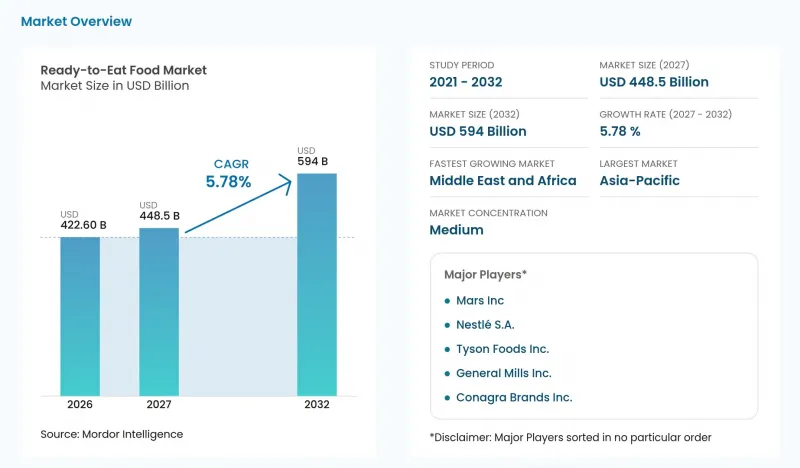
This report is segmented by Product Type (Baked Goods, Ready Meals, and more), Category (Conventional and Organic/Clean Label), Distribution Channel (Supermarkets/Hypermarkets, Convenience Stores, and more), and Geography (Asia-Pacific, North America, and more). The market forecasts are provided in terms of value (USD), based on availability.
Global Ready-to-Eat Food Market Trends and Insights
Rising number of single-person households and dual-income families
Cooking for one makes portion suitability a different problem from preparing food for a shared household. The United States had 39.7 million one-person households in 2025, representing 29% of all households. A prepared individual meal can serve that buyer without requiring the preparation of a larger dish. For dual-income households, the same format can also let household members choose a meal independently when their eating schedules differ. The scale of the US one-person household base gives suppliers a commercial reason to develop dedicated single-serve pack sizes.
Rising penetration of e-grocery and q-commerce fulfillment
Digital grocery fulfillment makes packaged meals accessible without a separate shopping trip, extending their usefulness for short-notice eating occasions. US online food sales rose nearly 19% in 2025. Swiggy expanded Instamart from 27 to 124 Indian cities in FY 2024-25, offering 10-minute delivery of groceries alongside other categories. That wider service footprint creates additional routes through which packaged ready meals and snacks can reach consumers. For suppliers, the demand opportunity lies in making an immediately usable food purchase part of an existing digital grocery order. Converting geographic reach into meal purchases therefore depends on an assortment suited to rapid fulfillment.
Growing ultra-processed-food regulation momentum
Ingredient-based restrictions can make a convenient packaged product ineligible for a particular sales channel. From the 2026-27 school year, Arizona law prohibits schools participating in federally funded or assisted meal programs from serving, selling, or allowing third-party sales of covered foods on campus during the normal school day. The definition covers foods or beverages containing any of 11 listed additives. Parents and guardians may provide these foods to their own students. For suppliers of packaged snacks sold through affected campus channels, that distinction makes ingredient composition a condition of access. Reformulating an affected product or forgoing that channel adds a commercial burden that convenience alone cannot overcome.
Other drivers and restraints analyzed in the detailed report include:
- Changing consumer lifestyles
- Growth in food processing industry
- Health and nutritional transparency issues
For complete list of drivers and restraints, kindly check the Table Of Contents.
Segment Analysis
Baked goods accounted for a 34.14% share of the ready-to-eat food market size in 2026. The largest segment includes substantial branded businesses, illustrated by Mondelez International, Inc.'s USD 18.4 billion in global net revenue for Biscuits & Baked Snacks in 2025. North America contributed USD 9.33 billion of that category's 2025 net revenue, about half of the total. Europe added USD 4.97 billion, so North America and Europe together supplied most of the category's global net revenue.
Instant soups and snacks are forecast to be the fastest-growing segment, with a CAGR of 6.4% between 2027 and 2032. The World Instant Noodles Association (WINA) estimated worldwide instant-noodle demand at 123.4 billion servings in 2025. On June 11, 2025, Samyang Foods began full-scale operation at its second Miryang plant in South Korea, with 6 production lines and annual capacity of 830 million Buldak noodle units. The lines comprised 3 packet-noodle lines and 3 cup-noodle lines. By accommodating both formats in one expansion, a supplier can broaden its product offer while keeping manufacturing investment concentrated in instant noodles.
Complete Report Scope:
- By Product Type
- Instant Breakfast / Cereals
- Instant Soups and Snacks
- Ready Meals
- Baked Goods
- Meat Products
- Other Product Types
- By Category
- Conventional
- Organic/Clean Label
- By Distribution Channel
- Supermarkets/Hypermarkets
- Convenience Stores
- Online Retail Stores
- Other Retail Channels
- By Geography
- North America
- United States
- Canada
- Mexico
- Rest of North America
- South America
- Brazil
- Argentina
- Colombia
- Chile
- Rest of South America
- Europe
- United Kingdom
- Germany
- France
- Italy
- Spain
- Russia
- Sweden
- Belgium
- Poland
- Netherlands
- Rest of Europe
- Asia-Pacific
- China
- Japan
- India
- Thailand
- Singapore
- Indonesia
- South Korea
- Australia
- New Zealand
- Rest of Asia-Pacific
- Middle East and Africa
- United Arab Emirates
- South Africa
- Saudi Arabia
- Nigeria
- Egypt
- Morocco
- Turkey
- Rest of Middle East and Africa
- North America
Geography Analysis
Asia-Pacific accounted for 41.4% of the ready-to-eat food market size in 2026, making it the largest region. WINA estimated instant-noodle demand in China/Hong Kong at 43.27 billion servings in 2025. In Malaysia, OTS Holdings, a ready-to-eat and ready-to-cook meat-products group, opened a food manufacturing facility through its wholly owned subsidiary, Ellaziq (Malaysia), on October 28, 2025. The facility had stated capacity of up to 200 metric tons per month, although in the first half of fiscal 2026 it had not fully ramped up and local certifications and approvals remained pending. The noodle consumption and manufacturing investment illustrate Asia-Pacific's combination of substantial product demand and efforts to expand regional supply.
The Middle East and Africa region is forecast to be the fastest-growing, with a CAGR of 6.65% between 2027 and 2032. In 2025, Almarai Bakery said its daily production of 5 million items reached consumers through an increasing number of retail locations in Saudi Arabia and the wider Gulf Cooperation Council. The business used traditional and modern trade channels, creating different retail routes for its bakery output. This distribution-led mechanism can broaden the buyer base for established bakery products, making outlet reach an important commercial lever alongside the scale of daily production.
In North America, US food-at-home expenditures by consumers, businesses, and government entities reached USD 1.1 trillion in 2025. Guatemala had a local snack-production base, with GRUMA reporting a small corn-chip plant within Gruma Centroamerica in 2025. Retail represented the majority of Brazil's domestic food-industry sales in 2025, giving retail distribution particular weight for suppliers serving that South American country. Elsewhere in South America, Uruguay's free-zone branch 107B for prepared meals and dishes recorded a 13.0% year-over-year increase in physical production in August 2026. In Europe, HKFoods started production on its new Vantaa meal line in Finland in the third quarter of 2025, addressing growing ready-meal demand from foodservice buyers as well as retailers.
- Nestle S.A.
- Conagra Brands Inc.
- General Mills Inc.
- The Kraft Heinz Company
- Tyson Foods Inc.
- Nomad Foods Ltd.
- McCain Foods Limited
- The Campbell's Company
- The J.M. Smucker Co.
- Dr. August Oetker Nahrungsmittel KG
- Amy's Kitchen Inc.
- Mars Inc
- ITC Ltd.
- Orkla India Limited
- Gits Food Products Pvt Ltd.
- Hormel Foods Corp.
- Ajinomoto Co. Inc.
- BRF SA
- Charoen Pokphand Foods Public Company Limited
- Ready Pac Foods Inc.
Additional Benefits:
- The market estimate (ME) sheet in Excel format
- 3 months of analyst support
TABLE OF CONTENTS
1 INTRODUCTION
- 1.1 Study Assumptions and Market Definition
- 1.2 Scope of the Study
2 RESEARCH METHODOLOGY
3 EXECUTIVE SUMMARY
4 MARKET LANDSCAPE
- 4.1 Market Overview
- 4.2 Market Drivers
- 4.2.1 Rising number of single-person households and dual-income families
- 4.2.2 Rising penetration of e-grocery and q-commerce fulfillment
- 4.2.3 Changing consumer lifestyles
- 4.2.4 Growth in food processing industry
- 4.2.5 Advancements in packaging technology
- 4.2.6 Product innovation and flavor diversification
- 4.3 Market Restraints
- 4.3.1 Growing ultra-processed-food regulation momentum
- 4.3.2 Health and nutritional transparency issues
- 4.3.3 Consumer skepticism about additives and preservatives
- 4.3.4 Stringent food safety and regulatory compliance
- 4.4 Industry Value Chain Analysis
- 4.5 Regulatory Landscape
- 4.6 Technological Outlook
- 4.7 Porter's Five Forces Analysis
- 4.7.1 Threat of New Entrants
- 4.7.2 Bargaining Power of Suppliers
- 4.7.3 Bargaining Power of Buyers
- 4.7.4 Threat of Substitutes
- 4.7.5 Competitive Rivalry
5 MARKET SIZE AND GROWTH FORECASTS (VALUE)
- 5.1 By Product Type
- 5.1.1 Instant Breakfast / Cereals
- 5.1.2 Instant Soups and Snacks
- 5.1.3 Ready Meals
- 5.1.4 Baked Goods
- 5.1.5 Meat Products
- 5.1.6 Other Product Types
- 5.2 By Category
- 5.2.1 Conventional
- 5.2.2 Organic/Clean Label
- 5.3 By Distribution Channel
- 5.3.1 Supermarkets/Hypermarkets
- 5.3.2 Convenience Stores
- 5.3.3 Online Retail Stores
- 5.3.4 Other Retail Channels
- 5.4 By Geography
- 5.4.1 North America
- 5.4.1.1 United States
- 5.4.1.2 Canada
- 5.4.1.3 Mexico
- 5.4.1.4 Rest of North America
- 5.4.2 South America
- 5.4.2.1 Brazil
- 5.4.2.2 Argentina
- 5.4.2.3 Colombia
- 5.4.2.4 Chile
- 5.4.2.5 Rest of South America
- 5.4.3 Europe
- 5.4.3.1 United Kingdom
- 5.4.3.2 Germany
- 5.4.3.3 France
- 5.4.3.4 Italy
- 5.4.3.5 Spain
- 5.4.3.6 Russia
- 5.4.3.7 Sweden
- 5.4.3.8 Belgium
- 5.4.3.9 Poland
- 5.4.3.10 Netherlands
- 5.4.3.11 Rest of Europe
- 5.4.4 Asia-Pacific
- 5.4.4.1 China
- 5.4.4.2 Japan
- 5.4.4.3 India
- 5.4.4.4 Thailand
- 5.4.4.5 Singapore
- 5.4.4.6 Indonesia
- 5.4.4.7 South Korea
- 5.4.4.8 Australia
- 5.4.4.9 New Zealand
- 5.4.4.10 Rest of Asia-Pacific
- 5.4.5 Middle East and Africa
- 5.4.5.1 United Arab Emirates
- 5.4.5.2 South Africa
- 5.4.5.3 Saudi Arabia
- 5.4.5.4 Nigeria
- 5.4.5.5 Egypt
- 5.4.5.6 Morocco
- 5.4.5.7 Turkey
- 5.4.5.8 Rest of Middle East and Africa
- 5.4.1 North America
6 COMPETITIVE LANDSCAPE
- 6.1 Market Concentration
- 6.2 Strategic Moves
- 6.3 Market Share Analysis
- 6.4 Company Profiles (includes Global level Overview, Market level overview, Core Segments, Financials as available, Strategic Information, Market Rank/Share for key companies, Products and Services, and Recent Developments)
- 6.4.1 Nestle S.A.
- 6.4.2 Conagra Brands Inc.
- 6.4.3 General Mills Inc.
- 6.4.4 The Kraft Heinz Company
- 6.4.5 Tyson Foods Inc.
- 6.4.6 Nomad Foods Ltd.
- 6.4.7 McCain Foods Limited
- 6.4.8 The Campbell's Company
- 6.4.9 The J.M. Smucker Co.
- 6.4.10 Dr. August Oetker Nahrungsmittel KG
- 6.4.11 Amy's Kitchen Inc.
- 6.4.12 Mars Inc
- 6.4.13 ITC Ltd.
- 6.4.14 Orkla India Limited
- 6.4.15 Gits Food Products Pvt Ltd.
- 6.4.16 Hormel Foods Corp.
- 6.4.17 Ajinomoto Co. Inc.
- 6.4.18 BRF SA
- 6.4.19 Charoen Pokphand Foods Public Company Limited
- 6.4.20 Ready Pac Foods Inc.
7 MARKET OPPORTUNITIES AND FUTURE OUTLOOK
- 7.1 White-Space and Unmet-Need Assessment

