PUBLISHER: Mordor Intelligence | PRODUCT CODE: 2187239

PUBLISHER: Mordor Intelligence | PRODUCT CODE: 2187239
Beauty and Personal Care Products - Market Share Analysis, Industry Trends & Statistics, Growth Forecasts (2027 - 2032)
According to Mordor Intelligence, the beauty and personal care products market size is expected to grow from USD 636.2 billion in 2026 to USD 668.9 billion in 2027 and is forecast to reach USD 852 billion by 2032 at 4.96% CAGR over 2027-2032.
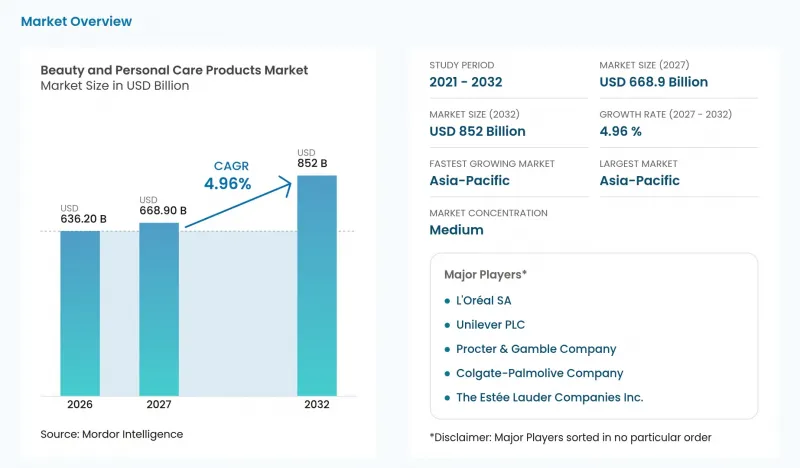
This report is segmented by Product Type (Personal Care Products and more), Category (Mass Products and more), Ingredient Type (Conventional/Synthetic and more), Distribution Channel (Specialty Stores and more), and Geography (Asia-Pacific and more). The market forecasts are provided in terms of value (USD), based on availability.
Global Beauty and Personal Care Products Market Trends and Insights
Consumer preference for natural and organic beauty and personal care products
Ingredient concerns can make the assurance behind an organic formulation part of the reason a consumer selects a beauty product. UK organic beauty and wellbeing sales grew 8% in 2025. Soil Association Certification linked rising awareness of controversial synthetics to increased customer demand for organic beauty and wellbeing products. It also identified improving recognition of COSMOS certification among beauty brands, adding a commercial signal to the sales result. A certified organic range can compete on verifiable assurance alongside ingredient choice, making certification commercially relevant when buyers question synthetic ingredients.
Growing demand for anti-aging and age management products
Age-management demand can support both recruitment of new skincare buyers and continued use of an established treatment brand. Shiseido reported double-digit growth in Japanese local consumer purchases of ELIXIR, its aging-care skincare brand, in Q2 2026. Management also said ELIXIR attracted new local customers through product launches and achieved strong repeat purchases. The combination connects initial recruitment with continued demand for the same age-care brand, rather than relying solely on successive launches.
Availability of counterfeit products impacts market development
In June 2025, the Korean Intellectual Property Office's Trademark Police recommended indicting 4 people over alleged counterfeit cosmetics distribution. The finding concerned alleged distribution from April 2023 to March 2024 of cosmetics falsely presented as genuine parallel imports. The goods reached wholesalers and TV home-shopping vendors, and wholesalers were deceived about authenticity. Such deception can place product identity inside the commercial decision even when goods pass through wholesale channels. Sourcing checks can address that risk but add work before goods reach buyers. Deception at the wholesale stage can thus burden legitimate suppliers with authentication costs beyond ordinary selling activity.
Other drivers and restraints analyzed in the detailed report include:
- Influence of social media and impact of digital technology on the market
- Rising demand for men's personal care products
- Growing concerns over product safety and ingredients
For complete list of drivers and restraints, kindly check the Table Of Contents.
Segment Analysis
Personal care products held 88.37% of the market in 2026, making them the largest segment. In fiscal 2026, Procter & Gamble Company's Personal Care category, comprising antiperspirants, deodorants and personal cleansing, accounted for 6% of its consolidated net sales excluding sales recorded in Corporate. Since July 2024, Procter & Gamble Company has managed Personal Care separately from Skin Care, with separate management and innovation plans. Separate planning allows antiperspirants, deodorants and cleansing products to follow their own development priorities, illustrating how the broader personal care segment's scale can encompass distinct product businesses.
Cosmetics/makeup products are forecast to be the fastest-growing segment at 5.72% CAGR over 2027-2032. The Estee Lauder Companies reported virtually flat makeup organic net sales in fiscal 2026, although growth improved over 500 basis points from fiscal 2025. Growth from M*A*C and TOM FORD was offset by declines from Bobbi Brown and Too Faced. L'Oreal said its Consumer Products Division's growth accelerated between the halves of 2025 with stronger innovation, particularly in haircare and makeup. Together, innovation-led acceleration and uneven brand results make product renewal a more credible basis for makeup expansion than extending every brand's range equally.
Mass products accounted for a 72.03% share of the beauty and personal care products market size in 2026. L'Oreal's Consumer Products Division, which focuses on mass beauty and also premiumizes its offer, accounted for 37% of group sales in 2025. The largest segment can therefore accommodate targeted product upgrades within a mass-oriented business, making value creation possible inside an established price tier. That revenue weight makes the pace of premiumization within its mass offer consequential for L'Oreal's group performance.
Premium products are forecast to be the fastest-growing segment at 6.25% CAGR over 2027-2032. L'Oreal Luxe sales grew 2.8% like-for-like and were flat on a reported basis in 2025. The group's luxury beauty division reported double-digit fragrance growth in the first half of 2026. Drivers included Prada Paradigme, deployment of Emporio Armani and core franchises such as Yves Saint Laurent Libre, MYSLF and Valentino Born in Roma. Established fragrance franchises can support premium expansion alongside newer deployments, reducing a luxury division's dependence on the next introduction alone.
Complete Report Scope:
- By Product Type
- Personal Care Products
- Hair Care
- Shampoo
- Conditioner
- Hair Colorant
- Hair Styling Products
- Others
- Skin Care
- Facial Care Products
- Body Care Products
- Lip and Nail Care Products
- Bath and Shower
- Shower Gels
- Soaps
- Others
- Oral Care
- Toothbrush
- Toothpaste
- Mouthwashes and Rinses
- Others
- Men's Grooming Products
- Deodorants and Antiperspirants
- Perfumes and Fragrances
- Hair Care
- Cosmetics/Makeup Products
- Facial Cosmetics
- Eye Cosmetics
- Lip and Nail Makeup Products
- Personal Care Products
- By Category
- Premium Products
- Mass Products
- By Ingredient Type
- Natural and Organic
- Conventional/Synthetic
- By Distribution Channel
- Specialty Stores
- Supermarkets/Hypermarkets
- Online Retail Stores
- Other Channels
- By Geography
- North America
- United States
- Canada
- Mexico
- Rest of North America
- Europe
- Germany
- France
- United Kingdom
- Spain
- Netherlands
- Italy
- Sweden
- Poland
- Belgium
- Rest of Europe
- Asia-Pacific
- China
- India
- Japan
- Australia
- South Korea
- Indonesia
- Thailand
- Singapore
- Rest of Asia-Pacific
- South America
- Brazil
- Argentina
- Chile
- Colombia
- Peru
- Rest of South America
- Middle East and Africa
- United Arab Emirates
- South Africa
- Nigeria
- Saudi Arabia
- Egypt
- Morocco
- Turkey
- Rest of Middle East and Africa
- North America
Geography Analysis
Asia-Pacific held the largest share at 36.18% of the beauty and personal care products market size in 2026 and is forecast to be the fastest-growing region at 7.25% CAGR over 2027-2032. In China, cosmetics retail sales by above-designated-size units increased 6.1% year over year in nominal terms in January-September 2026. L'Oreal attributed gradual improvement in China's beauty market in the first half of 2026 to recovery in its selective segment. Vietnamese consumers bought beauty and personal-care products through TikTok Shop, Shopee and Lazada in 2025, giving suppliers a platform-based route alongside China's category-specific recovery.
In the first half of 2026, L'Oreal described broad-based North American growth across categories, channels and price tiers, supported by digital and e-commerce focus and retailer partnerships. In its European business, online outperformance was a key driver of new-consumer recruitment in the same period. In Costa Rica, mass-consumption cosmetics reach buyers through retail and discount stores, pharmacies, big-box stores and catalogs. Suppliers placing cosmetics on Switzerland's market must prepare a product information file with a qualified person's signed safety report, manufacturing-method description and good manufacturing practice (GMP) compliance declaration, without mandatory GMP certification. Digital execution supported L'Oreal's regional businesses, while Costa Rican distribution and Swiss documentation duties illustrate additional country-specific conditions for reaching buyers.
In South America, Natura opened 76 new stores in Brazil in 2025, while Uruguay requires authorized importers and manufacturers to obtain registration and sales authorization for Grade 1 personal hygiene products, cosmetics and perfumes. L'Oreal reported that e-commerce accounted for 27.5% of its business in the United Arab Emirates and Saudi Arabia in 2025. In Sub-Saharan Africa, its 2025 sales grew through volume and mix, with South Africa the leading growth contributor. In February 2026, Kenya's State Department for Industry said unclear cosmetics classification and regulation had contributed to rising cosmetics imports and declining local production. Uruguay's authorization duties and Kenya's reported classification problems make market entry and local supply separate challenges from expanding stores or online reach.
- L'Oreal SA
- Unilever PLC
- Procter & Gamble Company
- Beiersdorf AG
- Colgate-Palmolive Company
- The Estee Lauder Companies Inc.
- Shiseido Company, Ltd.
- ITC Limited
- Kenvue Inc.
- Kao Corporation
- Henkel AG & Co. KGaA
- LVMH Moet Hennessy Louis Vuitton SE
- AmorePacific Corporation
- Natura Cosmeticos SA
- Revlon Group Holdings LLC
- Coty Inc.
- Edgewell Personal Care Company
- Mary Kay Inc.
- L'Occitane International SA
- Godrej Consumer Products Ltd.
Additional Benefits:
- The market estimate (ME) sheet in Excel format
- 3 months of analyst support
TABLE OF CONTENTS
1 INTRODUCTION
- 1.1 Study Assumptions and Market Definition
- 1.2 Scope of the Study
2 RESEARCH METHODOLOGY
3 EXECUTIVE SUMMARY
4 MARKET LANDSCAPE
- 4.1 Market Overview
- 4.2 Market Drivers
- 4.2.1 Consumer preference for natural and organic beauty and personal care products
- 4.2.2 Growing demand for anti-aging and age management products
- 4.2.3 Influence of social media and impact of digital technology on the market
- 4.2.4 Rising demand for men's personal care products
- 4.2.5 Digital transformation and virtual try-on
- 4.2.6 Increased awareness about oral hygiene among consumers
- 4.3 Market Restraints
- 4.3.1 Availability of counterfeit products impacts market development
- 4.3.2 Growing concerns over product safety and ingredients
- 4.3.3 Intense market competition leading to price pressure and reduced profit margins
- 4.3.4 High manufacturing costs and raw material expenses limit market growth
- 4.4 Industry Value Chain Analysis
- 4.5 Regulatory Landscape
- 4.6 Technological Outlook
- 4.7 Porter's Five Forces Analysis
- 4.7.1 Threat of New Entrants
- 4.7.2 Bargaining Power of Suppliers
- 4.7.3 Bargaining Power of Buyers
- 4.7.4 Threat of Substitutes
- 4.7.5 Competitive Rivalry
- 4.8 Consumer Behavior Analysis
5 MARKET SIZE AND GROWTH FORECASTS (VALUE)
- 5.1 By Product Type
- 5.1.1 Personal Care Products
- 5.1.1.1 Hair Care
- 5.1.1.1.1 Shampoo
- 5.1.1.1.2 Conditioner
- 5.1.1.1.3 Hair Colorant
- 5.1.1.1.4 Hair Styling Products
- 5.1.1.1.5 Others
- 5.1.1.2 Skin Care
- 5.1.1.2.1 Facial Care Products
- 5.1.1.2.2 Body Care Products
- 5.1.1.2.3 Lip and Nail Care Products
- 5.1.1.3 Bath and Shower
- 5.1.1.3.1 Shower Gels
- 5.1.1.3.2 Soaps
- 5.1.1.3.3 Others
- 5.1.1.4 Oral Care
- 5.1.1.4.1 Toothbrush
- 5.1.1.4.2 Toothpaste
- 5.1.1.4.3 Mouthwashes and Rinses
- 5.1.1.4.4 Others
- 5.1.1.5 Men's Grooming Products
- 5.1.1.6 Deodorants and Antiperspirants
- 5.1.1.7 Perfumes and Fragrances
- 5.1.1.1 Hair Care
- 5.1.2 Cosmetics/Makeup Products
- 5.1.2.1 Facial Cosmetics
- 5.1.2.2 Eye Cosmetics
- 5.1.2.3 Lip and Nail Makeup Products
- 5.1.1 Personal Care Products
- 5.2 By Category
- 5.2.1 Premium Products
- 5.2.2 Mass Products
- 5.3 By Ingredient Type
- 5.3.1 Natural and Organic
- 5.3.2 Conventional/Synthetic
- 5.4 By Distribution Channel
- 5.4.1 Specialty Stores
- 5.4.2 Supermarkets/Hypermarkets
- 5.4.3 Online Retail Stores
- 5.4.4 Other Channels
- 5.5 By Geography
- 5.5.1 North America
- 5.5.1.1 United States
- 5.5.1.2 Canada
- 5.5.1.3 Mexico
- 5.5.1.4 Rest of North America
- 5.5.2 Europe
- 5.5.2.1 Germany
- 5.5.2.2 France
- 5.5.2.3 United Kingdom
- 5.5.2.4 Spain
- 5.5.2.5 Netherlands
- 5.5.2.6 Italy
- 5.5.2.7 Sweden
- 5.5.2.8 Poland
- 5.5.2.9 Belgium
- 5.5.2.10 Rest of Europe
- 5.5.3 Asia-Pacific
- 5.5.3.1 China
- 5.5.3.2 India
- 5.5.3.3 Japan
- 5.5.3.4 Australia
- 5.5.3.5 South Korea
- 5.5.3.6 Indonesia
- 5.5.3.7 Thailand
- 5.5.3.8 Singapore
- 5.5.3.9 Rest of Asia-Pacific
- 5.5.4 South America
- 5.5.4.1 Brazil
- 5.5.4.2 Argentina
- 5.5.4.3 Chile
- 5.5.4.4 Colombia
- 5.5.4.5 Peru
- 5.5.4.6 Rest of South America
- 5.5.5 Middle East and Africa
- 5.5.5.1 United Arab Emirates
- 5.5.5.2 South Africa
- 5.5.5.3 Nigeria
- 5.5.5.4 Saudi Arabia
- 5.5.5.5 Egypt
- 5.5.5.6 Morocco
- 5.5.5.7 Turkey
- 5.5.5.8 Rest of Middle East and Africa
- 5.5.1 North America
6 COMPETITIVE LANDSCAPE
- 6.1 Market Concentration
- 6.2 Strategic Moves
- 6.3 Market Share Analysis
- 6.4 Company Profiles (includes Global level Overview, Market level overview, Core Segments, Financials as available, Strategic Information, Market Rank/Share for key companies, Products and Services, and Recent Developments)
- 6.4.1 L'Oreal SA
- 6.4.2 Unilever PLC
- 6.4.3 Procter & Gamble Company
- 6.4.4 Beiersdorf AG
- 6.4.5 Colgate-Palmolive Company
- 6.4.6 The Estee Lauder Companies Inc.
- 6.4.7 Shiseido Company, Ltd.
- 6.4.8 ITC Limited
- 6.4.9 Kenvue Inc.
- 6.4.10 Kao Corporation
- 6.4.11 Henkel AG & Co. KGaA
- 6.4.12 LVMH Moet Hennessy Louis Vuitton SE
- 6.4.13 AmorePacific Corporation
- 6.4.14 Natura Cosmeticos SA
- 6.4.15 Revlon Group Holdings LLC
- 6.4.16 Coty Inc.
- 6.4.17 Edgewell Personal Care Company
- 6.4.18 Mary Kay Inc.
- 6.4.19 L'Occitane International SA
- 6.4.20 Godrej Consumer Products Ltd.
7 MARKET OPPORTUNITIES AND FUTURE OUTLOOK
- 7.1 White-Space and Unmet-Need Assessment

