PUBLISHER: Mordor Intelligence | PRODUCT CODE: 2187244

PUBLISHER: Mordor Intelligence | PRODUCT CODE: 2187244
Offshore Support Vessels - Market Share Analysis, Industry Trends & Statistics, Growth Forecasts (2027 - 2032)
According to Mordor Intelligence, the offshore support vessels market size is projected to expand from USD 23.08 billion in 2026 and USD 24.95 billion in 2027 to USD 36.36 billion by 2032, registering a CAGR of 7.82% between 2027 and 2032.
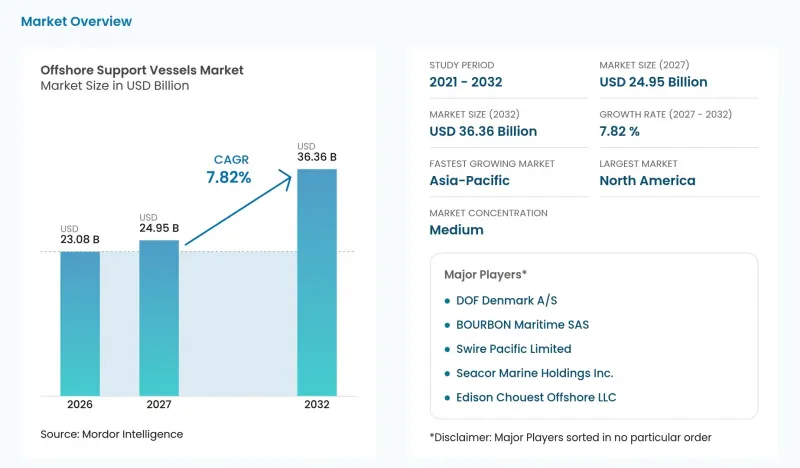
This report is segmented by Vessel Type (Anchor Handling Tug/Anchor Handling Towing Supply Vessels, Platform Supply Vessels, and more), Application (Offshore Oil and Gas, Offshore Wind, and more), and Geography (North America, Europe, and more). The market forecasts are provided in terms of value (USD), based on availability.
Global Offshore Support Vessels Market Trends and Insights
Up-cycle in offshore E&P CAPEX
Sanctioned offshore infrastructure spending creates marine-support demand as capital commitments move into field development. In July 2026, ADNOC made a USD 6.2 billion final investment decision to develop the Umm Shaif Gas Cap at an offshore field in Abu Dhabi, United Arab Emirates. The development includes 3 engineering, procurement and construction packages totaling USD 5.1 billion for offshore infrastructure. A USD 365 million drilling program is also a component of the development commitment. Infrastructure construction and drilling together create distinct requirements for offshore execution, giving vessel operators exposure to multiple workstreams within a single sanctioned development.
Accelerating offshore wind installations
Wind-farm expansion supports vessel demand through new connections and the subsequent commitment to maintaining generating assets. GWEC reported 9.3 GW of new grid-connected offshore wind capacity worldwide in 2025, up 16% from 2024 and the third-highest annual total on record. In August 2025, RWE agreed North Star charters of at least 12 years for Grampian Eagle at Britain's Triton Knoll and at least 10 years for Grampian Kestrel at German wind farms north of Heligoland. Each charter included an option for up to 3 additional years. Such commitments connect the installed wind base to recurring operations and maintenance revenue for service-vessel operators. Minimum terms of 10 and 12 years commit vessel capacity to RWE's wind farms well beyond construction, so charter demand follows the operating fleet rather than installation schedules.
High oil-price volatility
Oil-price uncertainty can constrain the length of charter commitments as well as the spending attached to them. In its 2025 Malaysian market review, Perdana Petroleum said volatility, alongside geopolitical and trade pressures, drove cautious customer spending and shorter contract tenures. Shorter agreements leave fewer future vessel days covered by a signed revenue commitment. Each expiry also brings the next charter negotiation forward, exposing the operator sooner to prevailing customer demand. Malaysian vessel operators such as Perdana consequently face more frequent repricing and the risk of employment gaps while carrying the cost of keeping vessels available.
Other drivers and restraints analyzed in the detailed report include:
- Stricter decommissioning mandates
- Surge in floating production systems (FPSO, FLNG)
- Capital-intensive newbuild costs
For complete list of drivers and restraints, kindly check the Table Of Contents.
Segment Analysis
Anchor handling tug/anchor handling towing supply vessels (AHT/AHTSs) accounted for a 42.15% share of the offshore support vessels market size in 2026, making them the largest vessel-type segment. China Oilfield Services Limited (COSL) recorded 20,918 AHTS operating days in the first half of 2026, up 2.3% year over year and the highest total among its marine-support vessel categories. The company's marine-support fleet recorded 43,814 operating days in total over that period. Anchor-handling vessels therefore represented COSL's largest block of vessel employment, with modest growth on an already substantial working base.
Other types (MPSV, subsea, standby crew) form the fastest-growing segment, with a forecast CAGR of 9.25% between 2027 and 2032. In May 2026, DOF Group ASA won 12-year contracts worth close to USD 2 billion for 4 Brazilian remotely operated vehicle (ROV) support newbuilds serving Petrobras deepwater inspection, maintenance and repair, with commencement expected from 2030. DOF Subsea Brasil is responsible for the contracts, operations and services. In August 2026, DOF Group ASA announced 2 Asia-Pacific subsea contract awards using the region's multipurpose vessels and subsea services for campaigns across 2026 and 2027, with an estimated combined duration of approximately 80 days. The Brazilian newbuild contracts defer service revenue until expected starts from 2030, whereas shorter Asia-Pacific campaigns offer vessel employment in 2026 and 2027.
Complete Report Scope:
- By Vessel Type
- Anchor Handling Tug/Anchor Handling Towing Supply Vessels (AHT/AHTSs)
- Platform Supply Vessels (PSV)
- Other Types (MPSV, Subsea, Standby Crew)
- By Application
- Offshore Oil and Gas
- Offshore Wind
- Offshore Decommissioning
- Other Applications
- By Geography
- North America
- United States
- Canada
- Mexico
- Europe
- United Kingdom
- Norway
- Germany
- France
- Italy
- Russia
- Rest of Europe
- Asia-Pacific
- China
- India
- Japan
- South Korea
- ASEAN Countries
- Australia and New Zealand
- Rest of Asia-Pacific
- South America
- Brazil
- Argentina
- Chile
- Rest of South America
- Middle East and Africa
- Saudi Arabia
- United Arab Emirates
- Qatar
- Nigeria
- Angola
- Rest of Middle East and Africa
- North America
Geography Analysis
North America accounted for a 33.56% offshore support vessels market share in 2026, making it the largest region. Oil production averaged 1.981 million barrels per day across the Central and Western Gulf of America planning areas in July 2026. In June 2025, Oceaneering's Offshore Projects Group agreed vessel services for an operator's expected Gulf of America subsea inspection, maintenance, repair and installation work using MPSV Harvey Deep Sea. Oceaneering was the charterer, with its charter then extending through February 2027. The combination of a producing base and contracted subsea work supports service opportunities tied to maintaining offshore operations as well as developing them.
Asia-Pacific is the fastest-growing region, with a forecast CAGR of 8.9% between 2027 and 2032. In May 2026, Numero Uno Marine and Transport announced 2 time-charter awards from Brunei Shell Petroleum for dynamic positioning class 2 (DP2) platform supply vessels supporting offshore operations in Brunei. In September 2026, Nippon Yusen Kabushiki Kaisha ordered one service operation vessel for offshore wind construction and maintenance in Taiwan and wider Asia-Pacific, with delivery planned around 2029. Regional expansion consequently has 2 distinct demand channels, combining supply-vessel awards for oil and gas campaigns with investment in dedicated wind-support capacity.
Europe's North Sea wind farms create a role for service operation vessels (SOVs) that remain offshore for several days. Vattenfall's 2025 contract with Louis Dreyfus Armateurs covered building, owning and operating up to 3 SOVs for operations and maintenance, with service intended from 2027. In South America, OceanPact's August 2025 Petrobras charters covered 4 ROV support vessels (RSVs) for 4 years of subsea inspection, maintenance, equipment installation and removal, including vessel and ROV operation. The Middle East and Africa supplier base includes Abu Dhabi-based ADNOC Logistics & Services, which reported expanded offshore support vessel (OSV) chartering in 2025 and wholly owns OSV operator Zakher Marine International Holdings. Vattenfall buys wind maintenance capacity and Petrobras charters subsea vessels, while ADNOC Logistics & Services integrates vessel ownership through a subsidiary, so counterparties range from asset operators to logistics groups.
- BOURBON Maritime SAS
- DOF Denmark A/S
- Seacor Marine Holdings Inc.
- Edison Chouest Offshore LLC
- Swire Pacific Limited
- Tidewater Inc.
- Harvey Gulf International Marine LLC
- Solstad Offshore ASA
- Hornbeck Offshore Services Inc.
- PACC Offshore Services Holdings Ltd.
- DOF Group ASA
- Vroon Offshore Services BV
- Sea1 Offshore Inc.
- Havila Shipping ASA
- Eidesvik Offshore ASA
- Vallianz Holdings Limited
- Companhia Brasileira de Offshore (CBO)
- Zakher Marine International
- Damen Shipyards Group
Additional Benefits:
- The market estimate (ME) sheet in Excel format
- 3 months of analyst support
TABLE OF CONTENTS
1 INTRODUCTION
- 1.1 Study Assumptions and Market Definition
- 1.2 Scope of the Study
2 RESEARCH METHODOLOGY
3 EXECUTIVE SUMMARY
4 MARKET LANDSCAPE
- 4.1 Market Overview
- 4.2 Market Drivers
- 4.2.1 Up-cycle in offshore E&P CAPEX
- 4.2.2 Accelerating offshore wind installations
- 4.2.3 Stricter decommissioning mandates
- 4.2.4 Surge in floating production systems (FPSO, FLNG)
- 4.2.5 Aging fleet renewal & green retrofit demand
- 4.2.6 Data-driven OPEX optimization (digital twins, CBM)
- 4.3 Market Restraints
- 4.3.1 High oil-price volatility
- 4.3.2 Capital-intensive newbuild costs
- 4.3.3 Shortage of experienced crew
- 4.3.4 Limited yard capacity & high steel prices
- 4.4 Industry Value Chain Analysis
- 4.5 Regulatory Landscape
- 4.6 Technological Outlook
- 4.7 Porter's Five Forces Analysis
- 4.7.1 Threat of New Entrants
- 4.7.2 Bargaining Power of Suppliers
- 4.7.3 Bargaining Power of Buyers
- 4.7.4 Threat of Substitutes
- 4.7.5 Competitive Rivalry
- 4.8 Fleet Age & Renewal Analysis
- 4.9 Investment Analysis
5 MARKET SIZE AND GROWTH FORECASTS (VALUE)
- 5.1 By Vessel Type
- 5.1.1 Anchor Handling Tug/Anchor Handling Towing Supply Vessels (AHT/AHTSs)
- 5.1.2 Platform Supply Vessels (PSV)
- 5.1.3 Other Types (MPSV, Subsea, Standby Crew)
- 5.2 By Application
- 5.2.1 Offshore Oil and Gas
- 5.2.2 Offshore Wind
- 5.2.3 Offshore Decommissioning
- 5.2.4 Other Applications
- 5.3 By Geography
- 5.3.1 North America
- 5.3.1.1 United States
- 5.3.1.2 Canada
- 5.3.1.3 Mexico
- 5.3.2 Europe
- 5.3.2.1 United Kingdom
- 5.3.2.2 Norway
- 5.3.2.3 Germany
- 5.3.2.4 France
- 5.3.2.5 Italy
- 5.3.2.6 Russia
- 5.3.2.7 Rest of Europe
- 5.3.3 Asia-Pacific
- 5.3.3.1 China
- 5.3.3.2 India
- 5.3.3.3 Japan
- 5.3.3.4 South Korea
- 5.3.3.5 ASEAN Countries
- 5.3.3.6 Australia and New Zealand
- 5.3.3.7 Rest of Asia-Pacific
- 5.3.4 South America
- 5.3.4.1 Brazil
- 5.3.4.2 Argentina
- 5.3.4.3 Chile
- 5.3.4.4 Rest of South America
- 5.3.5 Middle East and Africa
- 5.3.5.1 Saudi Arabia
- 5.3.5.2 United Arab Emirates
- 5.3.5.3 Qatar
- 5.3.5.4 Nigeria
- 5.3.5.5 Angola
- 5.3.5.6 Rest of Middle East and Africa
- 5.3.1 North America
6 COMPETITIVE LANDSCAPE
- 6.1 Market Concentration
- 6.2 Strategic Moves
- 6.3 Market Share Analysis
- 6.4 Company Profiles (includes Global level Overview, Market level overview, Core Segments, Financials as available, Strategic Information, Market Rank/Share for key companies, Products and Services, and Recent Developments)
- 6.4.1 BOURBON Maritime SAS
- 6.4.2 DOF Denmark A/S
- 6.4.3 Seacor Marine Holdings Inc.
- 6.4.4 Edison Chouest Offshore LLC
- 6.4.5 Swire Pacific Limited
- 6.4.6 Tidewater Inc.
- 6.4.7 Harvey Gulf International Marine LLC
- 6.4.8 Solstad Offshore ASA
- 6.4.9 Hornbeck Offshore Services Inc.
- 6.4.10 PACC Offshore Services Holdings Ltd.
- 6.4.11 DOF Group ASA
- 6.4.12 Vroon Offshore Services BV
- 6.4.13 Sea1 Offshore Inc.
- 6.4.14 Havila Shipping ASA
- 6.4.15 Eidesvik Offshore ASA
- 6.4.16 Vallianz Holdings Limited
- 6.4.17 Companhia Brasileira de Offshore (CBO)
- 6.4.18 Zakher Marine International
- 6.4.19 Damen Shipyards Group
7 MARKET OPPORTUNITIES AND FUTURE OUTLOOK
- 7.1 White-Space and Unmet-Need Assessment

