PUBLISHER: Mordor Intelligence | PRODUCT CODE: 2187259

PUBLISHER: Mordor Intelligence | PRODUCT CODE: 2187259
India Luxury Car - Market Share Analysis, Industry Trends & Statistics, Growth Forecasts (2027 - 2032)
According to Mordor Intelligence, the India luxury car market size is expected to increase from USD 1.52 billion in 2026 to USD 1.6 billion in 2027 and reach USD 2.09 billion by 2032, growing at a CAGR of 5.48% over 2027-2032.
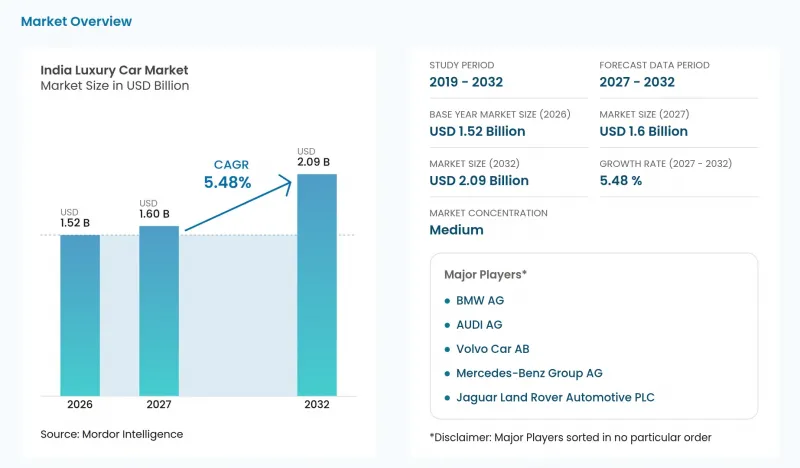
The market volume is expected to increase from 53.71 thousand units in 2026 to 55.8 thousand units in 2027 and reach 67.56 thousand units by 2032, growing at a CAGR of 3.9% over 2027-2032. This report is segmented by Vehicle Type (Sport Utility Vehicles and more), Drive Type (Internal Combustion Engine and more), Price Range (INR 50 to 80 Lakh and more), Sales Channel (Authorized Dealerships/Franchise and more), and Geography (West India and more). The market forecasts are provided in terms of value (USD) and volume (units), based on availability.
India Luxury Car Market Trends and Insights
Premiumization of Upper-Middle-Class Households
First-time luxury ownership expands demand by bringing new customers into premium brands rather than relying entirely on replacement purchases. Around 50% of BMW Group India customers were first-time luxury buyers in 2026. BMW Group India sold 9,075 cars in H1 2026, up 17% from H1 2025. The customer mix creates a substantial entry-buyer opportunity within an expanding company sales base. For BMW Group India, the roughly 50% first-time buyer share makes the first ownership experience a chance to establish a future replacement relationship, extending the commercial opportunity beyond initial conversion.
Rising Availability of Entry-Level Models (CKD)
Local assembly can expand entry-level luxury choices while creating room for competitive pricing. Audi launched the 2026 Q3, an entry-level luxury SUV, in India on October 16, 2026, with local assembly in Maharashtra and deliveries underway. BMW's January 2025 X1 Long Wheelbase All Electric launch had earlier introduced its first electric vehicle produced in India at BMW Group Plant Chennai. Autocar India attributed its introductory price below the petrol X1 to local assembly, with that price limited to the first 6 months of production. Buyers considering a petrol X1 therefore had an electric alternative without a higher initial vehicle price during that introductory period, while Audi's newer launch broadens the locally assembled entry-level offer.
High GST Structure
High taxation raises the price hurdle for luxury buyers even when the vehicle's underlying specification satisfies their needs. In October 2026, Volvo Car India managing director Jyoti Malhotra said India's 40% GST on luxury cars inflated prices and affected value perceptions among buyers comparing overseas prices. For internationally informed buyers, a higher vehicle specification cannot by itself explain the difference between an overseas reference price and an Indian tax-inclusive offer. For new, previously unregistered non-electric passenger cars imported as completely knocked-down (CKD) kits, basic customs duty is 15% when the engine, gearbox and transmission are not preassembled. For these non-electric models, local assembly therefore carries a customs-related input cost alongside the 40% GST, limiting how far domestic assembly can resolve the buyer's price objection.
Other drivers and restraints analyzed in the detailed report include:
- EV Incentives by State Governments
- Rapid Rollout of Public DC Chargers on Inter-City Corridors
- Import Duty Uncertainty on CBUs
For complete list of drivers and restraints, kindly check the Table Of Contents.
Segment Analysis
Sport utility vehicles (SUVs) accounted for a 46.05% share of the India luxury car market size in 2026, making them the largest segment. BMW Group India sold 10,748 Sports Activity Vehicles (SAVs) in 2025, up 22% from 2024. SAVs represented 60% of BMW Group India's total sales that year. The X1 was its best-selling SAV, followed by the X5. The X1 and X5 give BMW more than one proven source of SAV demand, making portfolio breadth relevant to competition within the leading vehicle category.
Sedans are forecast to be the fastest-growing segment, with a CAGR of 9.82% over 2027-2032. In 2025, BMW Group India reported that the 3 Series was its highest-selling premium sedan and the highest-selling model in its segment. BMW India launched a new 7 Series sedan range in September 2026 with petrol and all-electric powertrains. The developments combine an established high-selling model with a renewed flagship range offering different propulsion options. Powertrain choice can thus renew the premium sedan proposition without requiring buyers to switch to a different body style.
Internal combustion engine (ICE) vehicles represented a 72.07% India luxury car market share in 2026, making them the largest segment. In October 2026, Mercedes-Benz India CEO Santosh Iyer said the company's diesel share rose from 38% in 2025 to 40% in 2026. In H1 2026, strong demand for Mercedes-Benz India's diesel models could not be fully met because of limited availability. Together, Mercedes-Benz India's rising diesel share and its unmet H1 2026 diesel demand indicate that availability, not buyer interest, limited its diesel sales.
Battery-electric cars are forecast to be the fastest-growing segment, with a CAGR of 21.6% over 2027-2032. India's luxury electric passenger-vehicle segment reached a monthly retail-sales high of 975 units in September 2026, up 60% from 608 in September 2025. In March 2026, Volvo Car India offered a dealer-level assured buyback after 3 years on its all-electric EX30. Such arrangements can make an electric purchase less dependent on an uncertain future resale price, so competing for these buyers involves residual-value terms as well as the vehicle itself.
Complete Report Scope:
- By Vehicle Type
- Sport Utility Vehicles (SUVs)
- Sedan
- Hatchback
- By Drive Type
- Internal Combustion Engine (ICE)
- Hybrid
- Battery Electric
- By Price Range
- INR 20 to 50 Lakh
- INR 50 to 80 Lakh
- Above INR 80 Lakh
- By Sales Channel
- Company-owned Showrooms
- Authorized Dealerships/Franchise
- Online (Direct-to-Consumer)
- By Geography
- North India
- West India
- South India
- East and North-East India
List of Companies Covered in this Report:
- Mercedes-Benz Group AG
- BMW AG
- AUDI AG
- Jaguar Land Rover Automotive PLC
- Volvo Car AB
- Lexus
- Porsche AG
- Rolls-Royce Motor Cars Limited
- Bentley Motors Limited
- Automobili Lamborghini S.p.A.
- Ferrari S.p.A.
- Maserati S.p.A.
- Aston Martin Lagonda Global Holdings PLC
Additional Benefits:
- The market estimate (ME) sheet in Excel format
- 3 months of analyst support
TABLE OF CONTENTS
1 INTRODUCTION
- 1.1 Study Assumptions and Market Definition
- 1.2 Scope of the Study
2 RESEARCH METHODOLOGY
3 EXECUTIVE SUMMARY
4 MARKET LANDSCAPE
- 4.1 Market Overview
- 4.2 Market Drivers
- 4.2.1 Premiumization of Upper-Middle-Class Households
- 4.2.2 Rising Availability of Entry-Level Models (CKD)
- 4.2.3 EV Incentives by State Governments
- 4.2.4 Rapid Rollout of Public DC Chargers on Inter-City Corridors
- 4.2.5 OEM-Financed Subscription and Leasing Schemes
- 4.2.6 Chinese Ultra-Luxury EV Brands Eyeing India as Next Launch Pad
- 4.3 Market Restraints
- 4.3.1 High GST Structure
- 4.3.2 Import Duty Uncertainty on CBUs
- 4.3.3 Slow Build-Out of Certified Pre-Owned Luxury Networks
- 4.3.4 Scarcity of Trained Technicians for ADAS and High-Voltage Systems
- 4.4 Industry Value Chain Analysis
- 4.5 Regulatory Landscape
- 4.6 Technological Outlook
- 4.7 Porter's Five Forces Analysis
- 4.7.1 Threat of New Entrants
- 4.7.2 Bargaining Power of Suppliers
- 4.7.3 Bargaining Power of Buyers
- 4.7.4 Threat of Substitutes
- 4.7.5 Competitive Rivalry
5 MARKET SIZE AND GROWTH FORECASTS (VALUE AND VOLUME)
- 5.1 By Vehicle Type
- 5.1.1 Sport Utility Vehicles (SUVs)
- 5.1.2 Sedan
- 5.1.3 Hatchback
- 5.2 By Drive Type
- 5.2.1 Internal Combustion Engine (ICE)
- 5.2.2 Hybrid
- 5.2.3 Battery Electric
- 5.3 By Price Range
- 5.3.1 INR 20 to 50 Lakh
- 5.3.2 INR 50 to 80 Lakh
- 5.3.3 Above INR 80 Lakh
- 5.4 By Sales Channel
- 5.4.1 Company-owned Showrooms
- 5.4.2 Authorized Dealerships/Franchise
- 5.4.3 Online (Direct-to-Consumer)
- 5.5 By Geography
- 5.5.1 North India
- 5.5.2 West India
- 5.5.3 South India
- 5.5.4 East and North-East India
6 COMPETITIVE LANDSCAPE
- 6.1 Market Concentration
- 6.2 Strategic Moves
- 6.3 Market Share Analysis
- 6.4 Company Profiles (includes Global level Overview, Market level overview, Core Segments, Financials as available, Strategic Information, Market Rank/Share for key companies, Products and Services, and Recent Developments)
- 6.4.1 Mercedes-Benz Group AG
- 6.4.2 BMW AG
- 6.4.3 AUDI AG
- 6.4.4 Jaguar Land Rover Automotive PLC
- 6.4.5 Volvo Car AB
- 6.4.6 Lexus
- 6.4.7 Porsche AG
- 6.4.8 Rolls-Royce Motor Cars Limited
- 6.4.9 Bentley Motors Limited
- 6.4.10 Automobili Lamborghini S.p.A.
- 6.4.11 Ferrari S.p.A.
- 6.4.12 Maserati S.p.A.
- 6.4.13 Aston Martin Lagonda Global Holdings PLC
7 MARKET OPPORTUNITIES AND FUTURE OUTLOOK
- 7.1 White-Space and Unmet-Need Assessment

