PUBLISHER: Mordor Intelligence | PRODUCT CODE: 2187260

PUBLISHER: Mordor Intelligence | PRODUCT CODE: 2187260
Luxury Car - Market Share Analysis, Industry Trends & Statistics, Growth Forecasts (2027 - 2032)
According to Mordor Intelligence, the luxury car market size is expected to increase from USD 603.3 billion in 2026 to USD 641.2 billion in 2027 and reach USD 852.4 billion by 2032, growing at a CAGR of 5.86% over 2027-2032.
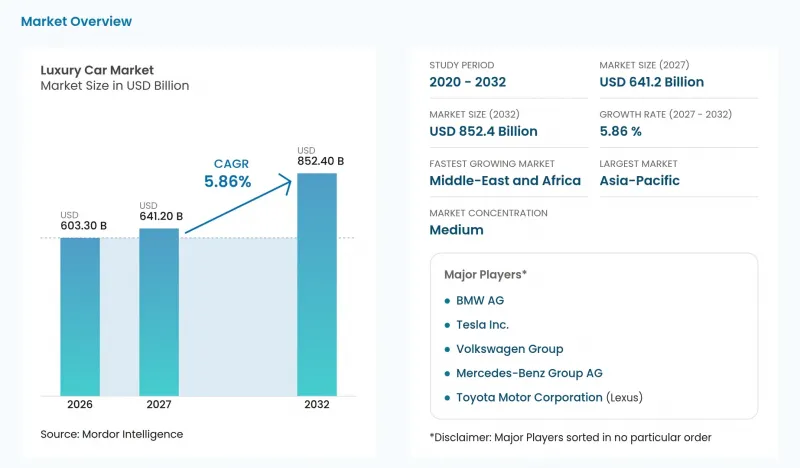
This report is segmented by Vehicle Type (Sports Utility Vehicles and more), Drive Type (Internal Combustion Engine and more), Vehicle Class (Mid-level Luxury and more), Sales Channel (Authorized Dealership and more), and Geography (Asia-Pacific and more). The market forecasts are provided in terms of value (USD), based on availability.
Global Luxury Car Market Trends and Insights
Luxury-SUV Demand Boom
Demand for an established luxury SUV can support a vehicle program and the regional retail business that brings it to buyers. Mercedes-Benz USA, the brand's US distributor, reported that preliminary US GLE SUV retail sales rose 14% in 2025, the model's best year ever. The preliminary figures also showed 12% year-over-year GLE retail sales growth in Q4 2025. Growth in both periods, with the fourth-quarter gain below the full-year gain, indicates demand for the Alabama-built GLE held through year-end.
Rapid Electrification of Premium Models
Customer demand is turning electrification into an operating-capacity issue for premium manufacturers. BMW Group reported provisional worldwide deliveries of 110,257 fully electric vehicles in Q3 2026, up 7.2% year over year. In its Q3 update, Mercedes-Benz said its battery-electric GLC, CLA, GLB, and GLA variants were sold out in Europe for the rest of 2026, with order books extending well into 2027. Its Bremen, Rastatt, and Kecskemet plants operated on 3-shift schedules to meet demand for these models. Because these electric variants were sold out in Europe for the rest of 2026 and the plants already ran 3 shifts, fulfilling committed European orders depends on added output.
High Purchase and Ownership Cost
High purchase prices can expose foreign luxury brands to competition from cheaper Chinese models. Those alternatives catered to buyer preferences for comfort and electronics, increasing the challenge of defending a premium through cabin features alone. Premium cars' share of total car sales in China fell to 13% in the first nine months of 2025 from 14% in 2024. For the foreign manufacturer, the constraint reaches both access to price-sensitive customers and the revenue attached to each vehicle transaction. A lower price can improve affordability while reducing the amount collected per sale, leaving a trade-off between retaining the buyer and defending the premium.
Other drivers and restraints analyzed in the detailed report include:
- Rising HNWI Population in Asia and Middle East
- Enhanced ADAS and Safety Expectations
- Semiconductor and Component Shortages
For complete list of drivers and restraints, kindly check the Table Of Contents.
Segment Analysis
Sports utility vehicles (SUVs) accounted for a 56.28% share of the luxury car market size in 2026, making them the largest segment, and are forecast to be the fastest-growing segment, with a CAGR of 7.3% over 2027-2032. Porsche AG delivered 59,586 Cayenne vehicles worldwide in January-September 2026, its strongest model line despite a 2% year-over-year decline. Porsche's total deliveries fell 16% to 178,532 in the same period, so Cayenne's smaller decline shows that the SUV line held up better than the rest of the range.
The all-electric Cayenne adds a different route to serve SUV demand within the same model family. Porsche AG delivered 7,002 all-electric Cayennes worldwide from the model's summer 2026 launch through September 2026. By February 2, 2026, Cayenne Electric production had begun in Bratislava on a line shared with combustion and hybrid Cayenne models. Porsche said this flexible setup enables rapid response to changes in demand. Sharing assembly across electric, combustion, and hybrid Cayennes lets Porsche adapt output to demand without committing the entire line to electric vehicles.
Internal combustion engine (ICE) vehicles represented a 67.78% luxury car market share in 2026, making them the largest segment. Porsche AG Group delivered 38,961 combustion-engined Macans worldwide in 2025, when the model was offered in most countries outside the European Union. Porsche AG delivered 27,996 combustion-engined Macans worldwide in January-September 2026. Production of the combustion-engined variant ended in summer 2026. The earlier non-EU footprint shows the geographic reach behind this combustion franchise, while its withdrawal demonstrates that delivery scale alone does not secure a variant's place in Porsche's portfolio.
Battery electric vehicles are forecast to be the fastest-growing segment, with a CAGR of 8.4% over 2027-2032. Porsche AG delivered 23,029 fully electric Macan vehicles worldwide in January-September 2026. Hybrid electric vehicles provide a separate choice, with BMW Group's FY2025 portfolio placing plug-in hybrids alongside combustion and battery-electric drivetrains to meet varied global customer needs.
Complete Report Scope:
- By Vehicle Type
- Hatchbacks
- Sedans
- Sports Utility Vehicles (SUVs)
- Multi-purpose Vehicles (MPVs)
- Sports / Exotic
- By Drive Type
- Internal Combustion Engine (ICE)
- Hybrid Electric
- Battery Electric
- By Vehicle Class
- Entry-level Luxury
- Mid-level Luxury
- Ultra-luxury / Exotic
- By Sales Channel
- Authorized Dealership
- Direct-to-Consumer / Online
- By Geography
- North America
- United States
- Canada
- Rest of North America
- South America
- Brazil
- Argentina
- Rest of South America
- Europe
- Germany
- United Kingdom
- France
- Italy
- Spain
- Rest of Europe
- Asia-Pacific
- China
- Japan
- India
- South Korea
- Rest of Asia-Pacific
- Middle-East and Africa
- United Arab Emirates
- Saudi Arabia
- Turkey
- Egypt
- South Africa
- Rest of Middle-East and Africa
- North America
Geography Analysis
Asia-Pacific held a 43.07% share of the luxury car market size in 2026, making it the largest geography. Audi delivered 617,514 vehicles in China, including Hong Kong, in 2025, down 5% from 2024. A substantial delivery base can coexist with pressure on an individual brand, so Asia-Pacific's commercial scale does not imply uninterrupted growth for Audi.
Middle-East and Africa is forecast to be the fastest-growing geography, with a CAGR of 7.5% over 2027-2032. Lexus sold 45,645 vehicles in the Middle East in 2025, equal to 101.4% of its 2024 volume, and 1,485 in Africa, equal to 118.8% of its 2024 volume. BMW importer Al-Uroush Automotive opened a 1,200-square-meter BMW and MINI showroom in Sulaymaniyah, Iraq, on October 9, 2025, with display capacity for up to 10 vehicles. The additional retail point creates local display and customer access through an official importer. Lexus's higher relative gain in Africa came from a much smaller sales base, while the Iraqi showroom adds a local route to buyers in the Middle East.
North America offers substantial brand-level demand, illustrated by Lexus's record 370,260 US vehicle sales in 2025, up 7.1% on a volume basis. South America has a distinct country-level growth example in Brazil, where K.Lume Consultoria reported 54,564 luxury-car registrations in 2025, up 6.6% from 2024. Europe presents a drivetrain-mix consideration, with battery-electric and plug-in hybrid vehicles comprising 40% of BMW Group deliveries there in 2025. In the first half of 2026, Canada's luxury sector faced cost and trade pressures, while BMW reported a preliminary Mexican premium-market contraction and Argentine premium-segment growth in 2025. Lexus's US gains and rising Brazilian registrations contrast with Canada's weaker luxury share and Mexico's preliminary premium-market contraction, while BMW's European delivery mix shows electrification coexisting with a larger base using other powertrains.
- Mercedes-Benz Group AG
- BMW AG
- Volkswagen Group
- Toyota Motor Corporation (Lexus)
- Jaguar Land Rover Automotive PLC
- Stellantis NV (Maserati, Alfa Romeo)
- Tesla Inc.
- Volvo Car Group
- Hyundai Motor Group (Genesis)
- Nissan Motor Co. (Infiniti)
- Geely Holding (Lotus, Zeekr)
- FAW Group (Hongqi)
- SAIC Motor (IM, Roewe)
- BYD Co. (Yangwang)
- Lucid Group
- Rivian Automotive
- Ferrari NV
- Aston Martin Lagonda
- Rolls-Royce Motor Cars
- McLaren Automotive
Additional Benefits:
- The market estimate (ME) sheet in Excel format
- 3 months of analyst support
TABLE OF CONTENTS
1 INTRODUCTION
- 1.1 Study Assumptions and Market Definition
- 1.2 Scope of the Study
2 RESEARCH METHODOLOGY
3 EXECUTIVE SUMMARY
4 MARKET LANDSCAPE
- 4.1 Market Overview
- 4.2 Market Drivers
- 4.2.1 Luxury-SUV Demand Boom
- 4.2.2 Rapid Electrification of Premium Models
- 4.2.3 Rising HNWI Population in Asia and Middle East
- 4.2.4 Enhanced ADAS and Safety Expectations
- 4.2.5 Online/Direct-To-Consumer Retail Shift
- 4.2.6 Mass-Customization and Bespoke Options
- 4.3 Market Restraints
- 4.3.1 High Purchase and Ownership Cost
- 4.3.2 Semiconductor and Component Shortages
- 4.3.3 Macroeconomic Demand Volatility
- 4.3.4 Anti-SUV Climate Regulation Pressure
- 4.4 Industry Value Chain Analysis
- 4.5 Regulatory Landscape
- 4.6 Technological Outlook
- 4.7 Porter's Five Forces Analysis
- 4.7.1 Threat of New Entrants
- 4.7.2 Bargaining Power of Suppliers
- 4.7.3 Bargaining Power of Buyers
- 4.7.4 Threat of Substitutes
- 4.7.5 Competitive Rivalry
5 MARKET SIZE AND GROWTH FORECASTS (VALUE)
- 5.1 By Vehicle Type
- 5.1.1 Hatchbacks
- 5.1.2 Sedans
- 5.1.3 Sports Utility Vehicles (SUVs)
- 5.1.4 Multi-purpose Vehicles (MPVs)
- 5.1.5 Sports / Exotic
- 5.2 By Drive Type
- 5.2.1 Internal Combustion Engine (ICE)
- 5.2.2 Hybrid Electric
- 5.2.3 Battery Electric
- 5.3 By Vehicle Class
- 5.3.1 Entry-level Luxury
- 5.3.2 Mid-level Luxury
- 5.3.3 Ultra-luxury / Exotic
- 5.4 By Sales Channel
- 5.4.1 Authorized Dealership
- 5.4.2 Direct-to-Consumer / Online
- 5.5 By Geography
- 5.5.1 North America
- 5.5.1.1 United States
- 5.5.1.2 Canada
- 5.5.1.3 Rest of North America
- 5.5.2 South America
- 5.5.2.1 Brazil
- 5.5.2.2 Argentina
- 5.5.2.3 Rest of South America
- 5.5.3 Europe
- 5.5.3.1 Germany
- 5.5.3.2 United Kingdom
- 5.5.3.3 France
- 5.5.3.4 Italy
- 5.5.3.5 Spain
- 5.5.3.6 Rest of Europe
- 5.5.4 Asia-Pacific
- 5.5.4.1 China
- 5.5.4.2 Japan
- 5.5.4.3 India
- 5.5.4.4 South Korea
- 5.5.4.5 Rest of Asia-Pacific
- 5.5.5 Middle-East and Africa
- 5.5.5.1 United Arab Emirates
- 5.5.5.2 Saudi Arabia
- 5.5.5.3 Turkey
- 5.5.5.4 Egypt
- 5.5.5.5 South Africa
- 5.5.5.6 Rest of Middle-East and Africa
- 5.5.1 North America
6 COMPETITIVE LANDSCAPE
- 6.1 Market Concentration
- 6.2 Strategic Moves
- 6.3 Market Share Analysis
- 6.4 Company Profiles (includes Global level Overview, Market level overview, Core Segments, Financials as available, Strategic Information, Market Rank/Share for key companies, Products and Services, and Recent Developments)
- 6.4.1 Mercedes-Benz Group AG
- 6.4.2 BMW AG
- 6.4.3 Volkswagen Group
- 6.4.4 Toyota Motor Corporation (Lexus)
- 6.4.5 Jaguar Land Rover Automotive PLC
- 6.4.6 Stellantis NV (Maserati, Alfa Romeo)
- 6.4.7 Tesla Inc.
- 6.4.8 Volvo Car Group
- 6.4.9 Hyundai Motor Group (Genesis)
- 6.4.10 Nissan Motor Co. (Infiniti)
- 6.4.11 Geely Holding (Lotus, Zeekr)
- 6.4.12 FAW Group (Hongqi)
- 6.4.13 SAIC Motor (IM, Roewe)
- 6.4.14 BYD Co. (Yangwang)
- 6.4.15 Lucid Group
- 6.4.16 Rivian Automotive
- 6.4.17 Ferrari NV
- 6.4.18 Aston Martin Lagonda
- 6.4.19 Rolls-Royce Motor Cars
- 6.4.20 McLaren Automotive
7 MARKET OPPORTUNITIES AND FUTURE OUTLOOK
- 7.1 White-Space and Unmet-Need Assessment

