PUBLISHER: Mordor Intelligence | PRODUCT CODE: 2187266

PUBLISHER: Mordor Intelligence | PRODUCT CODE: 2187266
Shampoo - Market Share Analysis, Industry Trends & Statistics, Growth Forecasts (2027 - 2032)
According to Mordor Intelligence, the shampoo market size was valued at USD 37.26 billion in 2026 and estimated to grow from USD 39.04 billion in 2027 to reach USD 48.7 billion by 2032, at a CAGR of 4.52% during the forecast period (2027-2032).
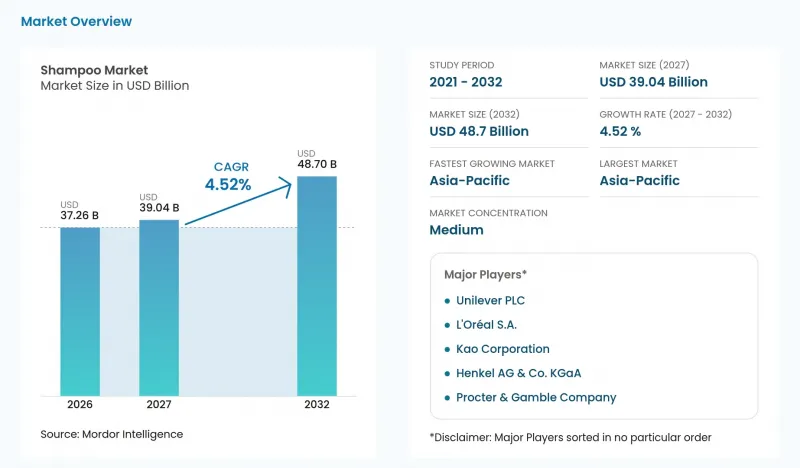
This report is segmented by Product Type (Standard Shampoo and Natural/Organic/Medicated Shampoo), Hair Concern (Specific Purpose and General/Multi-purpose), Category (Mass and Luxury/Premium), Distribution Channel (Supermarkets/Hypermarkets, Convenience/Grocery Stores, and more), and Geography (Asia-Pacific, Europe, and more). The market forecasts are provided in terms of value (USD), based on availability.
Global Shampoo Market Trends and Insights
Growing preference for organic and herbal shampoos
Preference for organic and herbal ingredients gives shampoo buyers a reason to choose a brand for more than cleansing alone. Dabur reported double-digit growth in Vatika Shampoo in the fourth quarter of fiscal 2025-26. In its FY2025-26 India FMCG discussion, Dabur said a campaign positioned Vatika as a natural/herbal shampoo choice. Dabur also reported that Vatika Shampoo delivered its highest-ever revenue in FY2025-26. These brand-level results show a revenue opportunity around a natural/herbal identity, giving suppliers a basis to seek purchases from ingredient-conscious shoppers rather than competing only on routine washing.
Influence of social media and digital marketing
Social platforms can bring shampoo brands into consideration before shoppers encounter competing bottles on a store shelf. An April 2025 U.S. survey found that 49% of consumers discovered personal-care products through social platforms, compared with 37% through word of mouth. The surveyed personal-care category included shampoo. For suppliers, that discovery channel creates an opportunity to explain a product's benefits outside the constraints of its physical placement. Converting attention into demand requires a recognizable connection between the message and the product shoppers can subsequently select. A brand absent from social feeds therefore misses a route to the nearly half of surveyed consumers who discover personal-care products there, making social visibility part of gaining consideration among those shoppers.
Regulatory challenges
Ingredient rules can turn continued anti-dandruff sales into a reformulation task for suppliers with affected formulas. EU rules prohibited zinc pyrithione in cosmetics from March 1, 2022. In the European Commission's 2025 review, stakeholders reported that frequent EU cosmetics ingredient reclassifications required repeated reformulations and raised operating and compliance costs. For a small shampoo supplier, ingredient review and claim maintenance can consume development resources before a replacement product reaches buyers. On June 16, 2026, the Commission reported a provisional agreement intended to reduce cosmetics paperwork and business costs. Reformulation places development spending ahead of replacement-product revenue, extending the cost of keeping an affected anti-dandruff offer on sale.
Other drivers and restraints analyzed in the detailed report include:
- Increasing demand for men's segment shampoos
- Rise of multifunctional shampoos with innovative active ingredients
- High competition and market saturation
For complete list of drivers and restraints, kindly check the Table Of Contents.
Segment Analysis
Standard shampoo accounted for a 90.92% share of the shampoo market size in 2026. The largest segment serves buyers choosing a routine cleanser, giving suppliers a broad base of purchases to defend through the washing benefit they promise. Standard formulas are the default purchase, so they compete on familiarity and price per wash rather than on a special claim. The leader's position consequently depends on remaining a dependable everyday cleanser that buyers can choose again without reassessing a treatment need.
Natural/organic/medicated shampoo is forecast to be the fastest-growing segment, at a 6.68% CAGR during 2027-2032. BaWang International's natural-based Litao series, mainly shower gels and laundry detergents but also including shampoo, recorded approximately 40.3% revenue growth in 2025 from 2024. In guidance updated December 11, 2023, the American Academy of Dermatology recommended over-the-counter dandruff shampoo when regular washing does not relieve mild dandruff. It also advised alternating dandruff shampoos with different active ingredients if one shampoo fails. Ingredient identity and an alternative after treatment failure give suppliers distinct reasons to win purchases beyond standard cleansing, supporting the combined segment's faster-growth outlook.
Specific-purpose shampoos were the largest segment, with 55.15% of revenue in 2026, and are forecast to be the fastest-growing segment, at a 4.62% CAGR during 2027-2032. According to Mandi's prospectus, its anti-hair-loss shampoo sold more than 500,000 bottles in the first 6 months after its 2025 launch in China. The product is sold against one stated problem, hair loss, and contains kopexil as an active ingredient. A buyer who arrives with that problem can judge the shampoo by one outcome, so a supplier in this segment sells the concern the formula addresses rather than a general promise of better hair.
General/multipurpose shampoos retain a distinct role when hair-care needs extend beyond treatment of one scalp concern. In December 2023 guidance, the American Academy of Dermatology said people can use their normal shampoo and conditioner after dandruff shampoo if needed for hair care. The conditional routine gives normal products a complementary application alongside a concern-directed cleanser. General cleansing therefore need not lose its commercial role whenever a shopper also selects a shampoo for a particular condition.
Complete Report Scope:
- By Product Type
- Standard Shampoo
- Natural/Organic/Medicated Shampoo
- By Hair Concern
- General/Multi-purpose
- Specific Purpose
- Anti-Dandruff and Scalp Health
- Volumizing and Thickening
- Strengthening and Repair
- Hair Regrowth and Hair Repair
- Others
- By Category
- Mass
- Luxury/Premium
- By Distribution Channel
- Supermarkets/Hypermarkets
- Convenience/Grocery Stores
- Online Retail Stores
- Other Distribution Channels
- By Geography
- North America
- United States
- Canada
- Mexico
- Rest of North America
- Europe
- Germany
- United Kingdom
- Italy
- France
- Spain
- Netherlands
- Poland
- Belgium
- Sweden
- Rest of Europe
- Asia-Pacific
- China
- India
- Japan
- Australia
- Indonesia
- South Korea
- Thailand
- Singapore
- Rest of Asia-Pacific
- South America
- Brazil
- Argentina
- Colombia
- Chile
- Peru
- Rest of South America
- Middle East and Africa
- South Africa
- Saudi Arabia
- United Arab Emirates
- Nigeria
- Egypt
- Morocco
- Turkey
- Rest of Middle East and Africa
- North America
Geography Analysis
Asia-Pacific was the largest and fastest-growing geography, representing 47.36% of the shampoo market size in 2026 and forecast to expand at a 5.1% CAGR during 2027-2032. In the quarter ended March 31, 2026, Hindustan Unilever Limited reported a 25% increase in distribution of shampoo bottles in India's general trade channel. Dabur India Limited reported 23% growth in its shampoo business in the quarter ended June 30, 2026. Both results come from companies already established in India, so the growth examples in this region belong to incumbents with existing local distribution rather than to new entrants.
In Europe, EU operators must individually list covered Annex III fragrance allergens when their concentrations exceed 0.01% in rinse-off products, enabling sensitized consumers to identify ingredients they need to avoid. From July 31, 2026, noncompliant products may not be newly placed on the EU market. Products placed before that date may be made available until July 31, 2028. Within North America, shampoo-and-conditioner combo packs were the fastest-growing U.S. mass-market hair segment in 2025. Label compliance governs access to EU sales, while the U.S. combo-pack example points to value within a combined purchase as a different route to buyers.
In South America, Brazilian shampoo value sales in Scanntech's tracked perfumery channel fell 8.2% in September 2026 from September 2025 on a same-store basis. A supplier assessing Brazilian distribution consequently faces a channel-exposure question before treating forecast regional expansion as uniform retail momentum. In the Middle East and Africa, NIQ's 2026 Saudi Arabia analysis described hair-care products designed for local climate conditions and lifestyle needs. For a shampoo brand entering Saudi Arabia, the opportunity is to make the intended local use explicit in its product proposition. Brazil's earlier May 2026 reading, when shampoo made up 16% of Scanntech's same-store perfumery-channel value and its value sales fell 5% from May 2025, shows that the perfumery exposure predates the September decline.
- Procter & Gamble Company
- Unilever PLC
- L'Oreal S.A.
- Kenvue Inc.
- Henkel AG & Co. KGaA
- Kao Corporation
- Shiseido Company, Limited
- Amorepacific Corporation
- LG Household & Health Care Ltd.
- Colgate-Palmolive Company
- Beiersdorf AG
- Revlon Group Holdings LLC
- Natura Cosmeticos S.A.
- O Boticario S.A. (Grupo Boticario)
- Dabur India Limited
- Patanjali Ayurved Limited
- Emami Limited
- Marico Limited
- The Himalaya Drug Company (Himalaya Wellness Company)
- Godrej Consumer Products Limited
Additional Benefits:
- The market estimate (ME) sheet in Excel format
- 3 months of analyst support
TABLE OF CONTENTS
1 INTRODUCTION
- 1.1 Study Assumptions and Market Definition
- 1.2 Scope of the Study
2 RESEARCH METHODOLOGY
3 EXECUTIVE SUMMARY
4 MARKET LANDSCAPE
- 4.1 Market Overview
- 4.2 Market Drivers
- 4.2.1 Growing preference for organic and herbal shampoos
- 4.2.2 Influence of social media and digital marketing
- 4.2.3 Increasing demand for men's segment shampoos
- 4.2.4 Rise of multifunctional shampoos with innovative active ingredients
- 4.2.5 Sustainability and eco-friendly packaging
- 4.2.6 Growing demand for AI-personalized and custom shampoos
- 4.3 Market Restraints
- 4.3.1 Regulatory challenges
- 4.3.2 High competition and market saturation
- 4.3.3 Supply chain disruptions
- 4.3.4 Availability of counterfeit shampoos
- 4.4 Industry Value Chain Analysis
- 4.5 Regulatory Landscape
- 4.6 Technological Outlook
- 4.7 Porter's Five Forces Analysis
- 4.7.1 Threat of New Entrants
- 4.7.2 Bargaining Power of Suppliers
- 4.7.3 Bargaining Power of Buyers
- 4.7.4 Threat of Substitutes
- 4.7.5 Competitive Rivalry
- 4.8 Consumer Behavior Analysis
5 MARKET SIZE AND GROWTH FORECASTS (VALUE)
- 5.1 By Product Type
- 5.1.1 Standard Shampoo
- 5.1.2 Natural/Organic/Medicated Shampoo
- 5.2 By Hair Concern
- 5.2.1 General/Multi-purpose
- 5.2.2 Specific Purpose
- 5.2.2.1 Anti-Dandruff and Scalp Health
- 5.2.2.2 Volumizing and Thickening
- 5.2.2.3 Strengthening and Repair
- 5.2.2.4 Hair Regrowth and Hair Repair
- 5.2.2.5 Others
- 5.3 By Category
- 5.3.1 Mass
- 5.3.2 Luxury/Premium
- 5.4 By Distribution Channel
- 5.4.1 Supermarkets/Hypermarkets
- 5.4.2 Convenience/Grocery Stores
- 5.4.3 Online Retail Stores
- 5.4.4 Other Distribution Channels
- 5.5 By Geography
- 5.5.1 North America
- 5.5.1.1 United States
- 5.5.1.2 Canada
- 5.5.1.3 Mexico
- 5.5.1.4 Rest of North America
- 5.5.2 Europe
- 5.5.2.1 Germany
- 5.5.2.2 United Kingdom
- 5.5.2.3 Italy
- 5.5.2.4 France
- 5.5.2.5 Spain
- 5.5.2.6 Netherlands
- 5.5.2.7 Poland
- 5.5.2.8 Belgium
- 5.5.2.9 Sweden
- 5.5.2.10 Rest of Europe
- 5.5.3 Asia-Pacific
- 5.5.3.1 China
- 5.5.3.2 India
- 5.5.3.3 Japan
- 5.5.3.4 Australia
- 5.5.3.5 Indonesia
- 5.5.3.6 South Korea
- 5.5.3.7 Thailand
- 5.5.3.8 Singapore
- 5.5.3.9 Rest of Asia-Pacific
- 5.5.4 South America
- 5.5.4.1 Brazil
- 5.5.4.2 Argentina
- 5.5.4.3 Colombia
- 5.5.4.4 Chile
- 5.5.4.5 Peru
- 5.5.4.6 Rest of South America
- 5.5.5 Middle East and Africa
- 5.5.5.1 South Africa
- 5.5.5.2 Saudi Arabia
- 5.5.5.3 United Arab Emirates
- 5.5.5.4 Nigeria
- 5.5.5.5 Egypt
- 5.5.5.6 Morocco
- 5.5.5.7 Turkey
- 5.5.5.8 Rest of Middle East and Africa
- 5.5.1 North America
6 COMPETITIVE LANDSCAPE
- 6.1 Market Concentration
- 6.2 Strategic Moves
- 6.3 Market Share Analysis
- 6.4 Company Profiles (includes Global level Overview, Market level overview, Core Segments, Financials as available, Strategic Information, Market Rank/Share for key companies, Products and Services, and Recent Developments)
- 6.4.1 Procter & Gamble Company
- 6.4.2 Unilever PLC
- 6.4.3 L'Oreal S.A.
- 6.4.4 Kenvue Inc.
- 6.4.5 Henkel AG & Co. KGaA
- 6.4.6 Kao Corporation
- 6.4.7 Shiseido Company, Limited
- 6.4.8 Amorepacific Corporation
- 6.4.9 LG Household & Health Care Ltd.
- 6.4.10 Colgate-Palmolive Company
- 6.4.11 Beiersdorf AG
- 6.4.12 Revlon Group Holdings LLC
- 6.4.13 Natura Cosmeticos S.A.
- 6.4.14 O Boticario S.A. (Grupo Boticario)
- 6.4.15 Dabur India Limited
- 6.4.16 Patanjali Ayurved Limited
- 6.4.17 Emami Limited
- 6.4.18 Marico Limited
- 6.4.19 The Himalaya Drug Company (Himalaya Wellness Company)
- 6.4.20 Godrej Consumer Products Limited
7 MARKET OPPORTUNITIES AND FUTURE OUTLOOK
- 7.1 White-Space and Unmet-Need Assessment

