PUBLISHER: Mordor Intelligence | PRODUCT CODE: 2187276

PUBLISHER: Mordor Intelligence | PRODUCT CODE: 2187276
Golf Equipment - Market Share Analysis, Industry Trends & Statistics, Growth Forecasts (2027 - 2032)
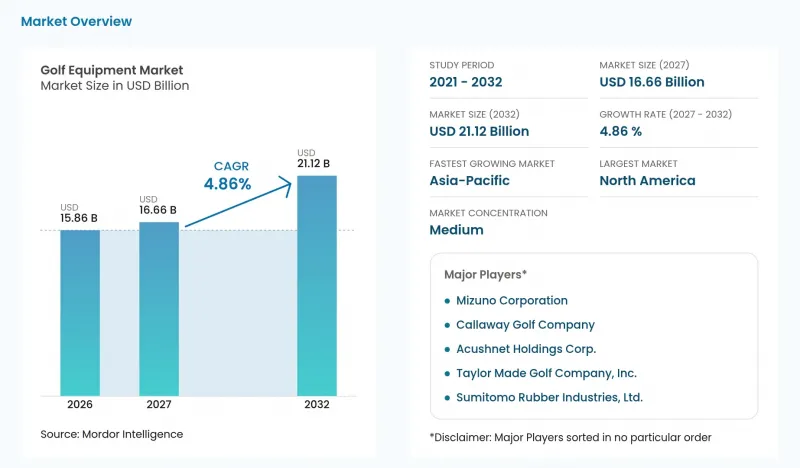
According to Mordor Intelligence, the golf equipment market size is expected to increase from USD 15.86 billion in 2026 to USD 16.66 billion in 2027 and reach USD 21.12 billion by 2032, growing at a CAGR of 4.86% over 2027-2032.
This report is segmented by Product Type (Golf Clubs, Golf Balls, and more), Category (Mass and Premium), End User (Adults and Kids/Children), Distribution Channel (Offline Retail Stores and Online Retail Stores), and Geography (North America, Asia-Pacific, and more). The market forecasts are provided in terms of value (USD), based on availability.
Global Golf Equipment Market Trends and Insights
Growing participation in golf across emerging markets
Emerging-market participation can create equipment opportunities through organized competitive play as well as initial registration. China's 2025 youth golf report recorded 13,173 newly registered youth golfers. The country also hosted 753 junior golf tournaments in 2025, 60 more than in 2024. By December 31, 2025, 1,200 players in the China Golf Association junior ranking had obtained competition handicap indexes from scores in association ranking events played at handicap-rated courses. Registration, tournament availability and documented competitive play give equipment suppliers different occasions to address the junior audience. Tournament-linked equipment offers can address an identifiable playing occasion, creating a more specific commercial route than an undifferentiated recruitment proposition.
Increasing investment in golf course development and expansion
Course development supports equipment demand by expanding the places where golfers can use clubs and balls. In June 2026, the National Golf Foundation reported nearly 150 United States course projects in active planning or construction, with more than half private. That composition concentrates the opportunity around private-club participation rather than creating equivalent access for every prospective golfer. Escalante Golf broke ground in 2026 on a second Kingsley Club course in Michigan within a USD 40 million, multi-phase expansion. Such construction creates a future playing venue, while its equipment opportunity depends on the transition from development to actual use. Course openings determine when the construction pipeline can support equipment demand, with the commercial contribution arriving in stages as new playing venues enter use.
High cost of premium golf clubs and equipment
Upfront equipment costs can delay a prospective golfer's entry into the sport. In a UK survey conducted from August 28 to September 2, 2026, 55% of aspiring golfers said equipment costs that were too high had personally delayed getting into golf. Censuswide surveyed 2,001 UK adults, including 210 aspiring golfers, with the affordability finding concerning basic equipment. Separately, 57% of respondents who had played golf said they had borrowed equipment rather than buying their own. Borrowing provides equipment access without requiring purchase of that item, creating a different commercial decision from taking up the sport. Entry delays and access to borrowed items separate participation from an immediate purchase, leaving equipment sellers with a conversion hurdle among people interested in playing.
Other drivers and restraints analyzed in the detailed report include:
- Rising demand for technologically advanced golf clubs
- Growing popularity of custom-fitted golf equipment
- Limited accessibility to golf courses in many regions
For complete list of drivers and restraints, kindly check the Table Of Contents.
Segment Analysis
Golf clubs accounted for a 51.97% share of the golf equipment market size in 2026, making them the largest segment. In South Korea, TaylorMade ranked first by golf-club brand unit sales across the full club range in 2025, based on NIQ Korea retail-index data covering online and offline channels. Callaway Golf Company reported USD 697.1 million in golf-club net sales for the 6 months ended June 30, 2026, up 6.8% from the comparable 2025 period. That half-year expansion gives established club suppliers an example of additional revenue within the largest equipment category, keeping competition for club spending relevant beyond protecting existing sales.
Golf balls are the fastest-growing segment, with a forecast CAGR of 5.22% over 2027-2032. Acushnet reported Titleist golf-ball revenue growth of 6% in the first half of 2026, led by Pro V1 against challenging prior-year launch volumes. NGF's 2025 midyear update placed United States golf-ball shipments 59% above recent pre-COVID levels, noting possible contributions from retailer stocking, tariff concerns, newer golfers losing balls and stockpiling. Replenishment execution matters alongside model appeal when ball-use demand and retailer stocking produce different shipment patterns, making channel demand distinct from the appeal of a new model.
Mass equipment represented a 63.7% golf equipment market share in 2026, making it the largest segment. At GOLFZON Market's offline stores in South Korea, Srixon 25 Soft Feel accounted for 4.7% of golf-ball dozen sales by unit volume in September 2026. The model ranked fifth in those stores' September dozen sales, while its official U.S. list price of USD 24.99 identifies its value tier in the United States. Mass suppliers can therefore compete on the cost of each replenishment purchase, extending their affordability proposition to golfers who already own equipment.
Premium is the fastest-growing segment, with a forecast CAGR of 5.4% over 2027-2032. Acushnet reported that Titleist Golf Equipment sales grew 14% in the first half of 2026, including 24% growth in golf-club sales. Management said the GTS launch moved from the third quarter into the seasonal peak of the second quarter, contributing to the period's results. Acushnet also attributed part of its 2025 Titleist equipment growth to higher average selling prices in golf clubs, demonstrating a revenue contribution from value per club. Higher selling prices give premium club makers a second revenue lever alongside model launches, so the category's growth case extends beyond moving sales between quarters.
Complete Report Scope:
- By Product Type
- Golf Clubs
- Golf Balls
- Golf Bags and Accessories
- By Category
- Mass
- Premium
- By End User
- Adults
- Kids/Children
- By Distribution Channel
- Offline Retail Stores
- Online Retail Stores
- By Geography
- North America
- United States
- Canada
- Mexico
- Rest of North America
- Europe
- United Kingdom
- Germany
- Spain
- France
- Italy
- Sweden
- Ireland
- Austria
- Rest of Europe
- Asia-Pacific
- China
- Japan
- South Korea
- New Zealand
- Australia
- Rest of Asia-Pacific
- South America
- Brazil
- Argentina
- Rest of South America
- Middle East and Africa
- United Arab Emirates
- South Africa
- Rest of Middle East and Africa
- North America
Geography Analysis
North America accounted for a 47.72% share of the golf equipment market size in 2026, making it the largest geography. In 2025, 48.1 million Americans age 6 and older played on-course or off-course golf, including 29.1 million on-course golfers and others using traditional or technology-enabled ranges, indoor simulators or golf entertainment venues. Golf courses in the United States also recorded more than 500 million rounds in each year from 2020 through 2025. Another 19 million Americans played only off-course in 2025, extending the potential buyer pool beyond course golfers alongside the active on-course base.
Asia-Pacific is the fastest-growing geography, with a forecast CAGR of 5.2% over 2027-2032. Oceania's registered and unregistered 9- and 18-hole golfer population reached an estimated 2.69 million in 2025, up 5% from 2024. Asia provided a larger established base of an estimated 20.3 million golfers on the same participation basis in 2025, unchanged from 2024. China's expansion of junior tournaments that year added competitive playing opportunities within this established regional audience. Expanding course participation in Oceania and junior competition in China create demand opportunities for first sets and age-appropriate clubs alongside replacements for established Asian golfers.
Europe's established playing base included an estimated 13.97 million registered and unregistered 9- and 18-hole golfers in 2025. France recorded 446,547 license holders that year, giving suppliers an identifiable organized-golf audience within the wider European opportunity. In South America, Brazil had 9,800 registered golfers alongside an estimated 16,000 registered and unregistered 9- and 18-hole players in 2025. Middle East and Africa includes South Africa, where the corresponding 2025 populations were 145,835 and an estimated 489,000, creating a wider gap between affiliation and participation. Reaching South Africa's wider playing population requires looking beyond registered golfers, because the estimated on-course audience is more than 3 times its affiliated base.
- Callaway Golf Company
- Acushnet Holdings Corp.
- Taylor Made Golf Company, Inc.
- Sumitomo Rubber Industries, Ltd.
- Mizuno Corporation
- PING, Inc.
- Bridgestone Sports Co., Ltd.
- Parsons Xtreme Golf, LLC
- Cobra Golf Incorporated
- Honma Golf Limited
- YONEX CO., LTD.
- Wilson Sporting Goods Co.
- Tour Edge Golf Manufacturing, Inc.
- FILA Golf Co., Ltd.
- MAJESTY GOLF CO., LTD.
- Fourteen Co., Ltd.
- Epon Golf Co., Ltd.
- Miura Golf Inc.
- Roger Cleveland Golf Company, Inc.
- Bettinardi Golf, LLC
Additional Benefits:
- The market estimate (ME) sheet in Excel format
- 3 months of analyst support
TABLE OF CONTENTS
1 INTRODUCTION
- 1.1 Study Assumptions and Market Definition
- 1.2 Scope of the Study
2 RESEARCH METHODOLOGY
3 EXECUTIVE SUMMARY
4 MARKET LANDSCAPE
- 4.1 Market Overview
- 4.2 Market Drivers
- 4.2.1 Growing participation in golf across emerging markets
- 4.2.2 Increasing investment in golf course development and expansion
- 4.2.3 Rising demand for technologically advanced golf clubs
- 4.2.4 Growing popularity of custom-fitted golf equipment
- 4.2.5 Expansion of indoor golf simulators driving equipment purchases
- 4.2.6 Increasing number of junior golf development programs
- 4.3 Market Restraints
- 4.3.1 High cost of premium golf clubs and equipment
- 4.3.2 Limited accessibility to golf courses in many regions
- 4.3.3 High maintenance and storage requirements for equipment
- 4.3.4 Economic downturns reducing discretionary spending on golf gear
- 4.4 Industry Value Chain Analysis
- 4.5 Regulatory Landscape
- 4.6 Technological Outlook
- 4.7 Porter's Five Forces Analysis
- 4.7.1 Threat of New Entrants
- 4.7.2 Bargaining Power of Suppliers
- 4.7.3 Bargaining Power of Buyers
- 4.7.4 Threat of Substitutes
- 4.7.5 Competitive Rivalry
- 4.8 Consumer Behaviour Analysis
5 MARKET SIZE AND GROWTH FORECASTS (VALUE)
- 5.1 By Product Type
- 5.1.1 Golf Clubs
- 5.1.2 Golf Balls
- 5.1.3 Golf Bags and Accessories
- 5.2 By Category
- 5.2.1 Mass
- 5.2.2 Premium
- 5.3 By End User
- 5.3.1 Adults
- 5.3.2 Kids/Children
- 5.4 By Distribution Channel
- 5.4.1 Offline Retail Stores
- 5.4.2 Online Retail Stores
- 5.5 By Geography
- 5.5.1 North America
- 5.5.1.1 United States
- 5.5.1.2 Canada
- 5.5.1.3 Mexico
- 5.5.1.4 Rest of North America
- 5.5.2 Europe
- 5.5.2.1 United Kingdom
- 5.5.2.2 Germany
- 5.5.2.3 Spain
- 5.5.2.4 France
- 5.5.2.5 Italy
- 5.5.2.6 Sweden
- 5.5.2.7 Ireland
- 5.5.2.8 Austria
- 5.5.2.9 Rest of Europe
- 5.5.3 Asia-Pacific
- 5.5.3.1 China
- 5.5.3.2 Japan
- 5.5.3.3 South Korea
- 5.5.3.4 New Zealand
- 5.5.3.5 Australia
- 5.5.3.6 Rest of Asia-Pacific
- 5.5.4 South America
- 5.5.4.1 Brazil
- 5.5.4.2 Argentina
- 5.5.4.3 Rest of South America
- 5.5.5 Middle East and Africa
- 5.5.5.1 United Arab Emirates
- 5.5.5.2 South Africa
- 5.5.5.3 Rest of Middle East and Africa
- 5.5.1 North America
6 COMPETITIVE LANDSCAPE
- 6.1 Market Concentration
- 6.2 Strategic Moves
- 6.3 Market Share Analysis
- 6.4 Company Profiles (includes Global level Overview, Market level overview, Core Segments, Financials as available, Strategic Information, Market Rank/Share for key companies, Products and Services, and Recent Developments)
- 6.4.1 Callaway Golf Company
- 6.4.2 Acushnet Holdings Corp.
- 6.4.3 Taylor Made Golf Company, Inc.
- 6.4.4 Sumitomo Rubber Industries, Ltd.
- 6.4.5 Mizuno Corporation
- 6.4.6 PING, Inc.
- 6.4.7 Bridgestone Sports Co., Ltd.
- 6.4.8 Parsons Xtreme Golf, LLC
- 6.4.9 Cobra Golf Incorporated
- 6.4.10 Honma Golf Limited
- 6.4.11 YONEX CO., LTD.
- 6.4.12 Wilson Sporting Goods Co.
- 6.4.13 Tour Edge Golf Manufacturing, Inc.
- 6.4.14 FILA Golf Co., Ltd.
- 6.4.15 MAJESTY GOLF CO., LTD.
- 6.4.16 Fourteen Co., Ltd.
- 6.4.17 Epon Golf Co., Ltd.
- 6.4.18 Miura Golf Inc.
- 6.4.19 Roger Cleveland Golf Company, Inc.
- 6.4.20 Bettinardi Golf, LLC
7 MARKET OPPORTUNITIES AND FUTURE OUTLOOK
- 7.1 White-Space and Unmet-Need Assessment

