PUBLISHER: Mordor Intelligence | PRODUCT CODE: 2187280

PUBLISHER: Mordor Intelligence | PRODUCT CODE: 2187280
Matcha - Market Share Analysis, Industry Trends & Statistics, Growth Forecasts (2027 - 2032)
According to Mordor Intelligence, the matcha market size is projected to expand from USD 3.91 billion in 2026 and USD 4.16 billion in 2027 to USD 5.8 billion by 2032, registering a CAGR of 6.88% between 2027 and 2032.
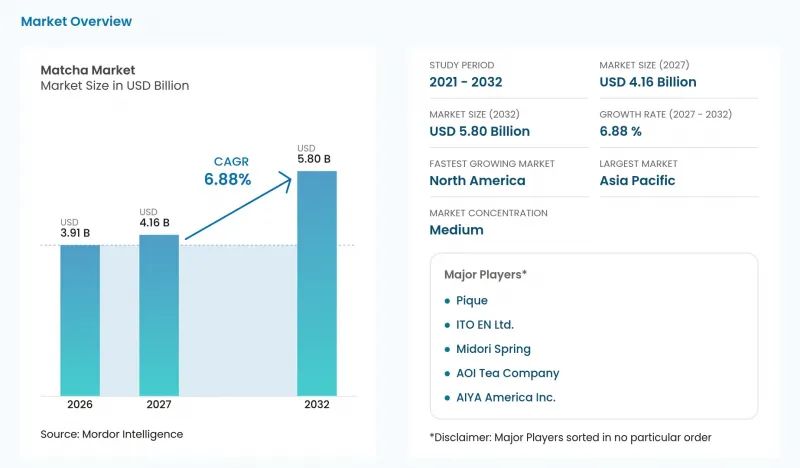
This report is segmented by Product Type (Regular and Flavored), Grade (Classic, Ceremonial, and more), Form (Powder and Liquid), Distribution Channels (Retail and Foodservice), and Geography (Asia Pacific, North America, and more). The market forecasts are provided in terms of value (USD), based on availability.
Global Matcha Market Trends and Insights
Popularity of functional foods and beverages
Demand for beverages with a defined wellness purpose creates an opening for matcha beyond flavor alone. In May 2026, 41% of US adults said they were seeking foods or beverages with hydration benefits more than a year earlier. Ocado Retail reported that Ocado.com health-drink sales rose 54% year over year in the comparison period ending April 23, 2025, across products from kombucha to prebiotic sodas. That wider category spending gives matcha suppliers a commercial reason to address health-oriented beverage occasions. US hydration interest and UK health-drink spending support testing a shared wellness message in both countries, while tailoring the specific beverage benefit to each offer.
Expansion of plant-based and vegan diets
Plant-based beverage growth gives matcha suppliers a way to serve convenience demand through formulations that can fit dairy-free product development. US retail sales and unit sales of ready-to-drink plant-based beverages grew by double digits in 2025, according to the Good Food Institute. The institute linked sales gains to distribution growth and consumer demand for convenient ready-to-drink beverages, including coffee and tea drinks. In October 2025, Green Beans Coffee introduced a matcha latte at its US cafes. Its ceremonial-grade matcha powder was described as naturally vegan, a formulation attribute relevant to developers selecting the beverage base. A developer can carry that powder into dairy-free recipes, but the other ingredients determine whether the finished beverage serves the plant-based occasion.
Competition from alternative superfoods
Competing superfoods can satisfy a broad wellness-drink occasion when the buyer has no preference for matcha itself. Taste, preparation requirements and price then become reasons to consider replacing the ingredient. This makes an offer based only on a general health promise more exposed than a recipe whose identity depends on matcha. A supplier can reduce that exposure by connecting its product to a distinctive matcha use occasion. Even then, wellness-led trial may require repeated selling effort before it becomes dependable ingredient demand, increasing the commercial cost of pursuing buyers who do not specifically seek matcha.
Other drivers and restraints analyzed in the detailed report include:
- Growth in e-commerce and online retail
- Increasing Product Innovation
- Price sensitivity in emerging markets
For complete list of drivers and restraints, kindly check the Table Of Contents.
Segment Analysis
Regular matcha accounted for an 84.78% share of the matcha market size in 2026. For a buyer developing several recipes, an unflavored base leaves the choice of added flavors in the buyer's hands. That flexibility can make a single matcha input useful across multiple formulations, provided it meets each recipe's required flavor and handling characteristics. Customization can then occur during final formulation, letting suppliers focus on the base matcha specification while application developers combine it with the other ingredients required by each finished recipe.
Flavored matcha is the fastest-growing segment, with a projected CAGR of 7.58% between 2027 and 2032. Shinzo Matcha launched naturally flavored powdered matcha latte stick packs in September 2025. The pre-portioned format was designed for addition to the consumer's milk of choice, removing the need to measure out matcha. For the brand, flavoring and portioning become part of the supplied matcha product, while the consumer supplies the final beverage base. This creates a supplier proposition in which flavored matcha carries part of the recipe, linking product differentiation to preparation convenience.
Classic matcha represented a 53.56% matcha market share in 2026. For a cafe developing a repeatable house matcha drink, a grade positioned for routine preparation can be judged by performance in that specific recipe. A supplier can define the matcha character and serving application clearly enough to let the operator keep the house drink recognizable over successive preparations. Once a cafe fixes its house recipe around a classic matcha specification, changing that specification can force the operator to reformulate the drink.
Ceremonial matcha is the fastest-growing segment, with a projected CAGR of 8.3% between 2027 and 2032. In June 2026, Moku Matcha co-owner Ryan Conching described customer demand for top-grade matcha he called ceremonial in Hawaii. Ceremonial was the retailer's grade description in a product category with no official grading system. For premium buyers, supplier-specific product descriptions therefore need to carry more weight than the grade name alone. The growth opportunity can favor suppliers that make premium distinctions intelligible, because a shared label does not by itself establish a common product standard.
Complete Report Scope:
- By Product Type
- Regular
- Flavored
- By Grade
- Ceremonial
- Classic
- Culinary
- By Form
- Powder
- Liquid
- By Distribution Channels
- Foodservice
- Retail
- Supermarket/Hypermarkets
- Specialty Stores
- Online Stores
- Other Distribution Channels
- By Geography
- North America
- United States
- Canada
- Mexico
- Rest of North America
- Europe
- United Kingdom
- Germany
- Spain
- France
- Italy
- Russia
- Rest of Europe
- Asia Pacific
- China
- India
- Japan
- Australia
- Rest of Asia Pacific
- South America
- Brazil
- Argentina
- Rest of South America
- Middle East and Africa
- Saudi Arabia
- South Africa
- Rest of Middle East and Africa
- North America
Geography Analysis
Asia Pacific accounted for a 44.3% matcha market share in 2026, making it the largest region. Japan produced more than 6,200 metric tons of tencha, the leaf used to make matcha, in 2025, roughly triple its production about a decade earlier. An expanding tencha crop can support a greater pool of raw material for matcha processors, linking the region's agricultural base to its finished-product business. The commercial opportunity is to add processing value close to that crop, so regional suppliers can sell finished matcha instead of relying only on leaf transactions.
North America is the fastest-growing region, with a projected CAGR of 7.95% between 2027 and 2032. Square reported that US matcha order counts among its sellers rose 36.5% year over year in Q3 2025. Canadian sellers using Square's platform recorded a 114% increase in matcha order counts from April 2024 to April 2025. Prepared-drink channels can expose more customers to matcha without requiring them to purchase powder or manage its preparation at home. For suppliers, this creates a route to sell matcha through operators whose ingredient requirements can expand with beverage orders, connecting consumer convenience to business-to-business demand.
Square transaction data showed 30% quarter-on-quarter sales growth for matcha items among food-and-beverage purchases across UK merchants in Q1 2026. In Brazil, Namu supplies matcha to cafeterias and recorded a 600% one-year increase in foodservice sales, as reported in January 2026. Emmi Group launched its lactose-free, ready-to-drink Matcha Latte made with Swiss milk in March 2026, with availability in Switzerland, Germany, Austria, Spain and Belgium reported by August 19, 2026. In Middle East and Africa, Riyadh-based WeGo offered made-to-order matcha drinks through home pickup in June 2026, combining the beverage with a Saudi hospitality experience. Hospitality positioning gives a Riyadh home-pickup venture such as WeGo a distinct matcha occasion to sell, adding a service dimension to the ingredient's commercial reach.
- AOI Tea Company
- AIYA America Inc.
- ITO EN Ltd.
- Marukyu Koyamaen
- PepsiCo Inc.
- Starbucks Corp.
- Breakaway Matcha LLC
- Matcha Maiden
- Mizuba Tea Co.
- DoMatcha
- Pique
- Midori Spring
- Ippodo Tea Co Ltd
- Cha Cha Matcha
- The AOI TEA Company
- Aiya America Inc
- Clearspring Ltd.
- Matcha.com
- MATCHA DNA
- Tenzo Tea
Additional Benefits:
- The market estimate (ME) sheet in Excel format
- 3 months of analyst support
TABLE OF CONTENTS
1 INTRODUCTION
- 1.1 Study Assumptions and Market Definition
- 1.2 Scope of the Study
2 RESEARCH METHODOLOGY
3 EXECUTIVE SUMMARY
4 MARKET LANDSCAPE
- 4.1 Market Overview
- 4.2 Market Drivers
- 4.2.1 Popularity of functional foods and beverages
- 4.2.2 Expansion of plant-based and vegan diets
- 4.2.3 Growth in e-commerce and online retail
- 4.2.4 Increasing Product Innovation
- 4.2.5 Increasing Demand for Premium Beverages
- 4.2.6 Geographic expansion beyond Asia
- 4.3 Market Restraints
- 4.3.1 Competition from alternative superfoods
- 4.3.2 Price sensitivity in emerging markets
- 4.3.3 Flavor and cultural acceptance barriers
- 4.3.4 Adulteration and quality inconsistency
- 4.4 Industry Value Chain Analysis
- 4.5 Regulatory Landscape
- 4.6 Technological Outlook
- 4.7 Porter's Five Forces Analysis
- 4.7.1 Threat of New Entrants
- 4.7.2 Bargaining Power of Suppliers
- 4.7.3 Bargaining Power of Buyers
- 4.7.4 Threat of Substitutes
- 4.7.5 Competitive Rivalry
5 MARKET SIZE AND GROWTH FORECASTS (VALUE)
- 5.1 By Product Type
- 5.1.1 Regular
- 5.1.2 Flavored
- 5.2 By Grade
- 5.2.1 Ceremonial
- 5.2.2 Classic
- 5.2.3 Culinary
- 5.3 By Form
- 5.3.1 Powder
- 5.3.2 Liquid
- 5.4 By Distribution Channels
- 5.4.1 Foodservice
- 5.4.2 Retail
- 5.4.2.1 Supermarket/Hypermarkets
- 5.4.2.2 Specialty Stores
- 5.4.2.3 Online Stores
- 5.4.2.4 Other Distribution Channels
- 5.5 By Geography
- 5.5.1 North America
- 5.5.1.1 United States
- 5.5.1.2 Canada
- 5.5.1.3 Mexico
- 5.5.1.4 Rest of North America
- 5.5.2 Europe
- 5.5.2.1 United Kingdom
- 5.5.2.2 Germany
- 5.5.2.3 Spain
- 5.5.2.4 France
- 5.5.2.5 Italy
- 5.5.2.6 Russia
- 5.5.2.7 Rest of Europe
- 5.5.3 Asia Pacific
- 5.5.3.1 China
- 5.5.3.2 India
- 5.5.3.3 Japan
- 5.5.3.4 Australia
- 5.5.3.5 Rest of Asia Pacific
- 5.5.4 South America
- 5.5.4.1 Brazil
- 5.5.4.2 Argentina
- 5.5.4.3 Rest of South America
- 5.5.5 Middle East and Africa
- 5.5.5.1 Saudi Arabia
- 5.5.5.2 South Africa
- 5.5.5.3 Rest of Middle East and Africa
- 5.5.1 North America
6 COMPETITIVE LANDSCAPE
- 6.1 Market Concentration
- 6.2 Strategic Moves
- 6.3 Market Share Analysis
- 6.4 Company Profiles (includes Global level Overview, Market level overview, Core Segments, Financials as available, Strategic Information, Market Rank/Share for key companies, Products and Services, and Recent Developments)
- 6.4.1 AOI Tea Company
- 6.4.2 AIYA America Inc.
- 6.4.3 ITO EN Ltd.
- 6.4.4 Marukyu Koyamaen
- 6.4.5 PepsiCo Inc.
- 6.4.6 Starbucks Corp.
- 6.4.7 Breakaway Matcha LLC
- 6.4.8 Matcha Maiden
- 6.4.9 Mizuba Tea Co.
- 6.4.10 DoMatcha
- 6.4.11 Pique
- 6.4.12 Midori Spring
- 6.4.13 Ippodo Tea Co Ltd
- 6.4.14 Cha Cha Matcha
- 6.4.15 The AOI TEA Company
- 6.4.16 Aiya America Inc
- 6.4.17 Clearspring Ltd.
- 6.4.18 Matcha.com
- 6.4.19 MATCHA DNA
- 6.4.20 Tenzo Tea
7 MARKET OPPORTUNITIES AND FUTURE OUTLOOK
- 7.1 White-Space and Unmet-Need Assessment

