PUBLISHER: Mordor Intelligence | PRODUCT CODE: 2187332

PUBLISHER: Mordor Intelligence | PRODUCT CODE: 2187332
Freight Forwarding - Market Share Analysis, Industry Trends & Statistics, Growth Forecasts (2027 - 2032)
According to Mordor Intelligence, the freight forwarding market size is expected to increase from USD 602.6 billion in 2026 to USD 633.9 billion in 2027 and reach USD 803.2 billion by 2032, growing at a CAGR of 4.85% over 2027-2032.
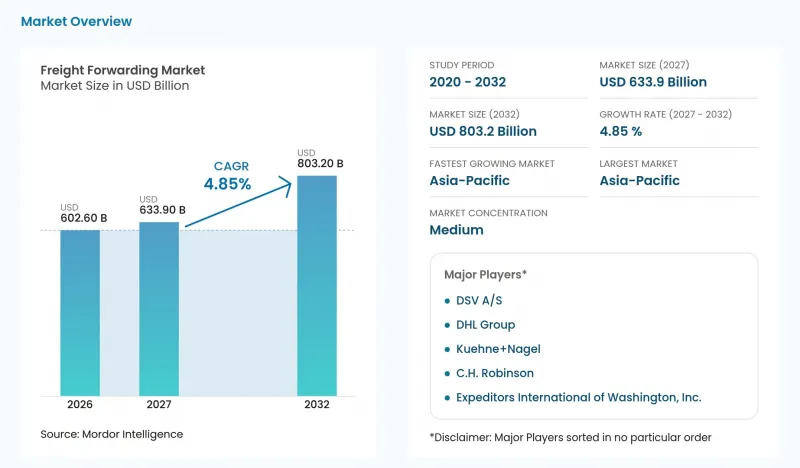
This report is segmented by Mode of Transport (Ocean Freight Forwarding and more), Enterprise Size (Large Enterprises and more), Forwarder Model (Traditional Asset-Light Forwarders and more), End-user Industry (Retail and E-commerce and more), and Geography (Asia-Pacific and more). The market forecasts are provided in terms of value (USD), based on availability.
Global Freight Forwarding Market Trends and Insights
Cross-Border E-Commerce Parcel Boom
Cross-border parcel growth creates a forwarding opportunity in combining numerous small consignments into manageable international movements. EU low-value imported consignments, which include most e-commerce consignments and some other imports, rose 26% in 2025 to close to 5.9 billion items. That expanding shipment population increases the potential workload for consolidation, documentation and handoffs even when individual merchandise values are low. For merchants, a forwarding service that coordinates those steps can make fragmented international orders easier to serve.
End-to-End Shipment-Visibility Adoption
Shipment visibility gives forwarders a service layer beyond arranging physical transport, provided shipment signals become usable customer information. In November 2025, Kuehne+Nagel reported that its Road Customer Visibility platform used a global network of more than 100 million network-enabled devices built with Chorusview. The platform transmitted smart-label and sensor data to the cloud for artificial intelligence to produce shipment insights. This combination can connect physical shipment information with a forwarder's customer service, making the information useful beyond an isolated location update. Because the reader network lets the road-forwarding service include AI-processed shipment insights, a shipper choosing a road forwarder can compare offers on the information delivered with the movement and not only on the haul price.
Port Congestion and Container Imbalances
Port congestion constrains forwarding when available vessel capacity cannot be deployed reliably enough to meet a shipper's movement requirements. UNCTAD reported that increased container cargo flows in 2025 strained port operations, increasing turnaround times and delays and reducing effective vessel supply and reliability. The cargo-flow increase included China-to-United States movements. For forwarders arranging those movements, delays at the port interface can undermine a service commitment even when a sailing has been booked. This creates a timing constraint across the shipment rather than simply a shortage of nominal vessel space.
Other drivers and restraints analyzed in the detailed report include:
- Near-Shoring and "China-Plus-One" Trade Shifts
- Cold-Chain Investment for Pharma and Food
- Global Driver and Warehouse-Labor Shortage
For complete list of drivers and restraints, kindly check the Table Of Contents.
Segment Analysis
Ocean freight forwarding accounted for a 61.78% share of the freight forwarding market size in 2026. DHL estimated global ocean-freight export volume in the portion controlled by forwarders at 69 million TEUs in 2025. The largest segment's container scale can support consolidation and routing services, with forwarders coordinating a broad pool of containerized export requirements.
Multimodal and intermodal forwarding is the fastest-growing segment, with a forecast CAGR of 6.05% over 2027-2032. In September 2025, CMA CGM Group announced its acquisition of UK intermodal rail freight operator Freightliner Ltd to strengthen its integrated, low-carbon intermodal offering. Freightliner retained operational autonomy as a multi-customer operator under the announced arrangement. Such arrangements can connect rail capabilities with a wider logistics offer while preserving access for customers beyond the acquiring group. The forwarding opportunity is to coordinate the interfaces between modes as a single service, while the underlying transport operators retain distinct operating roles.
Large enterprises represented a 68.1% freight forwarding market share in 2026. Amazon India announced 12 new fulfillment centers and the expansion of 6 others in August 2025, representing 8.6 million cubic feet of additional storage capacity. Logistics-industry partners were to operate and manage the new sites. Such multi-site programs can create a potential need to align international goods movements with several fulfillment locations, giving forwarders a program-wide coordination task. A shipment serving this kind of customer must fit the larger distribution footprint, making the integration of individual movements part of the service proposition.
Small and medium enterprises are the fastest-growing segment, with a forecast CAGR of 6.2% over 2027-2032. The share of UK SME employers directly importing goods or services rose to 24% in 2025 from 23% in 2024. Among goods-importing firms in that population, a shipment-specific forwarding offer can connect cross-border transport and clearance responsibilities without requiring a program covering multiple distribution locations.
Complete Report Scope:
- By Mode of Transport
- Ocean Freight Forwarding
- Full Container Load (FCL)
- Less-Than-Container Load (LCL)
- Road Freight Forwarding
- Full Truck Load (FTL)
- Less-Than-Truck Load (LTL)
- Air Freight Forwarding
- Rail Freight Forwarding
- Multimodal and Intermodal Forwarding
- Ocean Freight Forwarding
- By Enterprise Size
- Small and Medium Enterprises
- Large Enterprises
- By Forwarder Model
- Traditional Asset-Light Forwarders
- Digital-First / Online Platforms
- Hybrid Asset-Enabled Forwarders
- By End-user Industry
- Industrial and Manufacturing
- Retail and E-commerce
- Healthcare and Pharmaceuticals
- Oil, Gas and Energy
- Food and Beverages
- Automotive
- Chemicals
- Other End-users
- By Geography
- North America
- United States
- Canada
- Mexico
- South America
- Brazil
- Argentina
- Chile
- Rest of South America
- Europe
- Germany
- United Kingdom
- France
- Spain
- Italy
- Netherlands
- Russia
- Rest of Europe
- Asia-Pacific
- China
- India
- Japan
- South Korea
- Singapore
- Vietnam
- Indonesia
- Australia
- Rest of Asia-Pacific
- Middle East and Africa
- Saudi Arabia
- United Arab Emirates
- Turkey
- South Africa
- Nigeria
- Egypt
- Rest of Middle East and Africa
- North America
Geography Analysis
Asia-Pacific accounted for a 37.4% share of the freight forwarding market size in 2026 and is forecast to grow fastest at a CAGR of 7.4% over 2027-2032. Vietnam's airports handled approximately 1.8 million metric tons of cargo in 2025, a record, with international cargo comprising 74.7% of throughput. Airlines registered in Asia-Pacific also recorded 4.3% year-over-year growth in air-cargo demand, measured in metric ton-kilometers, in August 2026. Vietnam's record throughput and international cargo mix give forwarders a regional growth opening in connecting local airport execution with cross-border capacity.
In North America, Canada's export value to destinations outside the United States rose 16% in 2025, increasing freight demand through Canadian ports and airports. Demand for Canadian commodities and resources supported overseas growth, shifting reliance toward maritime, rail and air gateways. South America offers a different road-based opportunity, with Brazilian road-export value to the region totaling USD 22.6 billion in 2025. Industrialized and higher-value goods supported that regional road trade, making cross-border road execution relevant to the cargo mix. The commercial specialties diverge accordingly, with overseas gateway integration in Canada and regional industrial-goods routing from Brazil serving different movement requirements.
In Europe, international transport accounted for 24.4% of the EU's 2025 road-freight activity, measured in metric ton-kilometers and carried by EU-registered vehicles. That cross-border component offers forwarders a service base for coordinating road movements between national networks, with the opportunity centered on execution across borders. In the Middle East and Africa, DP World launched a shipping service from Jebel Ali in the United Arab Emirates to Berbera in Somaliland in October 2025. The announced service included scheduled calls at Aden and Djibouti, with cargo able to connect onward from Berbera toward Ethiopia. That inland option gives forwarders a basis for developing Ethiopia-bound itineraries through an additional maritime gateway, expanding the routing choices available to those shippers.
- A.P. Moller - Maersk
- C.H. Robinson
- CIMC Wetrans Logistics
- CMA CGM Group (including CEVA Logistics)
- DACHSER
- DHL Group
- DSV A/S
- Expeditors International of Washington, Inc.
- FedEx
- GEODIS
- Hellmann Worldwide Logistics
- KLN Logistics Group, Ltd.
- Kintetsu World Express
- Kuehne+Nagel
- Lineage, Inc.
- LX Pantos
- Nippon Express Co., Ltd.
- Rhenus Logistics
- Sinotrans, Ltd.
- Toll Group
- Uber Freight LLC
- UPS Supply Chain Solutions, Inc.
- XPO, Inc.
- Yusen Logistics Co., Ltd.
Additional Benefits:
- The market estimate (ME) sheet in Excel format
- 3 months of analyst support
TABLE OF CONTENTS
1 INTRODUCTION
- 1.1 Study Assumptions and Market Definition
- 1.2 Scope of the Study
2 RESEARCH METHODOLOGY
3 EXECUTIVE SUMMARY
4 MARKET LANDSCAPE
- 4.1 Market Overview
- 4.2 Market Drivers
- 4.2.1 Cross-Border E-Commerce Parcel Boom
- 4.2.2 End-to-End Shipment-Visibility Adoption
- 4.2.3 Near-Shoring and "China-Plus-One" Trade Shifts
- 4.2.4 Cold-Chain Investment for Pharma and Food
- 4.2.5 Shipper ESG Targets and Carbon-Pricing Demand
- 4.2.6 Generative-AI Dynamic Load-Matching
- 4.3 Market Restraints
- 4.3.1 Port Congestion and Container Imbalances
- 4.3.2 Global Driver and Warehouse-Labor Shortage
- 4.3.3 Geopolitical Flashpoints and Route Risk
- 4.3.4 Tightening De-Minimis Thresholds and Compliance Burden
- 4.4 Industry Value Chain Analysis
- 4.5 Regulatory Landscape
- 4.6 Technological Outlook
- 4.7 Porter's Five Forces Analysis
- 4.7.1 Threat of New Entrants
- 4.7.2 Bargaining Power of Suppliers
- 4.7.3 Bargaining Power of Buyers
- 4.7.4 Threat of Substitutes
- 4.7.5 Competitive Rivalry
- 4.8 Pricing Analysis
- 4.9 Impact of Geopolitical Events
5 MARKET SIZE AND GROWTH FORECASTS (VALUE)
- 5.1 By Mode of Transport
- 5.1.1 Ocean Freight Forwarding
- 5.1.1.1 Full Container Load (FCL)
- 5.1.1.2 Less-Than-Container Load (LCL)
- 5.1.2 Road Freight Forwarding
- 5.1.2.1 Full Truck Load (FTL)
- 5.1.2.2 Less-Than-Truck Load (LTL)
- 5.1.3 Air Freight Forwarding
- 5.1.4 Rail Freight Forwarding
- 5.1.5 Multimodal and Intermodal Forwarding
- 5.1.1 Ocean Freight Forwarding
- 5.2 By Enterprise Size
- 5.2.1 Small and Medium Enterprises
- 5.2.2 Large Enterprises
- 5.3 By Forwarder Model
- 5.3.1 Traditional Asset-Light Forwarders
- 5.3.2 Digital-First / Online Platforms
- 5.3.3 Hybrid Asset-Enabled Forwarders
- 5.4 By End-user Industry
- 5.4.1 Industrial and Manufacturing
- 5.4.2 Retail and E-commerce
- 5.4.3 Healthcare and Pharmaceuticals
- 5.4.4 Oil, Gas and Energy
- 5.4.5 Food and Beverages
- 5.4.6 Automotive
- 5.4.7 Chemicals
- 5.4.8 Other End-users
- 5.5 By Geography
- 5.5.1 North America
- 5.5.1.1 United States
- 5.5.1.2 Canada
- 5.5.1.3 Mexico
- 5.5.2 South America
- 5.5.2.1 Brazil
- 5.5.2.2 Argentina
- 5.5.2.3 Chile
- 5.5.2.4 Rest of South America
- 5.5.3 Europe
- 5.5.3.1 Germany
- 5.5.3.2 United Kingdom
- 5.5.3.3 France
- 5.5.3.4 Spain
- 5.5.3.5 Italy
- 5.5.3.6 Netherlands
- 5.5.3.7 Russia
- 5.5.3.8 Rest of Europe
- 5.5.4 Asia-Pacific
- 5.5.4.1 China
- 5.5.4.2 India
- 5.5.4.3 Japan
- 5.5.4.4 South Korea
- 5.5.4.5 Singapore
- 5.5.4.6 Vietnam
- 5.5.4.7 Indonesia
- 5.5.4.8 Australia
- 5.5.4.9 Rest of Asia-Pacific
- 5.5.5 Middle East and Africa
- 5.5.5.1 Saudi Arabia
- 5.5.5.2 United Arab Emirates
- 5.5.5.3 Turkey
- 5.5.5.4 South Africa
- 5.5.5.5 Nigeria
- 5.5.5.6 Egypt
- 5.5.5.7 Rest of Middle East and Africa
- 5.5.1 North America
6 COMPETITIVE LANDSCAPE
- 6.1 Market Concentration
- 6.2 Strategic Moves
- 6.3 Market Share Analysis
- 6.4 Company Profiles (includes Global level Overview, Market level overview, Core Segments, Financials as available, Strategic Information, Market Rank/Share for key companies, Products and Services, and Recent Developments)
- 6.4.1 A.P. Moller - Maersk
- 6.4.2 C.H. Robinson
- 6.4.3 CIMC Wetrans Logistics
- 6.4.4 CMA CGM Group (including CEVA Logistics)
- 6.4.5 DACHSER
- 6.4.6 DHL Group
- 6.4.7 DSV A/S
- 6.4.8 Expeditors International of Washington, Inc.
- 6.4.9 FedEx
- 6.4.10 GEODIS
- 6.4.11 Hellmann Worldwide Logistics
- 6.4.12 KLN Logistics Group, Ltd.
- 6.4.13 Kintetsu World Express
- 6.4.14 Kuehne+Nagel
- 6.4.15 Lineage, Inc.
- 6.4.16 LX Pantos
- 6.4.17 Nippon Express Co., Ltd.
- 6.4.18 Rhenus Logistics
- 6.4.19 Sinotrans, Ltd.
- 6.4.20 Toll Group
- 6.4.21 Uber Freight LLC
- 6.4.22 UPS Supply Chain Solutions, Inc.
- 6.4.23 XPO, Inc.
- 6.4.24 Yusen Logistics Co., Ltd.
7 MARKET OPPORTUNITIES AND FUTURE OUTLOOK
- 7.1 White-Space and Unmet-Need Assessment

