PUBLISHER: Mordor Intelligence | PRODUCT CODE: 2157073

PUBLISHER: Mordor Intelligence | PRODUCT CODE: 2157073
Indonesia Freight Forwarding - Market Share Analysis, Industry Trends & Statistics, Growth Forecasts (2026 - 2031)
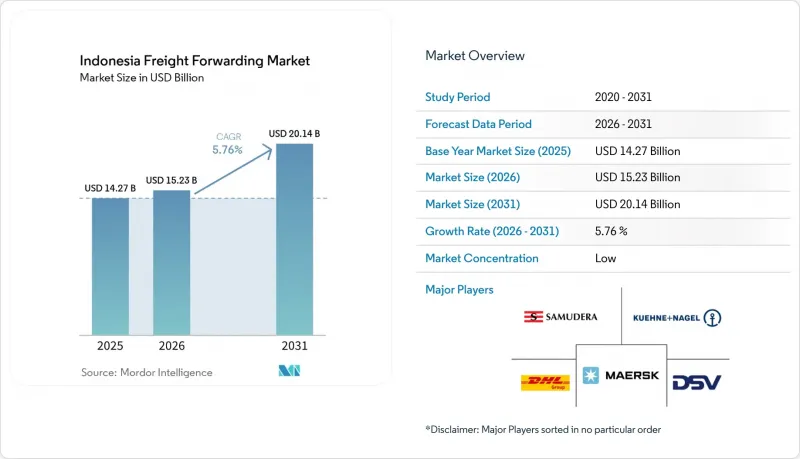
According to Mordor Intelligence, the Indonesia freight forwarding market size was valued at USD 14.27 billion in 2025, and is estimated to grow from USD 15.23 billion in 2026 to reach USD 20.14 billion by 2031, at a CAGR of 5.76% during the forecast period (2026-2031).
Indonesia Freight Forwarding Market Trends and Insights
Expansion of Export-Oriented Manufacturing and Specialized Cargo
Indonesia's downstreaming policy is shifting nickel, copper, and bauxite processing closer to source locations, increasing international shipments of semi-finished goods, industrial equipment, and related documentation. Manufacturing exports reached USD 75.57 billion in April 2026, with China, the United States, and India as important destinations, supporting demand for freight forwarders that coordinate supplier documents, origin certificates, and handling requirements. Smelter and refinery construction also creates project logistics demand for oversized equipment requiring breakbulk and heavy-lift capabilities. In contrast, healthcare, chemical, and EV cargo require dangerous goods handling, temperature control, compliant records, and timed delivery. Rising just-in-time manufacturing and EV component sequencing further increase service requirements, creating opportunities for providers with specialized capabilities beyond standard container brokerage.
Cross-Border E-Commerce and Consumer-Goods Imports
Smaller parcels are shifting freight mixes toward lower average shipment weights, increasing demand for consolidation, less-than-container-load, and air cargo services. The Indonesia freight forwarding market benefits as e-commerce sellers require frequent dispatches, while domestic fulfillment connects customs-controlled locations with local delivery networks. This favors providers offering integrated forwarding, storage, customs processing, and delivery handoffs, although competition is increasing from marketplaces developing in-house logistics capabilities. Demand extends beyond Java and Sumatra to markets such as Sulawesi and Bali. At the same time, digital quotation and automated documentation can improve access for smaller importers and simplify high-volume, low-value shipments. However, lower revenue per parcel requires efficient consolidation, predictable handoffs, and transparent pricing, making international-to-domestic fulfillment integration important for protecting shipment value.
Port Congestion and Customs Complexity
Tanjung Priok handles the majority of Indonesia's imports and around 40% of national container throughput, making congestion a key risk for the Indonesia freight forwarding market through longer vessel queues, higher yard occupancy, and greater demurrage exposure. During the March-April 2026 post-Eid peak, an Integrated Logistics Flow Control Command Center coordinated terminals, trucking firms, and public agencies, but new terminal capacity did not immediately address road access and truck-scheduling constraints, requiring forwarders to factor delays into transit times and cargo release planning. Customs clearance also requires coordination across duty, excise, quarantine, BPOM, and sector-specific licensing, with manual processes increasing documentation risks. The KBLI 2025 revision is being contested by around 600 freight-forwarding and logistics companies through ALFI, creating uncertainty for integrated service models and related investments. Providers with pre-arrival document checks and strong regulatory capabilities can reduce clearance delays and penalty risks.
Other drivers and restraints analyzed in the detailed report include:
- Port, Airport, Corridor Modernization and Digitalization
- Inter-Island Consolidation and Secondary Economic Hubs
- Network Imbalance and Uneven System Interoperability
For complete list of drivers and restraints, kindly check the Table Of Contents.
Segment Analysis
Ocean freight forwarding held 72.86% of the Indonesia freight forwarding market share in 2025, while air freight forwarding is forecast to expand at a 7.98% CAGR through 2031. The ocean freight serves containerized commodities, semi-processed products, and manufactured goods that need cost-effective long-distance transport. Full-container-load services support large shippers with regular export contracts in palm oil, coal, nickel products, garments, and related categories. Less-than-container-load movements serve suppliers that need more flexible dispatch timing and cannot fill a full container. Road forwarding connects factories, warehouses, and terminals across Java and the trans-Sumatra corridor. These first-mile and last-mile functions remain essential even when the main shipment moves by sea.
The Indonesia freight forwarding market size for air freight forwarding benefits from higher-value and time-sensitive cargo such as semiconductor components, pharmaceuticals, and fashion goods. Air services can meet short transit requirements that ocean movements cannot support. DHL Express opened an upgraded Surabaya Gateway in December 2025 and is expanding capacity at Jakarta Gateway. Rail forwarding remains limited because the freight network is concentrated on Java and faces gauge and capacity constraints. Sea-road intermodal options are becoming more relevant for palletized agricultural and fast-moving consumer goods between production areas and Java distribution centers. International Air Transport Association dangerous-goods and pharmaceutical standards are increasingly used by multinational shippers when selecting compliant air cargo services.
Large enterprises held 68.43% of the Indonesia freight forwarding market size in 2025, while small and medium enterprises are forecast to register at a 9.56% CAGR through 2031. Key customers include multinational manufacturers, state-owned energy companies, and large retailers that typically operate through preferred-carrier agreements. Their recurring shipment volumes support forwarders' investments in gateways, warehousing facilities, and licensed brokerage capabilities, while strengthening negotiating power with carriers. Large customers also prioritize reliable capacity, regulatory compliance, and service continuity, supporting the role of established operators in Indonesia's freight forwarding industry.
Online quotation, electronic bills of lading, and digital customs filing reduce the practical entry threshold for smaller exporters. Food processors, handicraft producers, electronics suppliers, and specialty chemical firms can access international freight services with smaller shipment sizes. These customers often require tracking, flexible consolidation schedules, and help with duty documentation. DSV completed its integration of DB Schenker into PT DSV Transport Indonesia in May 2026, expanding the combined company's local service coverage. This broader coverage may extend enterprise-grade service options to mid-market accounts. Import licensing requirements still favor established and licensed providers over informal brokers for regulated goods.
Complete Report Scope:
- By Mode of Transport
- Ocean Freight Forwarding
- Full Container Load (FCL)
- Less-Than-Container Load (LCL)
- Road Freight Forwarding
- Full Truck Load (FTL)
- Less-Than-Truck Load (LTL)
- Air Freight Forwarding
- Rail Freight Forwarding
- Multimodal and Intermodal Forwarding
- Ocean Freight Forwarding
- By Enterprise Size
- Small and Medium Enterprises
- Large Enterprises
- By Forwarder Model
- Traditional Asset-Light Forwarders
- Digital-First / Online Platforms
- Hybrid Asset-Enabled Forwarders
- By End-User Industry
- Industrial and Manufacturing
- Retail and E-commerce
- Healthcare and Pharmaceuticals
- Oil, Gas and Energy
- Food and Beverages
- Automotive
- Chemicals
- Other End-Users
- By Cargo Configuration
- Containerized Cargo
- Breakbulk and Project Cargo
- Dry Bulk Cargo
- Liquid Bulk Cargo
- By Region
- Java (Jakarta and BOD)
- Sumatra
- Kalimantan
- Sulawesi
- Bali and Nusa Tenggara
- Papua Region and Maluku Islands
List of Companies Covered in this Report:
- DHL Group
- DSV A/S
- Kuehne+Nagel
- A.P. Moller - Maersk
- CEVA Logistics (CMA CGM Group)
- NX Group / PT NX Lemo Indonesia Logistik
- Expeditors International
- GEODIS
- Yusen Logistics
- DP World
- KLN Logistics Group Limited
- Sinotrans Limited
- CJ Logistics
- PT Samudera Indonesia Tbk
- Meratus Group
- PT Cipta Krida Bahari (CKB Logistics)
- PT Kamadjaja Logistics
- PT Puninar Logistics
- PT Kintetsu World Express Indonesia (KWE)
- PT Multi Terminal Indonesia (MTI)
- JNE Freight / PT Tiki Jalur Nugraha Ekakurir
- Rhenus Logistics
Additional Benefits:
- The market estimate (ME) sheet in Excel format
- 3 months of analyst support
TABLE OF CONTENTS
1 INTRODUCTION
- 1.1 Study Assumptions and Market Definition
- 1.2 Scope of the Study
2 RESEARCH METHODOLOGY
3 EXECUTIVE SUMMARY
- 3.1 Market Size, Growth, and Forecast Outlook
- 3.2 Key Demand Drivers and Freight Forwarding Trends
- 3.3 Major Trade Corridors and Cargo Flow Concentration
- 3.4 Competitive Landscape and Leading Freight Forwarders
4 MARKET LANDSCAPE
- 4.1 Market Overview and Importance of Freight Forwarding
- 4.2 Market Drivers
- 4.2.1 Expansion of Export-Oriented Manufacturing
- 4.2.2 Cross-Border E-Commerce and Consumer-Goods Imports
- 4.2.3 Port, Airport and National Logistics-Corridor Modernization
- 4.2.4 National Logistics Ecosystem Digitalization
- 4.2.5 Specialized EV, Healthcare and Cold-Chain Cargo Flows
- 4.2.6 Inter-Island Consolidation Demand from Secondary Economic Hubs
- 4.3 Market Restraints
- 4.3.1 Port Congestion and Container-Yard Constraints
- 4.3.2 Customs Complexity and Documentation Risk
- 4.3.3 Inter-Island Network Imbalance and Empty-Container Repositioning
- 4.3.4 Uneven Digital-System Interoperability Across Logistics Stakeholders
- 4.4 Value Chain Structure and Freight Forwarding Flow Analysis
- 4.5 Freight Forwarding Regulatory and Customs Framework Analysis
- 4.6 Technology Adoption in Freight Forwarding Operations
- 4.7 Domestic and International Shipment Flow Pattern Analysis
- 4.8 Freight Rates and Forwarding Margin Structure Analysis
- 4.9 Major Port and Gateway Cargo Concentration Analysis
- 4.10 Porter's Five Forces Analysis
- 4.10.1 Threat of New Entrants
- 4.10.2 Bargaining Power of Buyers
- 4.10.3 Bargaining Power of Suppliers
- 4.10.4 Threat of Substitute Services
- 4.10.5 Intensity of Competitive Rivalry
- 4.11 Impact of Geo-Political Events on Supply Chain Shifts
5 MARKET SIZE AND GROWTH FORECASTS
- 5.1 By Mode of Transport
- 5.1.1 Ocean Freight Forwarding
- 5.1.1.1 Full Container Load (FCL)
- 5.1.1.2 Less-Than-Container Load (LCL)
- 5.1.2 Road Freight Forwarding
- 5.1.2.1 Full Truck Load (FTL)
- 5.1.2.2 Less-Than-Truck Load (LTL)
- 5.1.3 Air Freight Forwarding
- 5.1.4 Rail Freight Forwarding
- 5.1.5 Multimodal and Intermodal Forwarding
- 5.1.1 Ocean Freight Forwarding
- 5.2 By Enterprise Size
- 5.2.1 Small and Medium Enterprises
- 5.2.2 Large Enterprises
- 5.3 By Forwarder Model
- 5.3.1 Traditional Asset-Light Forwarders
- 5.3.2 Digital-First / Online Platforms
- 5.3.3 Hybrid Asset-Enabled Forwarders
- 5.4 By End-User Industry
- 5.4.1 Industrial and Manufacturing
- 5.4.2 Retail and E-commerce
- 5.4.3 Healthcare and Pharmaceuticals
- 5.4.4 Oil, Gas and Energy
- 5.4.5 Food and Beverages
- 5.4.6 Automotive
- 5.4.7 Chemicals
- 5.4.8 Other End-Users
- 5.5 By Cargo Configuration
- 5.5.1 Containerized Cargo
- 5.5.2 Breakbulk and Project Cargo
- 5.5.3 Dry Bulk Cargo
- 5.5.4 Liquid Bulk Cargo
- 5.6 By Region
- 5.6.1 Java (Jakarta and BOD)
- 5.6.2 Sumatra
- 5.6.3 Kalimantan
- 5.6.4 Sulawesi
- 5.6.5 Bali and Nusa Tenggara
- 5.6.6 Papua Region and Maluku Islands
6 COMPETITIVE LANDSCAPE
- 6.1 Market Concentration
- 6.2 Strategic Moves
- 6.3 Market Share Analysis
- 6.4 Company Profiles (includes Global Level Overview, Market Level Overview, Core Segments, Financials as available, Strategic Information, Geographic Coverage, Products and Services, Recent Developments)
- 6.4.1 DHL Group
- 6.4.2 DSV A/S
- 6.4.3 Kuehne+Nagel
- 6.4.4 A.P. Moller - Maersk
- 6.4.5 CEVA Logistics (CMA CGM Group)
- 6.4.6 NX Group / PT NX Lemo Indonesia Logistik
- 6.4.7 Expeditors International
- 6.4.8 GEODIS
- 6.4.9 Yusen Logistics
- 6.4.10 DP World
- 6.4.11 KLN Logistics Group Limited
- 6.4.12 Sinotrans Limited
- 6.4.13 CJ Logistics
- 6.4.14 PT Samudera Indonesia Tbk
- 6.4.15 Meratus Group
- 6.4.16 PT Cipta Krida Bahari (CKB Logistics)
- 6.4.17 PT Kamadjaja Logistics
- 6.4.18 PT Puninar Logistics
- 6.4.19 PT Kintetsu World Express Indonesia (KWE)
- 6.4.20 PT Multi Terminal Indonesia (MTI)
- 6.4.21 JNE Freight / PT Tiki Jalur Nugraha Ekakurir
- 6.4.22 Rhenus Logistics
7 MARKET OPPORTUNITIES AND FUTURE OUTLOOK
- 7.1 White-Space Opportunities and Unmet Freight Forwarding Needs
- 7.2 High-Potential Cargo Segments and Trade Growth Opportunities
- 7.3 Strategic Growth Priorities Across Freight Forwarding Ecosystem
- 7.4 Future Market Outlook and Emerging Trade Demand Pockets
8 APPENDIX

