PUBLISHER: Mordor Intelligence | PRODUCT CODE: 2187359

PUBLISHER: Mordor Intelligence | PRODUCT CODE: 2187359
United States Pet - Market Share Analysis, Industry Trends & Statistics, Growth Forecasts (2027 - 2032)
According to Mordor Intelligence, the United States pet market size was valued at USD 165.6 billion in 2026 and estimated to grow from USD 176.5 billion in 2027 to reach USD 235.1 billion by 2032, at a CAGR of 5.9% during the forecast period (2027-2032).
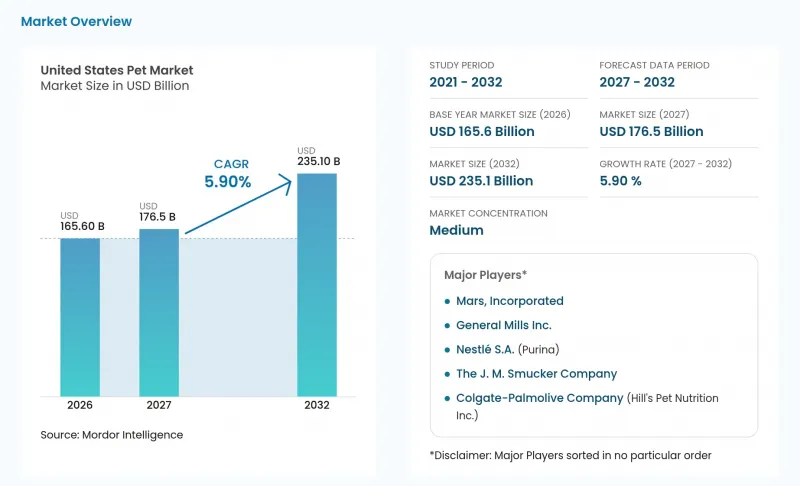
This report is segmented by Pet Type (Dog, Cat, and Other Pets), Product Type (Food, Supplies, and Services), and Distribution Channel (Online Retailers, Pet Specialty Stores, Mass Merchandisers / Club, Supermarkets / Hypermarkets, Veterinary Clinics, and Direct-to-Consumer Brands). The market forecasts are provided in terms of value (USD), based on availability.
United States Pet Market Trends and Insights
Humanization-Driven Premium Spend
Feeding personalization gives pet-food manufacturers more than one way to build a differentiated relationship with dog owners. The American Pet Products Association (APPA) reported that 19% of US dog owners purchased human-grade food in 2025. Its 2025 survey also found that Generation Z dog owners increasingly embraced mixers and toppers to customize meals and add variety. Human-grade food provides a differentiated main-diet offer, while mixers and toppers can add a separate purchase to the base diet. Because an add-on can be sold to households already buying another brand's main food, humanization can lift revenue per feeding occasion without requiring a switch of the primary diet.
Accelerating E-commerce and Omnichannel Penetration
Pet retailers can expand digital reach while retaining a role for stores in the same customer relationship. APPA's survey of 9,221 owners in October 2025 found that 53% of American pet owners shopped online, the highest share in 4 years. NielsenIQ data showed that 65.2% of US pet-care buyers shopped both in-store and online in 2025, with that share rising 6.6% year over year. This overlap makes channel exclusivity a less useful commercial premise than the ability to serve a buyer across formats. Online ordering can support product replenishment while a physical presence offers a separate point of contact. Digital expansion can consequently reinforce a store-supported service relationship rather than require the customer to abandon stores.
Inflation-Driven Trade-Down to Value Brands
Price pressure can constrain premium revenue even when owners preserve some higher-priced food in the bowl. APPA's 2025 survey found that US dog owners blended premium dog food with budget-friendly choices to stretch spending. Premium food remained the most commonly fed option. The Association for Pet Obesity Prevention's 2025 survey found that 40% of owners reported cost-related changes, including food-brand switching, fewer veterinary visits, reduced treats and limits on therapeutic diets. Together, these behaviors expose suppliers to substitution within feeding routines and providers to fewer paid care occasions. The remaining commercial constraint is a ceiling on spending intensity, with premium food brands and veterinary providers competing for a household's limited discretionary dollars.
Other drivers and restraints analyzed in the detailed report include:
- Rising Pet-Insurance Adoption
- Employer-Sponsored Pet-Care Benefits Expansion
- Veterinary Workforce Shortage
For complete list of drivers and restraints, kindly check the Table Of Contents.
Segment Analysis
Dogs accounted for a 59.7% share of the United States pet market size in 2026. APPA reported 71 million US dog-owning households in 2025, illustrating the large consumer base behind the largest segment. That ownership base expanded by about 4 million households between 2024 and 2025. An expanding household population gives food and care suppliers a route to additional demand alongside purchases from their established customer base. Growth can consequently come from wider ownership reach, reducing the need to rely exclusively on higher spending by each existing dog-owning household.
Cats are forecast to be the fastest-growing pet-type segment, at a 7.3% CAGR during 2027-2032. APPA reported 53 million US cat-owning households in 2025, up 5% from 2024. Nestle said US wet cat food led its PetCare growth in 2025, helped by new capacity in the fourth quarter after supply constraints affected most of the year. The combination of an expanding ownership base and format-specific supply investment creates a commercial case for cat-specific nutrition offers with production capacity suited to the food format. Wet-food suppliers can capture that opportunity only when manufacturing availability keeps pace with the buyer base, making execution as consequential as product positioning.
Complete Report Scope:
- By Pet Type
- Dog
- Cat
- Other Pets
- By Product Type
- Food
- Dry Kibble
- Wet / Canned
- Fresh / Frozen
- Treats and Chews
- Supplements
- Supplies
- Grooming and Hygiene
- Toys and Enrichment
- Bedding and Habitat
- Other Supplies
- Services
- Veterinary Care
- Insurance
- Boarding and Day-care
- Training and Behavior
- Food
- By Distribution Channel
- Supermarkets / Hypermarkets
- Mass Merchandisers / Club
- Pet Specialty Stores
- Veterinary Clinics
- Online Retailers
- Direct-to-Consumer Brands
List of Companies Covered in this Report:
- Mars, Incorporated
- Nestle S.A. (Purina)
- Colgate-Palmolive Company (Hill's Pet Nutrition Inc.)
- The J. M. Smucker Company
- General Mills Inc.
- Spectrum Brands, Inc.
- BC Partners
- Petco Animal Supplies, Inc.
- Elanco Animal Health Inc.
- Freshpet Inc.
- Zoetis Inc.
- Trupanion
- Central Garden & Pet Company
- Bark, Inc.
- The Farmer's Dog, Inc.
Additional Benefits:
- The market estimate (ME) sheet in Excel format
- 3 months of analyst support
TABLE OF CONTENTS
1 INTRODUCTION
- 1.1 Study Assumptions and Market Definition
- 1.2 Scope of the Study
2 RESEARCH METHODOLOGY
3 EXECUTIVE SUMMARY
4 MARKET LANDSCAPE
- 4.1 Market Overview
- 4.2 Market Drivers
- 4.2.1 Humanization-Driven Premium Spend
- 4.2.2 Accelerating E-commerce and Omnichannel Penetration
- 4.2.3 Rising Pet-Insurance Adoption
- 4.2.4 Employer-Sponsored Pet-Care Benefits Expansion
- 4.2.5 FDA Efforts to Expedite Review of Novel Therapeutics
- 4.2.6 Climate-Resilient Novel Protein Sourcing
- 4.3 Market Restraints
- 4.3.1 Inflation-Driven Trade-Down to Value Brands
- 4.3.2 Veterinary Workforce Shortage
- 4.3.3 Extended Producer-Responsibility Packaging Fees
- 4.3.4 Social-Media Trend Volatility and Inventory Risk
- 4.4 Industry Value Chain Analysis
- 4.5 Regulatory Landscape
- 4.6 Technological Outlook
- 4.7 Porter's Five Forces Analysis
- 4.7.1 Threat of New Entrants
- 4.7.2 Bargaining Power of Suppliers
- 4.7.3 Bargaining Power of Buyers
- 4.7.4 Threat of Substitutes
- 4.7.5 Competitive Rivalry
5 MARKET SIZE AND GROWTH FORECASTS (VALUE)
- 5.1 By Pet Type
- 5.1.1 Dog
- 5.1.2 Cat
- 5.1.3 Other Pets
- 5.2 By Product Type
- 5.2.1 Food
- 5.2.1.1 Dry Kibble
- 5.2.1.2 Wet / Canned
- 5.2.1.3 Fresh / Frozen
- 5.2.1.4 Treats and Chews
- 5.2.1.5 Supplements
- 5.2.2 Supplies
- 5.2.2.1 Grooming and Hygiene
- 5.2.2.2 Toys and Enrichment
- 5.2.2.3 Bedding and Habitat
- 5.2.2.4 Other Supplies
- 5.2.3 Services
- 5.2.3.1 Veterinary Care
- 5.2.3.2 Insurance
- 5.2.3.3 Boarding and Day-care
- 5.2.3.4 Training and Behavior
- 5.2.1 Food
- 5.3 By Distribution Channel
- 5.3.1 Supermarkets / Hypermarkets
- 5.3.2 Mass Merchandisers / Club
- 5.3.3 Pet Specialty Stores
- 5.3.4 Veterinary Clinics
- 5.3.5 Online Retailers
- 5.3.6 Direct-to-Consumer Brands
6 COMPETITIVE LANDSCAPE
- 6.1 Market Concentration
- 6.2 Strategic Moves
- 6.3 Market Share Analysis
- 6.4 Company Profiles (includes Global level Overview, Market level overview, Core Segments, Financials as available, Strategic Information, Market Rank/Share for key companies, Products and Services, and Recent Developments)
- 6.4.1 Mars, Incorporated
- 6.4.2 Nestle S.A. (Purina)
- 6.4.3 Colgate-Palmolive Company (Hill's Pet Nutrition Inc.)
- 6.4.4 The J. M. Smucker Company
- 6.4.5 General Mills Inc.
- 6.4.6 Spectrum Brands, Inc.
- 6.4.7 BC Partners
- 6.4.8 Petco Animal Supplies, Inc.
- 6.4.9 Elanco Animal Health Inc.
- 6.4.10 Freshpet Inc.
- 6.4.11 Zoetis Inc.
- 6.4.12 Trupanion
- 6.4.13 Central Garden & Pet Company
- 6.4.14 Bark, Inc.
- 6.4.15 The Farmer's Dog, Inc.
7 MARKET OPPORTUNITIES AND FUTURE OUTLOOK
- 7.1 White-Space and Unmet-Need Assessment

