PUBLISHER: Mordor Intelligence | PRODUCT CODE: 2187375

PUBLISHER: Mordor Intelligence | PRODUCT CODE: 2187375
Pyrolysis Oil - Market Share Analysis, Industry Trends & Statistics, Growth Forecasts (2027 - 2032)
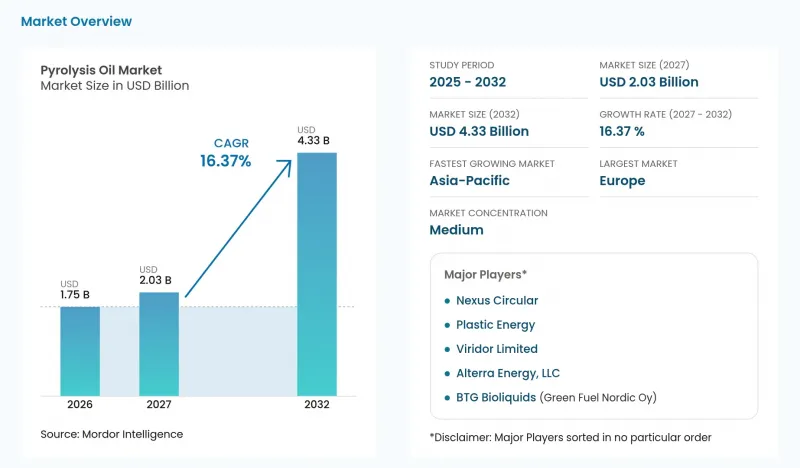
According to Mordor Intelligence, the pyrolysis oil market size is projected to expand from USD 1.75 billion in 2026 and USD 2.03 billion in 2027 to USD 4.33 billion by 2032, registering a CAGR of 16.37% between 2027 and 2032.
This report is segmented by Raw Material (Waste Plastics, Waste Tires, Others, and Biomass), Application (Fuels and Chemicals), and Geography (Europe, Asia-Pacific, North America, Middle-East and Africa, and South America). The market forecasts are provided in terms of value (USD), based on availability.
Global Pyrolysis Oil Market Trends and Insights
Rising demand for renewable and circular fuel substitutes
Fuel substitution creates a demand opportunity when renewable liquids can enter an established fuel application. The International Energy Agency expects global renewable energy use in transport to rise 50% from 2024 to 2030, across electricity, liquid biofuels, biogases, and renewable hydrogen-based fuels. Road biofuels contribute 35% of that projected growth, with significant growth forecast in Brazil, Indonesia, India, and Malaysia. For biomass-oil producers, the liquid-fuel component of this transition creates a potential downstream route whose value depends on acceptance by a specific fuel process. Matching output to that route can establish a buyer for the liquid before a producer commits capital to expanding its dedicated supply.
Stricter plastic-waste regulations and bans worldwide
Packaging requirements can create a durable reason to secure circular feedstock beyond voluntary substitution commitments. The EU's Packaging and Packaging Waste Regulation requires recycled plastic in new plastic packaging from 2030. Its phased application began on August 12, 2026, separating the broader framework from the later recycled-plastic requirement. For pyrolysis-oil suppliers targeting packaging chains, commercial value depends on buyers being able to count the resulting recycled plastic toward that obligation. This favors supply arrangements connecting oil conversion with qualifying packaging output rather than treating every outlet as equivalent. The intervening period gives oil producers a window to qualify a packaging conversion route before recycled content becomes compulsory in that application.
Corrosivity and instability during storage/transport
Storage conditions can limit how flexibly a biomass-oil producer moves output between production and delivery. IEA Bioenergy reported in 2025 that strongly acidic pyrolysis oil from wood or straw cannot be stored for long periods above 25°C because reactions change properties such as viscosity. The limitation depends on feedstock and process quality, and some plants produce oil usable as fuel after several months of storage. This variation makes the supplied oil's condition relevant to storage arrangements and shipment timing. A producer serving a distant fuel buyer may therefore face a tighter delivery window than reactor capacity alone suggests. Preserving a usable liquid between conversion and delivery can add handling costs and restrict scheduling flexibility.
Other drivers and restraints analyzed in the detailed report include:
- Rising chemical-recycling investment pipelines
- FCC / hydro-processing co-feeding can lower refinery CAPEX
- High CAPEX and scale-up execution risk
For complete list of drivers and restraints, kindly check the Table Of Contents.
Segment Analysis
Waste plastics accounted for a 59.26% share of the pyrolysis oil market size in 2026 and are projected to record a 17.08% CAGR between 2027 and 2032. TotalEnergies started production at its Grandpuits chemical plastics recycling plant in France in March 2026, with capacity to process 15,000 metric tons of plastic waste annually. The plant converts hard-to-recycle French household plastics into synthetic oil through pyrolysis, connecting a defined waste stream with an operating conversion asset. A producer following this model would need collection-system partners as well as conversion equipment, tying expansion to access to household waste streams.
Waste-plastic oil reached Shell Chemicals Europe B.V. through Trifol Resources Limited's first commercial shipment of approximately 50 metric tons from Tipperary, Ireland, in March 2025. The shipment formed part of an August 2024 supply agreement, with processing intended at Moerdijk, Netherlands. Waste tires supply BASF through Pyrum's conversion of end-of-life and scrap tires into oil used with fossil feedstocks for butadiene and styrene, under the European tire-to-tire initiative launched July 22, 2026. At Hengelo, Netherlands, the pyrolysis plant formerly operated by Empyro BV, whose acquisition Aurora Renewable Carbon announced on August 1, 2025, converts clean wood-waste biomass into fast-pyrolysis bio-oil and also generates process steam and electricity for internal use and adjacent industrial operations. Chemical offtake can anchor plastic-oil commercialization, while biomass projects can combine oil production with an industrial site's energy needs.
Complete Report Scope:
- By Raw Material
- Waste Plastics
- Waste Tires
- Biomass
- Others
- By Application
- Fuels
- Chemicals
- By Geography
- Asia-Pacific
- China
- India
- Japan
- South Korea
- Malaysia
- Thailand
- Indonesia
- Vietnam
- Rest of Asia-Pacific
- North America
- United States
- Canada
- Mexico
- Europe
- Germany
- United Kingdom
- France
- Italy
- Spain
- Nordic Countries
- Turkey
- Russia
- Rest of Europe
- South America
- Brazil
- Argentina
- Colombia
- Rest of South America
- Middle-East and Africa
- Saudi Arabia
- South Africa
- Nigeria
- Qatar
- Egypt
- United Arab Emirates
- Morocco
- Rest of Middle-East and Africa
- Asia-Pacific
Geography Analysis
Europe held a 33.44% share of the pyrolysis oil market size in 2026, making it the largest region. In April 2026, Vitol reported that its WPU facility in Farevejle, Denmark, had capacity to recycle 20,000 metric tons of plastic waste annually, was operating close to full capacity, and supplied customers. WPU converts end-of-life plastics through batch pyrolysis into oil used as petrochemical feedstock for recycled-plastics production. European materials buyers thus have an operating regional supply route linking plastic-waste conversion with petrochemical use, allowing sourcing from established conversion rather than depending entirely on future plant commissioning.
Asia-Pacific is the fastest-growing region, with a projected 18% CAGR between 2027 and 2032. Chemical Recycle Japan, an Idemitsu Kosan subsidiary, began commercial operation at its Ichihara oil-conversion facility in Chiba, Japan, on April 27, 2026, with capacity to process 20,000 metric tons of used plastics annually. The process uses the resulting recycled oil as raw material for chemical-recycling products, connecting used-plastics conversion with downstream chemical manufacturing. Expansion of this kind makes coordination between oil conversion and chemical processing central to growth, because new upstream capacity needs an outlet capable of using its liquid output.
North America has a refinery-delivery route illustrated by Freepoint Eco-Systems' first rail-car loading of waste-plastic pyrolysis oil in 2025 for Shell USA's Norco, Louisiana, refinery. Dispatch from Ohio connected a separate conversion facility with the intended refining recipient. In South America, Brazil's Vallourec Florestal unit supplied non-food biomass bio-oil in 2025, made by condensing vapors from eucalyptus charcoal production. In Middle-East and Africa, Mandini Group reported in 2026 that its Johannesburg tire-pyrolysis facility had operated continuously for 12 years and produced oil, steel wire, and carbon char. Oil expansion around a rail-served refinery would prioritize delivery links, while a tire-recovery operation would need outlets for several recovered products.
- Agilyx
- Alterra Energy, LLC
- Arbios Biotech
- Bioenergy AE Cote-Nord
- BTG Bioliquids (Green Fuel Nordic Oy)
- Kerry Group plc
- New Energy Kft.
- New Hope Energy
- Nexus Circular
- Plastic Energy
- Pyrocell (Setra)
- Scandinavian Enviro Systems AB
- Trident Fuels (Pty) Ltd
- Twence
- Viridor Limited
Additional Benefits:
- The market estimate (ME) sheet in Excel format
- 3 months of analyst support
TABLE OF CONTENTS
1 INTRODUCTION
- 1.1 Study Assumptions and Market Definition
- 1.2 Scope of the Study
2 RESEARCH METHODOLOGY
3 EXECUTIVE SUMMARY
4 MARKET LANDSCAPE
- 4.1 Market Overview
- 4.2 Market Drivers
- 4.2.1 Rising demand for renewable and circular fuel substitutes
- 4.2.2 Stricter plastic-waste regulations and bans worldwide
- 4.2.3 Rising chemical-recycling investment pipelines
- 4.2.4 FCC / hydro-processing co-feeding can lower refinery CAPEX
- 4.2.5 Carbon-credit monetization for low-carbon pyrolysis oil
- 4.3 Market Restraints
- 4.3.1 Corrosivity and instability during storage/transport
- 4.3.2 High CAPEX and scale-up execution risk
- 4.3.3 PAH/contaminant concerns triggering regulatory delays
- 4.4 Industry Value Chain Analysis
- 4.5 Regulatory Landscape
- 4.6 Technological Outlook
- 4.7 Porter's Five Forces Analysis
- 4.7.1 Threat of New Entrants
- 4.7.2 Bargaining Power of Suppliers
- 4.7.3 Bargaining Power of Buyers
- 4.7.4 Threat of Substitutes
- 4.7.5 Competitive Rivalry
5 MARKET SIZE AND GROWTH FORECASTS (VALUE)
- 5.1 By Raw Material
- 5.1.1 Waste Plastics
- 5.1.2 Waste Tires
- 5.1.3 Biomass
- 5.1.4 Others
- 5.2 By Application
- 5.2.1 Fuels
- 5.2.2 Chemicals
- 5.3 By Geography
- 5.3.1 Asia-Pacific
- 5.3.1.1 China
- 5.3.1.2 India
- 5.3.1.3 Japan
- 5.3.1.4 South Korea
- 5.3.1.5 Malaysia
- 5.3.1.6 Thailand
- 5.3.1.7 Indonesia
- 5.3.1.8 Vietnam
- 5.3.1.9 Rest of Asia-Pacific
- 5.3.2 North America
- 5.3.2.1 United States
- 5.3.2.2 Canada
- 5.3.2.3 Mexico
- 5.3.3 Europe
- 5.3.3.1 Germany
- 5.3.3.2 United Kingdom
- 5.3.3.3 France
- 5.3.3.4 Italy
- 5.3.3.5 Spain
- 5.3.3.6 Nordic Countries
- 5.3.3.7 Turkey
- 5.3.3.8 Russia
- 5.3.3.9 Rest of Europe
- 5.3.4 South America
- 5.3.4.1 Brazil
- 5.3.4.2 Argentina
- 5.3.4.3 Colombia
- 5.3.4.4 Rest of South America
- 5.3.5 Middle-East and Africa
- 5.3.5.1 Saudi Arabia
- 5.3.5.2 South Africa
- 5.3.5.3 Nigeria
- 5.3.5.4 Qatar
- 5.3.5.5 Egypt
- 5.3.5.6 United Arab Emirates
- 5.3.5.7 Morocco
- 5.3.5.8 Rest of Middle-East and Africa
- 5.3.1 Asia-Pacific
6 COMPETITIVE LANDSCAPE
- 6.1 Market Concentration
- 6.2 Strategic Moves
- 6.3 Market Share Analysis
- 6.4 Company Profiles (includes Global level Overview, Market level overview, Core Segments, Financials as available, Strategic Information, Market Rank/Share for key companies, Products and Services, and Recent Developments)
- 6.4.1 Agilyx
- 6.4.2 Alterra Energy, LLC
- 6.4.3 Arbios Biotech
- 6.4.4 Bioenergy AE Cote-Nord
- 6.4.5 BTG Bioliquids (Green Fuel Nordic Oy)
- 6.4.6 Kerry Group plc
- 6.4.7 New Energy Kft.
- 6.4.8 New Hope Energy
- 6.4.9 Nexus Circular
- 6.4.10 Plastic Energy
- 6.4.11 Pyrocell (Setra)
- 6.4.12 Scandinavian Enviro Systems AB
- 6.4.13 Trident Fuels (Pty) Ltd
- 6.4.14 Twence
- 6.4.15 Viridor Limited
7 MARKET OPPORTUNITIES AND FUTURE OUTLOOK
- 7.1 White-Space and Unmet-Need Assessment

