PUBLISHER: Mordor Intelligence | PRODUCT CODE: 2187384

PUBLISHER: Mordor Intelligence | PRODUCT CODE: 2187384
Malaysia Hospitality - Market Share Analysis, Industry Trends & Statistics, Growth Forecasts (2027 - 2032)
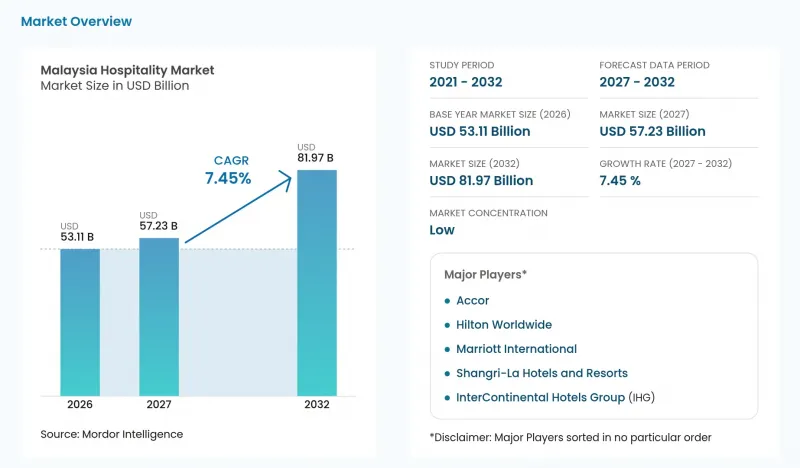
According to Mordor Intelligence, the Malaysia hospitality market size is projected to expand from USD 53.11 billion in 2026 and USD 57.23 billion in 2027 to USD 81.97 billion by 2032, registering a CAGR of 7.45% between 2027 and 2032.
This report is segmented by Type (Independent Hotels and Chain Hotels), Accommodation Class (Mid & Upper-Mid-scale, Budget & Economy, and more), Booking Channel (OTAs, Direct Digital, and more), and Geography (Central, Northern, and more). The market forecasts are provided in terms of value (USD), based on availability.
Malaysia Hospitality Market Trends and Insights
Post-COVID "Visit Malaysia 2026" tourism push
The tourism push gives accommodation operators a national demand-building framework atop an already substantial guest base. Tourism Malaysia launched Visit Malaysia 2026 on January 1, 2026, with welcoming ceremonies at 55 entry points and strategic locations across all 13 states. Malaysia's accommodation establishments recorded 104.4 million guests in 2025, up from 102.6 million in 2024, covering domestic and international guests. That breadth gives hotels scope to connect destination promotion with overnight itineraries for both resident and inbound travelers. International visitor arrivals reached 28.8 million from January to August 2026, up 1.8% from 28.2 million in the same period of 2025, a modest gain during the campaign's first 8 months.
Accelerated luxury pipeline in Kuala Lumpur & Penang
Luxury development can widen the premium accommodation offer when new properties serve distinct kinds of stays. Soori Penang opened in George Town on January 15, 2026, with a boutique luxury format centered on the city's cultural legacy. By June 28, 2026, Hilton had opened reservations for its 268-suite Waldorf Astoria Kuala Lumpur, which was scheduled to welcome guests on October 30, 2026. The George Town opening gives heritage-focused travelers an operating boutique option, while the capital's all-suite project provides a reservable option ahead of its scheduled opening.
Labor-cost inflation after 2025 minimum-wage hike
After the 2025 minimum-wage increase, higher staffing costs constrain the earnings hotels can retain from accommodation sales. In October 2024, the Malaysian Association of Hotels expected the increase effective February 1, 2025, to pressure hotel costs, including overtime on weekends, public holidays, and peak hours. Where employees are affected by the wage floor, maintaining the same staffing pattern creates a higher payroll requirement for the room business. In September 2026, MAH Sarawak chairman John Teo said minimum wages had raised hotel operating costs and hotels could not fully pass additional costs to consumers. If a property holds its nightly price constant, that additional wage expense leaves less revenue available for property upkeep or reinvestment. Sarawak operators cannot rely on price increases alone to preserve earnings against the reported wage burden.
Other drivers and restraints analyzed in the detailed report include:
- OTA dominance boosting room-night conversion
- Infrastructure roll-outs (RTS Link, ECRL) expected to unlock secondary cities
- Slow visa processing for emerging markets
For complete list of drivers and restraints, kindly check the Table Of Contents.
Segment Analysis
Independent hotels accounted for a 62.32% share of the Malaysia hospitality market size in 2026, making them the largest segment by type. In 2025, independently run Lloyd's Inn Kuala Lumpur offered 110 rooms across 10 room types in Imbi. That range gives an independent hotel scope to serve different stay requirements through the accommodation mix of a single property.
Chain hotels are forecast to be the fastest-growing segment by type, at a CAGR of 10.4% between 2027 and 2032. Hilton opened its 251-room beachfront Hilton Burau Bay Langkawi Resort in Langkawi in June 2026. The completed opening added resort accommodation under the group's flagship brand. That creates a route for chain expansion through additional destination-specific room supply, with the hotel's beach setting shaping the stay proposition.
Complete Report Scope:
- By Type
- Chain Hotels
- Independent Hotels
- By Accommodation Class
- Luxury
- Mid & Upper-Mid-scale
- Budget & Economy
- Service Apartments
- By Booking Channel
- Direct Digital
- OTAs
- Corporate / MICE
- Wholesale & Traditional Agents
- By Geography
- Central (Kuala Lumpur, Selangor, Putrajaya)
- Northern (Penang, Kedah, Perlis, Perak)
- Southern (Johor, Melaka, Negeri Sembilan)
- East Coast (Pahang, Terengganu, Kelantan)
- East Malaysia (Sabah, Sarawak, Labuan)
List of Companies Covered in this Report:
- Marriott International
- Hilton Worldwide
- Accor
- InterContinental Hotels Group (IHG)
- Shangri-La Hotels and Resorts
- Hyatt Hotels Corporation
- Radisson Hotel Group
- Wyndham Hotels & Resorts
- Minor Hotels (Anantara, Avani)
- Banyan Tree Holdings
- YTL Hotels
- Berjaya Hotels & Resorts
- Sunway Hotels & Resorts
- Genting Malaysia (Resorts World)
- TA Global (Aviator, Swiss-Garden)
- Tune Hotels
- OYO Malaysia
- GSH Corporation (Hotel Jen, Sutera)
- Plenitude Berhad (The Nomad, Mercure Penang)
- Ormond Group (The Chow Kit, MoMo's)
Additional Benefits:
- The market estimate (ME) sheet in Excel format
- 3 months of analyst support
TABLE OF CONTENTS
1 INTRODUCTION
- 1.1 Study Assumptions and Market Definition
- 1.2 Scope of the Study
2 RESEARCH METHODOLOGY
3 EXECUTIVE SUMMARY
4 MARKET LANDSCAPE
- 4.1 Market Overview
- 4.2 Market Drivers
- 4.2.1 Post-COVID "Visit Malaysia 2026" tourism push
- 4.2.2 Accelerated luxury pipeline in Kuala Lumpur & Penang
- 4.2.3 OTA dominance boosting room-night conversion
- 4.2.4 Infrastructure roll-outs (RTS Link, ECRL) expected to unlock secondary cities
- 4.2.5 Niche ESG-certified resorts capturing premium ADR (under-the-radar)
- 4.2.6 E-sports-themed hotels tapping millennial demand (under-the-radar)
- 4.3 Market Restraints
- 4.3.1 Labor-cost inflation after 2025 minimum-wage hike
- 4.3.2 Slow visa processing for emerging markets
- 4.3.3 Strain on urban utilities from rapid hotel densification (under-the-radar)
- 4.3.4 High OTA commission squeeze on independents' margins (under-the-radar)
- 4.4 Industry Value Chain Analysis
- 4.5 Regulatory Landscape
- 4.6 Technological Outlook
- 4.7 Porter's Five Forces Analysis
- 4.7.1 Threat of New Entrants
- 4.7.2 Bargaining Power of Suppliers
- 4.7.3 Bargaining Power of Buyers
- 4.7.4 Threat of Substitutes
- 4.7.5 Competitive Rivalry
5 MARKET SIZE AND GROWTH FORECASTS (VALUE)
- 5.1 By Type
- 5.1.1 Chain Hotels
- 5.1.2 Independent Hotels
- 5.2 By Accommodation Class
- 5.2.1 Luxury
- 5.2.2 Mid & Upper-Mid-scale
- 5.2.3 Budget & Economy
- 5.2.4 Service Apartments
- 5.3 By Booking Channel
- 5.3.1 Direct Digital
- 5.3.2 OTAs
- 5.3.3 Corporate / MICE
- 5.3.4 Wholesale & Traditional Agents
- 5.4 By Geography
- 5.4.1 Central (Kuala Lumpur, Selangor, Putrajaya)
- 5.4.2 Northern (Penang, Kedah, Perlis, Perak)
- 5.4.3 Southern (Johor, Melaka, Negeri Sembilan)
- 5.4.4 East Coast (Pahang, Terengganu, Kelantan)
- 5.4.5 East Malaysia (Sabah, Sarawak, Labuan)
6 COMPETITIVE LANDSCAPE
- 6.1 Market Concentration
- 6.2 Strategic Moves
- 6.3 Market Share Analysis
- 6.4 Company Profiles (includes Global level Overview, Market level overview, Core Segments, Financials as available, Strategic Information, Market Rank/Share for key companies, Products and Services, and Recent Developments)
- 6.4.1 Marriott International
- 6.4.2 Hilton Worldwide
- 6.4.3 Accor
- 6.4.4 InterContinental Hotels Group (IHG)
- 6.4.5 Shangri-La Hotels and Resorts
- 6.4.6 Hyatt Hotels Corporation
- 6.4.7 Radisson Hotel Group
- 6.4.8 Wyndham Hotels & Resorts
- 6.4.9 Minor Hotels (Anantara, Avani)
- 6.4.10 Banyan Tree Holdings
- 6.4.11 YTL Hotels
- 6.4.12 Berjaya Hotels & Resorts
- 6.4.13 Sunway Hotels & Resorts
- 6.4.14 Genting Malaysia (Resorts World)
- 6.4.15 TA Global (Aviator, Swiss-Garden)
- 6.4.16 Tune Hotels
- 6.4.17 OYO Malaysia
- 6.4.18 GSH Corporation (Hotel Jen, Sutera)
- 6.4.19 Plenitude Berhad (The Nomad, Mercure Penang)
- 6.4.20 Ormond Group (The Chow Kit, MoMo's)
7 MARKET OPPORTUNITIES AND FUTURE OUTLOOK
- 7.1 White-Space and Unmet-Need Assessment

